David Hoffman polices London.
Posted: November 11, 2014 Filed under: Conspiracies, Crime and Punishment, London scandals | Tags: Brixton riots, David Hoffman, East London Photomonth, G20 protests, Poll Tax Kiss, Roman Road Cafe Crawl, social unrest in London, Stop the City, Swamp 81 Comments Off on David Hoffman polices London. Poll tax riot kiss © David Hoffman 1990.
David Hoffman:
I’ve been fascinated by photographs for as long as I can remember. The school darkroom was a welcome teacher-free refuge. In my teens my first published photo was of an arrest outside Parliament. I got paid three guineas! About £100 in today’s money, rather more than they’d pay today. But then I got distracted by truck and van driving and a bit of education until I started taking photographs in earnest in 1976.
I’ve only been photographing social change and protest for 38 years, but even in my time I’ve seen massive changes in the way that protest has been policed.
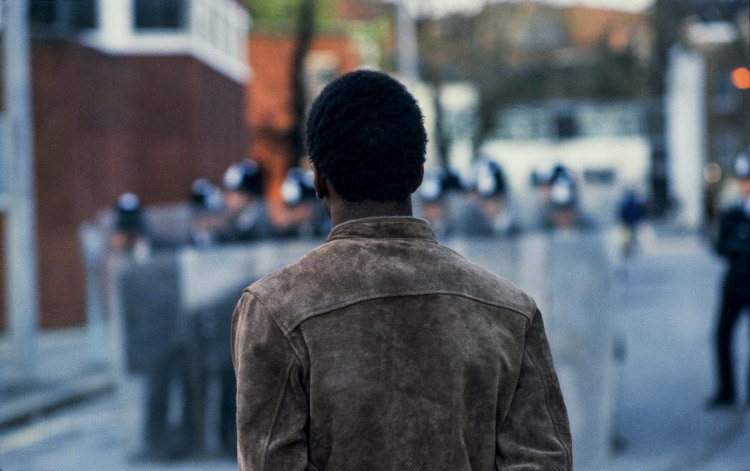 Youth faces police during the Brixton riots. © David Hoffman 1981.
It seems to me that police lost their sense of direction in policing protest after the wave of anti-Thatcher riots that swept across the country in 1981. Rather than understanding and adapting to social change, the police responded by opposing it and trying to prevent it. Since then, attempts to control and contain protest have led to growing antagonism on both sides, and an escalation of conflict between activists & police.
This has created a vicious circle with suppression of protests leading to angrier, more determined protests. That in turn has been seized upon to legitimise a more military style of policing with shields, body armour and Tasers now standard items in the police kitbag.
The police have tremendous power to assist or to stifle protest. It is their actions that determine whether a protest is peaceful or violent. With that power comes an obligation to be open to scrutiny and to be visible and accountable. But what we have seen is very different. The police have formed multiple secret undercover units, they have stepped up surveillance on responsible citizens working for a better society, they have built a network of secret databases and have done all that they can to undermine movements for social change.
As the police have become more involved in shaping protest, so it becomes even more important that their actions and behaviour are openly reported.
 G20 police officer, and protestor on ground. © David Hoffman 2009.
I took this photograph as this protester was knocked to the ground by police and was, I believe, about to be punched by the officer shown. As my flash went off I saw the officer visibly restrain himself and in the event the man on the ground was not hit.
I’ve seen countless brutal and unjustifiable assaults on passive protesters, but my role at protests is as a photographer, documenting the events – not intervening directly. The more dispassionate I can be, the stronger and more useful I think my pictures become.
Photographers trying to record the process of social change are under pressure from both sides. Attacks on protesters are bad enough – but attacks on working journalists are attacks on democracy and on society’s ability to make informed decisions. Showing these processes in action is all too often seen by police as criticism and an attempt to constrain their activities. In response the police have targeted photographers, who have found themselves stopped, harassed, assaulted and surveilled, with their activities logged on secret databases by special units. At the same time protesters increasingly see photographers as ‘spies’ for the police or as reactionary propagandists working for an unloved and untrusted press.
 Black arrest, hidden truncheon. © David Hoffman 1979.
In the ’70s ,aggressively racist policing in Notting Hill continued to raise the tensions that had been building there for decades. This, combined with discrimination in jobs and housing, turned hopeful young citizens into an angry subculture of black youth. This was then targeted by police, creating a feedback loop with young people reacting violently each year to the confrontational, high-profile policing at Carnival and the police in turn reacting by stepping up their own violence. So we have this kind of policing – look at the sleeve of the PC with his arm round the young man’s neck. There’s a truncheon up his sleeve, nobody sees as it rams into the kid’s jaw. It is hardly surprising when that leads to this:
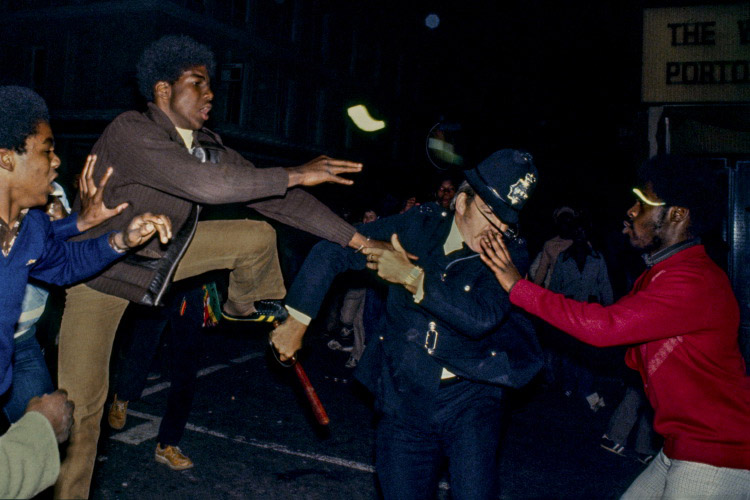 Youths Attack PC. © David Hoffman 1979.
I grabbed that photo as more police arrived and the attackers ran off. So the hyped-up police beat me to the ground and tried to grab my camera. That sort of set the tone for the next 30-odd years.
The 1981 Brixton riots started because of just this mistrust of police. It was brought to a head by the pressure of Swamp 81, a heavy-handed racist stop-and-search operation specifically targeting black people. The riots caught the police unprepared. It was the first time I’d seen police in retreat. They had almost no shields or protective clothing, just pointy hats and dustbin lids grabbed from the street. Fear and desperation led police to an ‘anything-goes’ attitude. The police behaviour was uncontrolled and outrageous. At night they went out hunting. I slipped through a cordon and was standing with a group of nervous police by an alley off Coldharbour Lane when I saw this group of police in civvies carrying homemade weapons – pickaxe handles, a heavy chain. They didn’t look like police. I heard one cop ask “who are these thugs?” and another replied “It’s OK, They’re our thugs.” I snapped off just one frame before I was firmly ‘advised’ to stop. A moment after this police group passed me, all the street lights in the alley went off, and they disappeared into the darkness. A moment later I heard screaming and thudding as these policemen laid into anyone they could find. Anyone. Young men and women staggered out bleeding. There was no attempt to arrest anybody, it was just an exercise in violently beating people off the streets.
 Stop the City demonstration. © David Hoffman 1983.
A couple of years on, 1983, still 25 years before the banking crisis and the credit crunch but the anarchists of the ‘80s were well ahead of the game with the first Stop the City demo – a protest against globalisation, big business and the banks.
The police sergeant here is strangling a protester who had photographed him strangling another protester. Then he dropped this guy and thought he’d strangle me. It was just that sort of day. Behind that picture lies a revealing story about just how far some cops will go for no reason but the enjoyment of their power.
I’d been around from about 7 o’clock, sharp as a rubber razor and so bleary as to be near invisible. I was hanging around by the Bank of England when Kieran – he’s the one getting his neck squeezed – saw this sergeant doing his thing on the neck of yet another chap. So Kieran takes a photograph. The sergeant spots him. A moment later the sergeant has dropped the first guy and is moving in on photographer Kieran. The long fingers of the law wrap around his neck.
Of course I’d not noticed any of this. But I did notice a group of three cops making off with their prey in my direction. I continued to gaze vacantly into space until they reached me. I raised the camera and fired off three quick frames. Then I ran away, jumped a cab and got the film away double quick. Meanwhile the sergeant and his mates had dumped a half unconscious Kieran in the gutter and set off looking for me; but I was well away so, disappointed, the cops plod their way back to the gutter, re-nab the still dazed Kieran and off to the nick with him. Job well done. Well, not quite. Kieran was charged – assault on a policeman’s fingers with his throat or something. In court the sergeant said “I never touched him” and claimed that my photograph was a fake. The prosecution called in an expert from Scotland Yard who took just seconds to confirm that the image was genuine and unaltered. Keiran was acquitted. He sued the police, got £4,000 and formed a punk band.
 Poll tax riot, mounted police, Trafalgar Square. © David Hoffman 1990.
1990 saw the Poll Tax protests, a series of demos which got more and more angry with Thatcher and with the aggressive policing. There were major protests in Brixton, Hackney, Islington, and finally Trafalgar Square. What I found interesting was how the police dealt with the angry crowd.
In every case the police had the crowd contained, and had the opportunity to disperse the protesters into open spaces nearby. Instead, they chased them violently towards high-value shopping areas. This time I had no trouble from police. There seemed to be a deliberate plan to ensure that there would be photos of looting & smashed shops for the next day’s papers. That can only have been a high-level decision intended to move debate away from the Poll Tax and to discredit the protest. Once or twice might possibly have been explained as poor decision-making, but with military precision this happened at every one of those five protests.
Over the 24 years since the Poll Tax riot the police have been used to suppress and prevent protest to an ever greater degree. This has encouraged the belief within the police that it is they who own the streets, not us. Excessive force has not only gone unchecked – it has been endorsed by court support for ever more oppressive interpretations of the law. A closed, un-self-critical police culture leaves individual officers with little choice but to support their colleagues, even in gross breaches of the law.
© David Hoffman.
The above text was taken from a talk David Hoffman gave at the London College of Communication. As part of East London Photomonth, David’s images are on display until the end of this month at a variety of cafes forming the ‘Roman Road Cafe Crawl’. David’s show at Muxima cafe runs until 27th of November. More details here.
Urban Myths no. 5: tales from a ghost club.
Posted: October 31, 2014 Filed under: Amusements, Fictional London, Hospitals, Tall Tales, Theatrical London | Tags: Andrew Martin, David Warner, Kieran Hill, London hauntings, Miles Richardson, Old Vic, Shoreditch clubs Comments Off on Urban Myths no. 5: tales from a ghost club. Props outside the Old Vic, Waterloo. © David Secombe 1989.
From Ghost Club by Andrew Martin and David Secombe:
Synopsis: The three members of the North Yorkshire Paranormal Investigation Society are engaged in a night-time vigil at a country house on the southern edge of the Yorkshire Moors.
Act Two, Scene 1:
It is now 11.30 pm. We find the three in the middle of their second ’session’. They occupy the three disparate seats, as before. Everyone looks jaded and more disheveled, but at least the electricity appears to have been restored – the lighting is from the Anglepoise lamps set up on the table. Quite atmospheric. As before, the aim is to maintain silence in hopes of contacting the beyond. PETE has commandeered a second seat, for the purpose of resting his legs and is reading a paperback – Elmore Leonard or similar.
IAN:
Pete … have you had any experiences that really gave you the, like, willies?
PETE:
How long have you got?
Pause; considering something.
Actually … No, forget it.
JOHN:
No, actually – what?
Pause. PETE looks at both his companions in turn. Puts his book down.
PETE:
I worked as a security guard once. In London. After I left college.
JOHN:
Yes, Classics is hardly the most useful degree –
PETE:
On my first day, they sent me to an abandoned maternity hospital in Finsbury Park that was waiting to be demolished. My job was to sit by the front door and patrol the place twice in an eight-hour hour shift. That’s all. I arrived at seven a.m. on a bright summer’s day, relieved the night shift – who I noticed was sitting outside – and sat down in the old reception booth and tried reading P.G. Wodehouse. But I couldn’t shake off a feeling of being watched. There was a telephone ringing somewhere in the building, but all the lines were supposed to be dead: I had to communicate with my manager via a callbox in the street. My first round was at ten. The place was an absolute shambles. God only knows what had gone on in there. It was a hot day but a storm was brewing. By the time I did my second round, at three, the sky was so dark it was difficult to see into the corners of the wards. Up on the second floor the heat from the day seemed to vanish and the air was very cold. That’s when I heard footsteps. First I thought they were my own echo: but they seemed to carry on after I’d stopped. They seemed to be getting closer each time, gaining on me.
IAN:
Then?
PETE:
I felt it was time to leave. I ran out of the building and used the call box to phone in my resignation. They were very apologetic: seems it was someone’s idea of a joke to send me there on my first day, as no-one liked working the place.
Pause – then PETE tells another one:
Later on, I was working at a club in Shoreditch. Used to be a pub, but it was all leather and sparkly lights when I knew it. The building was Georgian, but you’d hardly guess from the front. It had been bombed in the war and during rebuilding they came across medieval corpses. An unhappy spot. Didn’t stop them turning the basement into a dance floor. It was always cold; we’d try turning up the heating but the walls just ran with condensation. The landlord’s rottweiler refused to go down there. Once, I found some traumatised queen bleating that he’d followed someone into the toilet and seen them walk through the wall. Not quite the encounter he was expecting.
IAN:
Oh …
PETE:
I was cleaning up one morning-after-the-night- before, and I distinctly heard a voice close to my ear say “This one’s not afraid to be down here on his own”. … You’d have some nights down there and I used to wonder how many live bodies we had in and how many from the other side. You’d be hard pressed to tell them apart.
Silence. JOHN pours himself some more wine.
© Andrew Martin & David Secombe 2008-2013.
Ghost Club has yet to have a proper airing, although an earlier draft was presented as a rehearsed reading at the Jermyn Street Theatre in 2010, featuring David Warner as JOHN, Miles Richardson as PETE and Kieran Hill as IAN. We present this excerpt as our annual Halloween offering.
Robin Hood Gardens.
Posted: October 24, 2014 Filed under: Architectural, Class, Housing, Monumental | Tags: Balfron Tower, Brutalism, Peter and Alison Smithson, Poplar, Robin Hood Gardens 3 Comments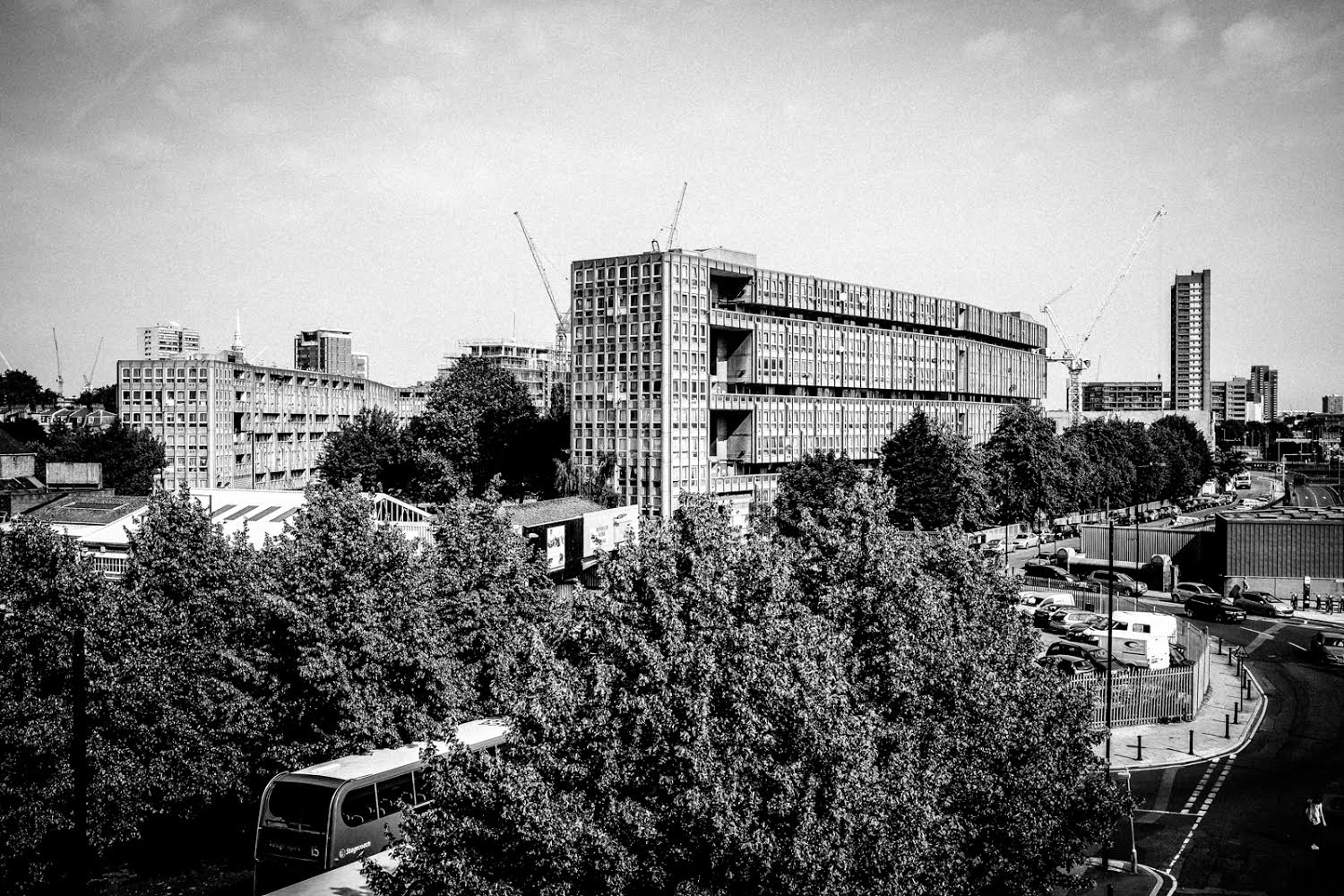 Robin Hood Gardens, looking north, Balfron Tower behind. © Craig Atkinson.
From Building Design, 19 November 2010:
The controversial plan to tear down the Robin Hood Gardens estate will move a step closer in the next few days when a winner for its replacement is named. Proposals by Tower Hamlets Council to take the wrecking ball to the housing estate, designed by Alison and Peter Smithson, caused outrage among the profession, with more than 2,000 people, including Richard Rogers and Zaha Hadid, backing a BD campaign to have it listed. This week Simon Smithson, architect son of Alison and Peter, again condemned the decision to knock the estate down. “If it’s pulled down I think history will view it as a real act of vandalism,” he said.
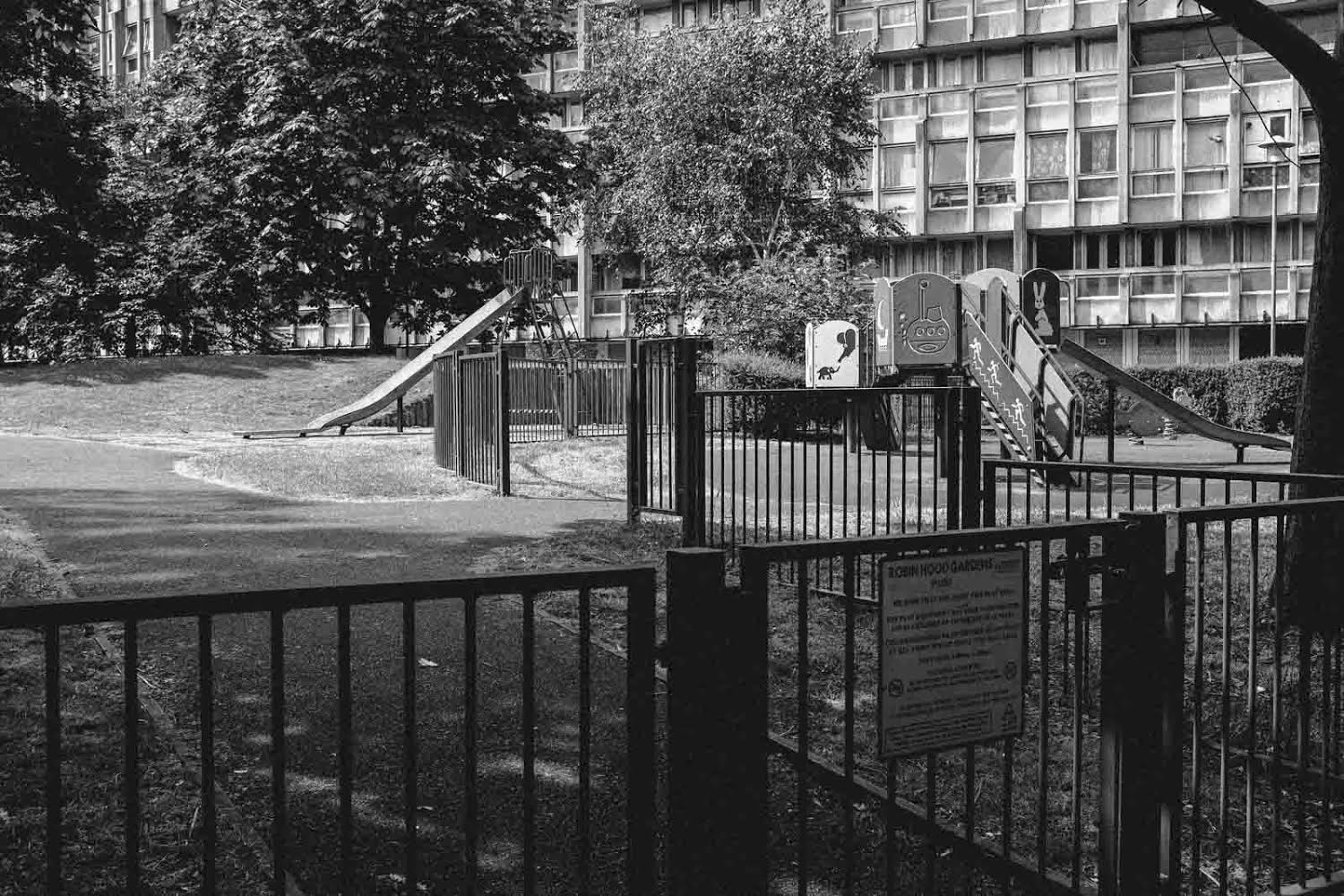
In the wake of our recent pieces on Balfron Tower, we present another feature on a controversial, maligned and generally unloved piece of 1960s architecture. Robin Hood Gardens, a mere stone’s throw away from its Goldfinger-designed neighbour, was designed by Peter and Alison Smithson, Brutalism’s golden couple, theorists-cum-architects, ‘the leading architectural thinkers of their generation in the UK’ (it says here). Unfortunately, the location could not be less promising: Robin Hood Gardens teeters like a cliff above the northbound carriageway of the A12 exiting the Blackwall Tunnel, although motorists on the southbound lanes get a clearer view of its looming bulk. As a motorist who has used the Blackwall Tunnel for over a quarter of a century, this view of RHG has always reminded me of a discarded set from Alien or Space 1999 that has been inexplicably dumped in Poplar. Regardless of all other considerations, its fabulously disadvantaged position alone mitigates against 21st century rehabilitation. Not for Robin Hood Gardens the executive-friendly make-over of Balfron Tower; discussions of RHG’s qualities invariably involve a stand-off between those calling for demolition (past and present residents, Tower Hamlets council) arrayed against those who want it listed and thus preserved (Brutalist apologists, mid-century modern aficionados).
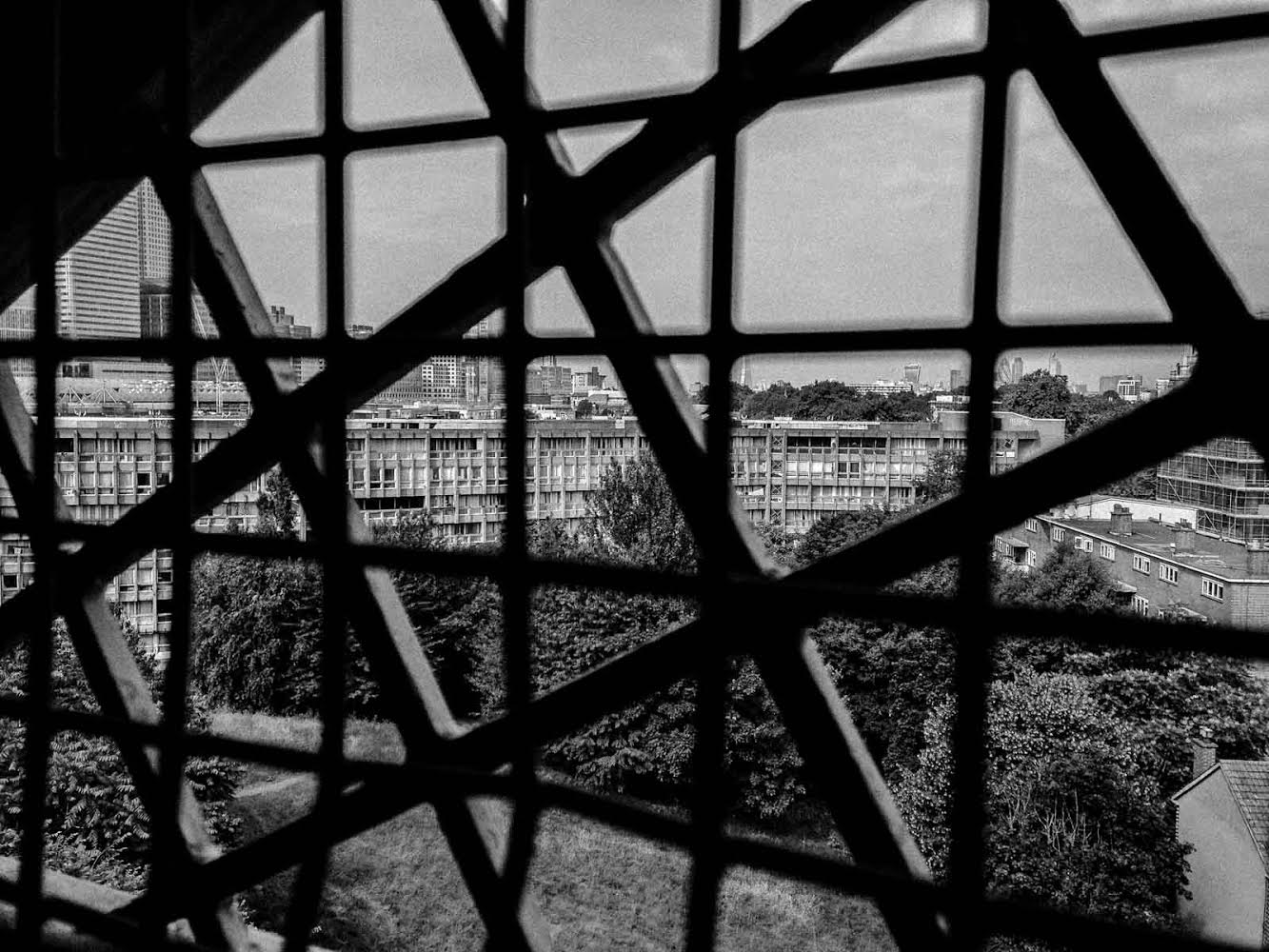 © Craig Atkinson.
A great deal has been written on the failure of Robin Hood Gardens. Those who defend the building speak of the spaciousness of the flats themselves, of the noble attempt to create a space of ‘central greenery’ in the site’s layout, and the Smithsons’ genuine feeling for the humanity that would eventually inhabit their design: ‘Belonging is a basic emotional need … from it comes the enriching sense of neighbourliness. The short narrow street of the slum succeeds where spacious redevelopment frequently fails.’ Robin Hood Gardens has heavyweight admirers; thus sprach Lord (Richard) Rogers of Riverside: ‘It has heroic scale with beautiful human proportions and has a magical quality. It practically hugs the ground, yet it has also a majestic sense of scale, reminiscent of a Nash terrace’.
 © Craig Atkinson.
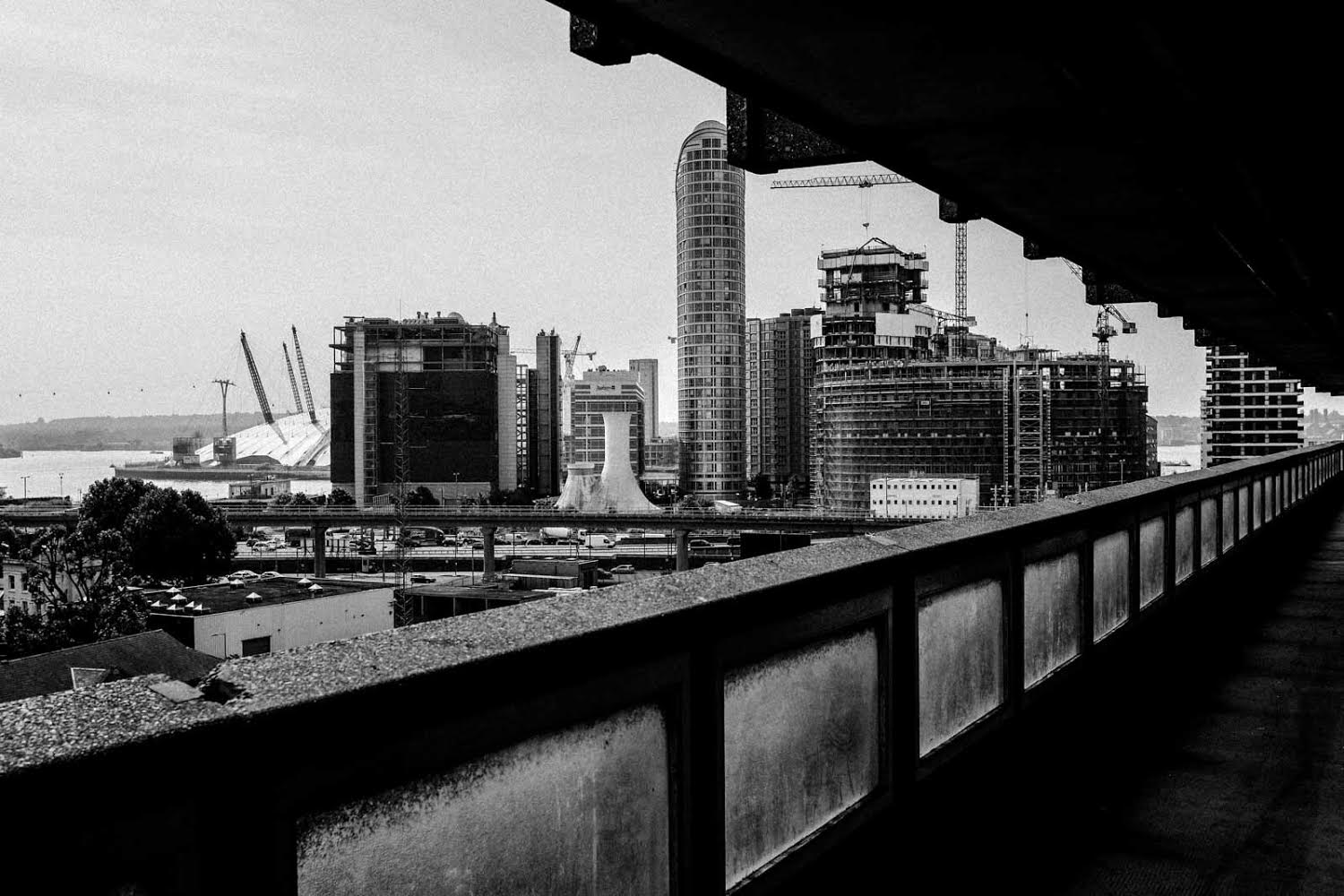
Its fans have something of a hard sell. Even the most ardent Smithson admirer has to admit that the site is hideous. A friend of mine, an architect from the Caribbean, spoke of her numbed disappointment on seeing RHG for the first time; in her eyes what had seemed eloquent and rational as a plan failed hopelessly as an actual environment. (In researching this piece, I stumbled across a fascinating item comparing RHG’s central green space to WW1’s battlefield of Ypres.) In 2009 RHG was denied the protection of ‘listed’ status (with English Heritage voting firmly against listing) and in 2012 Tower Hamlets Council announced demolition of the estate as part of a wider ‘regeneration’ scheme for the area. There isn’t room here to excavate the arguments and sheer heat of the ensuing debate, which is taking place even as RHG is being dismantled; but whilst nostalgia for the legacy of Brutalism might be compared to a fondness for discredited utopian certainties, the current complexion of London’s skyline makes one shudder at what is likely to be erected in RHG’s place.
 © Craig Atkinson.
These photographs by Craig Atkinson (from a fine new edition published by the ever-admirable Cafe Royal Books) give an indication of RHG’s imposing mass as well as its shortcomings as an urban environment. But it is the last picture in this sequence that is so telling; the view across to the 21st Century Isle of Dogs and Greenwich Peninsula. There’s the new money, and what all of London will, most likely, soon resemble. There goes the neighbourhood. DS
Further reading: the invaluable site Municipal Dreams published two articles on Robin Hood Gardens in April this year, and they are mandatory reading on this topic.
See also: Balfronism, Balfron Remembered, A Clockwork London 1, A Clockwork London 2, Pepys Estate.
Tommy Cooper.
Posted: October 14, 2014 Filed under: Amusements, Churches, Entertainment, Theatrical London | Tags: English humour, Hawksmoor churches, John Claridge, Museum of Comedy, St. George's Bloomsbury, Tommy Cooper Comments Off on Tommy Cooper.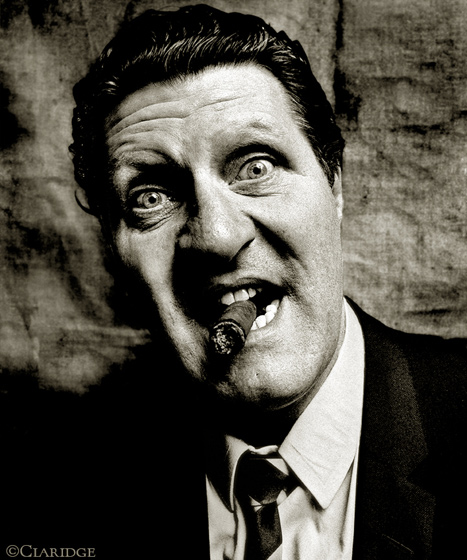
Tommy Cooper, Thames Television Studios, 1967. Photo © John Claridge.
On Tommy Cooper by Garry Lyons:
FRANKIE:
It’s all for you, isn’t it, Tommy? All the time – even offstage – you’re thinking: how can I get noticed? How can I get a gag out of this? You’d piss in the gutter to make a drain laugh, wouldn’t you? You’d shoot your granny for half a titter.
TOMMY:
You leave that gutter out of this.
These lines are a characteristic interchange from the two eponymous comics in my play Frankie and Tommy. Frankie is my dad aged 23, as I re-imagined him. His oppo is none other than Tommy Cooper. The play tells the story of their brief and ill-fated double-act, entertaining the troops in Cairo in 1946.
It was commissioned by John Godber for the 21st anniversary of Hull Truck Theatre Company, and premiered at the Edinburgh Festival in 1992. It caused a bit of a stir. I didn’t see my play as an exposé of a celebrity so much as a bitter-sweet Everyman tale about lost opportunities and faded dreams. For me, the story was a universal one about the shadow cast over youthful illusions by a brief, fleeting brush with true genius. It was about lost opportunity, and coming to terms with one’s failures and mediocrity.
The play is like a variety show Amadeus, with my dad as Salieri and Cooper as Mozart. It’s as much a professional tribute to Cooper’s stage brilliance as it is an unveiling of Cooper the man. It was an attempt to show the fez-wearing buffoon in all his perfectionist complexity, an artist in whom emotional inadequacy was the spur that drove his hyper-nervous and shambolically skilful act – an act full of fumbled magic tricks and painful wordplay acting as armour-plated defence mechanisms from too much inquiry into the inner self.
The invented dialogue of Frankie and Tommy – which owes a lot to Morecambe and Wise, Barker and Corbett and similar duos – is full of puns and evasions in which Cooper constantly undercuts a serious point with a wisecrack or non sequitur. It’s the technique of the inveterate joker who can’t bear to face reality, yet in dodging it not only makes us laugh but often presents us with an even more profound truth.
Perhaps, in the end, that is the enduring force of Cooper’s humour. He wasn’t, as some have claimed, the first ‘alternative comedian’. There was nothing politically anti-establishment about his mainstream, commercial television style. But it was certainly subversive in the way it used ineptitude as comic strategy, satirising the empty slickness of much light entertainment and reminding us that at heart we’re all fools within.
… for The London Column. © Garry Lyons 2011.
This post appeared on The London Column in 2011; we are reposting it as John Claridge’s photos of Tommy Cooper are currently showing in the auditorium of the Museum of Comedy, implausibly located the crypt of Hawksmoor’s St.George’s, Bloomsbury. Museum of Comedy, The Undercroft, St Georges Church, Bloomsbury Way, WC1A 2SR (open Tuesday – Sunday 12pm – 5pm).


 The London Column