Four streets off Hockley Hole.
Posted: September 12, 2013 Filed under: Amusements, Entertainment, Fictional London, London Places, London Types, The Fleet | Tags: Artful Dodger, Back Hill, bear baiting in London, Fagin's lair, Hockley Hole, John Londei, King of Clerkenwell, old Clerkenwell, Oliver Twist, Saffron Hill, Sally in our alley 2 Comments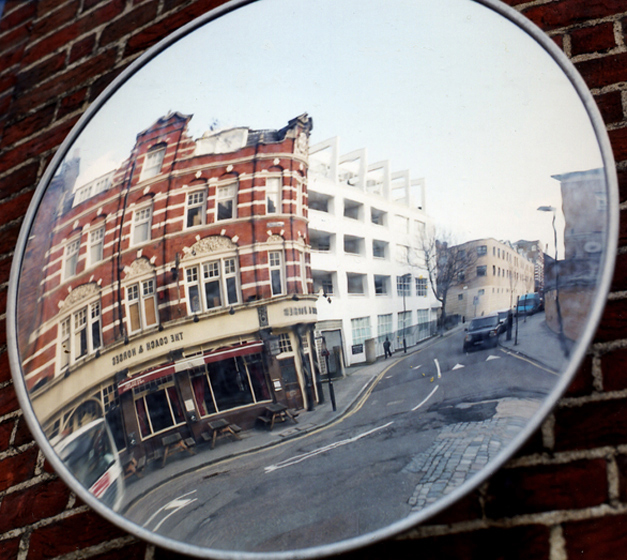
Back Hill and Ray Street, Clerkenwell. © David Secombe 2010
From The Fascination of London: Holborn and Bloomsbury, ed. Sir Walter Besant 1903:
Just here, where Back Hill and Ray Street meet, was Hockley Hole, a famous place of entertainment for bull and bear baiting, and other cruel sports that delighted the brutal taste of the eighteenth century. One of the proprietors, named Christopher Preston, fell into his own bear-pit, and was devoured, a form of sport that doubtless did not appeal to him. Hockley in the Hole is referred to by Ben Jonson, Steele, Fielding, and others. It was abolished soon after 1728.
David Secombe:
The Coach and Horses pub – reflected in the mirror in the picture above – now occupies the site of Hockley Hole, one of the least salubrious entertainment venues in London’s history. The pub rests at the bottom of a curious depression in the heart of Clerkenwell, behind the old Guardian building on Farringdon Road – which itself marks the course of the river Fleet, which Victorian engineers – eventually – paved and tamed into a churning sewer. (Supposedly, the original Coach and Horses afforded access to the Fleet from its cellars, providing Georgian fugitives with an escape route to the Thames.) This dingy, hidden locale is a beacon for anyone of a Psychogeographical persuasion, as three centuries of real and imagined associations intersect here. We have touched upon Hockley Hole before, but a passage in Lucy Inglis’s fine new book Georgian London: Into the Streets prompted us to revisit the immediate environs. In her book, Lucy provides further details of the delights afforded by Hockley Hole (or Hockley-in-the-Hole) :
By the turn of the eighteenth century, baiting had moved north of the river – to Hockley-in-the-Hole, in Clerkenwell. In 1710, there was ‘… a match to be fought by two dogs, one from Newgate-market, against one from Honey-lane market, at a bull … which goes fairest and fastest in, wins all. Likewise, a green bull to be baited, which was never baited before; and a bull to be turned loose with fireworks all over him. Also a mad ass to be baited. With a variety of bull-baiting and bear-baiting, and a dog to be drawn up with fireworks. To begin exactly at three of the clock.’ Hockley was the centre of bull terrier breeding in London, and so perhaps it was natural that the sport would move there. In 1756, Hockley disappeared with the continuing Fleet development, and bull-baiting moved to Spitalfields. Increasingly unpopular, it was soon confined almost exclusively to market towns.
The mirror in the picture above is located on the wall of a huge industrial building (now home to one of Central St Martins design campuses) which straddles Back Hill and lower Saffron Hill. In The Fascination of London, Walter Besant quotes an earlier writer’s description of Saffron Hill as “narrow and mean, full of Butchers and Tripe Dressers, because the Ditch runs at the back of their Slaughter houses, and carries away the filth.” Besant takes the opportunity to add that ‘in later times Italian organ-grinders and ice-cream vendors had a special predilection for the place, and did not add to its reputation’ – but he also acknowledges that ‘all this district is strongly associated with the stories of Dickens’. In Oliver Twist, set in 1838, the year it was written, Dickens describes the Artful Dodger leading Oliver to Fagin’s lair:
‘They crossed from the Angel into St. John’s Road; struck down the small street which terminates at Sadler’s Wells Theatre; through Exmouth Street and Coppice Row; down the little court by the side of the workhouse; across the classic ground which once bore the name of Hockley-in-the-Hole; thence into Little Saffron Hill; and so into Saffron Hill the Great: along which the Dodger scudded at a rapid pace, directing Oliver to follow close at his heels.’
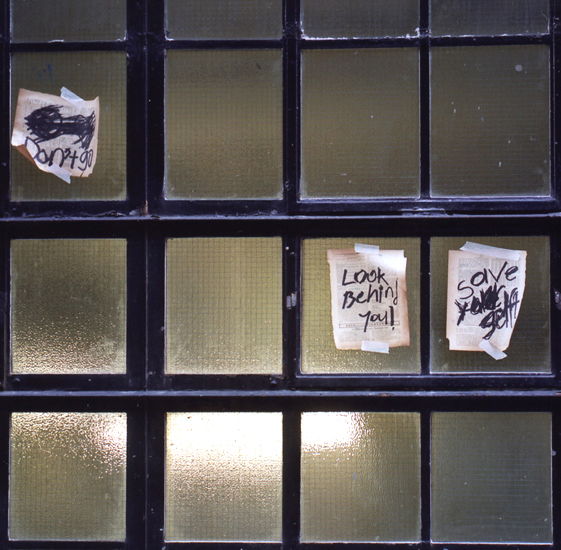
College window, Back Hill. © David Secombe, 2010.
On the same turf 150 years later, a real-life match for Dickens’s characters is described by the late John Londei, a much-missed photographer, writer and contributor to this site. As John wrote in 2011:
Some people might think little Jimmy Cleary eccentric, but to me he was a walking landmark: someone whose presence brings a touch of magic to an area. Whenever I saw Jimmy I knew I was in Clerkenwell. Jimmy’s speciality was annoying motorists. He would not tolerate errant parking; his life seemed devoted to chasing drivers on from yellow lines. And woe betide anymore who ignored his orders! Bringing out a tattered notebook he took their number, and created such a commotion that the poor motorist found himself the centre of attention.
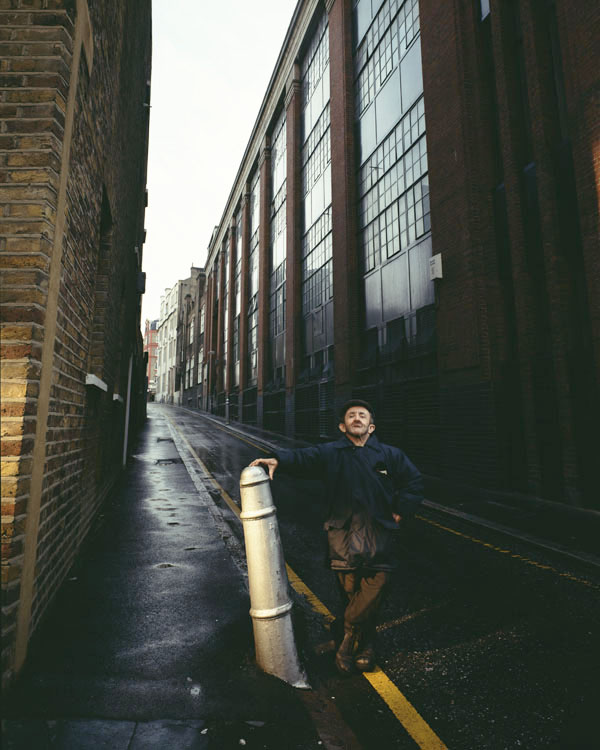
Jimmy Cleary, ‘King of Clerkenwell’, Back Hill. © John Londei 1983.
Returning to the photo at the top of this page, the modern white building in the reflection lies on Warner Street, formerly Great Warner Street. In the 18th Century, this street was the home of Henry Carey, author of Sally in our Alley: ‘one of the very prettiest of old London love songs.’ Walter Thornbury, writing in 1878 (Old and New London Vol.2; Clerkenwell) provides this biographical snippet:
Henry Carey … lived and died at his house in Great Warner Street. Carey, by profession a music-master and song-writer for Sadler’s Wells, was an illegitimate son of the Marquis of Halifax, who presented the crown to William III. The origin of Carey’s great hit, Sally in our Alley, was a ‘prentice day’s holiday, witnessed by Carey himself. A shoemaker’s apprentice making holiday with his sweetheart, treated her with a sight of Bedlam, the puppet-shows, the flying chairs the elegancies of Moorfields, and from thence proceeding to the Farthing Pye House, he gave her a collation of buns, cheesecakes, stuffed beef, and bottled ale; through all of which scenes the author dodged them. Charmed with the simplicity of their courtship, he wrote his song of Sally in our Alley, which has been well described as one of the most perfect little pictures of humble life in the language. Reduced to poverty or despair by some unknown cause, Carey hung himself in 1743. Only a halfpenny was found in his pocket.
In the 19th century, Great Warner Street was bisected by Rosebery Avenue,a Victorian creation forming part of the general ‘ventilation’ of Holborn, clearing away many of the old houses in the area.

Staircase to Rosebery Avenue from Warner Street. © David Secombe 2010.
… for The London Column. Georgian London is published by Penguin.
Two Men And A Dog.
Posted: August 30, 2013 Filed under: Architectural, Dereliction, The Thames, Vanishings, Wildlife | Tags: 80s Britain, 80s Docklands, Battersea Dogs Home, Bill Pearson, gentrification, south-east London, Stephen Watts poet 2 Comments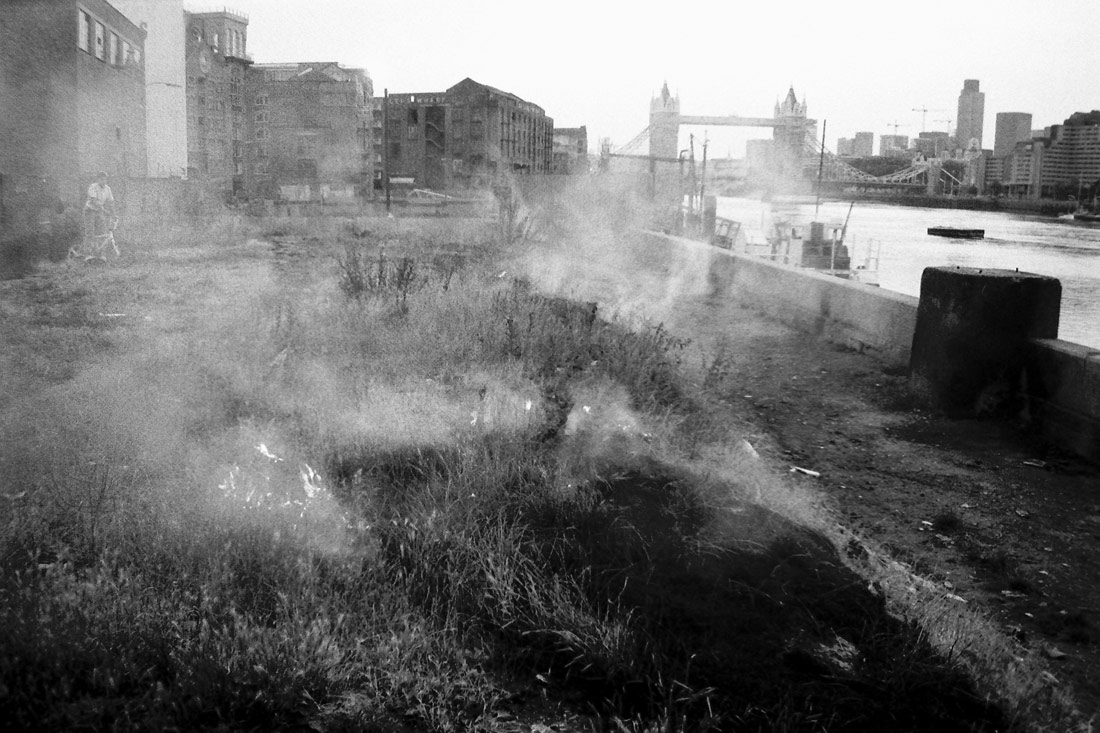
© Bill Pearson 1982/85
Late August ’87 by Stephen Watts:
Saturday. Afternoon.
Thunder on the Greenland Dock.
A few kids. Wet sand. Fishing.
All of us feel the vatic lack.
Girders. Cranes. New roads.
Bright sciatic colours. Cans.
Concrete. Cables. Coiled wire.
Flesh still curt to our bone.
Autumn thunder on the Greenland
Dock. Suddenly – houses rearing up.
That pall of human indifference.
Heart of the heart ripped out.
Yellow air. Pipes of cloud.
A sky that’s been lifted from Bihar.
Houses with archways of walled wood.
Our lives. A crushed heat of air.
Cranes. Wet sand. Girders.
The kids laugh. And then scatter.
Dear body. The poor in their lack.
The rich in their whorl of languor.
© Stephen Watts
Bill Pearson writes:
I moved to New Cross Gate over the Easter weekend, 1981. My only previous experience of living in the big city had been a few years at Kingston upon Thames, very different in all respects to inner city south-east London. Exploring the new area I discovered empty, desolate docks and rundown industrial areas that reminded me of my homeland in the North of England. It was the early days of Thatcherism, before the Falklands War, before the inner city riots, and before the Miners’ Strike, when Thatcher was still the most unpopular Prime Minister there had ever been.

© Bill Pearson 1982/85
My local Desolation Row was Surrey Docks – re-generated as Surrey Quays – but on walking and cycling trips I discovered the run down warehouses of Shad Thames (which still smelled of the spices they had once stored), Limehouse Basin, Wapping and the Isle of Dogs, which looked like a war zone. I remember rummaging around a warehouse in Wapping one day and hearing a roaring noise on the floor below. I rushed along to see what it was and discovered that the place had been set on fire by some local kids.
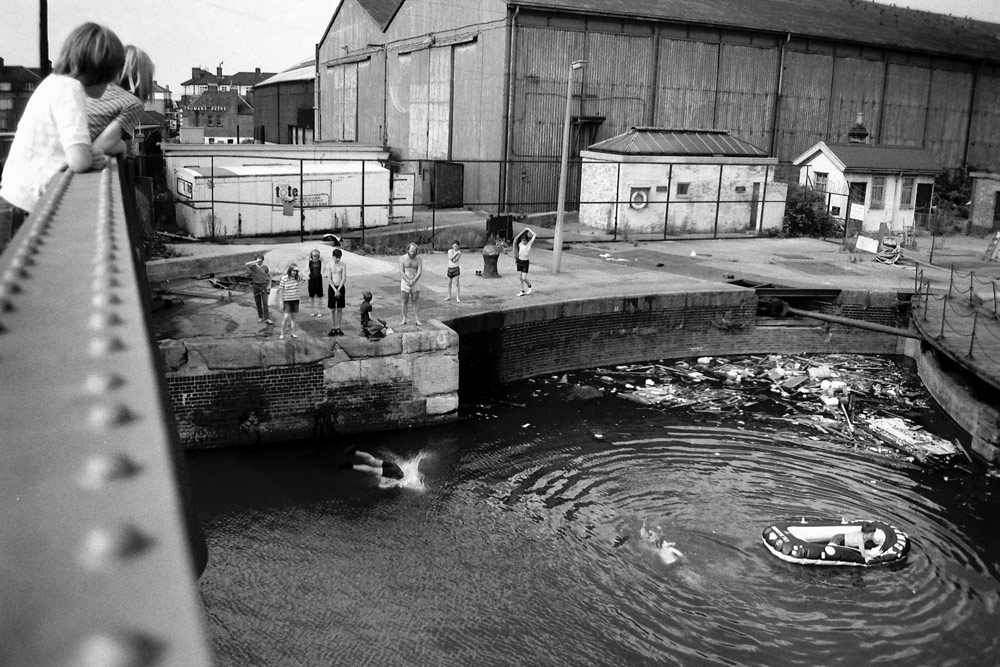
© Bill Pearson 1982/85
The absent other in all of these photographs was Mr. Charles Fox. A Battersea Dogs Home graduate, selected for his fetching smile, his hairy ears and his endearing determination to escape from the Home by digging through the concrete floor. His name was chosen because nobody in our shared house was prepared to have the utility bills under their names, so Charlie the dog ended up taking responsibility for everything. He never seemed to mind. At the Post Office I would occasionally be asked, “are you Mr Fox?” – and when people from the utilities phoned up wanting to speak to Mr Fox and we would invariably say “He’s unable to speak at the moment”.
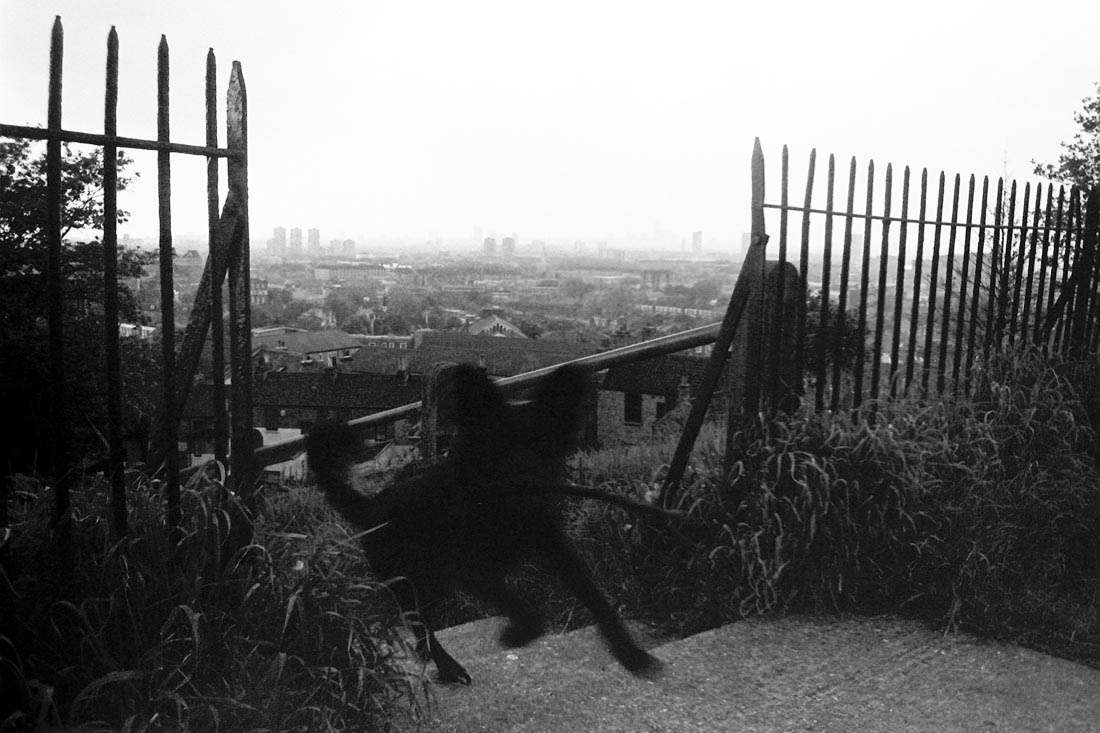
© Bill Pearson 1982/85
Charlie and myself covered a lot of miles on our walks. Sometimes I would carry my Canon AE1 and sometimes I would take my Bolex movie camera and sometimes I wouldn’t take either because I couldn’t afford any film. On these urban forays, I often encountered a fellow rambler who turned out to be another newcomer to south-east London, a political exile from Soweto who had wound up living on the Pepys Estate in Deptford. Not that I knew this at the time: I only learned the identity of Chief Dawethi a quarter-century later, when Chief and I found ourselves sharing an office. Sharing our reminiscences of living in south-east London in the early 1980s, we discovered that we were the ghosts on each other’s travels. I mentioned that I took a lot of photographs back then, and it was Chief’s suggestion that people might be interested in those images, as the area had since changed beyond recognition. Chief’s insight encouraged me to dig out the negatives and study them with fresh eyes.

© Bill Pearson 1982/85
Looking at them now, they appear as remnants of a lost world. ‘There is nothing more recent than the distant past’. It seemed unthinkable in the early 1980s that the purlieus of east London could ever become desirable, let alone exclusive. Yet the areas seen in these pictures is today the playground of those who profited from the sale of England; those inhabitants of the soulless apartments that are ruining the London skyline. Even Chief’s old stamping ground, the Pepys Estate, is home to Aragon Tower, one of the most up-scale of all gentrification projects, a block of high-rise council flats sold off and transformed into luxury riverside dwellings for the few that can afford them.
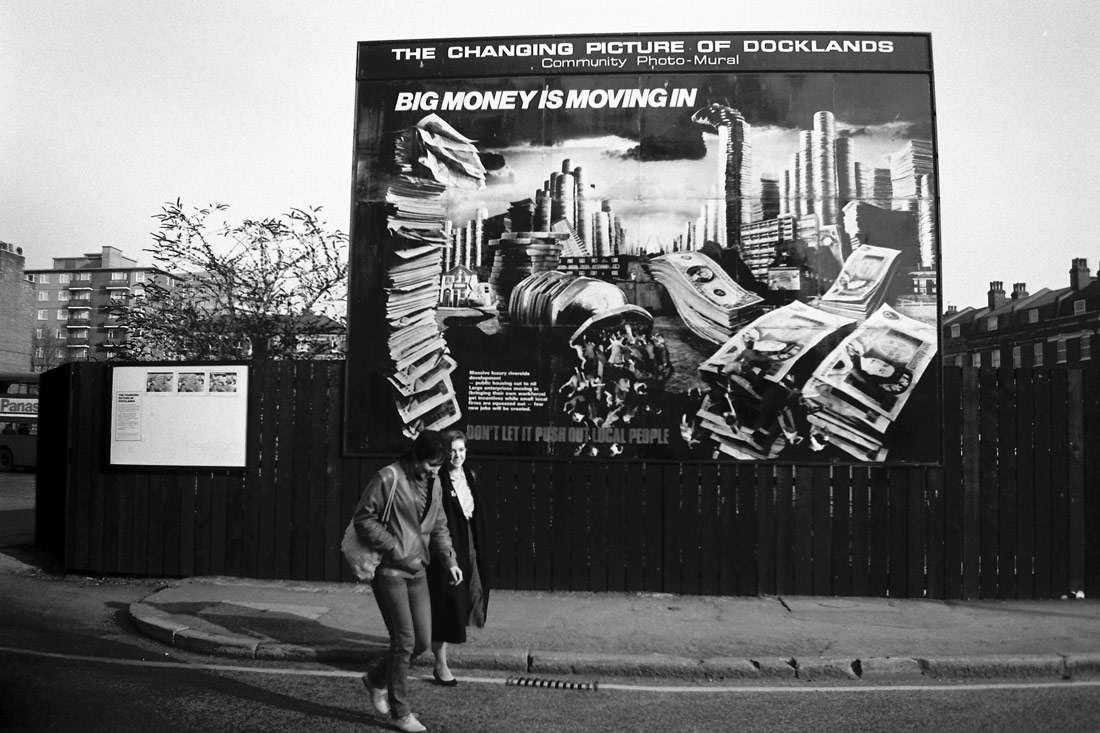
© Bill Pearson 1982/85
What of Mr Charles Fox? He moved away to York with one of my housemates. We reasoned that he would have a much better life there than on the mean streets of south-east London. I saw him a few times after he moved and he seemed far happier in the North.
Text © Bill Pearson 2013.
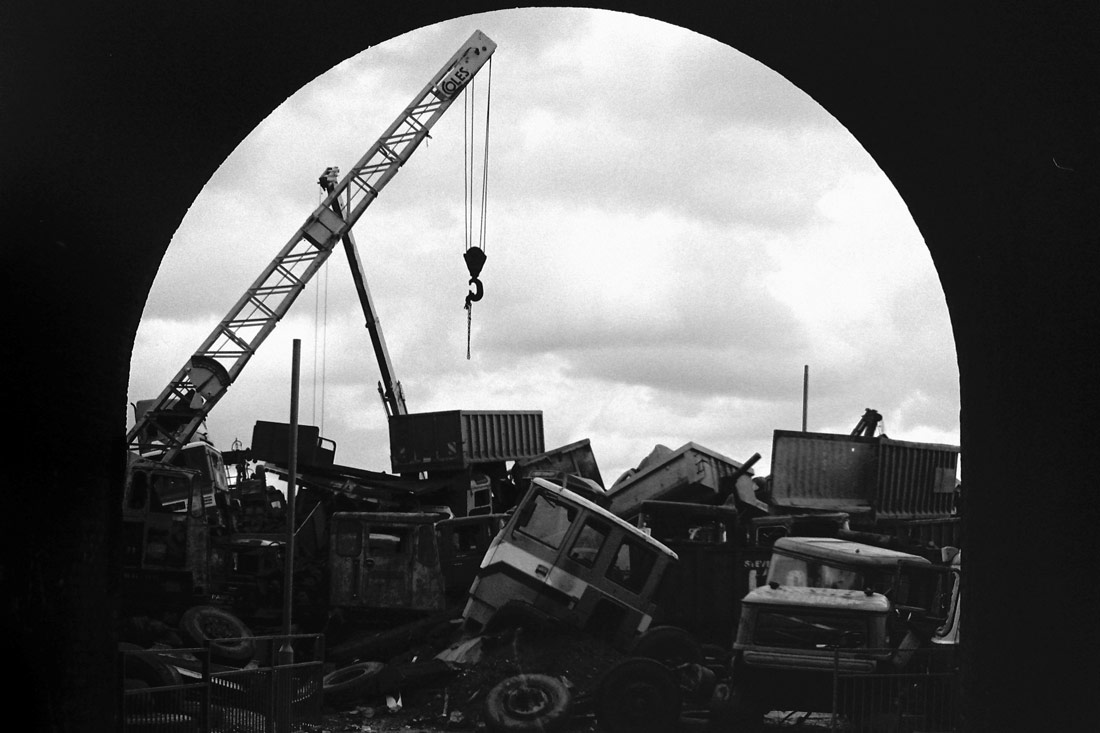
© Bill Pearson 1982/85
Heart Of The City by Stephen Watts:
Grey sky. Fifteen cranes swing
between the road and the river.
A darkened ribcage of girders is
Fleshed out with granite slivers.
Slow bursts of cars stream past
and lead rises up to our rooftops.
It eats the aortas of our babies.
Wee kids who spiral at hopscotch.
We have savage material hearts.
Mine hangs just under my shoulder.
There are reds, yellows and ochres
if I think of colour in some order.
It hangs and pumps at my ribcage
as if a blue bag were slung there.
Full with wet fish & blae-berries.
Words – jump off my tongue here.
It is good to dream as dreaming
makes lucid our human potential …
The spiral of blood in our bodies.
Just where it pumps by my nipple.
Sunflowers. Asters. Fuchsia.
Whatever their colours they seem
held by tight and straitened stalks.
The sun will crash from its beam.
Too close to the savaged heart.
We live in the heart of this city.
Cranes that swing out on the dark
measure our hearts without pity.
© Stephen Watts.
On the South Bank. (5)
Posted: August 10, 2013 Filed under: Artistic London, London Music | Tags: London's South Bank, Royal Festival Hall Comments Off on On the South Bank. (5)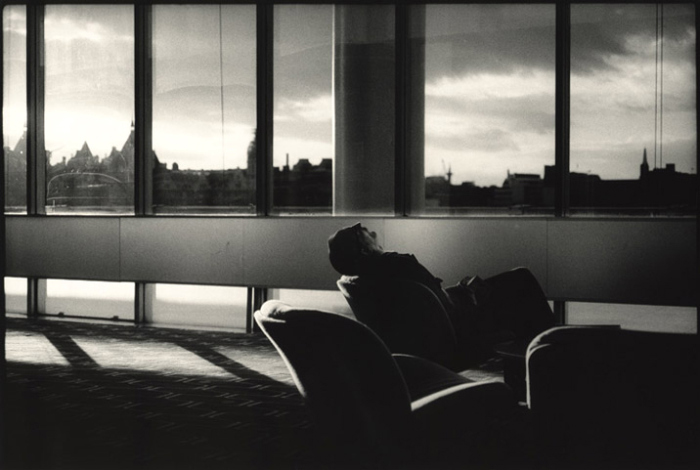
Before a concert, Level 3 terrace, Royal Festival Hall. Photo © David Secombe 1988.
In the years since The Royal Festival Hall opened in 1951, people have sat in this foyer waiting to hear:
Claudio Abbado, Laurie Anderson, Louis Armstrong, Burt Bacharach, Dame Janet Baker, Sir John Barbirolli, Daniel Barenboim, Count Basie, The Bee Gees, Luciano Berio, Leonard Bernstein, Pierre Boulez, Sir Adrian Boult, David Bowie, Alfred Brendel, John Cale, Maria Callas, Ornette Coleman, Elvis Costello, Sir Colin Davis, Miles Davis, Neil Diamond, Christophe von Dohnanyi, Nick Drake, Jacqueline Du Pre, Bob Dylan, Electric Prunes, Duke Ellington, Fairport Convention, Marianne Faithfull, The Fall, Ella Fitzgerald, John Eliot Gardiner, Valery Gergiev, Carlo Maria Giulini, Goldfrapp, Benny Goodman, Bernard Haitink, Herbie Hancock, Tony Hancock, Jimi Hendrix, Vladimir Horowitz, Keith Jarrett, Jethro Tull, Elton John, Tom Jones, Herbert von Karajan, Rudolf Kempe, B.B. King, Carlos Kleiber, Otto Klemperer, Radu Lupu, Humphrey Lyttleton, Lorin Maazel, Wayne Marshall, Steve Martin, John Martyn, Johnny Mathis, John McLaughlin, George Melly, Modern Jazz Quartet, Thelonius Monk, Pierre Monteux, Motorhead, Riccardo Muti, Evgeny Mvravinsky, Randy Newman, New York Dolls, The Nice, Jessye Norman, Murray Perahia, Pere Ubu, Oscar Peterson, Pink Floyd, Maurizio Pollini, Lucia Popp, Simon Rattle, Lou Reed, Buddy Rich, Sviatoslav Richter, Mstislav Rostropovich, Artur Rubinstein, Sir Malcolm Sargent, Saint Etienne, Andras Schiff, Elisabeth Schwarzkopf, Ronnie Scott, George Shearing, Frank Sinatra, Nina Simone, Soft Machine, Georg Solti, Patti Smith, Karlheinz Stockhausen, Leopold Stokowski, Igor Stravinsky, Jack Teagarden, Klaus Tennstedt, T-Rex, Richard Thompson, Arturo Toscanini, Stan Tracey, Tricky, McCoy Tyner, William Walton, Brian Wilson, Yes, Frank Zappa, Krystian Zimmerman . . . amongst others.
This entry is the 200th post on The London Column. Thanks to all our contributors and readers … D.S., K.E.B.
On the South Bank. (4)
Posted: August 9, 2013 Filed under: London Places, Monumental, The Thames | Tags: disability access, Hungerford Bridge, Saison Poetry Library, The Southbank Centre Comments Off on On the South Bank. (4)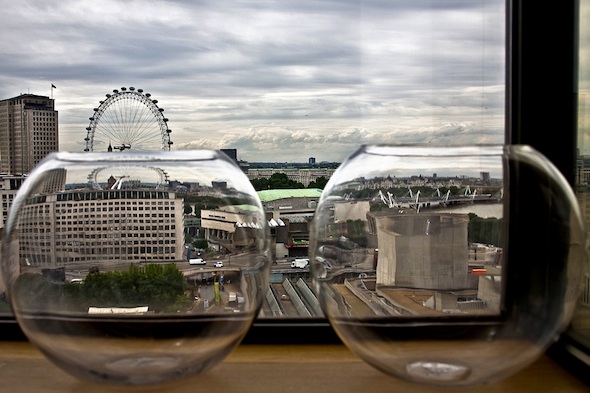
Circles Within Circles: Photo © Mark Granier
Paul Carney: An Odyssey
I have a huge-mungulous love-hate thing going with the South Bank. On the one hand it’s almost the only place to which I ever escape, ergo overwhelming connotations of freedom, restored sanity etc. On t’other, I think it was designed specifically to kill me.
The whole experience is utterly surreal; out from among Embankment station’s gloomy pillars, I’m falling again, down those same four always-forgotten steps. A silhouette thrusts paper at me as I get up. Selling, collecting, petitioning for something. I wave my white stick in a signal that clearly reads please either lend a hand or bugger off. Would a Samurai battle-cry help at this point? Best not. A bit of wild fumbling and here is the handrail at the foot of the Hungerford Bridge.
At the top, I invariably bump (literally) into a man in a wheelchair who seems poised forever at the top of the 42 steps; it’s as though he’s being punished in a Greek myth. At least I haven’t collided with him this week. Halfway over the bridge an old friend and tripping hazard, Tattered Guitar Man, is still endlessly ringing in the Apocalypse with his one weary, toneless chord, and passers-by are always ridiculing him and he just strums all the more. I would drop him a coin, if I could ever see where he lays his hat.
The first time I ever crossed this bridge, there was a man walking ahead of me dressed as a giant green triangle, with scrawny legs in tights of a paler green, and people weren’t giving him a second glance, whereas assorted hot young women were pointing and giggling at me for having a white stick and a hi-viz jacket.
The South Bank Centre itself is allegedly a stunning view, but to Paulish eyes it looks like a cross between a construction site and Eliot’s Waste Land. I pull my baseball cap down and make myself look up. Remember the view! Some of these buildings have won awards… The magazine articles… A shipwreck on a rooftop… But I see no ships. There is no view. Only the Waste Land.
There are, says the legend, doors all over the place here. But only one entrance is my entrance, whence I can feel my remembered way to a lift. And don’t get me started on the indoors of the Royal Festival Hall! Only in the company of a certain genius poetry tutor I know do I brave it…
One thing I’ve never come across is the beleagured skateboard park – I’ve never made it that far – but since it is clearly doing Paul no harm whatsoever (UNlike the new pre-fab restaurant that blocks my route and has caused multiple injuries!), I’m now passionately in favour of letting it be. Why shouldn’t the young’uns have somewhere to whizz about on wheels? It does actually sound like fun.
Pigeons get into this building. Often, the clatter of wings above has startled me. Does some slow-ambling, gently dolorous janitor finally come by night to sweep up their small bones? Should I get out on the wrong floor, he would probably find my bones too, in due course. Elevator, take me straight to the Fifth, and only to the Fifth … There, all will be daylight and space. Windows and pale columns. Got to be wary of those columns, though – inexplicable shelf-things protrude from some of them at vital-organ height. But I am way-wise on the Fifth, now. Ha! Or at least that part of it that is touched by the sun. I was told that the Poetry Library is right here, in this place and on this floor. Down the Dark Stairs, past the Lesser Toilets and farther into the Realm of No Light Whatsoever.
Poetry? Here? Sometimes I have tried picturing poems – I see them as the little frail white moths of childhood – flitting among all the unlovely columns, slabs and balustrades. Can poetry truly live here?
I have a table. I have chairs. I have my back to the sun, the river and the Telecom Tower. I can breathe now, and take off my luminous jacket. I will hang it on the empty chair – it will be my flag, proclaiming this furniture is taken. It is ours alone. She will find me here when she comes, and she will yell out my name, dancing and waving her arms above her head.
© Paul Carney


 The London Column