Tom Sharpe.
Posted: June 6, 2013 Filed under: Literary London, Out Of Town | Tags: Porterhouse Blue, Riotous Assembly, The Throwback, Tom Sharpe, Wilt Comments Off on Tom Sharpe.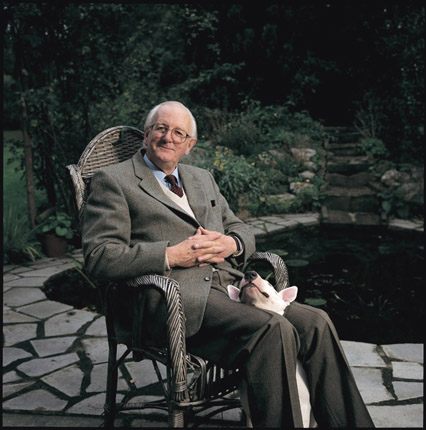
Tom Sharpe, Cambridge, 1992. Photo © David Secombe
Farewell Tom Sharpe … the author of Wilt, Porterhouse Blue, The Throwback, Riotous Assembly, etc. has died at the age of 85.
As an adolescent, I loved Tom Sharpe’s books. In his 1970s pomp, his fierce, majestic and paralysingly funny satires were a cause for great joy, and even made one proud to be British. But it can be a tricky thing to meet your heroes; and driving to Cambridge in the company of a nervous Spanish journalist (on his first ever visit to the UK) to interview the great man, I was fighting off my own attack of nerves. The interview started a bit awkwardly, as my colleague tried a line of questioning about the power of literature, during which he asserted: ‘Madame Bovary changed my life’ – to which Tom replied, ‘Well, you can’t have met that many doctors’ wives’. Things settled down after that, and we ended up going to a local pub – driven there at high speed along wild Fen roads by the author himself – where I finally got my chance to tell him that I thought Chapter 4 of The Throwback was the funniest thing I had ever read.
We discussed contemporary comedy and literature (he wasn’t much impressed), film version of his books (he hated the Smith/Jones version of Wilt but loved Channel 4’s Porterhouse Blue adaptation) and indeed photography, as he had once been a professional photographer and had pleasingly trenchant views on the subject. (When we came to do the photos, he insisted that I use his own tripod for the purpose of making the above picture, as he wasn’t convinced that mine was up to the task.)
The interview was for the Spanish edition of Elle magazine, as Tom had a strong following in Spain, and he eventually went to live there. He ascribed his popularity in Spain to the surrealism Spanish readers found in his books; but his own offering of an example of ‘typically English humour’, as requested on a Spanish TV interview, did not go down too well. He told the story of a troop of Tommies marching to the front line on the Western Front, and an exchange between a young soldier and a sergeant at a posting on the way. ”Ere, Sarge, when do we get to have a rest, been marching all day!’ ‘Don’t worry son, you’ll be dead in half an hour’.
My recollection of the day has a kind of glowing quality: it’s not often you an encounter someone whose work you love and in whom you discover someone who feels like a friend. He struck me much as he appears in the photo above: elegant, droll, mischievous, and as English as a Tudor manor house. We have lost another great one.
… for The London Column.
Calling at the Albany to see Graham Greene.
Posted: May 21, 2013 Filed under: Fictional London, Literary London | Tags: Albany, Dmitri Kasterine, Graham Greene, The Comedians 1 Comment
Graham Greene, Antibes. © Dmitri Kasterine 1983.
Expedition to Greeneland by Susan Grindley
There was a problem with the spellings
of Yeastrol, or Yeastrel, and Tontons Macoutes.
I was the office junior, despatched
with marked-up galley proofs to Albany.
I washed and ironed my hair the night before,
wore my shift dress from Peter Robinson’s
new Top Shop with white stockings and white
patent shoes from Elliott’s of Bond Street.
I’d cracked the secret code to all his books –
women who thought that they were loved were not.
He kept them parked and waiting in the margins,
all that religious stuff – just an excuse.
I didn’t see him. I just left the envelope
with the top-hatted porter at the lodge.
I told them casually back at Production,
‘GG is lunching at his club today.’
© Susan Grindley. The poem is from Susan’s collection New Reader, published by Rack Press; also available from Waterstones, and The London Review Bookshop, 14 Bury Place, London, WC1A.
A Clockwork London. (3)
Posted: April 15, 2013 Filed under: Dereliction, London on film | Tags: East Ham, Full Metal Jacket, Millennium Mills, Sgt Lee Ermey, Stanley Kubrick Comments Off on A Clockwork London. (3)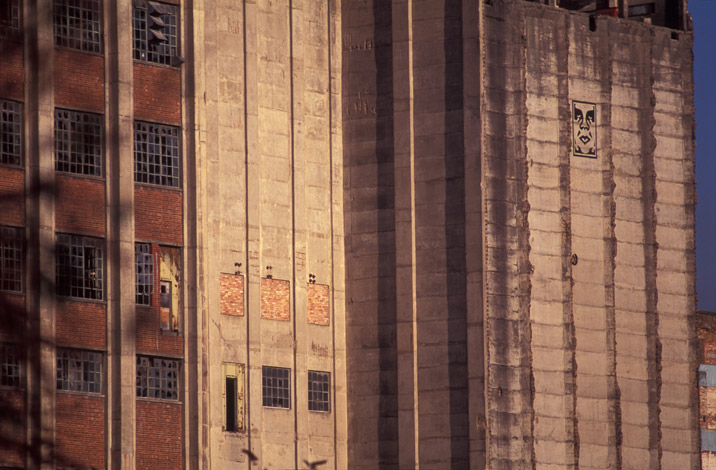
Millennium Mills. © David Secombe 2013.
The Road to East Ham – Micheal MacCumiskeigh:
East Ham. I’m still only in East Ham. I walk down the cracked concrete road under an arborial sky on the road to Vietnam in all its artifice.
The derelict gas works is dressed with imported Spanish palm trees hanging their heads, famished in a cold climate. The wrong choppers and the wrong soldiers. A bellicose nest of English squaddies squat in a huge marquee, drinking tea and intermittently stuffing their faces with carbs and gravy.
Further still from here the final act is played out, the monolith that is Millennium Mills made of indestructible stuff: concrete and thick muscle-studded girders and lots and lots of asbestos. Made of all these things yet held together with an austere elegance. She casts a shadow of disdain across the ticky-tacky Barrett homes that now blister one side of the elegant watery fingers of Albert Docks.
I left the day I arrived, after a morning of basic drilling, Sgt. Lee Ermey’s venom still damp on my face. I walked back the way I came. I was a kid. I didn’t know any better, I didn’t know Kubrick was one of my favourite directors. I kicked my heels walking slowly down the road. I’ve been kicking myself ever since.
Micheal – who was a young dance student at the time – was engaged as a ‘marine’ extra on Stanley Kubrick’s Vietnam epic Full Metal Jacket, which recreated Saigon and Hue in East Ham. The unit base was at Millennium Mills. Lee Ermey played the drill sergeant in the film, having been originally hired as a military adviser.
A Clockwork London. (2)
Posted: April 4, 2013 Filed under: Fictional London, Housing, London on film | Tags: A Clockwork Orange, Binsey Walk, Bird's Eye View, George Plemper, John Betjeman, Owen Hatherley, Stanley Kubrick, Thamesmead 1 Comment
Southmere Lake and Binsey Walk, Thamesmead. © George Plemper 1976.
George Plemper:
In late 1972 I made the journey to Leicester Square to see A Clockwork Orange. As with all Kubrick’s
films I thought the film was visually stunning and I loved the use of music throughout. The physical
and sexual violence seemed to me more theatrical than factual and I was astonished to hear a year
later the film had been banned.
All thoughts of the film had long gone when I crossed the footbridge across Yarnton Way
to Riverside School, Thamesmead in 1976. I had no idea I was entering a scene from Kubrick’s vision
of a desolate and violent Britain. My aims were simple; I was going to use the camera to show my
pupils that they were great, to show them that we were all worthwhile.
From A Guide to the New Ruins of Great Britain by Owen Hatherley:
It’s impossible to praise the original Thamesmead without caveats. There were never enough facilities, the transport links to the centre were always appalling, and the development was always shockingly urban for its outer-suburban context. Regardless, it is something special, a truly unique place. It always was, and remains so in its current, amputated form.
Unlike its successors, it’s flood-proof and still architecturally cohesive, after decades of abuse. Around Southmere lake you can see, just about, how with some decent upkeep and with tenants being given the choice rather than being dumped here, this could have been a fantastic place … This is basically a working-class Barbican, and if it were in EC1 rather than SE28 the price of a flat would be astronomical. Today it feels beaten and downcast, and it only ever gets into the news through vaguely racist stories about the Nigerian fraudsters apparently based here; but its architectural imagination, civic coherence and thoughtful detail, its nature reserves and wild birds, have everything that the ‘luxury flats’ lack.

Southmere Lake and Binsey Walk today. © David Secombe 2013.
Where Alex walked … watch him pitch his droogs into the cold, cold waters of Southmere Lake here.
See also: Pepys Estate 1, Pepys Estate 2, Domeland, Metro-Land.


 The London Column