A Short Walk Down The Old Kent Road.
Posted: October 14, 2013 Filed under: Class, Public Art, Pubs, Tall Tales | Tags: Andrew Martin, Dun Cow, gentrification, Old Kent Road, only fools and horses, Pink Tank, Thomas A Becket 5 Comments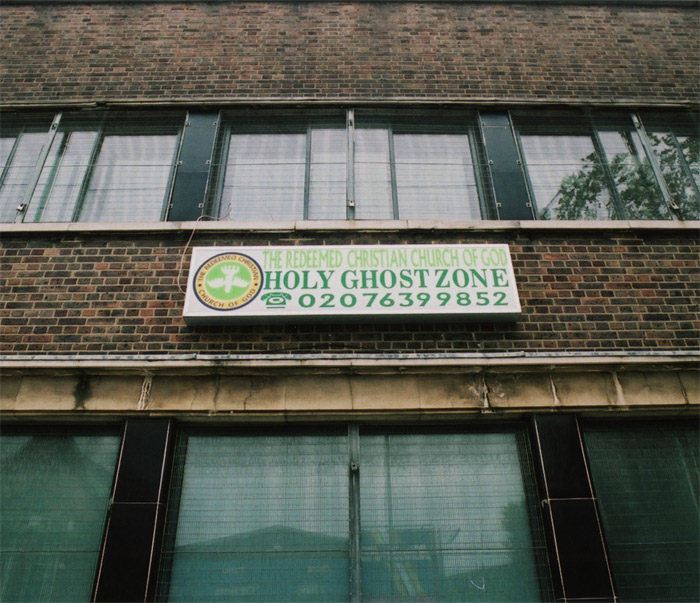
Holy Ghost Zone, Old Kent Road. © David Secombe 2008.
Andrew Martin:
When playing Monopoly my father was always determined to acquire Old Kent Road and Whitechapel, and to build on them as soon as possible. It’s the most modest portfolio on the board, with houses on Old Kent Road, as I remember, costing little more than a hotel on Mayfair. ‘You might laugh,’ my father would tell us in baleful tones, ‘but everybody always lands on Old Kent Road.’
I’m interested in the Old Kent Road as a sort of social counterweight to Hampstead, but my friend David, a South London partisan, is a genuinely keen on it, and gave me a guided tour this week.

Tesco, Old Kent Road. © David Secombe 2004.
‘When the evening sun’s like this,’ he said cheerfully, as we skirted a sofa that had been thoughtfully set out on the pavement, ‘it’s got a sort of I’m-in-a-scary-part-of-LA charm.’ We were walking past the Old Kent Road’s array of cosmopolitan food shops, beauty parlours, international cash transfer places, evangelical ministries, van washing businesses. As the cars screamed by, David would stop every now and again to photograph the lowering clouds over some light industrial unit or brutalist block of flats. He seemed particularly taken with the visual possibilities of the flyover at the southern end of the Road. ‘A friend of mine owns a flat that looks right on to that,’ he said enviously.
 .
.
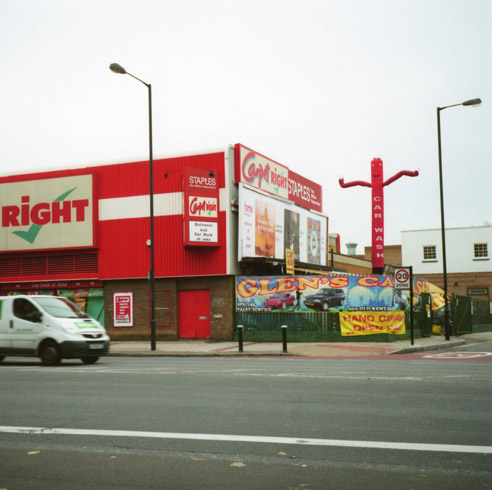
Carpet Right, Old Kent Road. © David Secombe 2008.
I looked at a price list outside one of the Road’s pubs: it advertised a cocktail called a Slippery Nipple, consisting of Sambuca, Bailey’s and Grenadine. You could have a jug of Slippery Nipple for £12.50. Another sign forbade anybody wearing a hat to enter the pub. You knew there was some insight into human behaviour behind this, and that it had been won the hard way.
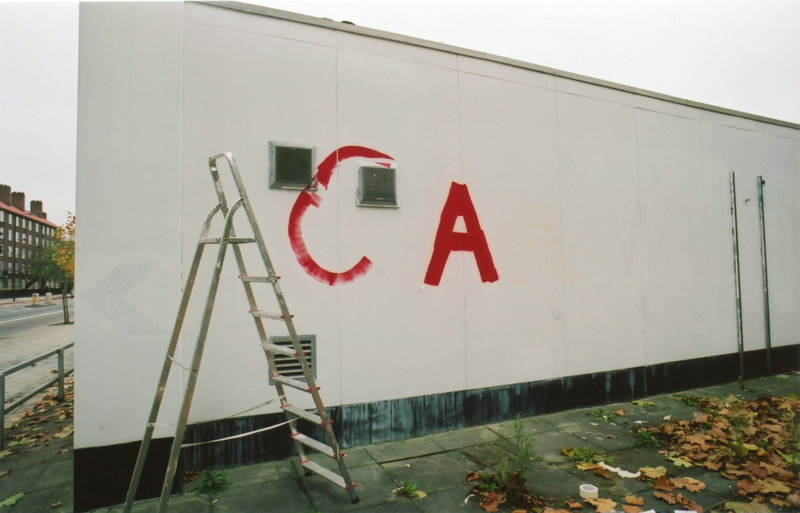
Re-branding exercise, Old Kent Road. © David Secombe 2008.
‘If Dickens were alive today he’d be down here all the time,’ said David as car came crawling noisily down the Road with only two of its tyres inflated. David then attempted, with windmilling arms, to direct the dazed-looking driver to a nearby sprawling depot called Madhouse Tyres.
As he did so, I reflected that the Old Kent Road does have the look of suburban LA or Chicago – that rangy wildness – and it occurred to me that this is what happens to British streetscapes when middle class vigilance is reduced and planning controls relaxed: they begin to look American.
………….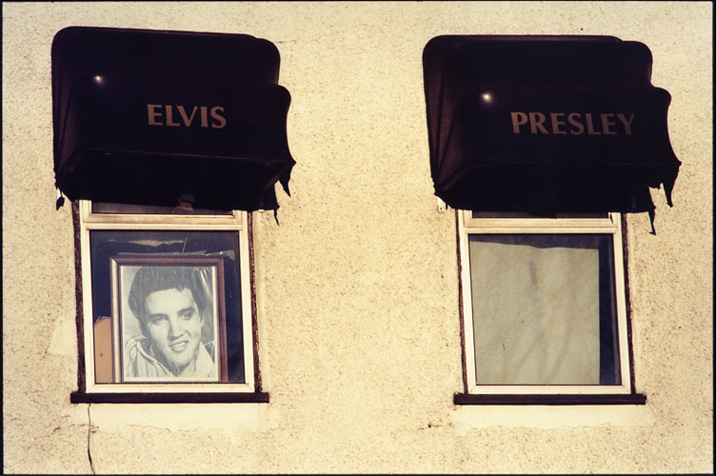
Chinese Elvis restaurant, Old Kent Road. © David Secombe 2002.
David pointed out East Street, which goes off the Old Kent Road. Its market features in the opening credits of ‘Only Fools and Horses’, in which Rodney and Del Boy inhabit a tower block inevitably called Nelson Mandela House. David took me to Mandela Way, which intersects with Old Kent Road, and where there is a small patch of green space occupied by a tank that has been painted pink and decorated repeatedly with the stencilled word ‘Scab’. ‘If this was North London,’ I marvelled, ‘there would be letters in the Hampstead and Highgate Express every week until it was taken away.’ ‘Really?’ said David, snapping away, ‘it’s been here for years.’*

Tank, Mandela Way. © David Secombe 2004.
In the streets off Old Kent Road, you never know what you’ll find: a battered looking Georgian house with an ice cream van parked in the front drive and a lone security camera staring at it; a tiny house with a sign saying ‘This property is protected by guard dogs’ – that’s dogs, plural; sudden bombsites with rampant buddleia, the scars of the Second World War still seemingly fresh. There are also surprising runs of pristine Georgian and Victorian houses with obviously middle class occupants.
……..
Almshouses, Asylum Road, SE15. © David Secombe 2008.
You could argue that Old Kent Road is going upmarket. The famous old Dun Cow pub is now the Dun Cow Surgery, and the Thomas A Becket, the even more famous boxing pub, built on one of the many sites where the Canterbury pilgrims took liquid refreshment, is now an estate agency, a sign of the times to an extent almost ridiculous. ‘You’d think there’d be a plaque acknowledging what it used to be,’ I said to David. But he frowned and shook his head, ‘That’s one of the great things about the Old Kent Road,’ he said, as we trudged on, ‘a profound lack of sentimentality.’
.. .
.
Andrew Martin outside the Asylum Tavern, Asylum Road, off the Old Kent Road, at the end of the trip described in the foregoing article. © David Secombe 2004.
© Andrew Martin. This article originally appeared in Andrew’s Class Conscious column for The New Statesman in 2004.
(*The tank is a Soviet T-34 placed on Mandela Way as a protest by a disgruntled property developer following the rejection of a planning application.)
The Haunted House. Photo: David Secombe, text: Andrew Martin.
Posted: November 1, 2012 Filed under: Architectural, Funereal, Housing, Tall Tales | Tags: Alexander Woolcott, Andrew Martin, Bleak House, charles dickens, Edith Nesbitt, Haunted House, Inigo Jones, Lincolns inn Fields, Tulkinghorn Comments Off on The Haunted House. Photo: David Secombe, text: Andrew Martin.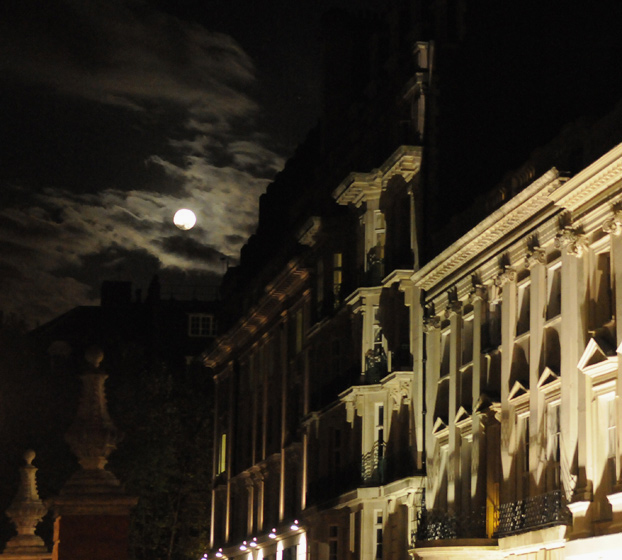
Lincoln’s Inn Fields, west side. Photo © David Secombe 2010.
The Haunted House
If ghost stories arise from the Gothic tradition, which was as much architectural as literary, it is also the case that persistent ghosts need a persistent location in which to manifest. So no wonder houses are haunted.
Haunted houses tend to be old and big. Such properties appeal to the romantic idea of faded grandeur, and also a baser snobbery. Every account of Borley Rectory, ‘the most haunted house in England’, describes it as hideous, but when I look at the pictures I wonder how much it would cost today if it were still standing, and whether the seller would take a low offer in view of its poltergeist infestation. Reading ghost stories we are torn: yes, a malevolent spirit stalks the east wing, but at least there’s am east wing for it to stalk. Ghost stories, both real and fictional, sometimes come with floor plans of the haunted area – literally, property particulars – and very mouth-watering they usually are.
Haunted houses also come with libraries, and with servants. The protagonist in a ghost story is quite alone in his huge house … except for his fifteen servants. The reader might not know about the servants until one of them hesitantly knocks and enters the master’s study on the final page and finds him slumped in his chair ‘With a look on his face, the like of which I’ve never seen …’
The author denigrates the house, but also slyly boosts it to engage our snobbery. In Walter de la Mare’s story, Out of the Deep (1923) the protagonist, Jimmie, inherits his uncle’s ‘horrible old London mansion’. But how horrible and old can a London mansion be? In Moonlight Sonata (1931) by Alexander Woolcott, one of the two principals inhabits ‘the collapsing family manor house to which he had indignantly fallen heir.’ The owner is down to his last gardener, who tends the ‘once sumptuous’ grounds, but the place doesn’t sound too bad to me. The Mystery of the Semi-Detached by Edith Nesbitt (1893) seems, from its title, to be bucking the trend, but the house is ‘commodious’, with several sitting rooms.
I myself grew up in a semi-detached of a more modest sort. We were its first occupants, and I was proud of inhabiting a new house. Those of my contemporaries who lived in old houses seemed to me to be taking a considerable risk. They were living in houses in which people had died, and people they didn’t know at that – people that nobody currently alive knew. It must be like living in a tomb. There would have to be certain echoes. In grappling with the subject, in his collection of sightings, Apparitions and Haunted Houses, Sir Ernest Bennett plaintively wonders, ‘Can it conceivably be the case that in some inscrutable fashion the woodwork and masonry of a house may exert some physical or mental influences which cause certain individuals to see the phantasmal figure of a former resident?’
… from Ghoul Britannia, published by Short Books. © Andrew Martin 2009.
David Secombe:
Elsewhere in his fine book (an overview of the British ghost story tradition), Andrew examines Charles Dickens’s fascination with ghosts and how they impacted on his fiction. The above photograph shows the Inigo Jones mansion – on the right – believed to have been the model for the chambers of Tulkinghorn, the sinister lawyer in Bleak House. Although Bleak House is not ostensibly a novel about ghosts, it deals with the dead hand of the past weighing upon the present; and Dickens’s treatment of Lincoln’s Inn is appropriately atmospheric, menacing and grotesque. Here is the opening of chapter 32:
‘It is night in Lincoln’s Inn — perplexed and troublous valley of the shadow of the law, where suitors generally find but little day — and fat candles are snuffed out in offices, and clerks have rattled down the crazy wooden stairs, and dispersed. The bell that rings at nine o’clock, has ceased its doleful clangour about nothing; the gates are shut; and the night-porter, a solemn warder with a mighty power of sleep, keeps guard in his lodge. [. . . ] It is a close night, though the damp cold is searching too; and there is a laggard mist a little way up in the air. It is a fine steaming night to turn the slaughter-houses, the unwholesome trades, the sewerage, bad water, and burial grounds to account, and give the Registrar of Deaths some extra business’.
See also: The Avoided House, Halloween.
London Gothic. Photo: David Secombe, text: Andrew Martin (3/5)
Posted: July 4, 2012 Filed under: Architectural, Dereliction, Housing | Tags: Andrew Martin, Avoided House, Bates Motel, Camberwell, haunted London Comments Off on London Gothic. Photo: David Secombe, text: Andrew Martin (3/5)
Camberwell. © David Secombe 1988.
From Ghoul Britannia (2010) by Andrew Martin:
THE AVOIDED HOUSE
In a street of any length, there’s one of these: a vacant house, or one that changes hands too often, or not often enough; a house in shadow or being taken over by its own garden. There were a couple of these on my paper round when I was a boy. One had cracked windows, and a decaying Transit van parked immediately in front of the front door. Another had the curtains permanently closed and a front garden filled with rubble. I was encouraged by this rubble. I thought: ‘One day soon they’re going to use it to construct something marvellous like a pond with a fountain.’ But the rubble just remained. I never saw the occupants of either house and I didn’t want to. I found it hard to imagine them going into Ellis’s newsagents and paying for the papers I delivered to them. That would require a degree of normality incompatible with the state of their homes.
It didn’t take much for me to condemn a property; it didn’t have to be semi-derelict. For example, I wasn’t very keen on any of the house facing our own because they didn’t have the sun on them in the morning; and some of my friends’ houses just felt wrong inside. I am not going to broach the subject of psycho-geography because I find myself dying with exhaustion at the typing of the word, but it has been argued that houses with a reputation for being haunted occupy sites where ley lines intersect. Also blamed – and I like this – is carbon monoxide poisoning. This occurs where carbon combustion occurs with too little ventilation, and there’s quite a neat fit with ghostliness in that the symptoms can include anxiety and hallucinations. People burning wood or coal, or using coal-gas lighting in a shuttered room might be at risk, which connects the condition with Victorian winters – a fertile time for ghost stories.
When I first came to London I was amazed at the number of avoided houses. They constitued about fifteen percent of the total stock.
© Andrew Martin. Ghoul Britannia is published by Short Books.
See also: Halloween, The Haunted House.
Underground, Overground. Text: Andrew Martin, photo: Tim Marshall. (5/5)
Posted: June 1, 2012 Filed under: Tall Tales, Transport | Tags: Andrew Martin, ghosts on the tube, Pizza on the Park, Underground Overground Comments Off on Underground, Overground. Text: Andrew Martin, photo: Tim Marshall. (5/5)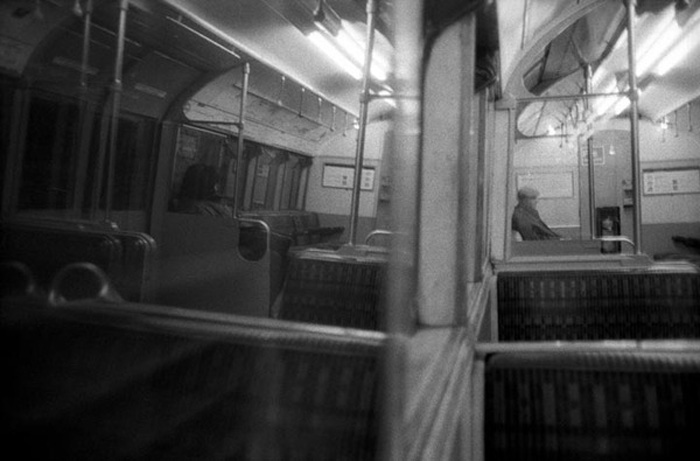
Bakerloo Line. © Tim Marshall 1992.
Andrew Martin writes:
There are the books full of Underground ghost stories. An invisible runner pounds along the platforms at Elephant & Castle; children scream in the basement of what used to be the surface building of Hyde Park Corner, and which became Pizza on the Park. (They continued to scream it was said, even while the Four Seasons and Margheritas were being rolled out.) William Terris, an actor murdered in 1897, manifests in Covent Garden station. The best one I know of was sent to me in a letter a few years ago. Late one night a Piccadilly Line driver was running his empty train into the depot at Northfields when he heard a knock on his cab’s connecting door into the carriage. He turned and opened the door, saw no one there but noticed that all the connecting doors of the carriage were open, as though someone had walked along the length of the train. The driver refused to continue, so another man was brought in to close the doors and take the train into the depot. Shortly after he started the train he heard a knock … and all the doors were open again.
The text is from Underground, Overground: a passenger’s history of the Tube, published by Profile Books (also available here). The photos are from Tim Marshall’s series When a Tube train stops.


 The London Column