New Year’s Eve.
Posted: December 31, 2013 Filed under: London Places, Monumental, Theatrical London | Tags: Denys Lasdun, Royal National Theatre Comments Off on New Year’s Eve. National Theatre from Waterloo Bridge, December 2013. © David Secombe.
It’s been a smeary, wind-tossed festive season in London and the UK, and I am in a rush to go to a party in Walthamstow – but by way of farewell to 2013, here is an iPhone image of the National Theatre in which Denys Lasdun’s Brutalist masterpiece resembles a giant boiled sweet.
I don’t know about any of you but I am hoping for better things in 2014: let us hope they start tonight. Thanks to all our readers and contributors and a very Happy New Year.
David Secombe.
Christmas in the city.
Posted: December 24, 2013 Filed under: London Types, Pubs | Tags: Christmas Comments Off on Christmas in the city.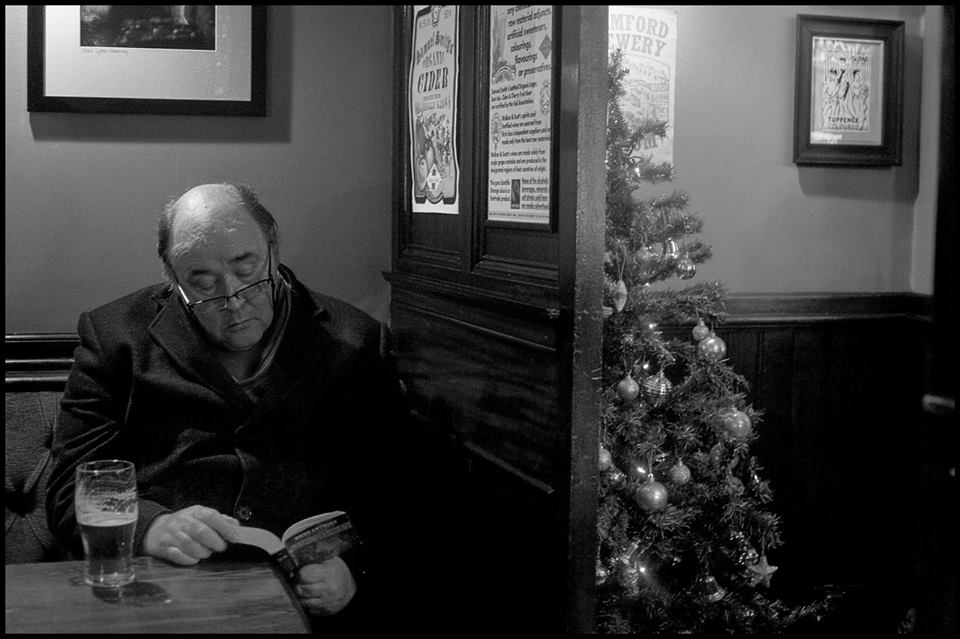
The Crown, New Oxford Street. Photo: © Tim Marshall 2013.
Merry Christmas from The London Column.
Bvsh Hovse.
Posted: December 11, 2013 Filed under: Architectural, Corridors of Power, Fictional London, Interiors, Lettering, Literary London, Monumental, Wartime London | Tags: Aldwych, Bogdan Frymorgen, Bush House, Claire Grove, George Orwell BBC, London architecture, Ministry of Truth, Wych Street Comments Off on Bvsh Hovse.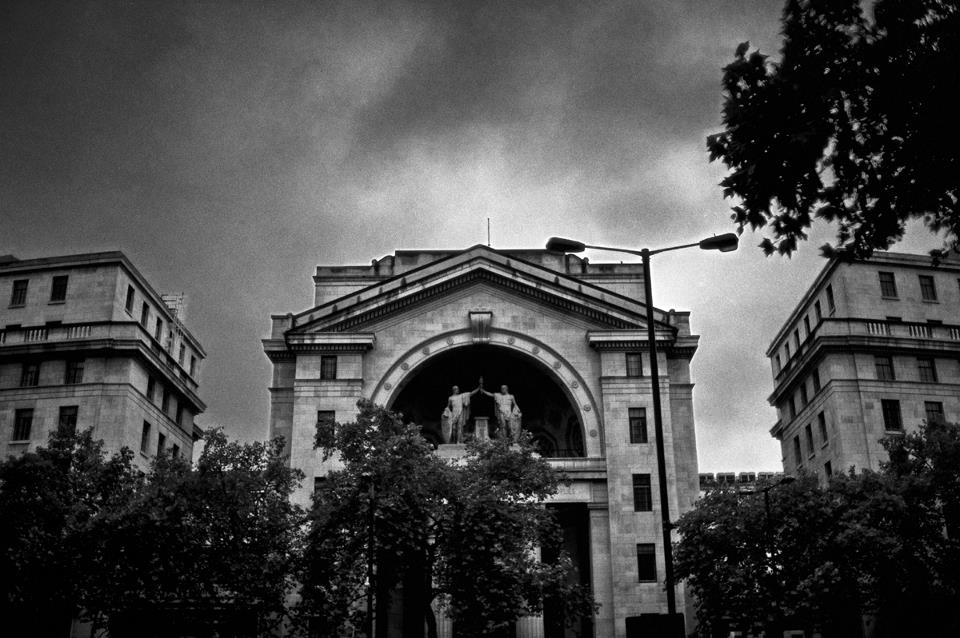
Bush House from Kingsway. © Bogdan Frymorgen 2012.
Bush House, the imposing 1920s edifice which dominates the Aldwych and looms over Kingsway, was once declared to be “the most expensive [building] in the world”: by 1929 its construction had cost its American backers £2,000,000. It was built on the site of Wych Street, an ancient survivor of the Great Fire that was ruthlessly destroyed by London County Council circa 1901.
Built of Portland stone, with extravagant use of marble for its cavernous halls, and fronted by forbidding columns surmounted by statues symbolising ‘Anglo-American friendship’, Bush House embodies its era just as much as the Deco Telegraph Building on Fleet Street, or Collcutt and Hemp’s monolithic Adelphi. (The chunk of old London flattened for the Adelphi was the Adam brothers’ graceful riverside development of 1768.) Like the ‘new’ Adelphi, the sheer bombast of Bush House trails unfortunate traces of Fascist architecture; but where Colcutt and Hemp’s stridently moderne behemoth might look at home in Mussolini’s Rome, Bush House’s gigantic faux-classical styling prefigures the more stolid brand of ‘Totalitarian Retro’ that came to be favoured by Hitler and Stalin.

Main entrance. © Bogdan Frymorgen 2012.

© Bogdan Frymorgen 2012.
The BBC established offices in the building in 1941, and for over 70 years Bush House was home to the BBC World Service, originally known as the BBC Overseas Service. George Orwell was a BBC staff member during the war, and the interiors of the building – in particular its canteen – informed his conception of The Ministry of Truth in Nineteen Eighty Four. (It’s clear that the exterior of Orwell’s Ministry was modelled on Senate House in Bloomsbury, and Room 101 was said to be located somewhere in Broadcasting House, but the echoing, labyrinthine interior of Bush House invites us to imagine Winston Smith lost within it.) It might be easy to resent Bush House – for what was sacrificed for its creation, for its monumental scale, and for the sheer absurdity of that portico (which echoes, in the Latin script above its main entrance, the opening titles of a certain famous 1970s TV series: I CLAVDIVS). You could even say that the payoff for the loss of ancient Aldwych is nothing more than a faceless autostrada with a giant conceited lump at its southern end.

© Bogdan Frymorgen 2012.

© Bogdan Frymorgen 2012.
But London is a restless, shape-shifting city, and Bush House has come to stand for more than the pretensions of its sponsors and designers. With the good fortune to house an institution that infused its overblown rhetoric with genuine purpose, it has become a great London building by default. Orwell’s ironic attitude to the BBC aside, during WW2 it acted as a hub for displaced European intellectuals, who broadcast to their besieged home countries from its offices; coded messages aimed at resistance fighters and SOE agents were transmitted to occupied Europe from its studios. It became a symbol of the War Effort. (It was damaged by a V1 flying bomb that hit the Aldwych in 1944; the V1 landed on the Air Ministry directly opposite, leading to worries over the eerie accuracy of those early cruise missiles.)
Even its grandiose classicism may be said to have a claim to authenticity: workmen laying Bush House’s foundations unearthed Roman statuary beneath the dust of Wych Street. A bust of a Roman noble was duly and reverently put on display in the new building’s lobby (even if there are doubts as to its provenance …).

© Bogdan Frymorgen 2012.
These photographs by Bogdan Frymorgen – a studio manager for the World Service – were taken just hours before the BBC finally left Bush House in July 2012, when the humming bustling halls and studios were already silent. Even as a series of absences, they capture a real sense of the urgency and activity that had so recently been going on. They’re full of love for a building and an institution that came to occupy an important place in British cultural history. It’s too easy to forget the esteem in which the BBC World Service is held by its distant listeners; it’s not television – therefore not sexy – but that is what gives it its reach, as radio waves can go anywhere and radios can be found everywhere. The World Service is a unique and magnificent public service; it’s Reithian; and, as such, it’s permanently under threat.

© Bogdan Frymorgen 2012.
But the BBC’s activities at Bush House weren’t confined to the World Service. Amongst other things, a great deal of radio drama was produced there, and in the past weeks I’ve been thinking of this again. A few years ago, I was fortunate enough to spend a few days working on a radio play at Bush House under the aegis of Claire Grove, one of the most innovative and successful radio drama producers of our time. Her funeral was last week. Her Guardian obituary gives a rough idea of her professional brilliance, but it is hard to sum up such a vital person within the confines of an ‘Other Lives’ entry. Lemn Sissay’s appreciation gives some hints of the energy and life that occupied Claire, and indeed Bush House.

Studio 8, cleared out. © Bogdan Frymorgen 2012.
Amidst current refurbishment, Bush House is now occupied by a law firm and HM Customs and Excise. The love really has left the building. D.S. (with K.E-B.)
… for The London Column. Copies of Bogdan Frymorgen’s photographic tribute to Bush House may be ordered from him at frymorgen@googlemail.com or via his Facebook page.
Dmitri Kasterine’s portraits.
Posted: November 26, 2013 Filed under: Artistic London, Bohemian London | Tags: Anthony Powell, David Niven, Dirk Bogarde, Dmitri Kasterine, Francis Bacon, Germaine Greer, Kingsley Amis, Martin Amis, Michael Caine, Paul Theroux, Roald Dahl Comments Off on Dmitri Kasterine’s portraits.
 Martin & Kingsley Amis, London, 1975. © Dmitri Kasterine.
David Secombe:
There are too many photographers. Far, far too many. As the truism goes, these days everyone with a mobile phone is a photographer. Not only that, but everyone who’s been photographed is a celebrity. Current devalued concepts of achievement in the public sphere mean that the ever-increasing number of portrait photographers are faced with a chronic shortage of real, vital personalities worth photographing. (Celebrity chefs, boy bands, soap stars and their ilk – really?)
 Dirk Bogarde, London, 1981. © Dmitri Kasterine.
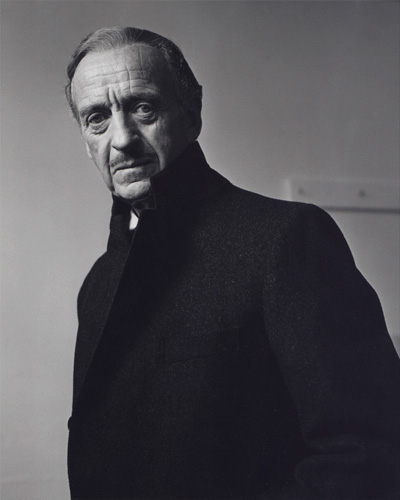 David Niven, Hertfordshire, 1979. © Dmitri Kasterine.
Major cultural figures are in short supply. Perhaps more to the point, the ones we’ve got don’t occupy the same space that they might have done 30 or even 20 years ago. Artists, writers, and thinkers used to be listened to as public figures; we’ve got no time for that now. For an ambitious portrait photographer, there are forums for the dissemination of photographic portraits as art, but such well-meaning, prize-giving endeavours seem culturally marginal and a more than little academic, when you compare them to the oracular power of a photograph that everyone was going to be looking at, of a person everyone was listening to.
 Roald Dahl, Great Missenden, Bucks., 1976. © Dmitri Kasterine.
Enter: a portfolio of limpidly beautiful portraits by Dmitri Kasterine, derived from his career as an editorial photographer in London and New York from 1960 to the 1990s. Looking at these pictures now, it is hard not to think, a little bitterly, that Dmitri was fortunate to be working before the internet, the population explosion, and a thousand TV channels splintered our attention forever; but it is also clear that he has the rare ability – it is genuinely rare – to photograph any human being with sovereign insight. His portrayal of everyday English life may be seen in this series of posts we ran in 2011; today, we are showing a selection from his chronicle of London’s intellectual life during the 70s-90s.
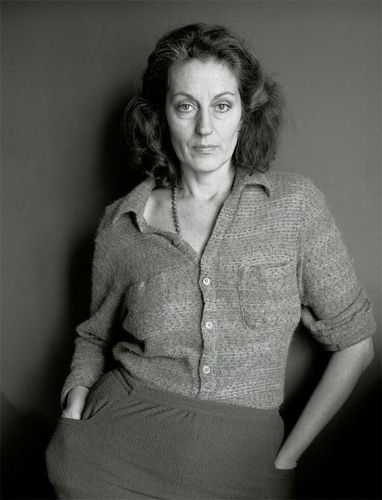 Germaine Greer London, 1975. © Dmitri Kasterine.
Part of Dmitri’s shtick (it almost looks like a shtick, these days) is an unassuming method: unobtrusive lighting, plain backgrounds, tones in the middle register … With simple means and an instinct for the essential, he penetrates his subjects’ defences far beyond the remit of a magazine portrait. Take the portraits of the actors on this page. There is genuine pain in his study of David Niven; Dirk Bogarde was reportedly unhappy with Kasterine’s portrait, its piercing honesty too much for the old matinee idol; and Michael Caine, denied his usual opportunity for Bermondsey charm or gangster menace, is revealed as a shrewd tycoon in ‘70s eyewear. Roald Dahl poses jauntily enough in summer gear, but his reptilian stare flatly contradicts his clothes’ carefree attitude, and forbids the viewer to find anything amusing. Paul Theroux, on the other hand, appears as if playing the part of a novelist: dominated by his accessories, he seems uncomfortable with the costume that wardrobe has assigned him.

Michael Caine, London, 1973. © Dmitri Kasterine.
 Paul Theroux, London, 1974. © Dmitri Kasterine.
Dmitri’s portrait of Kingsley and Martin Amis is a forensic document of English letters’ most awkward dynastic double act – Kingsley in his proto-Thatcherite pomp, the broken arm a possible souvenir of a drunken bender, and Martin exhausted by the sheer effort of trying to write better novels than his father. Anthony Powell determinedly maintains his aristocratic poise in the face of encroaching age, but the price is a whiff of camp – by contrast, Francis Bacon defiantly shows us the youthful hustler he once was.
 Anthony Powell, Somerset, 1984. © Dmitri Kasterine.
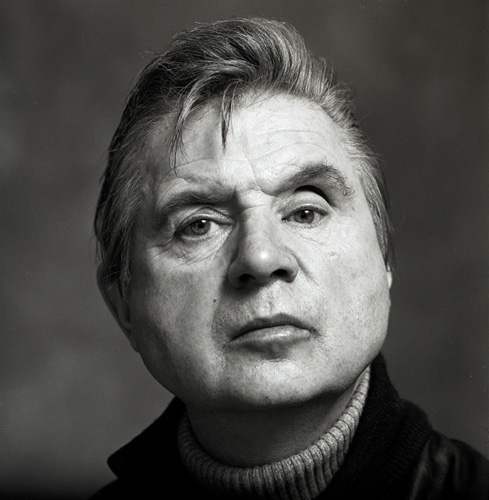 Francis Bacon, London, 1978. © Dmitri Kasterine.
Dmitri moved to America in 1985 and continued his career in New York: his Stateside subjects range from Saul Bellow to Cindy Sherman, Johnny Cash to Jean-Paul Basquiat, Steve Martin to Mick Jagger. Like Irving Penn, he captures his sitters by stealth. Now 80, he lives in Newburgh, New York, where he has been photographing the city and its inhabitants since 1992.
So many photographers are called to the profession with the burning desire to document the world, and that’s a noble thing. The gift is actually to be able to see it.
… for The London Column.


 The London Column


