Urban Myths no.2: Airport Caterpillars.
Posted: October 4, 2013 Filed under: Amusements, Tall Tales, Transport, Wildlife Comments Off on Urban Myths no.2: Airport Caterpillars.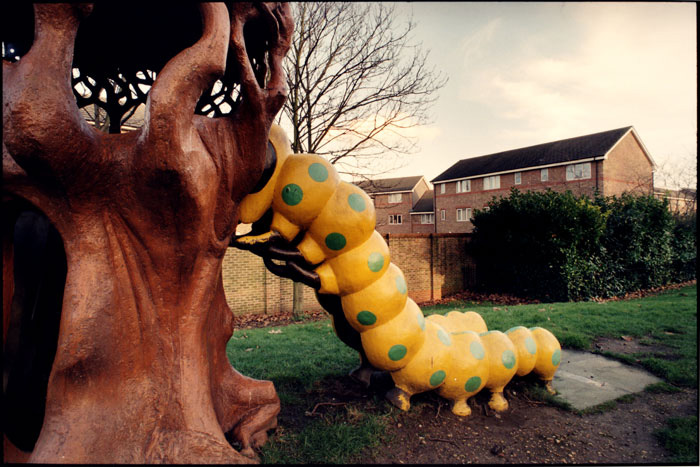
Playground, Rotherhithe. © David Secombe 2003.
Giant Edible Caterpillars Seized at Gatwick*
Customs officers at Gatwick Airport got more than they bargained for when they searched the luggage of a passenger arriving from Nigeria: inside his suitcase they found more than ninety kilograms of giant caterpillars swarming inside a bubble wrap cocoon.
The man told the customs officials that they were for his personal consumption during his stay in Britain. However, the caterpillars are a popular delicacy across Africa and, as such, represent a valuable trading commodity. Customs official Bridget Fumes commented: ‘We get a lot of people trying to smuggle animals into the country – last month we had someone wearing a lizard as a hat and a man with a pair of monkeys down his trousers, but to my knowledge this is the first time we have had giant caterpillars.’
Stavros Wilt, an insect expert at the Natural History Museum, commented: ‘These are likely to be mopane worms, the larvae of emperor moths, which are commonly eaten in Africa. A favoured method of consumption is to pinch the caterpillar at the tail to rupture its innards, followed by a sharp flick to liberate the guts via the burst carapace. The resulting matter may be fried until crisp with onion, tomatoes and chillis. Alternatively, they may be dried and eaten raw as a crunchy snack.’
‘This was an unusual seizure but the vigilance of our officers prevented this consignment of rogue insects from entering the UK, and possibly posing a risk to the health and wellbeing of the populace,’ proclaimed Ms Fumes. ‘I would warn travellers not to attempt to bring any products of animal origin into the UK without a permit, as they may not have been inspected to appropriate standards and may contain diseases. These caterpillars are not something I expect to see in the Gatwick staff canteen any time soon!’
An increasing number of British outlets offer mopane worms for ‘own consumption only’. The online retailer Planet Nosh sells 40g bags for £16.99, saying that the insects are a tasty and nutritious alternative to traditional meat products, and describes them as ‘the ultimate barbecue novelty’. Experts estimate that the caterpillars seized at Gatwick had a street value of £40,000.
The caterpillars are being cared for at an animal rescue shelter in Kent.
* NB: A mostly, if not entirely, genuine news item: a mash-up of reports from International Business Times, The Independent, lepidoptera.pro, etc. The second in an occasional series. See also: The Supermarket Spider (http://wp.me/p1twhU-33W)
Two buildings on Fleet Street.
Posted: September 27, 2013 Filed under: Architectural, Fictional London, Literary London, Street of Shame | Tags: Art Deco in London, Daily Express Building, Evelyn Waugh, old Fleet Street, Owen Williams, Scoop, Telegraph Building Comments Off on Two buildings on Fleet Street.
Telegraph Building, Fleet Street. Photo © David Secombe 2010.
From Scoop by Evelyn Waugh:
The bells of St.Bride’s chimed unheard in the customary afternoon din of the Megalopolitan Building. The country edition had gone to bed; below traffic level, in grotto-blue light, leagues of paper ran noisily through the machines; overhead, where floor upon floor rose from the dusk of the streets to the clear air of day, ground-glass doors opened and shut; on a hundred lines reporters talked at cross purposes; sub-editors busied themselves with their humdrum task of reducing to blank nonsense the sheaves of misinformation which whistling urchins piled before them; beside a hundred typewriters soggy biscuits lay in a hundred tepid saucers. At the hub and still centre of all this animation, Lord Copper sat alone in splendid tranquility. His massive head, empty of thought, rested in sculptural fashion upon his left fist. He began to draw a little cow on his writing pad.
David Secombe: Scoop was published in 1938 and is, of course, a literary monument to the glory days of inter-war Fleet Street, drawing on Waugh’s brief 1935 stint as a Daily Mail war correspondent in Abyssinia. The novel’s monstrous Lord Copper is usually described as being an admixture of the proprietor of the Daily Express, Lord Beaverbrook, and The Times’s Lord Northcliffe, with the Mail‘s Lord Rothermere somewhere in the mix as well. The immense power of these men reflected the vast circulations and influence of the titles at their disposal; and, for all its comic genius, the paragraph from Waugh’s novel speaks of the glamour and excitement of old Fleet Street.
The Telegraph Building, designed by Elcock & Sutcliffe and finished in 1928, is a fine example of serious-minded Deco, with sculptural detailing typical of the era’s public buildings (e.g. London Underground’s 55 Broadway, BBC’s Broadcasting House), whilst the clock and detailing of the facade speaks of the 1920s’ infatuation with all things Egyptian. Alfred Oakley’s dynamic frieze above the main entrance depicts a brace of Mercuries flying from Britain to despatch news to her dominions and beyond; whilst, at the very top of the facade, two gravely portentous sculptural masks by Samuel Rabinovitch – ‘Past’ and ‘Future’ – offer further proof of the self-importance of the parties who commissioned the building. (However, Oakley and Rabinovitch were not as celebrated as Gill or Epstein, and their work on the Telegraph building was the high-water mark for both of them.) Together the elements add up to a rich, imposing and endearingly absurd edifice, entirely suitable for a sober, venerable newspaper keen to project an engagement with the hectic modern ‘scene’.
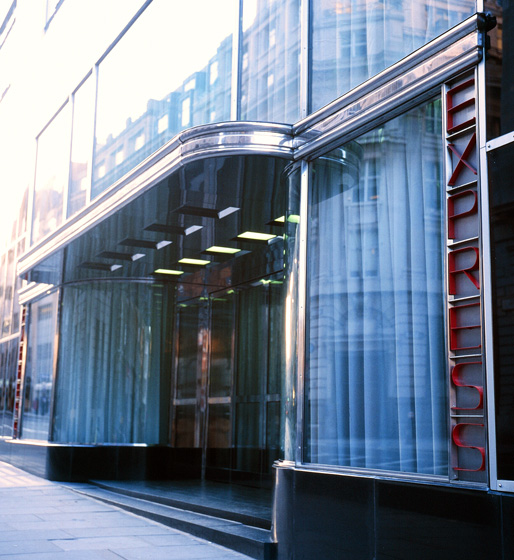
Daily Express Building, Fleet Street. Photo © David Secombe 2010.
A few years later, in 1932, and just four doors away, the new Daily Express Building opened for business and immediately made Elcock & Sutcliffe’s Telegraph design look like something by Augustus Pugin. A self-proclaimed icon of modernity streamlining down inky old Fleet Street, this sleek edifice is as characteristic of the 1930s as the suddenly obsolete Telegraph Building was of the 1920s. Significantly, the building was to a large extent the design of a structural engineer, Owen Williams, who had also advised on the Telegraph Building, and who went on to design Express offices in Manchester and Glasgow in the same fashion as their London prototype. The stark finish common to all three Express buildings – an aggressively moderne melange of black Vitrolite, glass and chrome – may be seen as an expression of the thrusting personality of Beaverbrook: the self-parodic press baron whose considerable political influence derived from the conspicuous popularity of his titles (during its post war zenith, The Daily Express was the biggest-selling newspaper in the world). Reading Scoop, it seems clear that Lord Copper’s Daily Beast is based in a building more like the Express than the Telegraph; quite apart from the architectural stylings, St Bride’s church stands directly opposite the Express Building, its spire reflecting darkly in the inscrutable facade of its upstart neighbour (however much Evelyn Waugh deplored the architecture of his time, he relished its capacity for inadvertent comedy).
Both the Telegraph and Express buildings are now owned by Goldman Sachs, their fabled Deco interiors available for inspection only on rare open days. And ‘The Street of Shame’ remains a street of ghosts, its pristine sense of purpose departing with the newspapers that gave it its unique identity. But for anyone seeking echoes of the giddy aspirations of the 1920s and 30s, these buildings remain evocative and potent, each epitomising the preoccupations of its decade. They are relics of a lost and dizzying world of inter-continental airships, Howard Carter and Tutankhamun, racing at Brooklands, the talkies, the Mitfords, the Blackshirts, Hollywood stars on the Queen Mary, Noel Coward’s Design for Living and Evelyn Waugh in his pomp … factories and temples dedicated to the latest news, expressed in architectural forms as up-to-the-minute as a Clarice Cliff tea-set.

Entrance frieze, Telegraph building, Fleet Street, EC1. Photo © David Secombe 2010.
Fleet Street Portrait – Charles Jennings:
New Life For Doomed Thoroughfare. It Takes All Sorts, Says Cockney. THE HELL OF THE STREET. ‘I was left for minutes on end. My thirst got the better of me.’ Starting today: her unique story. BANKERS WHERE ONCE WERE JOURNALISTS.My Secret Can Be Yours. FAMOUS ARTERY RUNS THROUGH BRITISH LIFE. ‘They were like savages.’ Can you name the missing ingredient? ‘A squalid, dirty and often pathetic affair.’In the space of ten minutes I saw no fewer than seventeen buses.RED-FACED MAN EJECTED FROM EL VINO’S. Why I Did It. ‘It took eight minutes for the police to arrive, by which time the thieves were long gone.’ To bring you this story I have crossed three continents under an assumed name. PREPARE YOURSELF FOR SMELLS GALORE. ‘He claimed it would change our lives’. Mersey House and a tale of neglect. Fantastic New Hunt Is On. Pasty-Faced Office Workers: ‘A Waking Nightmare’. Can 2/6 Really Buy Happiness? WORKSHY MAN CLAIMS TO HAVE FOUND SECRET OF ETERNAL YOUTH. He Was An Actor To The End. This Is The Gutter Press. And This Is The Gutter. Read my remarkable account.
Four streets off Hockley Hole.
Posted: September 12, 2013 Filed under: Amusements, Entertainment, Fictional London, London Places, London Types, The Fleet | Tags: Artful Dodger, Back Hill, bear baiting in London, Fagin's lair, Hockley Hole, John Londei, King of Clerkenwell, old Clerkenwell, Oliver Twist, Saffron Hill, Sally in our alley 2 Comments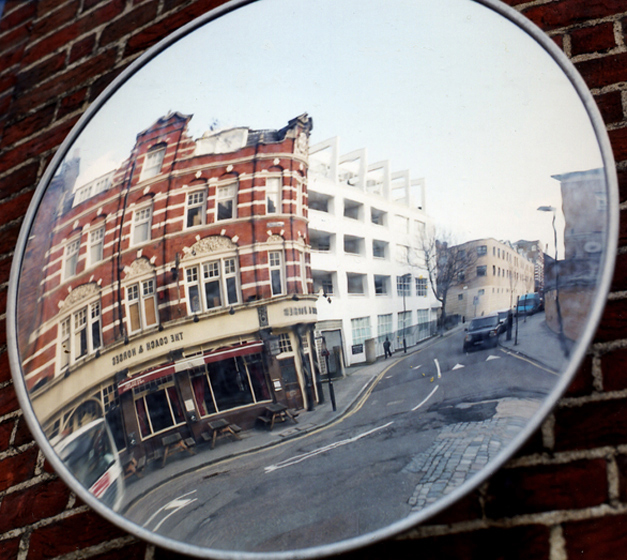
Back Hill and Ray Street, Clerkenwell. © David Secombe 2010
From The Fascination of London: Holborn and Bloomsbury, ed. Sir Walter Besant 1903:
Just here, where Back Hill and Ray Street meet, was Hockley Hole, a famous place of entertainment for bull and bear baiting, and other cruel sports that delighted the brutal taste of the eighteenth century. One of the proprietors, named Christopher Preston, fell into his own bear-pit, and was devoured, a form of sport that doubtless did not appeal to him. Hockley in the Hole is referred to by Ben Jonson, Steele, Fielding, and others. It was abolished soon after 1728.
David Secombe:
The Coach and Horses pub – reflected in the mirror in the picture above – now occupies the site of Hockley Hole, one of the least salubrious entertainment venues in London’s history. The pub rests at the bottom of a curious depression in the heart of Clerkenwell, behind the old Guardian building on Farringdon Road – which itself marks the course of the river Fleet, which Victorian engineers – eventually – paved and tamed into a churning sewer. (Supposedly, the original Coach and Horses afforded access to the Fleet from its cellars, providing Georgian fugitives with an escape route to the Thames.) This dingy, hidden locale is a beacon for anyone of a Psychogeographical persuasion, as three centuries of real and imagined associations intersect here. We have touched upon Hockley Hole before, but a passage in Lucy Inglis’s fine new book Georgian London: Into the Streets prompted us to revisit the immediate environs. In her book, Lucy provides further details of the delights afforded by Hockley Hole (or Hockley-in-the-Hole) :
By the turn of the eighteenth century, baiting had moved north of the river – to Hockley-in-the-Hole, in Clerkenwell. In 1710, there was ‘… a match to be fought by two dogs, one from Newgate-market, against one from Honey-lane market, at a bull … which goes fairest and fastest in, wins all. Likewise, a green bull to be baited, which was never baited before; and a bull to be turned loose with fireworks all over him. Also a mad ass to be baited. With a variety of bull-baiting and bear-baiting, and a dog to be drawn up with fireworks. To begin exactly at three of the clock.’ Hockley was the centre of bull terrier breeding in London, and so perhaps it was natural that the sport would move there. In 1756, Hockley disappeared with the continuing Fleet development, and bull-baiting moved to Spitalfields. Increasingly unpopular, it was soon confined almost exclusively to market towns.
The mirror in the picture above is located on the wall of a huge industrial building (now home to one of Central St Martins design campuses) which straddles Back Hill and lower Saffron Hill. In The Fascination of London, Walter Besant quotes an earlier writer’s description of Saffron Hill as “narrow and mean, full of Butchers and Tripe Dressers, because the Ditch runs at the back of their Slaughter houses, and carries away the filth.” Besant takes the opportunity to add that ‘in later times Italian organ-grinders and ice-cream vendors had a special predilection for the place, and did not add to its reputation’ – but he also acknowledges that ‘all this district is strongly associated with the stories of Dickens’. In Oliver Twist, set in 1838, the year it was written, Dickens describes the Artful Dodger leading Oliver to Fagin’s lair:
‘They crossed from the Angel into St. John’s Road; struck down the small street which terminates at Sadler’s Wells Theatre; through Exmouth Street and Coppice Row; down the little court by the side of the workhouse; across the classic ground which once bore the name of Hockley-in-the-Hole; thence into Little Saffron Hill; and so into Saffron Hill the Great: along which the Dodger scudded at a rapid pace, directing Oliver to follow close at his heels.’
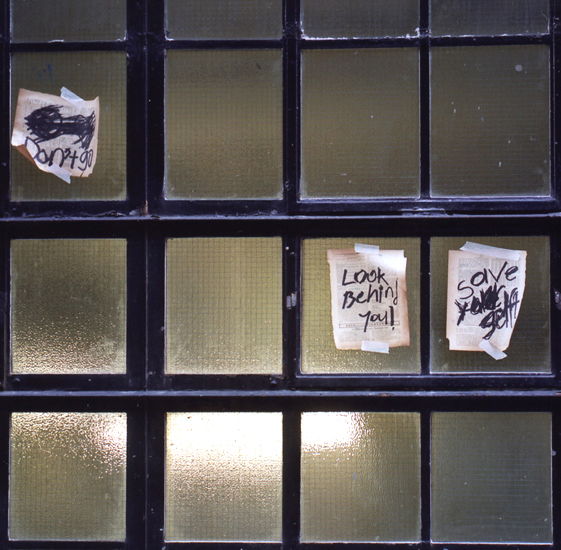
College window, Back Hill. © David Secombe, 2010.
On the same turf 150 years later, a real-life match for Dickens’s characters is described by the late John Londei, a much-missed photographer, writer and contributor to this site. As John wrote in 2011:
Some people might think little Jimmy Cleary eccentric, but to me he was a walking landmark: someone whose presence brings a touch of magic to an area. Whenever I saw Jimmy I knew I was in Clerkenwell. Jimmy’s speciality was annoying motorists. He would not tolerate errant parking; his life seemed devoted to chasing drivers on from yellow lines. And woe betide anymore who ignored his orders! Bringing out a tattered notebook he took their number, and created such a commotion that the poor motorist found himself the centre of attention.
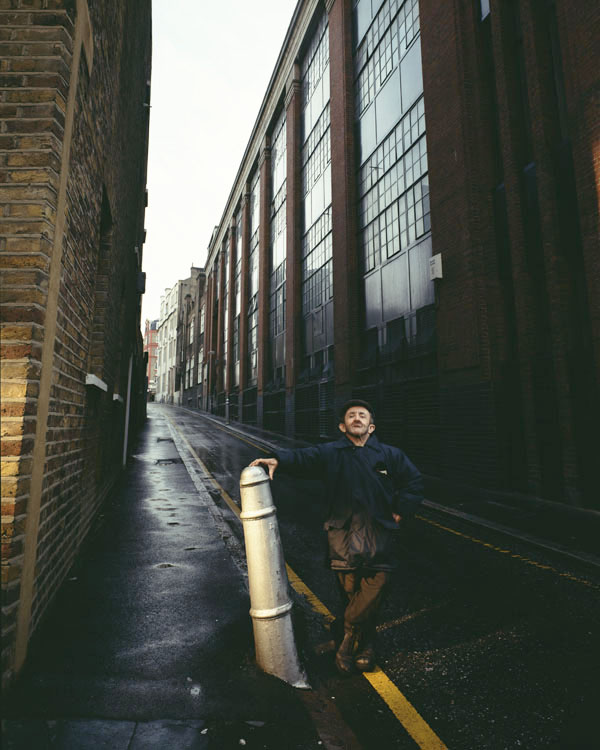
Jimmy Cleary, ‘King of Clerkenwell’, Back Hill. © John Londei 1983.
Returning to the photo at the top of this page, the modern white building in the reflection lies on Warner Street, formerly Great Warner Street. In the 18th Century, this street was the home of Henry Carey, author of Sally in our Alley: ‘one of the very prettiest of old London love songs.’ Walter Thornbury, writing in 1878 (Old and New London Vol.2; Clerkenwell) provides this biographical snippet:
Henry Carey … lived and died at his house in Great Warner Street. Carey, by profession a music-master and song-writer for Sadler’s Wells, was an illegitimate son of the Marquis of Halifax, who presented the crown to William III. The origin of Carey’s great hit, Sally in our Alley, was a ‘prentice day’s holiday, witnessed by Carey himself. A shoemaker’s apprentice making holiday with his sweetheart, treated her with a sight of Bedlam, the puppet-shows, the flying chairs the elegancies of Moorfields, and from thence proceeding to the Farthing Pye House, he gave her a collation of buns, cheesecakes, stuffed beef, and bottled ale; through all of which scenes the author dodged them. Charmed with the simplicity of their courtship, he wrote his song of Sally in our Alley, which has been well described as one of the most perfect little pictures of humble life in the language. Reduced to poverty or despair by some unknown cause, Carey hung himself in 1743. Only a halfpenny was found in his pocket.
In the 19th century, Great Warner Street was bisected by Rosebery Avenue,a Victorian creation forming part of the general ‘ventilation’ of Holborn, clearing away many of the old houses in the area.

Staircase to Rosebery Avenue from Warner Street. © David Secombe 2010.
… for The London Column. Georgian London is published by Penguin.
Two Men And A Dog.
Posted: August 30, 2013 Filed under: Architectural, Dereliction, The Thames, Vanishings, Wildlife | Tags: 80s Britain, 80s Docklands, Battersea Dogs Home, Bill Pearson, gentrification, south-east London, Stephen Watts poet 2 Comments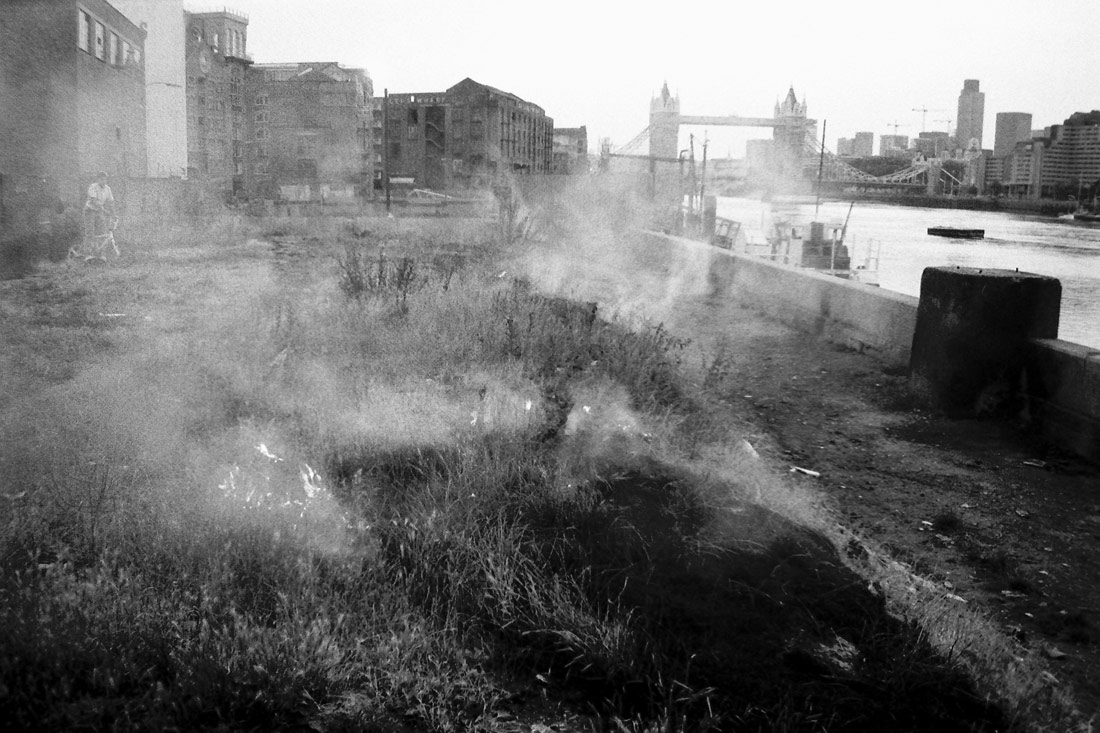
© Bill Pearson 1982/85
Late August ’87 by Stephen Watts:
Saturday. Afternoon.
Thunder on the Greenland Dock.
A few kids. Wet sand. Fishing.
All of us feel the vatic lack.
Girders. Cranes. New roads.
Bright sciatic colours. Cans.
Concrete. Cables. Coiled wire.
Flesh still curt to our bone.
Autumn thunder on the Greenland
Dock. Suddenly – houses rearing up.
That pall of human indifference.
Heart of the heart ripped out.
Yellow air. Pipes of cloud.
A sky that’s been lifted from Bihar.
Houses with archways of walled wood.
Our lives. A crushed heat of air.
Cranes. Wet sand. Girders.
The kids laugh. And then scatter.
Dear body. The poor in their lack.
The rich in their whorl of languor.
© Stephen Watts
Bill Pearson writes:
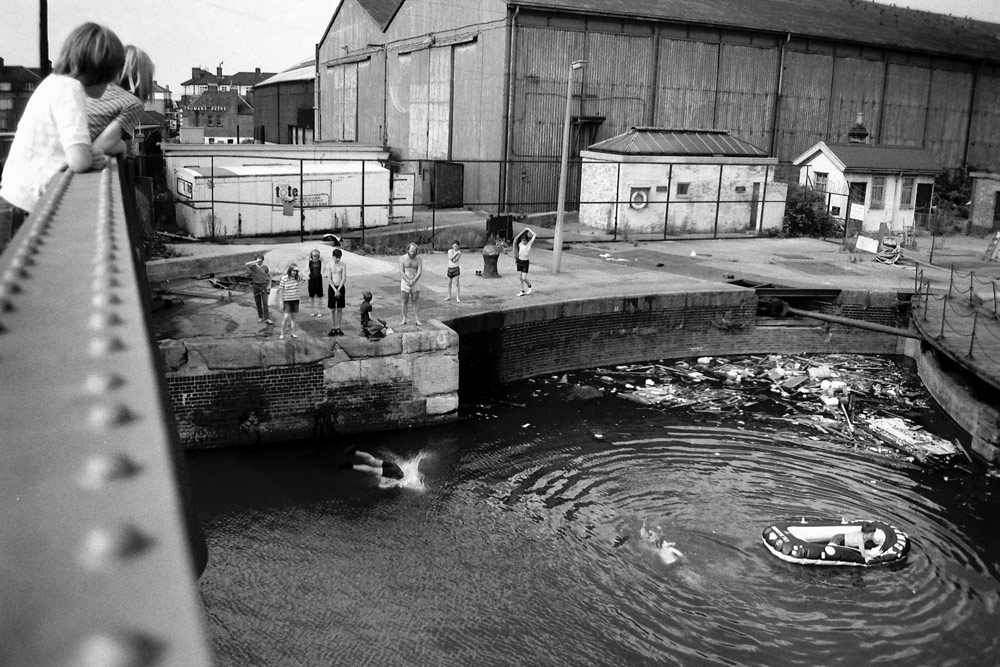
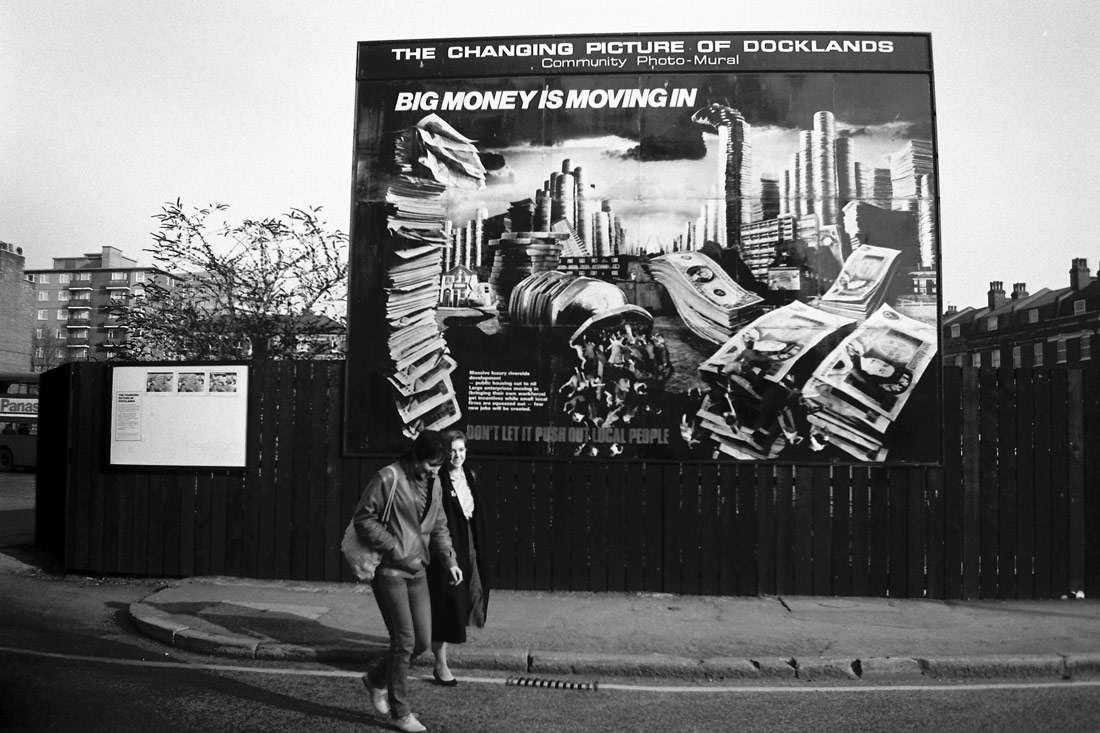
I moved to New Cross Gate over the Easter weekend, 1981. My only previous experience of living in the big city had been a few years at Kingston upon Thames, very different in all respects to inner city south-east London. Exploring the new area I discovered empty, desolate docks and rundown industrial areas that reminded me of my homeland in the North of England. It was the early days of Thatcherism, before the Falklands War, before the inner city riots, and before the Miners’ Strike, when Thatcher was still the most unpopular Prime Minister there had ever been.

© Bill Pearson 1982/85
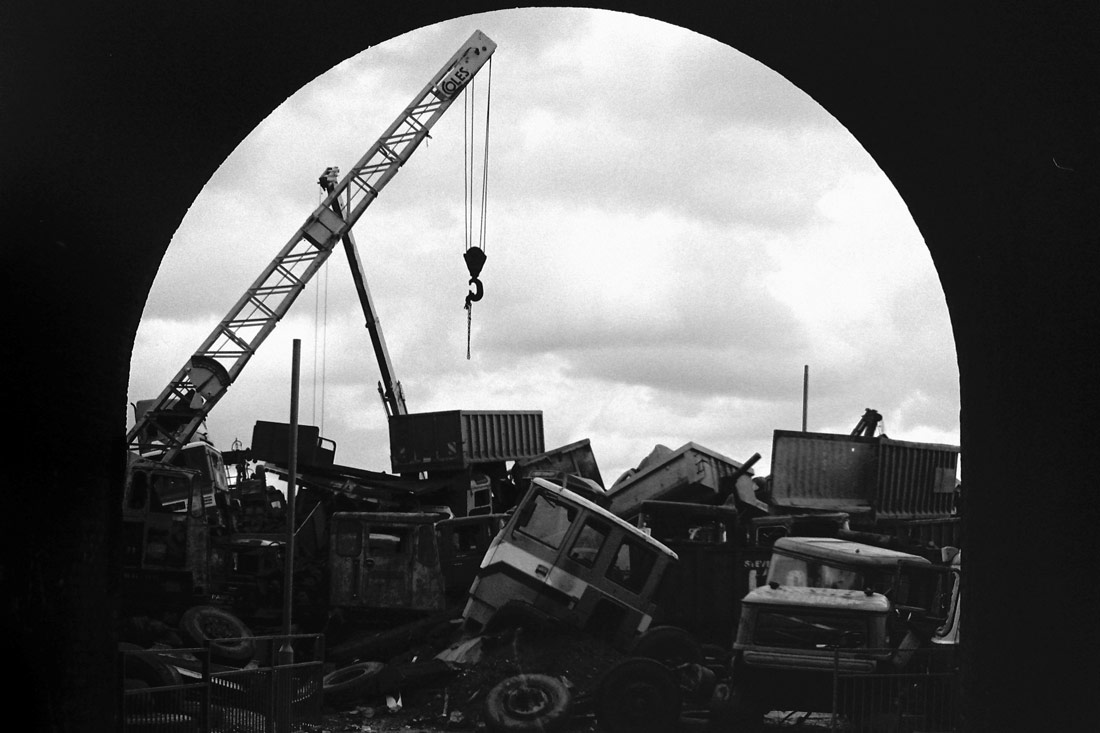
My local Desolation Row was Surrey Docks – re-generated as Surrey Quays – but on walking and cycling trips I discovered the run down warehouses of Shad Thames (which still smelled of the spices they had once stored), Limehouse Basin, Wapping and the Isle of Dogs, which looked like a war zone. I remember rummaging around a warehouse in Wapping one day and hearing a roaring noise on the floor below. I rushed along to see what it was and discovered that the place had been set on fire by some local kids.
© Bill Pearson 1982/85
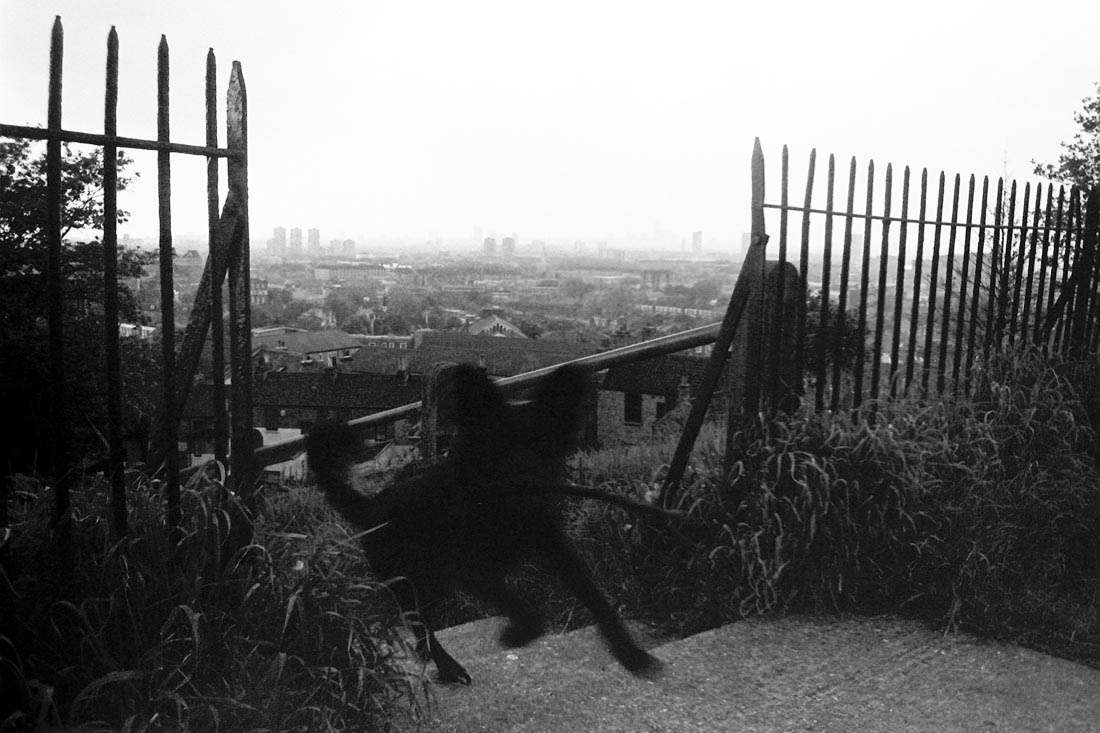
The absent other in all of these photographs was Mr. Charles Fox. A Battersea Dogs Home graduate, selected for his fetching smile, his hairy ears and his endearing determination to escape from the Home by digging through the concrete floor. His name was chosen because nobody in our shared house was prepared to have the utility bills under their names, so Charlie the dog ended up taking responsibility for everything. He never seemed to mind. At the Post Office I would occasionally be asked, “are you Mr Fox?” – and when people from the utilities phoned up wanting to speak to Mr Fox and we would invariably say “He’s unable to speak at the moment”.
© Bill Pearson 1982/85
Charlie and myself covered a lot of miles on our walks. Sometimes I would carry my Canon AE1 and sometimes I would take my Bolex movie camera and sometimes I wouldn’t take either because I couldn’t afford any film. On these urban forays, I often encountered a fellow rambler who turned out to be another newcomer to south-east London, a political exile from Soweto who had wound up living on the Pepys Estate in Deptford. Not that I knew this at the time: I only learned the identity of Chief Dawethi a quarter-century later, when Chief and I found ourselves sharing an office. Sharing our reminiscences of living in south-east London in the early 1980s, we discovered that we were the ghosts on each other’s travels. I mentioned that I took a lot of photographs back then, and it was Chief’s suggestion that people might be interested in those images, as the area had since changed beyond recognition. Chief’s insight encouraged me to dig out the negatives and study them with fresh eyes.

© Bill Pearson 1982/85
Looking at them now, they appear as remnants of a lost world. ‘There is nothing more recent than the distant past’. It seemed unthinkable in the early 1980s that the purlieus of east London could ever become desirable, let alone exclusive. Yet the areas seen in these pictures is today the playground of those who profited from the sale of England; those inhabitants of the soulless apartments that are ruining the London skyline. Even Chief’s old stamping ground, the Pepys Estate, is home to Aragon Tower, one of the most up-scale of all gentrification projects, a block of high-rise council flats sold off and transformed into luxury riverside dwellings for the few that can afford them.
© Bill Pearson 1982/85
What of Mr Charles Fox? He moved away to York with one of my housemates. We reasoned that he would have a much better life there than on the mean streets of south-east London. I saw him a few times after he moved and he seemed far happier in the North.
Text © Bill Pearson 2013.
© Bill Pearson 1982/85
Heart Of The City by Stephen Watts:
Grey sky. Fifteen cranes swing
between the road and the river.
A darkened ribcage of girders is
Fleshed out with granite slivers.
Slow bursts of cars stream past
and lead rises up to our rooftops.
It eats the aortas of our babies.
Wee kids who spiral at hopscotch.
We have savage material hearts.
Mine hangs just under my shoulder.
There are reds, yellows and ochres
if I think of colour in some order.
It hangs and pumps at my ribcage
as if a blue bag were slung there.
Full with wet fish & blae-berries.
Words – jump off my tongue here.
It is good to dream as dreaming
makes lucid our human potential …
The spiral of blood in our bodies.
Just where it pumps by my nipple.
Sunflowers. Asters. Fuchsia.
Whatever their colours they seem
held by tight and straitened stalks.
The sun will crash from its beam.
Too close to the savaged heart.
We live in the heart of this city.
Cranes that swing out on the dark
measure our hearts without pity.
© Stephen Watts.


 The London Column