The March.
Posted: June 24, 2015 Filed under: Events | Tags: anti-austerity march, austerity, People's Assembly, people's right to protest, The Strand Comments Off on The March.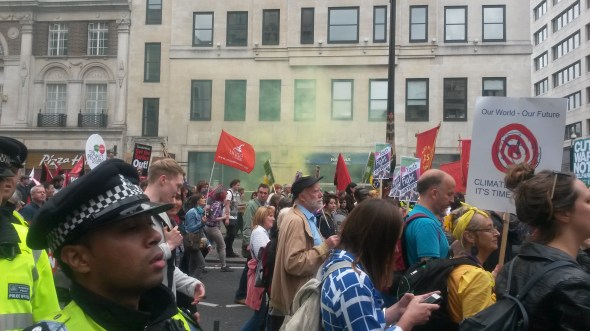
Katy Evans-Bush:
So, a few of us went for a walk the other day. The London Column was there, though we have not exactly been infused with alacrity in putting our pictures up. But we were a bit tired, the day after the march. It had all been rather emotional.
If this seems overblown, consider why we were marching, and who the marchers were. They were our fellow countrymen, women, and children. Many of them were elderly, walking with sticks, and many, many were in wheelchairs. They were marching for their lives, for our lives, for our NHS and schools, for our libraries and jobs.

In the time-honoured tradition, England became – if just for the day – a populace. The crowd filled both sides of the Strand, a street the London Column has always had a soft spot for, and took almost two hours to walk past, singing and blowing horns and chanting and laughing and dealing with their kids. That’s five miles of people.
And what people. They poured in from all over the country. They carried People’s Assembly signs, and banners from everywhere you can think of: Rotherham, Newcastle, Devon, Surrey, the Midlands; from the Trades Council of the Cities of London and Westminster. They came from Wales. The Rhyl Youth Group was there. They were Feminists Against Austerity. Deaf People Against the Cuts. Economists Against Austerity. Musicians, mothers, teachers, retired university professors, the Indian Workers’ Association. The Fire Brigades Union drove a fire engine blaring out eighties hits, and people were literally dancing in the street in front of it as it went past. No one who remembers the men weeping as they were forced out of Clerkenwell Fire Station for the last time could fail to find this joyfulness particularly moving.


in fact, the people, this populace, showed the qualities England is so noted for – all except perhaps shopkeeping, although in truth London was full of tourists and other consumers who were just out shopping; we don’t know what their problem is, but we support their right to it. The real business of the country that day was right here.


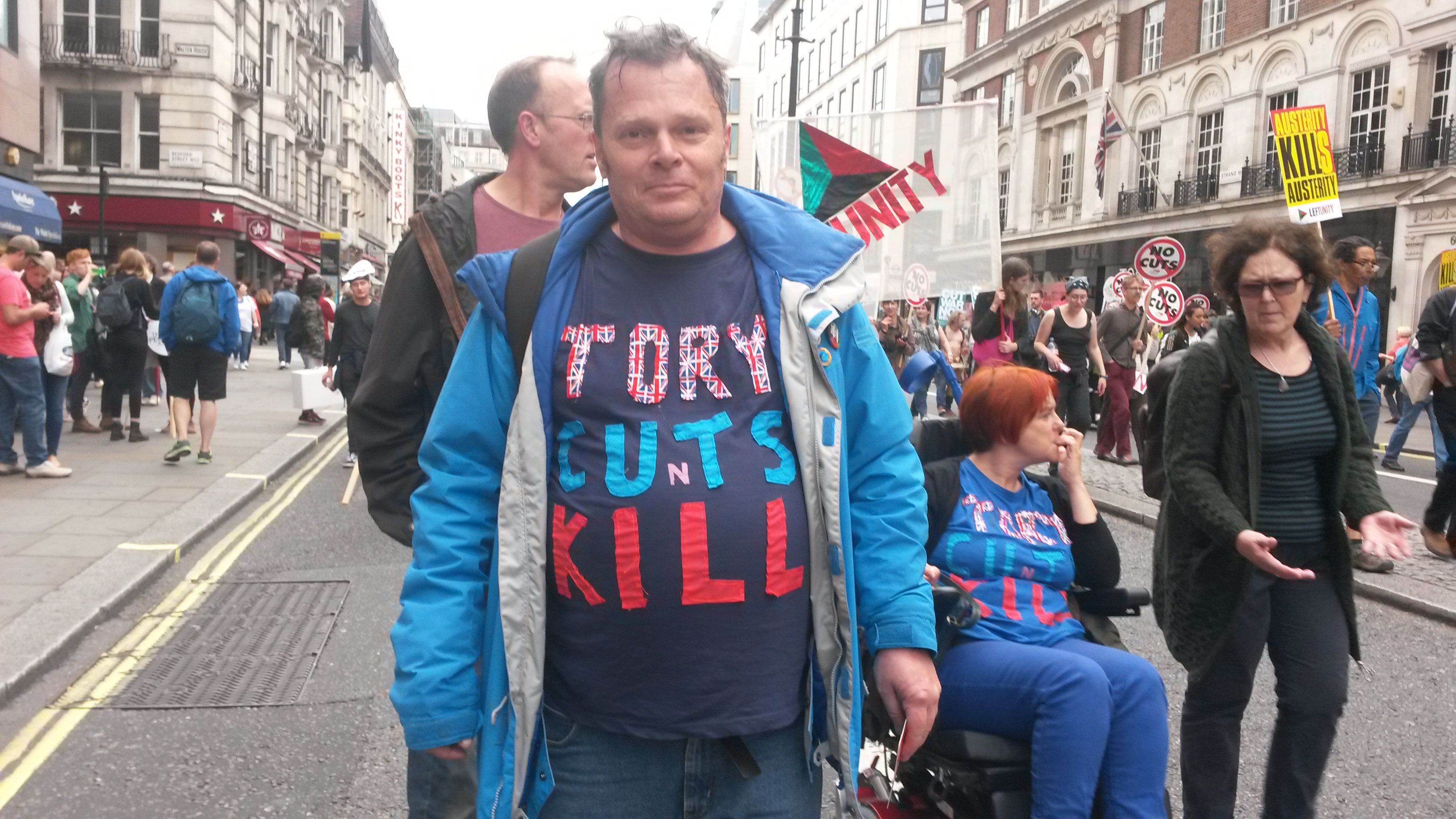


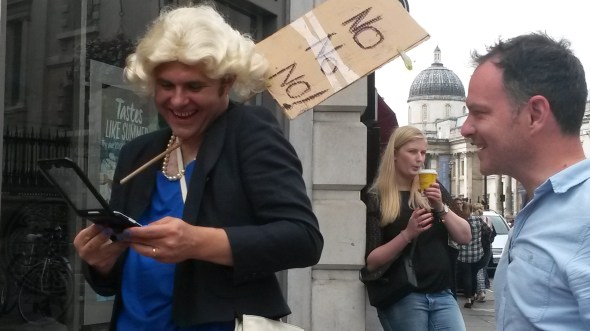
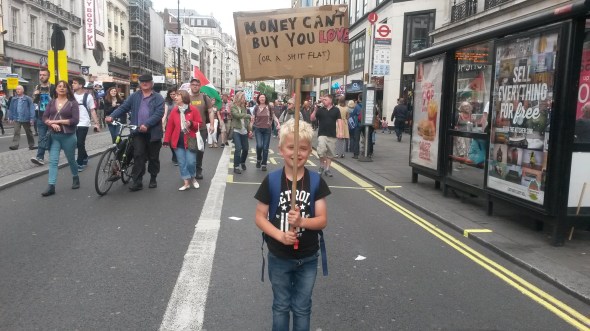
This populace was noisy, cheerful, vulgar. They were ribald and profane, they were angry, they were proud, they were together in solidarity. They were in solidarity with the political prisoners in Egypt, and with Greece (‘Give Greece a chance’). They showed scant respect for those who do not respect them (‘Cameron is a cock’). They were peaceful. They were well-informed, good-humoured, witty. And they were funny: slogans referenced Monty Python, Father Ted, Marx (“I warned you this would happen’). They were exuberant. Some had dressed up, some had dressed down, some had cross-dressed. They were beaten but not bowed, and definitely not defeated. And they knew the government wasn’t going to listen to them, and they came together and engaged in their democratic right to assemble in protest anyway.
The London Column fell in love with them all, every one.
 All photos © Katy Evans-Bush, 2015
New River Network.
Posted: May 1, 2015 Filed under: Architectural, Interiors, London Places, Performers, The Thames and its Tributaries | Tags: Alan Cox, Caroline Lennon, Christopher Brand, Dallas Campbell, Eliot Levey, Jack Tarlton, Liam McKenna, Network, Peter Finch, Riverhead, Russell Layton, Sir John Greene's Oak Room Comments Off on New River Network. Boardroom. Photo © Katherine Grice 2015.
Katy Evans-Bush:
Remember that old 70s movie, Network? It’s mainly famous for its catchphrase – ‘I’m as mad as hell and I’m not going to take it any more!’ – and for Peter Finch’s bravura performance (which earned him a posthumous Oscar) as Howard Beale, the newscaster who has a meltdown on television and gets the whole country saying it. On Saturday night I went to a private reading of a stage adaptation of the film, scripted by my friend Chris Brand (a fine actor as well as a writer) and produced by another friend, Peter Finch’s nephew Dallas Campbell. There are several reasons why it was a brilliant evening, and the first of them – before the evening even began – was the surprise of the surroundings.
We were in the old Water Board building in Rosebery Avenue in Clerkenwell. This sounds boring enough, and indeed we had only been told it was going to be in a ‘board room’. But this is grand municipal architecture, and this particular example harbours a secret at its heart.
The Water Board building was built on the site of a previous water company building – the old New River Company building, Water House. The New River is the river you can see a bit of, running through Clissold Park in Stoke Newington; it’s technically more of a canal; built by one Hugh Myddleton to bring water from Hertfordshire to a rapidly growing London. It was completed in 1613. Water House, built in the same year, was originally a ‘cestern house’ adjoining the reservoir, and included accommodation for the site manager.Many people had use of its residential accommodation (including Edward Sadler, who was also probably the founder of next-door Sadler’s Wells). This building grew over the decades to reflect the massive success of the New River company (King James, a key funder, lost money on it, and Hugh Myddelton was created a baronet). It grew larger and larger, and more and more respectable until finally it was a large house. In about 1693, one Sir John Grene, a wealthy shareholder of the New River Company, was living in Water house, and he commissioned an ornately carved set of pannelling for a room that became known as the Oak Room… You can read a long and intensely interesting account on British History Online.
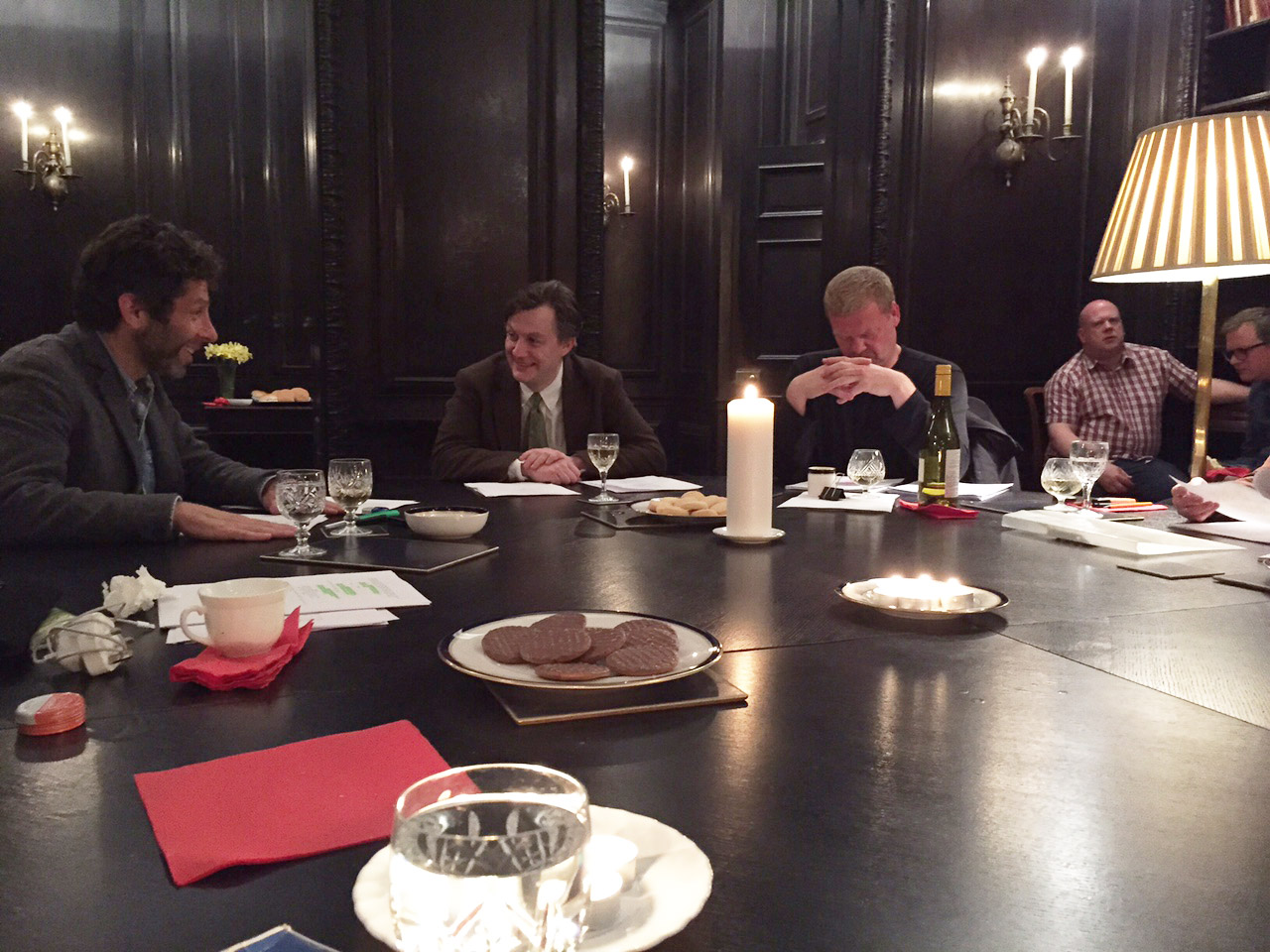 Network cast, L-R: Eliot Levey, Alan Cox, Liam McKenna. Photo © Katherine Grice 2015.
In 1914, London’s water was municipalised and Water House had to go. Work on the new Water Board building began in 1915 – stopping between 1916 and 1919 due to the War – and the building, on a scale commensurate with the ambition of its civic status, was finished in 1920. For the past twenty years it’s been flats. When you walk in through its large stone-clad entrance, it feels plausibly Edwardian – but then the first thing you are confronted with is a grand, glorious, light-filled, pink-painted Art Deco ballroom. (This, however, is the former Rental Ledger Room, and used to host ranks of large oak desks.) The building is awash with light.
Turn left and through large glass doors to a wide, high, sweeping staircase with huge windows. At the top, back through the doors, turn down a little corridor, open another door, and you are suddenly in a rather unexpected time-warp: an oak-carved antechamber, which is the mirror of another oak antechamber, at the two ends of a dark, oak-panelled room. A marble fireplace looms in the middle of the long wall, with bookshelves in the alcoves on the sides, and intricate carvings above. Pride of place belongs to a magnificent lion and unicorn panel, where the unicorn’s horn stands free of the carving.
This is Sir John Grene’s Oak Room – given new ceiling joists in the 1860s, and then carefully dismantled and reassembled in the new Water Board building – a nod to the history of the site. The room was dismantled again in the War and the panelling taken away for safe-keeping, but the ceiling could not be moved again and the central painting had to be restored again after the War. The room is very dark – it makes more sense when you know that in its day it had glorious windows on three sides, giving panoramic views over the Round Pond that was the New River reservoir, and its filter beds. It was even open to the public.
 L-R: Liam McKenna, Fliss Walton, Jack Tarlton. Photo © Katherine Grice 2015.
Accommodations had to be made when it was transplanted into the new building; in one corner we found a door which, opened, revealed only brick. It was on the outside wall of the building. It’s been not-a-door for almost a century, but for two and a half centuries before that, it was a door and people walked through it. And the doorways into the antechambers – two on each end of the room, with a central panel – will have been its other windows.
You could write a whole blog post just about the notion of civic pride and historical awareness, the respect for the past and sense of beauty and historical decency that made a company spend £2,000, back when that was proper money, to keep this in situ. Nowadays, they would more likely put it on display in an airlocked vault under perspex.
In the middle of the room is a giant black oval table. When we were there it was littered with scripts, plates of chocolate biscuits, and numerous large white candles. The room has electric light, too, of course, but the three-dimensional black walls seem to just absorb it. Those three walls of windows have been a bit of a loss, in fact.
So there we were. Friends on chairs around the walls of the room, with glasses of wine or gin & tonics. Around the table sat the actors. And the reading, in due course, began…
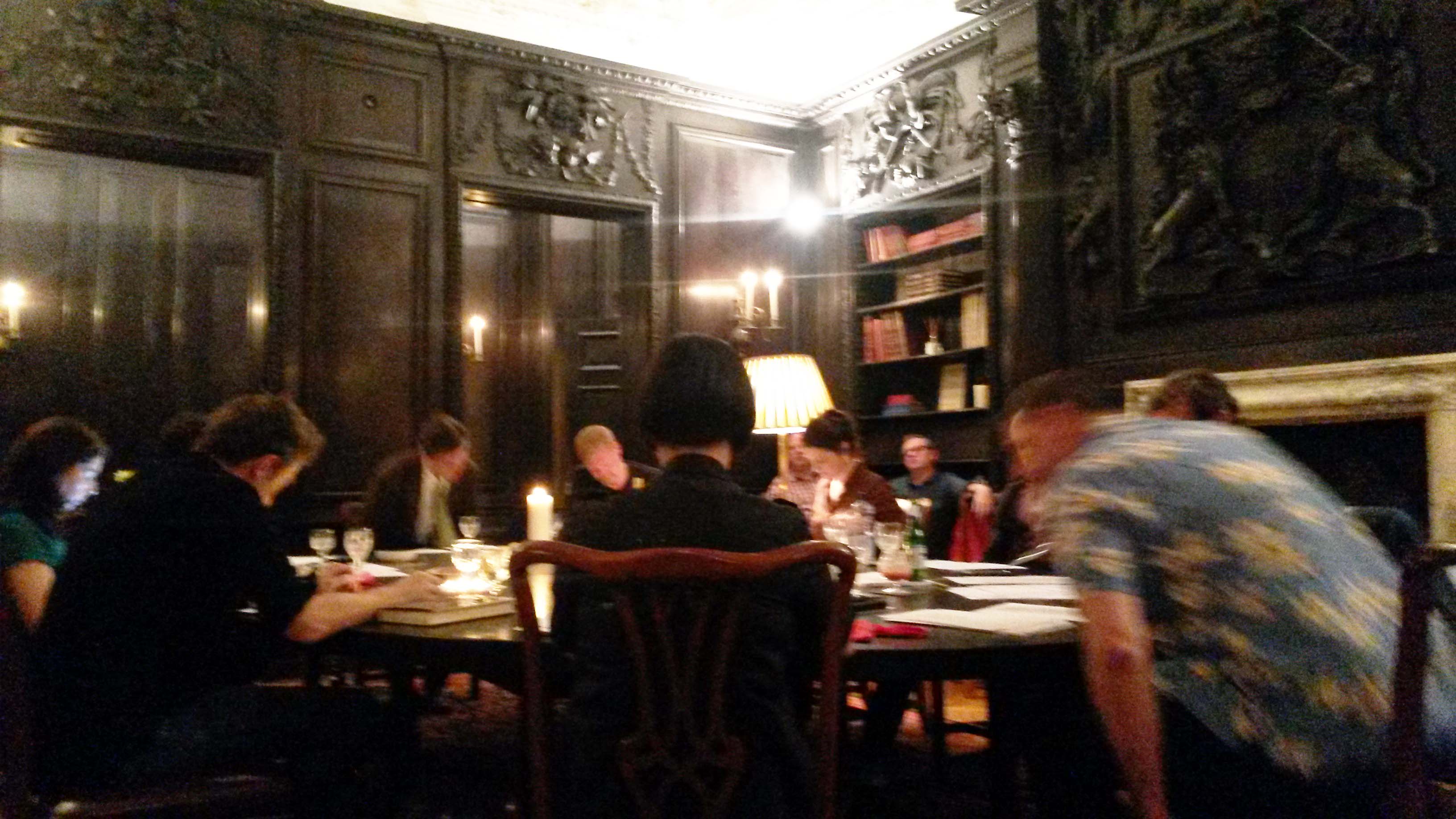 Rest of the Network cast: Caroline Lennon, Dallas Campbell, Saffron Sprackling, Christopher Brand, Russell Layton. Photo © Katy Evans Bush.
(See more here … )
Estates of Mind.
Posted: April 20, 2015 Filed under: Architectural, Class, Hospitals, The Thames, Vanishings | Tags: Isle of Dogs, Michael Mulcahy, Mike Seaborne, Samuda Estate, St John's Estate, Tarling Estate, Transition Group 3 Comments Tarling Estate, 2002. © Mike Seaborne.
Tarling Estate, Shadwell:
Located immediately to the east of Watney Street Market, Shadwell, the Tarling Estate was built c. 1950 to replace overcrowded slums and reduce the population density by half.
The run-down estate was demolished in 2003 and replaced by a higher density mixed-use development intended to both regenerate the area and create what the developer, Toynbee Housing Association, described as ‘a more mixed and balanced community’.
 Tarling Estate 2015. © Mike Seaborne.
Samuda Estate, Isle of Dogs:
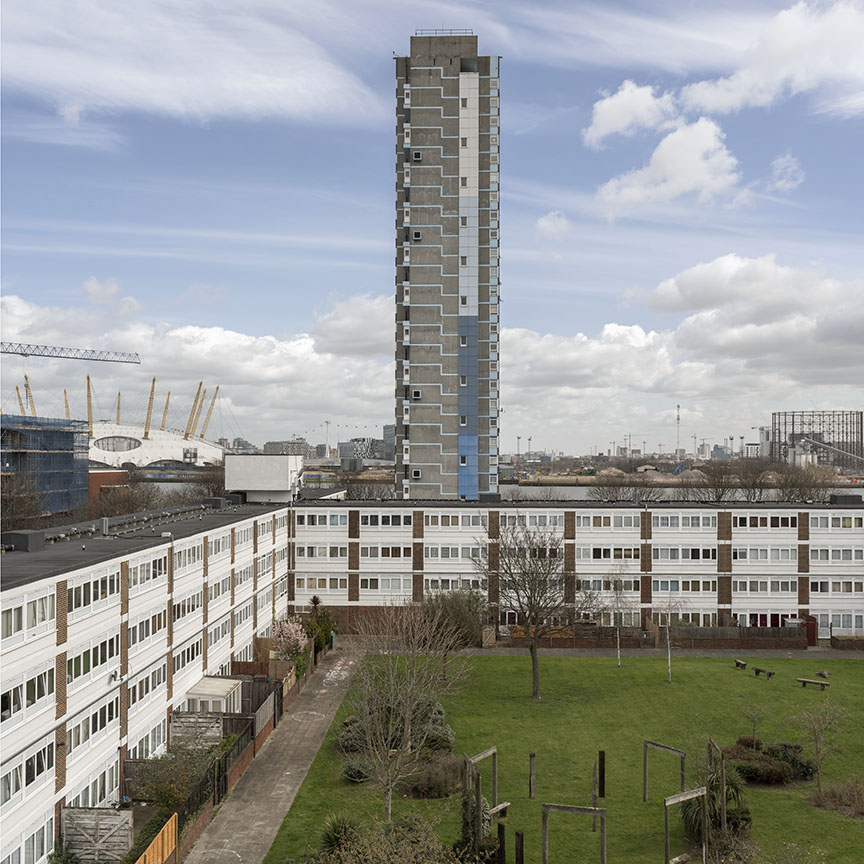 Samuda Estate 2015. © Mike Seaborne.
The Samuda Estate, completed by the Greater London Council in 1967, is mainly comprised of four and six story blocks arranged around a traffic-free square. There is also a 25-storey tower block of maisonettes – Kelson House – situated on a prime site by the river. The estate is in need of refurbishment and some residents believe that the estate’s owner, One Housing Group, are deliberately running it down so it can be demolished to make way for private housing.
St John’s Estate, Isle of Dogs:
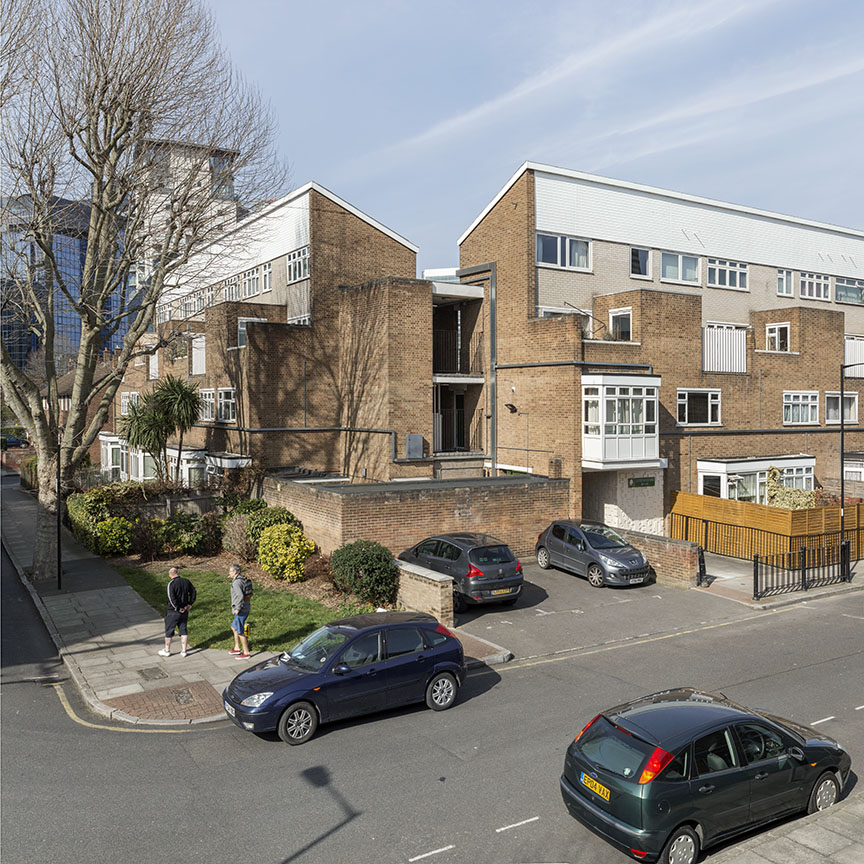 St John’s Estate 2015. © Mike Seaborne.
Planned in 1952 by Poplar Borough Council and described by John Betjeman as ‘one of the best post-war housing estates I have seen’, St John’s Estate was intended as a new self-contained neighbourhood along the lines of the award-winning Lansbury Estate in Poplar. In this it has largely succeeded but One Housing Group, owner of this and three other estates on the island, are considering the possibility of demolition and replacement by new high-density housing which might include several tower blocks of 50+ storeys.
Kingsbridge Estate, Isle of Dogs:
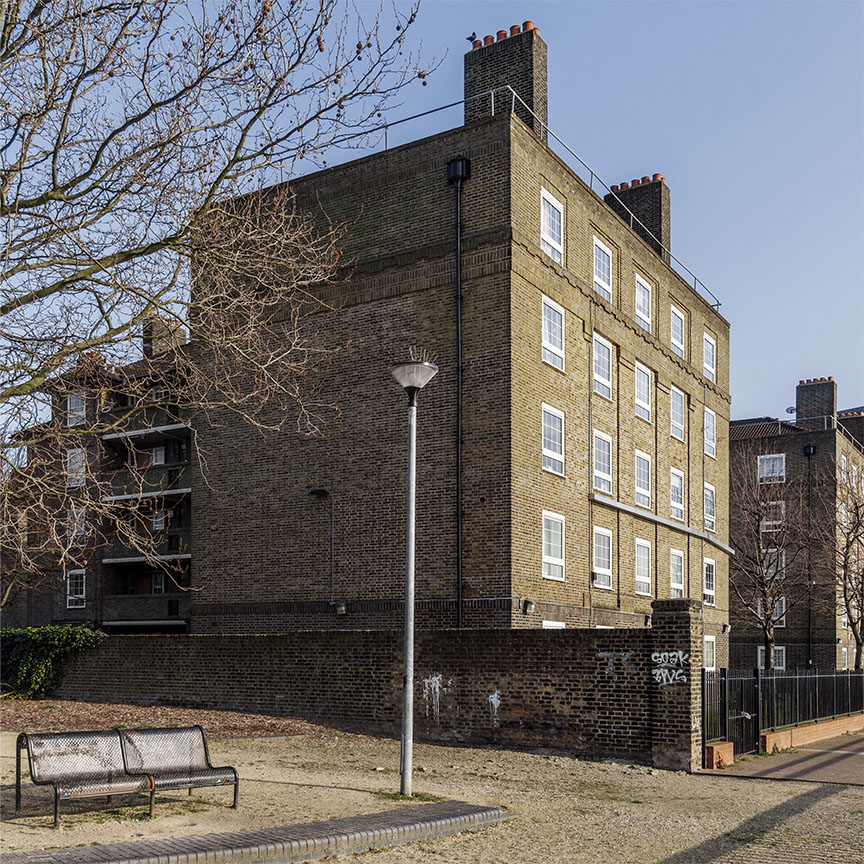 Kingsbridge Estate, 2015. © Mike Seaborne.
Originally known as the Millwall Estate, Kingsbridge was built by the London County Council in 1936-7, with an additional block being added in 1958-60. Despite their age, the blocks are structurally sound and are liked by many of the residents. However, their riverside location means that the value of the land they occupy is very high. The estate’s owner, One Housing Group, is currently consulting on ideas for the future, which may involve replacing the blocks with new housing for private sale.
Photos and text by Mike Seaborne, taken from Estates of Mind, photographs documenting 20th Century social housing by the Transition Group. Twitter feed: @TransitionLDN #TransitionProject. The pictures below are by Michael Mulcahy. Thanks to Mike and Michael.
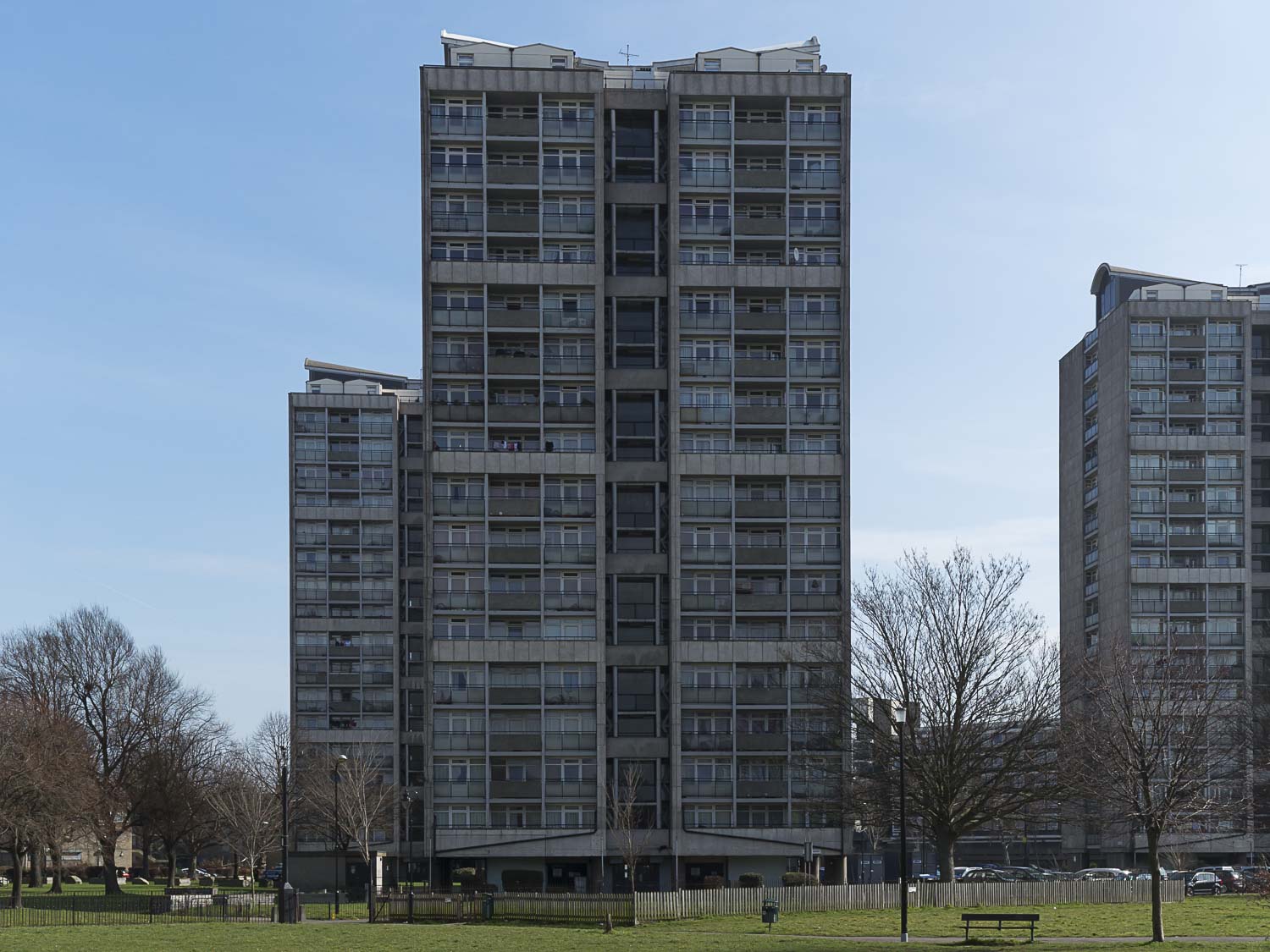 Brandon Estate, Kennington. © Michael Mulcahy.
 Lansbury Estate, Poplar. © Michael Mulcahy.
 Lansbury Estate, Isle of Dogs behind. © Michael Mulcahy.
See also: Balfron Remembered, Balfronism, Robin Hood Gardens, Two Men And A Dog, Pepys Estate.
When Boulez met the Womble.
Posted: March 23, 2015 Filed under: Architectural, London Music | Tags: Arnold Schoenberg, Chris Morris, Chris Spedding, Gurrelieder, Mike Batt, Pierre Boulez, Pierre Boulez dead, Remember you're a Womble, The Wombles, Yvonne Minton Comments Off on When Boulez met the Womble.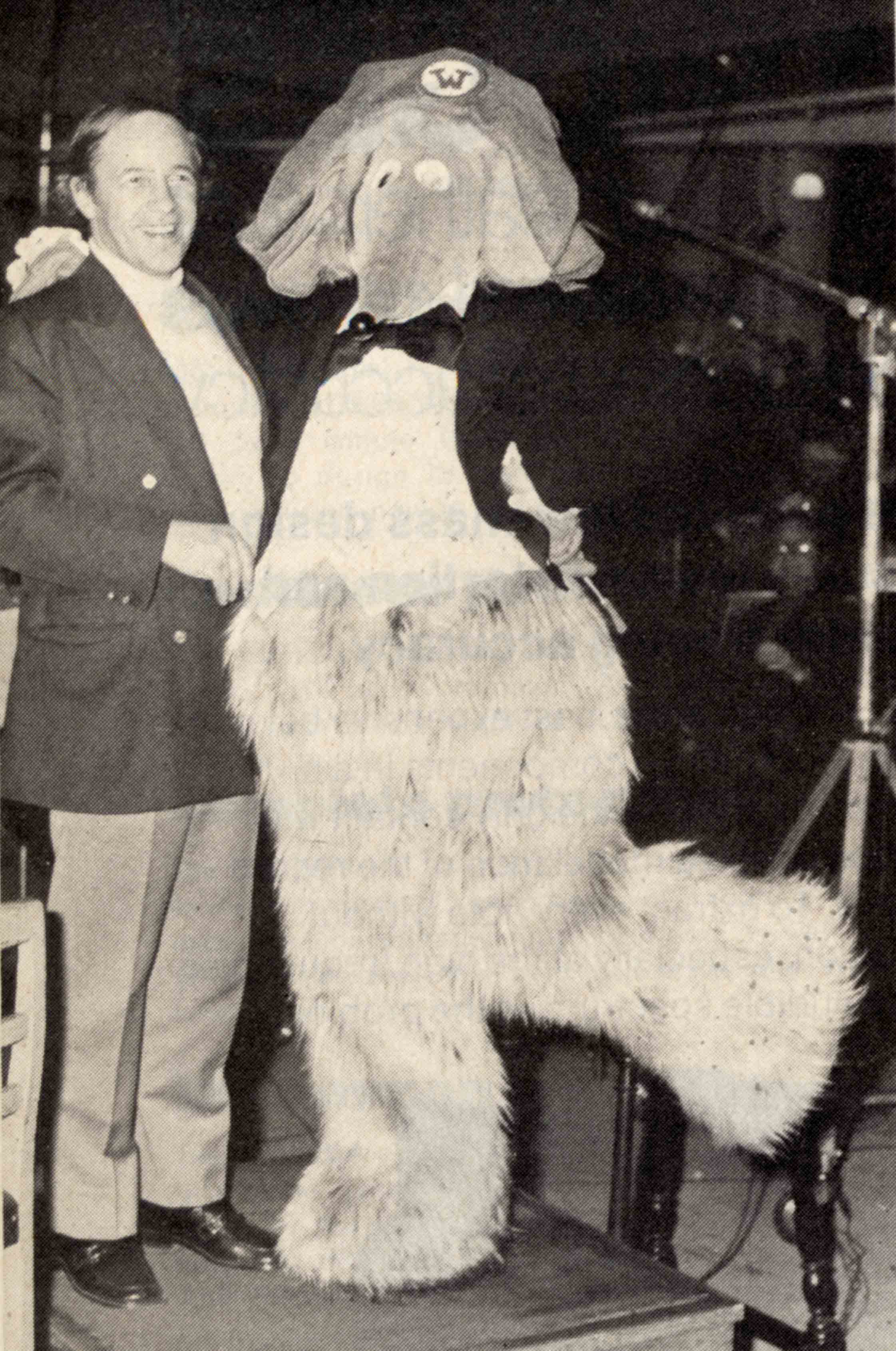
Boulez and Womble, West Ham Central Mission, 1975. Photographer unknown.
Edward Greenfield, writing in High Fidelity and Musical America, March 1975:
The Wombles, in their Disney-esque costumes, are an enormous success on television with children of all ages, and their signature tune was an enormous pop hit for CBS. Needless to say, Boulez had never heard of the Wombles but with a patience rarely given to such formidably intense artists, he willingly joined in the joke.
These photos from High Fidelity form part of a report on the recording of two monumental Schoenberg works by the BBC Symphony Orchestra under Pierre Boulez. The recordings, for CBS – now Sony – were made in West Ham Central Mission – now the Memorial Community Church, Plaistow – which enjoyed a brief spell as a recording venue for orchestral music in the 1970s, until the interior of the building was altered and its spacious acoustic properties lost for good. Boulez was there to record Schoenberg’s Gurrelieder and Moses und Aron.

Someone at CBS thought it was a good idea to send a Womble along to hug Boulez for a photo, and thus Orinoco (or is it Great Uncle Bulgaria?) greets the composer of Le Marteau sans Maitre. Just as one doesn’t expect to see Michel Foucault cosying up to Roland Rat, or Gore Vidal doing a turn on The Basil Brush Show, the sight of Boulez in such company is slightly disturbing. Apart from the CBS connection, Boulez happened to be chief conductor of the BBC Symphony Orchestra at the time, and The Wombles were being relentlessly plugged by the BBC as a sort of corporate emblem; hence, the photo is a souvenir of a poorly thought-out PR opportunity, as well as a reminder of the mysterious reach of the Wombles and their co-creator Mike Batt. Inside one of the Womble suits was Chris Spedding, a virtuoso rock guitarist who was once (allegedly) considered as Mick Taylor’s replacement in The Rolling Stones, and who went on to produce records for The Sex Pistols; one would like to think that it is Spedding himself who is Wombling next to Boulez on the podium, but it probably isn’t. Apart from The Wombles, Batt also gave the world Bright Eyes, produced the likes of Steeleye Span and Cliff Richard, was sued by the estate of Boulez’s one-time friend John Cage for a joke at the expense of 4’33”, and who – in the imagination of Chris Morris – co-wrote the musical Sutcliffe!. Ultimately, however, he is bound to be remembered for this …
Anyway, Pierre Boulez turns 90 this week, so this is The London Column’s opportunity to offer the maestro a modest tribute. Your correspondent was a regular at Boulez’s concerts in London in the 80s and 90s; he represented a personal link to Stravinsky, Varese and the post-war avant-garde, and in today’s denuded cultural landscape it is hard to see who will ever replace him. Here is Yvonne Minton singing the Song of the Wood Dove from Boulez’s magnificent recording of Gurrelieder, the same one he was working on when Batt’s creature showed up. D.S.


 The London Column