New River Network.
Posted: May 1, 2015 Filed under: Architectural, Interiors, London Places, Performers, The Thames and its Tributaries | Tags: Alan Cox, Caroline Lennon, Christopher Brand, Dallas Campbell, Eliot Levey, Jack Tarlton, Liam McKenna, Network, Peter Finch, Riverhead, Russell Layton, Sir John Greene's Oak Room Comments Off on New River Network. Boardroom. Photo © Katherine Grice 2015.
Katy Evans-Bush:
Remember that old 70s movie, Network? It’s mainly famous for its catchphrase – ‘I’m as mad as hell and I’m not going to take it any more!’ – and for Peter Finch’s bravura performance (which earned him a posthumous Oscar) as Howard Beale, the newscaster who has a meltdown on television and gets the whole country saying it. On Saturday night I went to a private reading of a stage adaptation of the film, scripted by my friend Chris Brand (a fine actor as well as a writer) and produced by another friend, Peter Finch’s nephew Dallas Campbell. There are several reasons why it was a brilliant evening, and the first of them – before the evening even began – was the surprise of the surroundings.
We were in the old Water Board building in Rosebery Avenue in Clerkenwell. This sounds boring enough, and indeed we had only been told it was going to be in a ‘board room’. But this is grand municipal architecture, and this particular example harbours a secret at its heart.
The Water Board building was built on the site of a previous water company building – the old New River Company building, Water House. The New River is the river you can see a bit of, running through Clissold Park in Stoke Newington; it’s technically more of a canal; built by one Hugh Myddleton to bring water from Hertfordshire to a rapidly growing London. It was completed in 1613. Water House, built in the same year, was originally a ‘cestern house’ adjoining the reservoir, and included accommodation for the site manager.Many people had use of its residential accommodation (including Edward Sadler, who was also probably the founder of next-door Sadler’s Wells). This building grew over the decades to reflect the massive success of the New River company (King James, a key funder, lost money on it, and Hugh Myddelton was created a baronet). It grew larger and larger, and more and more respectable until finally it was a large house. In about 1693, one Sir John Grene, a wealthy shareholder of the New River Company, was living in Water house, and he commissioned an ornately carved set of pannelling for a room that became known as the Oak Room… You can read a long and intensely interesting account on British History Online.
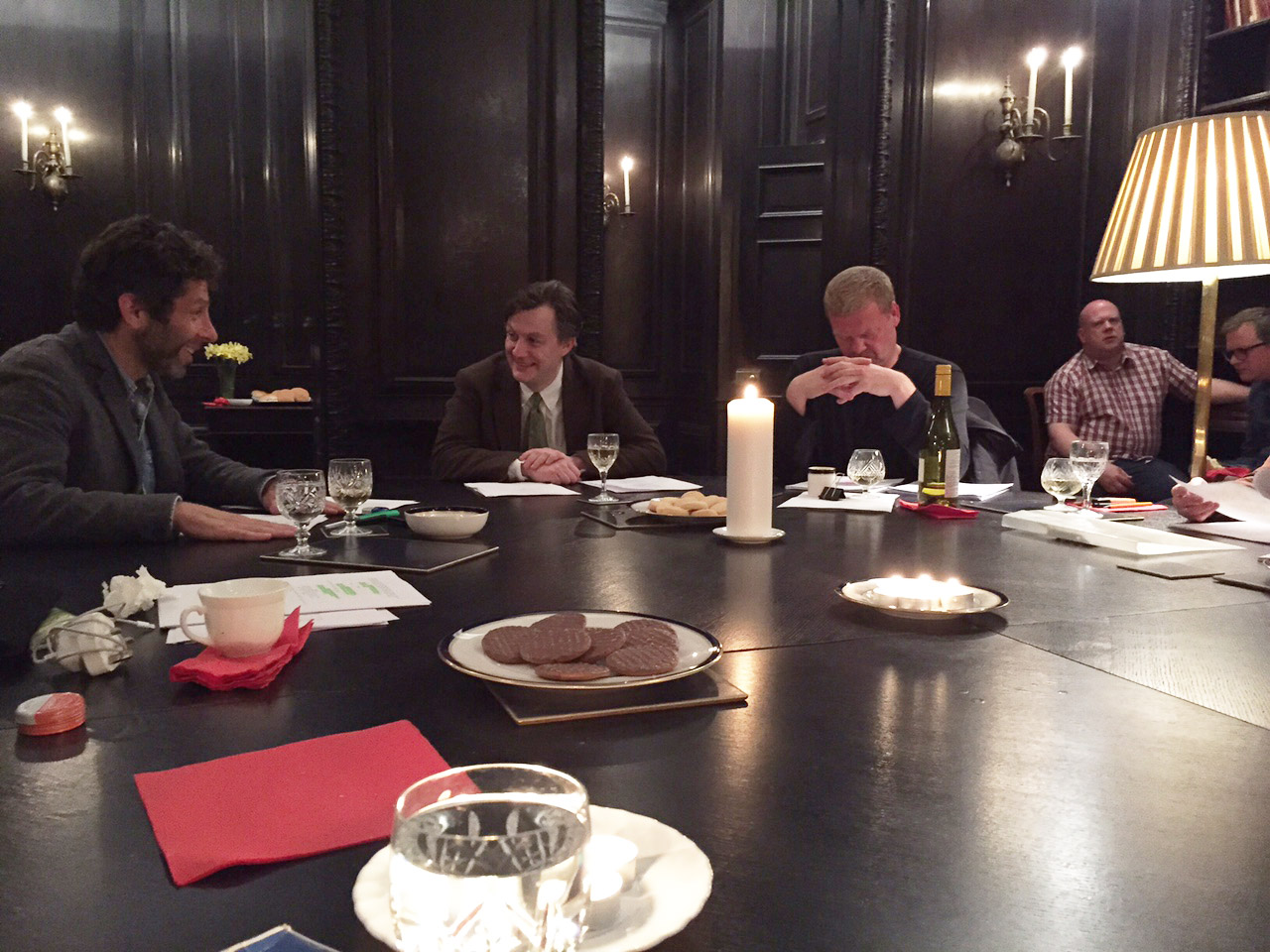 Network cast, L-R: Eliot Levey, Alan Cox, Liam McKenna. Photo © Katherine Grice 2015.
In 1914, London’s water was municipalised and Water House had to go. Work on the new Water Board building began in 1915 – stopping between 1916 and 1919 due to the War – and the building, on a scale commensurate with the ambition of its civic status, was finished in 1920. For the past twenty years it’s been flats. When you walk in through its large stone-clad entrance, it feels plausibly Edwardian – but then the first thing you are confronted with is a grand, glorious, light-filled, pink-painted Art Deco ballroom. (This, however, is the former Rental Ledger Room, and used to host ranks of large oak desks.) The building is awash with light.
Turn left and through large glass doors to a wide, high, sweeping staircase with huge windows. At the top, back through the doors, turn down a little corridor, open another door, and you are suddenly in a rather unexpected time-warp: an oak-carved antechamber, which is the mirror of another oak antechamber, at the two ends of a dark, oak-panelled room. A marble fireplace looms in the middle of the long wall, with bookshelves in the alcoves on the sides, and intricate carvings above. Pride of place belongs to a magnificent lion and unicorn panel, where the unicorn’s horn stands free of the carving.
This is Sir John Grene’s Oak Room – given new ceiling joists in the 1860s, and then carefully dismantled and reassembled in the new Water Board building – a nod to the history of the site. The room was dismantled again in the War and the panelling taken away for safe-keeping, but the ceiling could not be moved again and the central painting had to be restored again after the War. The room is very dark – it makes more sense when you know that in its day it had glorious windows on three sides, giving panoramic views over the Round Pond that was the New River reservoir, and its filter beds. It was even open to the public.
 L-R: Liam McKenna, Fliss Walton, Jack Tarlton. Photo © Katherine Grice 2015.
Accommodations had to be made when it was transplanted into the new building; in one corner we found a door which, opened, revealed only brick. It was on the outside wall of the building. It’s been not-a-door for almost a century, but for two and a half centuries before that, it was a door and people walked through it. And the doorways into the antechambers – two on each end of the room, with a central panel – will have been its other windows.
You could write a whole blog post just about the notion of civic pride and historical awareness, the respect for the past and sense of beauty and historical decency that made a company spend £2,000, back when that was proper money, to keep this in situ. Nowadays, they would more likely put it on display in an airlocked vault under perspex.
In the middle of the room is a giant black oval table. When we were there it was littered with scripts, plates of chocolate biscuits, and numerous large white candles. The room has electric light, too, of course, but the three-dimensional black walls seem to just absorb it. Those three walls of windows have been a bit of a loss, in fact.
So there we were. Friends on chairs around the walls of the room, with glasses of wine or gin & tonics. Around the table sat the actors. And the reading, in due course, began…
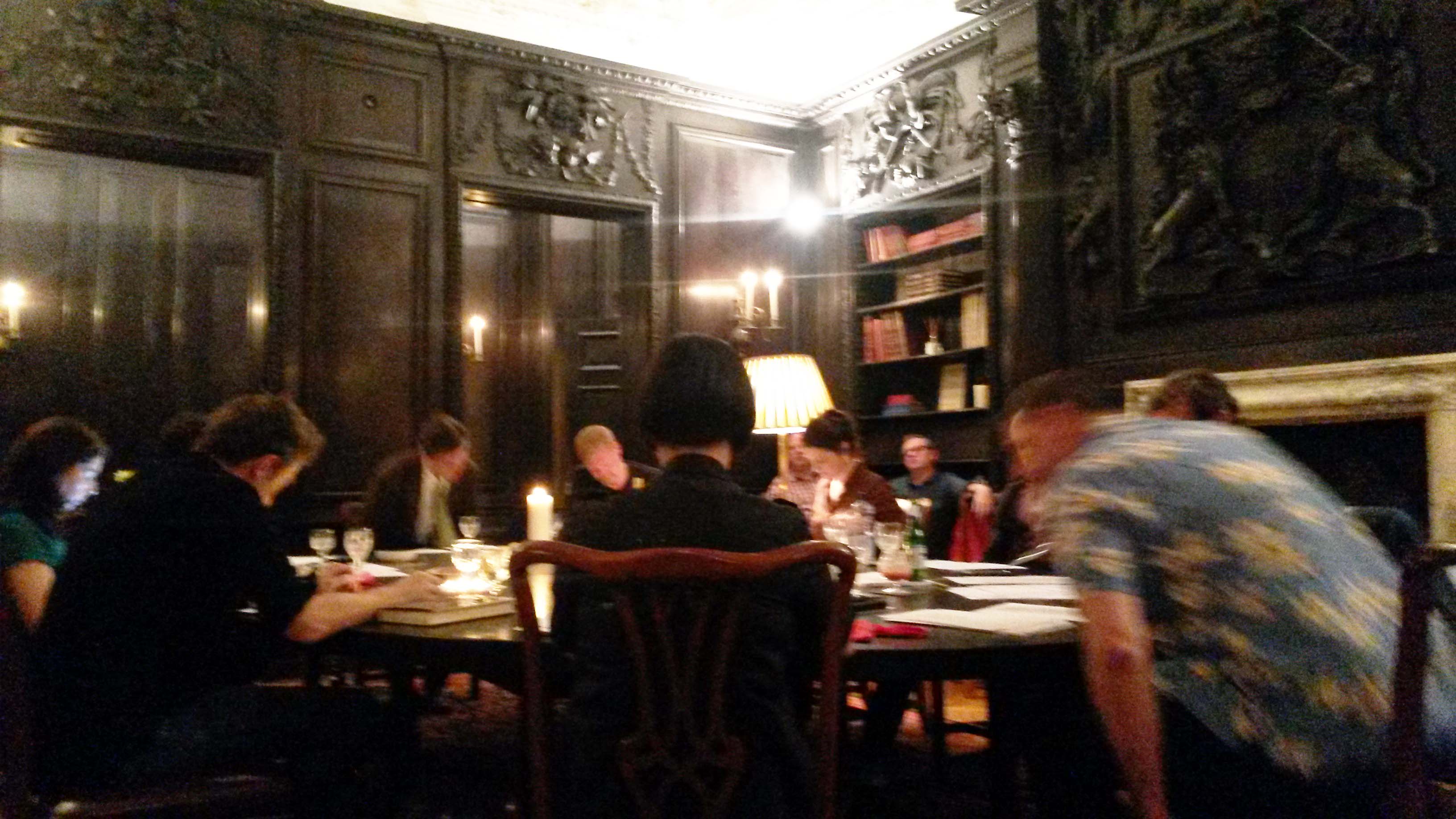 Rest of the Network cast: Caroline Lennon, Dallas Campbell, Saffron Sprackling, Christopher Brand, Russell Layton. Photo © Katy Evans Bush.
(See more here … )
Estates of Mind.
Posted: April 20, 2015 Filed under: Architectural, Class, Hospitals, The Thames, Vanishings | Tags: Isle of Dogs, Michael Mulcahy, Mike Seaborne, Samuda Estate, St John's Estate, Tarling Estate, Transition Group 3 Comments Tarling Estate, 2002. © Mike Seaborne.
Tarling Estate, Shadwell:
Located immediately to the east of Watney Street Market, Shadwell, the Tarling Estate was built c. 1950 to replace overcrowded slums and reduce the population density by half.
The run-down estate was demolished in 2003 and replaced by a higher density mixed-use development intended to both regenerate the area and create what the developer, Toynbee Housing Association, described as ‘a more mixed and balanced community’.
 Tarling Estate 2015. © Mike Seaborne.
Samuda Estate, Isle of Dogs:
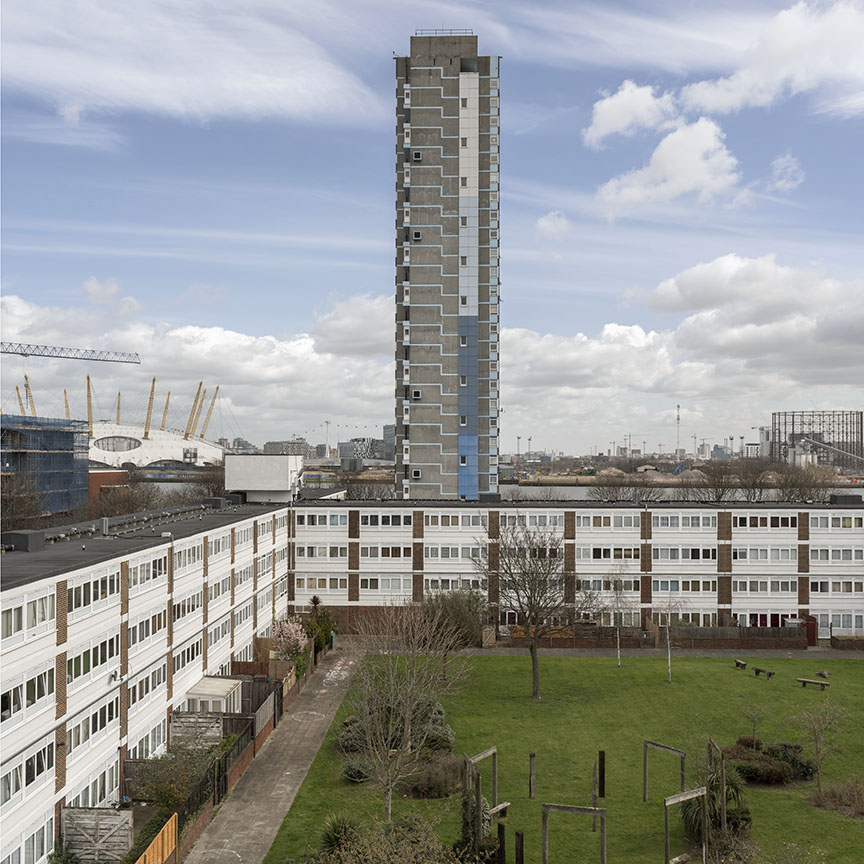 Samuda Estate 2015. © Mike Seaborne.
The Samuda Estate, completed by the Greater London Council in 1967, is mainly comprised of four and six story blocks arranged around a traffic-free square. There is also a 25-storey tower block of maisonettes – Kelson House – situated on a prime site by the river. The estate is in need of refurbishment and some residents believe that the estate’s owner, One Housing Group, are deliberately running it down so it can be demolished to make way for private housing.
St John’s Estate, Isle of Dogs:
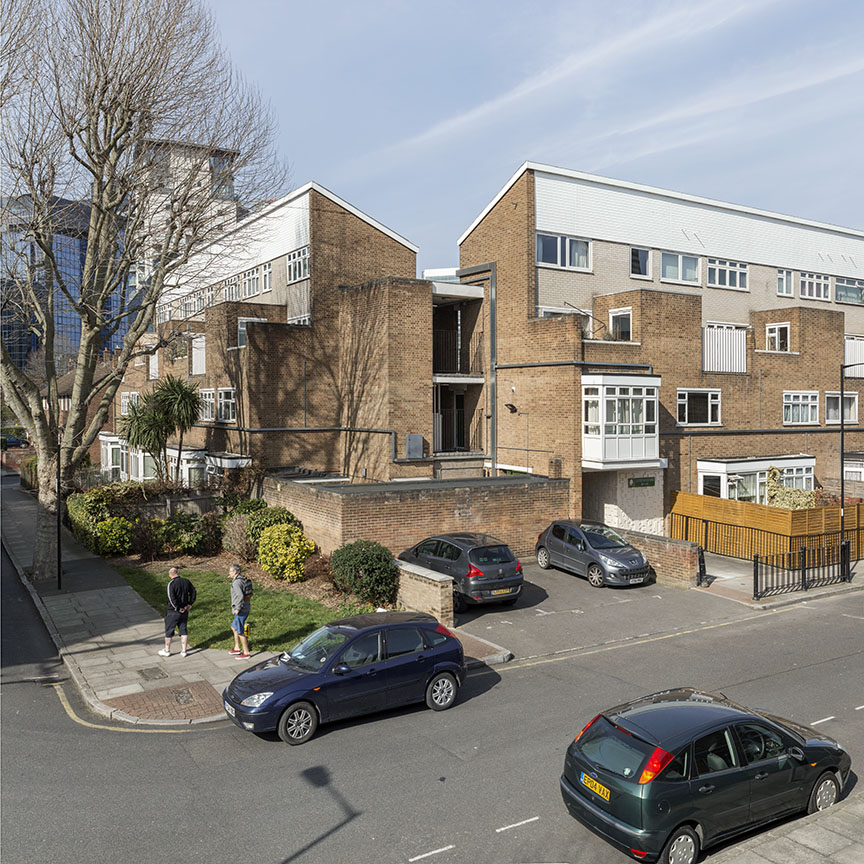 St John’s Estate 2015. © Mike Seaborne.
Planned in 1952 by Poplar Borough Council and described by John Betjeman as ‘one of the best post-war housing estates I have seen’, St John’s Estate was intended as a new self-contained neighbourhood along the lines of the award-winning Lansbury Estate in Poplar. In this it has largely succeeded but One Housing Group, owner of this and three other estates on the island, are considering the possibility of demolition and replacement by new high-density housing which might include several tower blocks of 50+ storeys.
Kingsbridge Estate, Isle of Dogs:
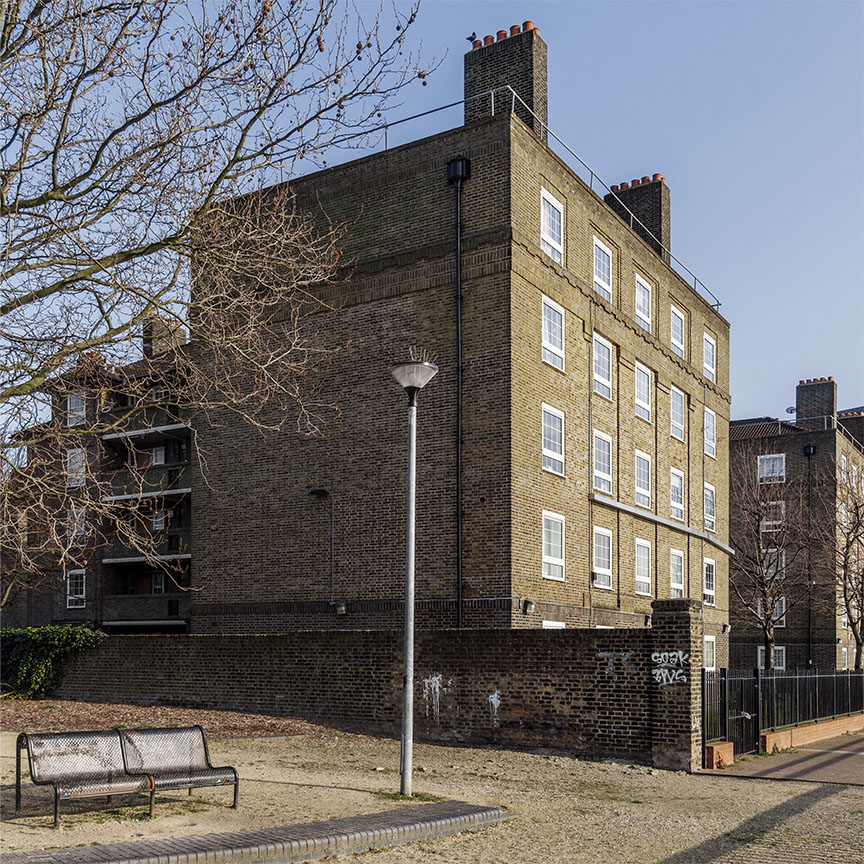 Kingsbridge Estate, 2015. © Mike Seaborne.
Originally known as the Millwall Estate, Kingsbridge was built by the London County Council in 1936-7, with an additional block being added in 1958-60. Despite their age, the blocks are structurally sound and are liked by many of the residents. However, their riverside location means that the value of the land they occupy is very high. The estate’s owner, One Housing Group, is currently consulting on ideas for the future, which may involve replacing the blocks with new housing for private sale.
Photos and text by Mike Seaborne, taken from Estates of Mind, photographs documenting 20th Century social housing by the Transition Group. Twitter feed: @TransitionLDN #TransitionProject. The pictures below are by Michael Mulcahy. Thanks to Mike and Michael.
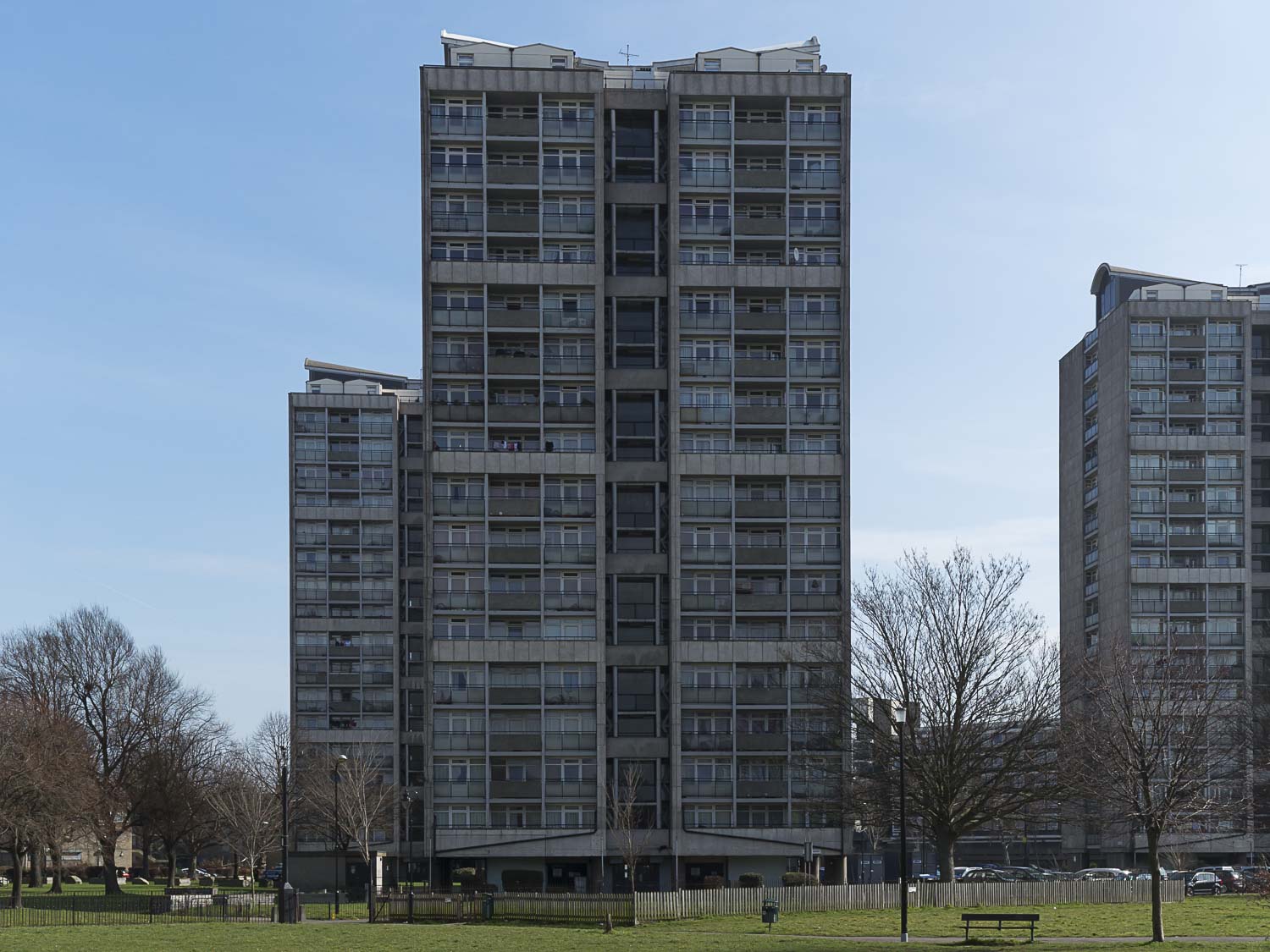 Brandon Estate, Kennington. © Michael Mulcahy.
 Lansbury Estate, Poplar. © Michael Mulcahy.
 Lansbury Estate, Isle of Dogs behind. © Michael Mulcahy.
See also: Balfron Remembered, Balfronism, Robin Hood Gardens, Two Men And A Dog, Pepys Estate.
When Boulez met the Womble.
Posted: March 23, 2015 Filed under: Architectural, London Music | Tags: Arnold Schoenberg, Chris Morris, Chris Spedding, Gurrelieder, Mike Batt, Pierre Boulez, Pierre Boulez dead, Remember you're a Womble, The Wombles, Yvonne Minton Comments Off on When Boulez met the Womble.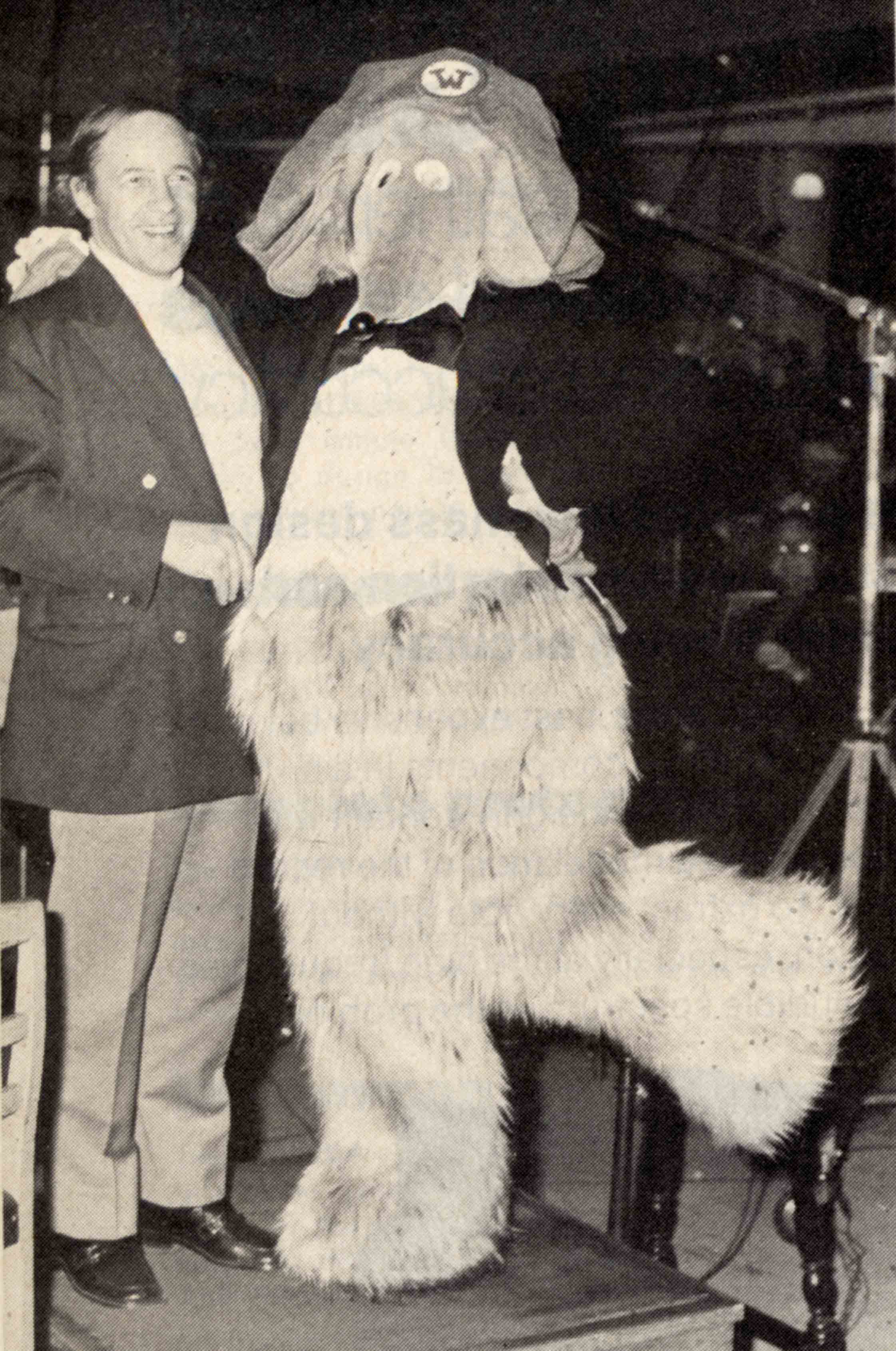
Boulez and Womble, West Ham Central Mission, 1975. Photographer unknown.
Edward Greenfield, writing in High Fidelity and Musical America, March 1975:
The Wombles, in their Disney-esque costumes, are an enormous success on television with children of all ages, and their signature tune was an enormous pop hit for CBS. Needless to say, Boulez had never heard of the Wombles but with a patience rarely given to such formidably intense artists, he willingly joined in the joke.
These photos from High Fidelity form part of a report on the recording of two monumental Schoenberg works by the BBC Symphony Orchestra under Pierre Boulez. The recordings, for CBS – now Sony – were made in West Ham Central Mission – now the Memorial Community Church, Plaistow – which enjoyed a brief spell as a recording venue for orchestral music in the 1970s, until the interior of the building was altered and its spacious acoustic properties lost for good. Boulez was there to record Schoenberg’s Gurrelieder and Moses und Aron.

Someone at CBS thought it was a good idea to send a Womble along to hug Boulez for a photo, and thus Orinoco (or is it Great Uncle Bulgaria?) greets the composer of Le Marteau sans Maitre. Just as one doesn’t expect to see Michel Foucault cosying up to Roland Rat, or Gore Vidal doing a turn on The Basil Brush Show, the sight of Boulez in such company is slightly disturbing. Apart from the CBS connection, Boulez happened to be chief conductor of the BBC Symphony Orchestra at the time, and The Wombles were being relentlessly plugged by the BBC as a sort of corporate emblem; hence, the photo is a souvenir of a poorly thought-out PR opportunity, as well as a reminder of the mysterious reach of the Wombles and their co-creator Mike Batt. Inside one of the Womble suits was Chris Spedding, a virtuoso rock guitarist who was once (allegedly) considered as Mick Taylor’s replacement in The Rolling Stones, and who went on to produce records for The Sex Pistols; one would like to think that it is Spedding himself who is Wombling next to Boulez on the podium, but it probably isn’t. Apart from The Wombles, Batt also gave the world Bright Eyes, produced the likes of Steeleye Span and Cliff Richard, was sued by the estate of Boulez’s one-time friend John Cage for a joke at the expense of 4’33”, and who – in the imagination of Chris Morris – co-wrote the musical Sutcliffe!. Ultimately, however, he is bound to be remembered for this …
Anyway, Pierre Boulez turns 90 this week, so this is The London Column’s opportunity to offer the maestro a modest tribute. Your correspondent was a regular at Boulez’s concerts in London in the 80s and 90s; he represented a personal link to Stravinsky, Varese and the post-war avant-garde, and in today’s denuded cultural landscape it is hard to see who will ever replace him. Here is Yvonne Minton singing the Song of the Wood Dove from Boulez’s magnificent recording of Gurrelieder, the same one he was working on when Batt’s creature showed up. D.S.
In search of Old Wych.
Posted: November 25, 2014 Filed under: Architectural, Ceremonial, Class, Health and welfare, Lettering, London Places, London Types, Pubs, Sartorial, Vanishings | Tags: 1890s Decadents, Bleak House, Dickens's London, Holywell St., King's College London, Old Curiosity Shop, Royal Courts of Justice, Sediment blog, The Seven Stars, Wych St. 3 Comments St. Mary le Strand. © David Secombe.
‘Bomber Harris looks like he’s pushing out a discreet fart’.
Thus observed CJ, of Sediment and Up North notoriety, as we stood in front of St. Clement Danes contemplating the statue of Arthur ‘Bomber’ Harris that stares balefully at Australia House. I could see CJ’s point; certainly, Air Chief Marshal Dowding is looking pointedly in the opposite direction, disavowing all association with his war-time colleague. On the other hand, Harris could just as well be evaluating Australia House’s chances of withstanding a thousand bomber raid.
CJ and I were drawn to this spot not by the relative dispositions of memorialized RAF grandees but to see if we could find traces of the ancient streets obliterated by early 20th century redevelopment. Australia House stands roughly on the site of Wych Street. Old Wych was described as ‘the prettiest street in London’ but the city’s civic class regarded it and its neighbours as inconvenient and unwholesome. An area full of theatres, bookshops, churches, inns of court and something like 600 historic houses, it was simultaneously a romantic backdrop to London’s intellectual life and an impediment to the aspirations of Boris’s Edwardian forbears. The planners won out, of course: cherished streets were cleared and replaced by monumental blocks of numbing pomposity. The names of the streets lost in this fatuous exercise in Haussmanism toll like a litany: Holywell St., Little Wild St., Stanhope St., Little Queen St., Clare St., Hollis St., Newcastle St., Houghton St. etc., … whilst the name given to the boulevard that eviscerated the old district could not be more deadly: Kingsway. Somehow, St. Mary le Strand escaped the surrounding destruction and now wears the air of a dowager trapped in uncouth company, sandwiched between the 1920s bombast of Bush House and the high Brutalism of King’s College’s 1970’s Strand Building.
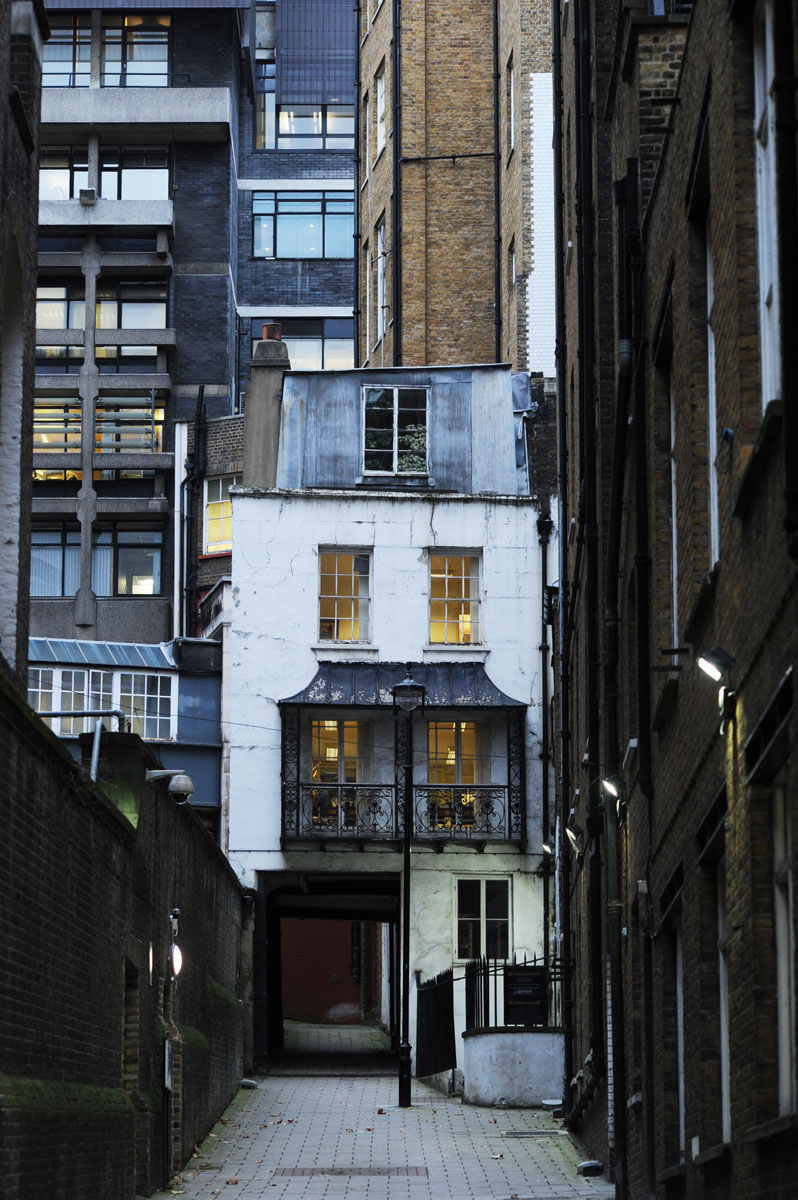 Strand Lane. © David Secombe 2014.
Just behind King’s Strand Building is Strand Lane, an alley running down to the Embankment which is now a pedestrianised access facility for the college. CJ and I accessed it via Surrey Steps, and found ourselves in the company of an American tourist searching for the ‘Roman bath’ which may be seen through a window in the courtyard of the galleried house in the above photo. Despite the assertions of Dickens and others, the bath isn’t Roman at all, and is thought to be a 16th or 17th century cistern that serviced one of the grand houses that stood here. We were more taken by the anomalous regency villa-ette that clings to the vast bulk of King’s like a remora on a whale. More office space for King’s – except for the attic, where well-tended plants indicate a domestic arrangement. An enviable address? I thought so and said as much to CJ, who merely looked at me pityingly (he lives in Mortlake).
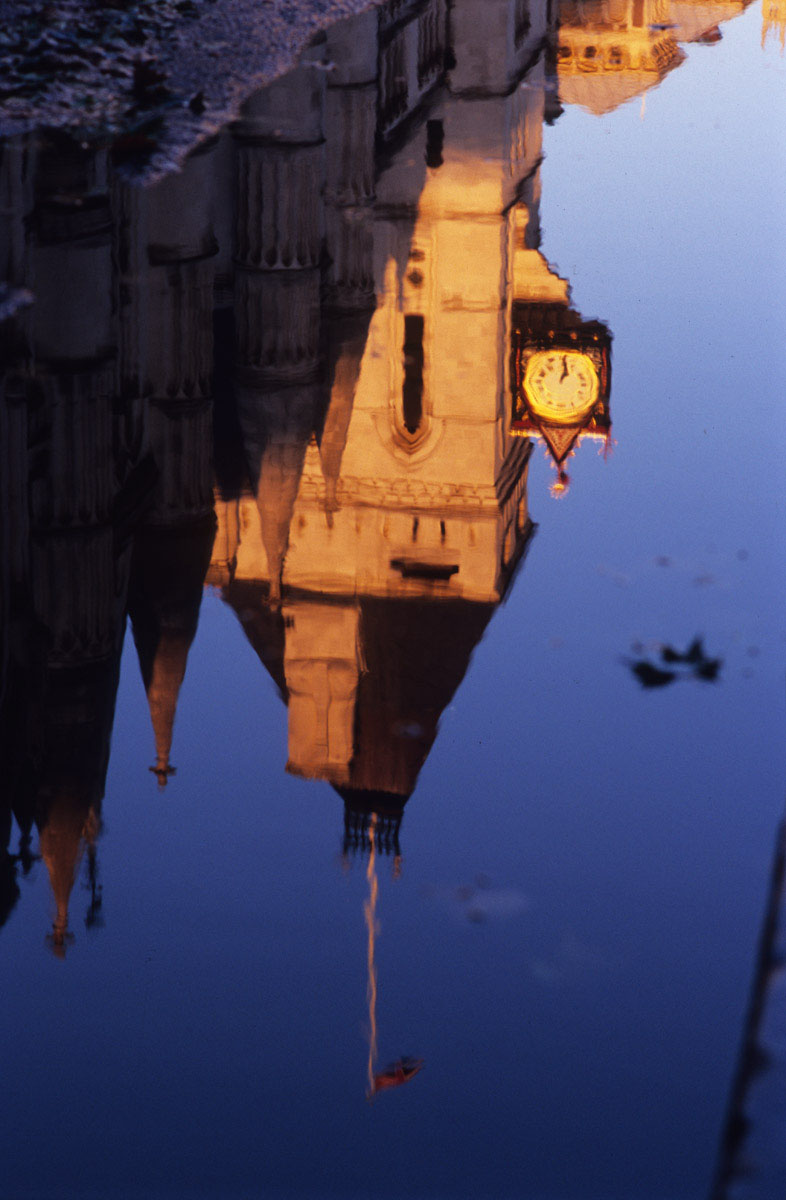 The Law Courts in a puddle. © David Secombe 2010.
We walked back to the Strand, past the disused Strand tube station (now owned by King’s and rented out for film shoots), and noted the wholesale demolition of 1960s blocks taking place between Surrey St. and Arundel St. In late Victorian times, this area was the heart of literary London. Holywell St. – where Bush House is now – was lined with bookshops and stalls, many of which specialised in naughty titles, and publishers’ offices. The Savoy, journal of the Decadent movement, was edited out of the Arundel St. premises of Leonard Smithers, publisher of Wilde, Beardsley, Beerbohm, Symons, Dowson, even Aleister Crowley. Arthur Symons edited The Savoy during the 1890s and lived nearby. In 1912 he wrote an elegy for the London that had been destroyed:
The old, habitable London exists no longer. Charles Lamb could not live in this mechanical city, out of which everything old and human has been driven by wheels and hammers and the fluids of noise and speed. When will his affectionate phrase, “the sweet security of streets,” ever be used again of London? No one will take a walk down Fleet Street any more, no one will shed tears of joy in the “motley Strand,” no one will be leisurable any more, or turn over old books at a stall, or talk with friends at the street corner. Noise and evil smells have filled the streets like tunnels in daylight; it is a pain to walk in the midst of all these hurrying and clattering machines; the multitude of humanity, that “bath” into which Baudelaire loved to plunge, is scarcely discernible, it is secondary to the machines; it is only in a machine that you can escape the machines.
 Entrance to New Square, Lincoln’s Inn, Carey St. north side. © David Secombe 2014.
We crossed the Strand in front of the Law Courts, past a pair of loitering petitioners, and sidled down Bell Yard towards Carey St. The Royal Courts of Justice was built in the 1870s, a product of the same mentality that later perpetrated Aldwych and Kingsway. A vast area of housing was cleared for George Edmund Street’s neo-Gothic scheme; in The Times, 12 September 1866, their correspondent profiled the district that was about to vanish:
The extensive and complicated networks of lanes, courts and alleys covering the area bounded east and west by Bell Yard and Clement’s Inn, north by Carey Street, and south by the Strand and Fleet Street, lately containing a population more numerous than many Parliamentary boroughs, is being fast deserted. Massive padlocks guard every door . . . The ground taken by the authorities entrusted with the arrangements for the new ‘Palace of Justice’ includes nearly thirty lanes and passages, the names of some of which will be familiar to all who have made acquaintance with the topography of London. Here still stand some old houses, the very peculiar, perhaps unique, character of whose construction is worthy of a visit. The main frontages to come down are, northwardly, nearly the whole of the south side of Carey Street, and, southwardly, the eastern and western extremities respectively, the north side of the Strand and Fleet Street, crossing Temple Bar.
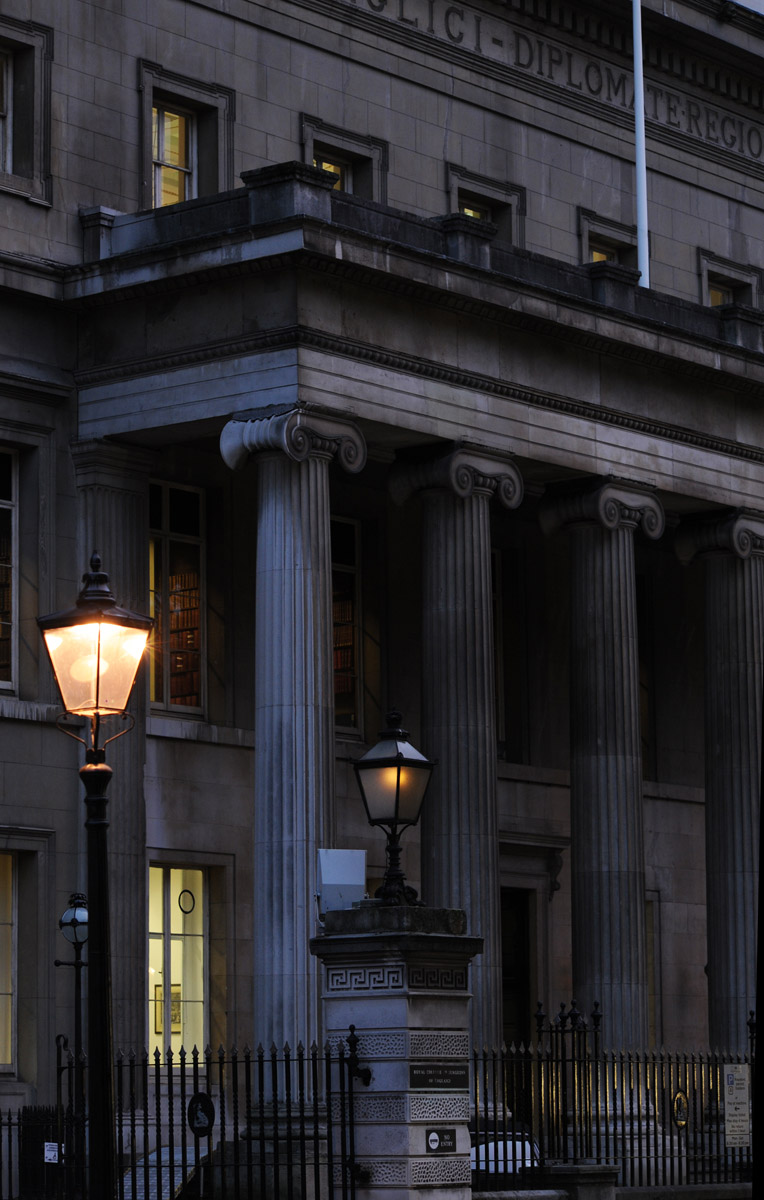 Royal College of Surgeons. © David Secombe 2014.
In the gathering twilight, CJ and I went for a quick jaunt around Lincoln’s Inn Fields. Outside the Royal College of Surgeons (Sir Charles Barry, 1833) we noted ostentatiously-parked production vans humming with the purposeful non-activity that is the exclusive preserve of film crews. We took in ‘The Old Curiosity Shop’ on Portsmouth St., a bizarre fragment of Tudor London which has acquired a spurious Dickensian connection and the aspect of a giant wendy house. But, as we are in Bleak House territory, everything has a spurious Dickensian connection. Dickens may have mined old London for his fiction but he also associated it with decay and, being a man of his time, was all for getting rid of it. The clearances and ugly ceremonialism of late Victorian and Edwardian London were driven by the logic of civil engineering yoked to the doctrine of economic growth. If traffic does not move fast London cannot grow; grand buildings are needed to reflect the city’s commercial/imperial status. … which, in the era of the Dome, the 2012 Olympics, Crossrail and Boris Johnson, shows that nothing has changed. The Times concluded its report on the 1866 clearances in bleakly familiar terms:
By the displacement of so many hundreds of poor families, the unhealthy courts about Drury Lane, Bedfordbury, the Seven Dials and other localities, already reeking and noisome with excess of numbers, have become more overcrowded than ever. The rents of the most miserable rooms have materially risen, and another entanglement is added to the difficult problem, ‘How and where are the poor to find suitable dwellings?’
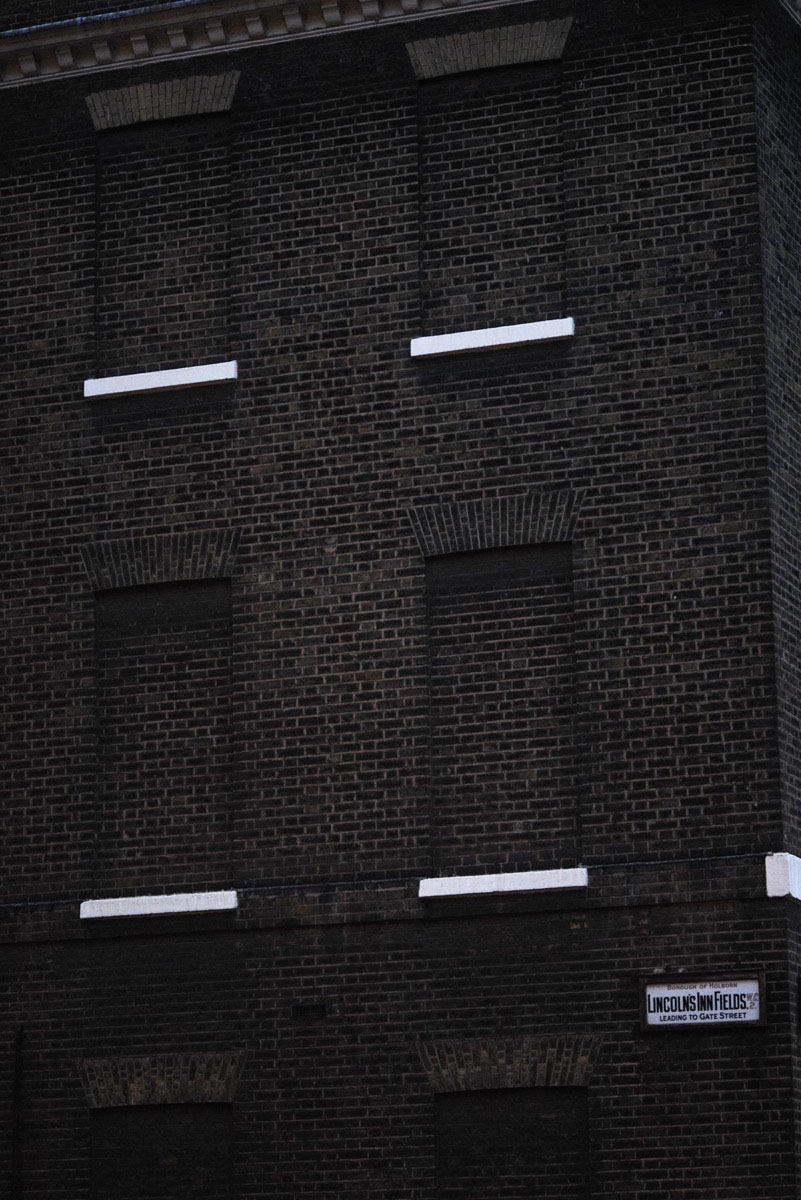 Corner of Remnant Street and Lincoln’s Inn Fields. © David Secombe 2014.
On the north-western corner of Lincoln’s Inn Fields is a pair of Georgian houses that have for many years lain empty, their facades sooted in a manner that has almost disappeared in London. Now the builders are in, and I doubt whether the old soot will remain on the brickwork for much longer. CJ quoted Iain Nairn waxing eloquently on the patina of soot on London’s buildings, but I can’t remember what he said now. In any case, I nodded sagely. We both nodded sagely. Then we stopped nodding sagely and decided to go for a drink. We had intended to spend some time exploring fragments of the pre-Edwardian landscape on the western side of Kingsway, but that will have to wait for another time. It was dark and we were old.
 ‘The Wig Box’, Seven Stars, Carey St.. © David Secombe 2014.
We headed back to Carey St. and The Seven Stars, installing ourselves at a tiny table in the pub’s ‘Wig Box’ extension. We drank beer which is a bit infra dig for CJ as he generally only drinks wine, albeit of a fairly desperate sort (if you have read Sediment you will know what I am talking about). I mentioned that I have a photo of The Wig Box that I took in 1986 when it was still an actual shop selling legal headgear. CJ looked a little fatigued, ignored my last factoid and commented that is a bit odd for a 50-year old man to be quite so indignant at the Edwardians who refashioned London. He’s probably right, although I would counter that modern Londoners are experiencing a coarsening of the environment which mirrors the arrogance of early-mid 20th Century planning. Arthur Symons’s anguish illustrates the gulf between those who find joy in the city and those who wish to control it. Everything is up for grabs and nothing can be taken for granted. Enjoy your pint while you can. Cheers.
… for The London Column.
See also: The Riverine Strand, A Short Walk Down the Old Kent Road, The Haunted House.


 The London Column
