Bvsh Hovse.
Posted: December 11, 2013 Filed under: Architectural, Corridors of Power, Fictional London, Interiors, Lettering, Literary London, Monumental, Wartime London | Tags: Aldwych, Bogdan Frymorgen, Bush House, Claire Grove, George Orwell BBC, London architecture, Ministry of Truth, Wych Street Comments Off on Bvsh Hovse.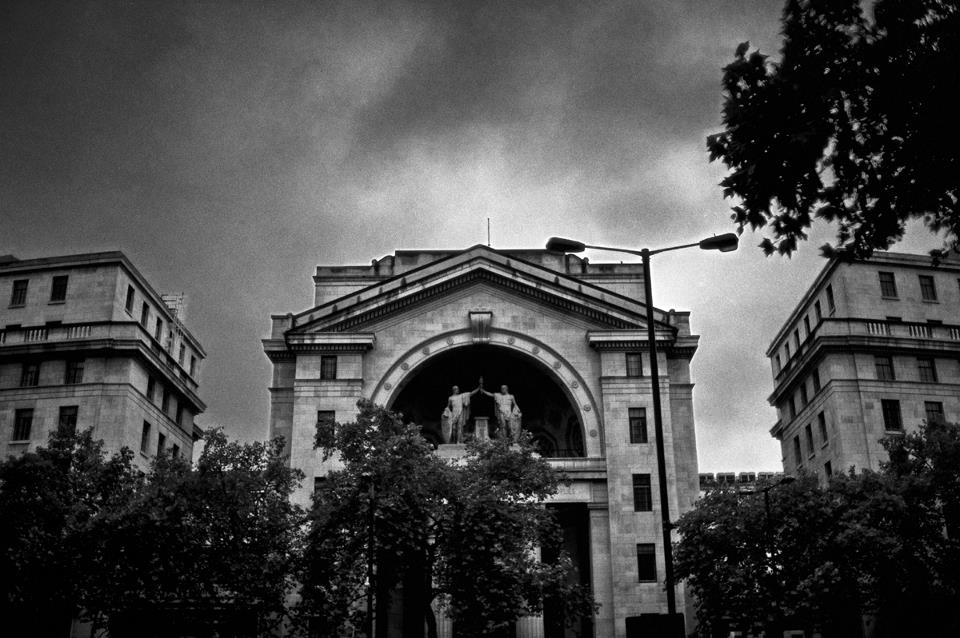
Bush House from Kingsway. © Bogdan Frymorgen 2012.
Bush House, the imposing 1920s edifice which dominates the Aldwych and looms over Kingsway, was once declared to be “the most expensive [building] in the world”: by 1929 its construction had cost its American backers £2,000,000. It was built on the site of Wych Street, an ancient survivor of the Great Fire that was ruthlessly destroyed by London County Council circa 1901.
Built of Portland stone, with extravagant use of marble for its cavernous halls, and fronted by forbidding columns surmounted by statues symbolising ‘Anglo-American friendship’, Bush House embodies its era just as much as the Deco Telegraph Building on Fleet Street, or Collcutt and Hemp’s monolithic Adelphi. (The chunk of old London flattened for the Adelphi was the Adam brothers’ graceful riverside development of 1768.) Like the ‘new’ Adelphi, the sheer bombast of Bush House trails unfortunate traces of Fascist architecture; but where Colcutt and Hemp’s stridently moderne behemoth might look at home in Mussolini’s Rome, Bush House’s gigantic faux-classical styling prefigures the more stolid brand of ‘Totalitarian Retro’ that came to be favoured by Hitler and Stalin.

Main entrance. © Bogdan Frymorgen 2012.

© Bogdan Frymorgen 2012.
The BBC established offices in the building in 1941, and for over 70 years Bush House was home to the BBC World Service, originally known as the BBC Overseas Service. George Orwell was a BBC staff member during the war, and the interiors of the building – in particular its canteen – informed his conception of The Ministry of Truth in Nineteen Eighty Four. (It’s clear that the exterior of Orwell’s Ministry was modelled on Senate House in Bloomsbury, and Room 101 was said to be located somewhere in Broadcasting House, but the echoing, labyrinthine interior of Bush House invites us to imagine Winston Smith lost within it.) It might be easy to resent Bush House – for what was sacrificed for its creation, for its monumental scale, and for the sheer absurdity of that portico (which echoes, in the Latin script above its main entrance, the opening titles of a certain famous 1970s TV series: I CLAVDIVS). You could even say that the payoff for the loss of ancient Aldwych is nothing more than a faceless autostrada with a giant conceited lump at its southern end.

© Bogdan Frymorgen 2012.

© Bogdan Frymorgen 2012.
But London is a restless, shape-shifting city, and Bush House has come to stand for more than the pretensions of its sponsors and designers. With the good fortune to house an institution that infused its overblown rhetoric with genuine purpose, it has become a great London building by default. Orwell’s ironic attitude to the BBC aside, during WW2 it acted as a hub for displaced European intellectuals, who broadcast to their besieged home countries from its offices; coded messages aimed at resistance fighters and SOE agents were transmitted to occupied Europe from its studios. It became a symbol of the War Effort. (It was damaged by a V1 flying bomb that hit the Aldwych in 1944; the V1 landed on the Air Ministry directly opposite, leading to worries over the eerie accuracy of those early cruise missiles.)
Even its grandiose classicism may be said to have a claim to authenticity: workmen laying Bush House’s foundations unearthed Roman statuary beneath the dust of Wych Street. A bust of a Roman noble was duly and reverently put on display in the new building’s lobby (even if there are doubts as to its provenance …).

© Bogdan Frymorgen 2012.
These photographs by Bogdan Frymorgen – a studio manager for the World Service – were taken just hours before the BBC finally left Bush House in July 2012, when the humming bustling halls and studios were already silent. Even as a series of absences, they capture a real sense of the urgency and activity that had so recently been going on. They’re full of love for a building and an institution that came to occupy an important place in British cultural history. It’s too easy to forget the esteem in which the BBC World Service is held by its distant listeners; it’s not television – therefore not sexy – but that is what gives it its reach, as radio waves can go anywhere and radios can be found everywhere. The World Service is a unique and magnificent public service; it’s Reithian; and, as such, it’s permanently under threat.

© Bogdan Frymorgen 2012.
But the BBC’s activities at Bush House weren’t confined to the World Service. Amongst other things, a great deal of radio drama was produced there, and in the past weeks I’ve been thinking of this again. A few years ago, I was fortunate enough to spend a few days working on a radio play at Bush House under the aegis of Claire Grove, one of the most innovative and successful radio drama producers of our time. Her funeral was last week. Her Guardian obituary gives a rough idea of her professional brilliance, but it is hard to sum up such a vital person within the confines of an ‘Other Lives’ entry. Lemn Sissay’s appreciation gives some hints of the energy and life that occupied Claire, and indeed Bush House.

Studio 8, cleared out. © Bogdan Frymorgen 2012.
Amidst current refurbishment, Bush House is now occupied by a law firm and HM Customs and Excise. The love really has left the building. D.S. (with K.E-B.)
… for The London Column. Copies of Bogdan Frymorgen’s photographic tribute to Bush House may be ordered from him at frymorgen@googlemail.com or via his Facebook page.
King’s Cross Stories.
Posted: October 28, 2013 Filed under: Fictional London, London on film, Transport | Tags: Andrew Martin, Channel Tunnel Rail Link, Dombey and Son, Kings Cross, Mrs Wilberforce, St. Pancras, The Ladykillers, Tim Marshall Comments Off on King’s Cross Stories.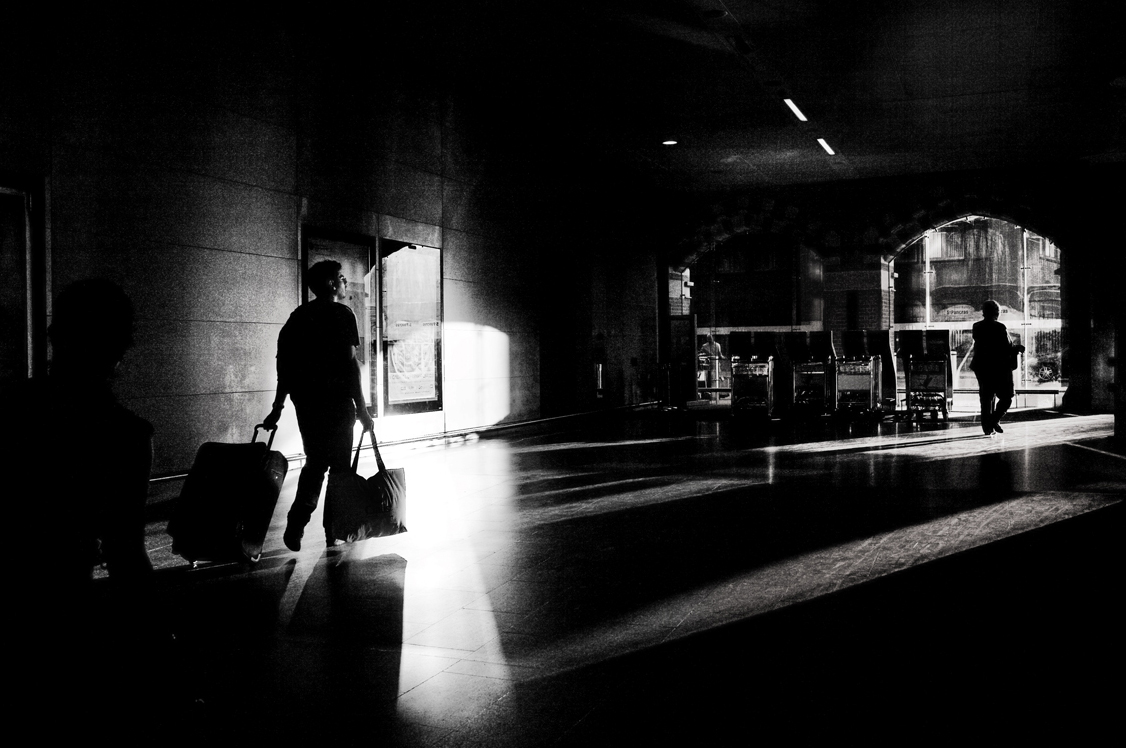
St Pancras, Midland Road exit. © Tim Marshall.
Andrew Martin, Notes From The Railways, The Independent, Aug 31 2006:
If, like me, you cycle through King’s Cross most days, the description of Staggs’s Gardens in ‘Dombey and Son’ will seem familiar: ‘…bridges that lead nowhere; thoroughfares that were wholly impassable; Babel towers of chimneys wanting half their height; temporary wooden houses and enclosures, in the most unlikely situations…’
When you remember that a Stag was a railway speculator, that Staggs’s Gardens is supposed to be in Camden, the whole scene is a remarkable prefiguring of the bringing of the Channel Tunnel Rail Link into St Pancras and the associated works, such as the transformation of the streets east of King’s Cross into ‘Regent Quarter’ (which is somehow ten times more irritating as a name than ‘Regent’s Quarter’ would have been) and the development of the old goods yards north of King’s Cross.
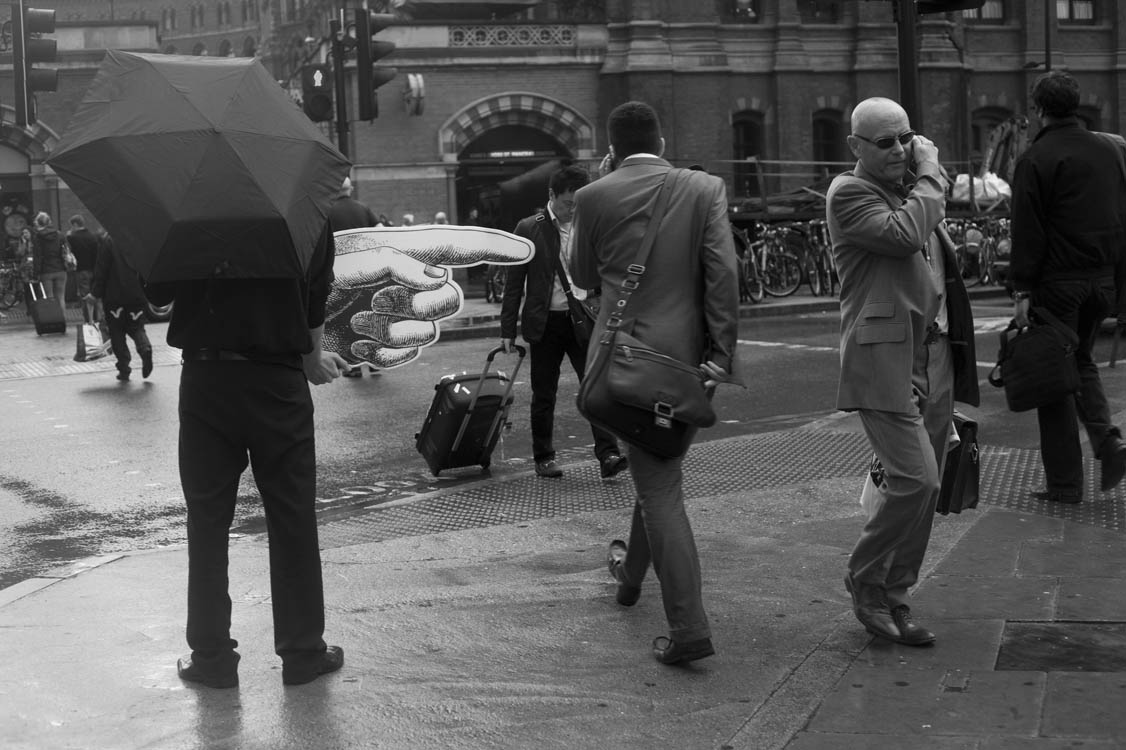
Corner of York Way. © Tim Marshall
The developers contend that ‘no one can be nostalgic for the old King’s Cross.’ Well, that depends what you mean by ‘old’. There was so much shilly-shallying over whether King’s Cross or St Pancras should receive the CTRL that the area has been blighted for at least twenty years. (And many locals, incidentally, still wonder why Eurostar is coming into North London at all, given that South London is closer to France, and that the Waterloo terminus seems to be doing perfectly well). Immediately before the blight, the area was, according to Albert Beale of Houseman’s book shop on Caledonian Road, ‘pleasantly seedy’, as opposed to the heart of darkness, which it became.
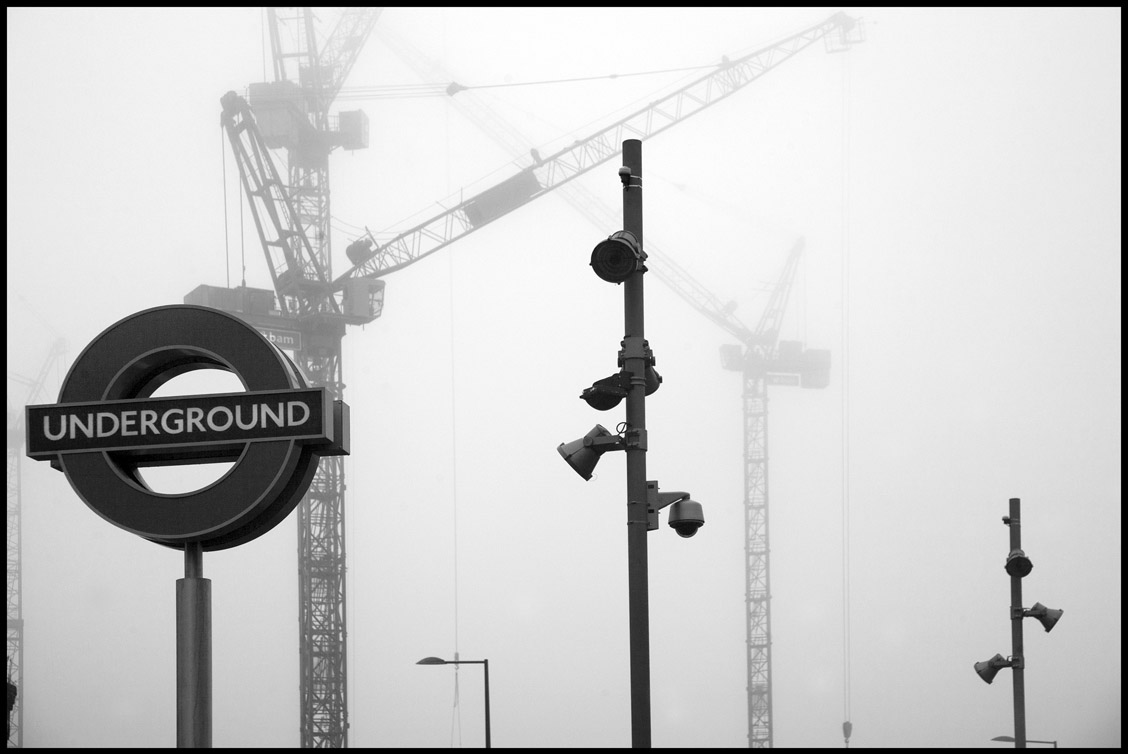
King’s Cross, Pancras Road exit 2. © Tim Marshall.
Pre-blight, there were dark pubs where the beer mat tended to stick to the bottom of the glass, but King’s Cross was full of interesting transients, and with a sooty, crepuscular, train-haunted feel. When coming down from York as a teenager, I would drink in two wonderful old pubs in the south end of York way. The first was the Duke of York. It’s now called ‘Offshore’. Nipping in there the other day, I asked the Antipodean barmaid if she knew what the pub had been called before. A rather cruel experiment, I admit. ‘As far as I know it’s always been called Offshore,’ she said. I wonder if she also thinks it’s always been painted sky blue, and carried the slogan ‘Backpacking the world’ as it does today. This would certainly have made it stand out in 1860.
The second pub was The Railway Tavern, which had a black and white tv as late as about 1995, and was full of railway men, with those distinctive box-like shoulder bags. It is now hidden behind a hoarding, waiting to re-emerge, hung, drawn and Regent Quartered. I suppose it’ll be a Juice Bar.
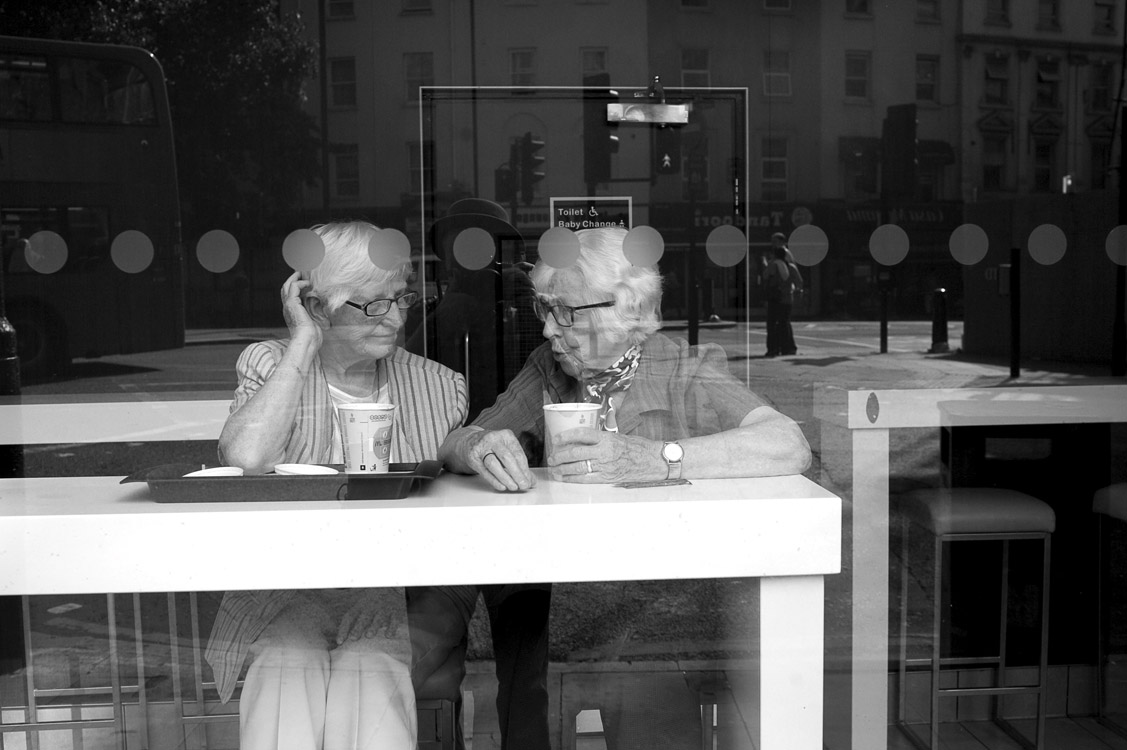
McDonalds, Pentonville Rd. © Tim Marshall.
In Staggs’s Gardens, the nice old Ham and Beef Shop suddenly becomes the Railway Eating House, and the word ‘Railway’ is imposed on everything, even buildings that have as yet only a façade. My fear for King’s Cross tends in the opposite direction. I worry it will lose its railway character. I could be wrong. Most of the old buildings on the Railway Lands are to be preserved. And many of the locations used in the Ladykillers – which was made in 1955 when getting on for forty trains a day were still coming into the goods yard – still survive.
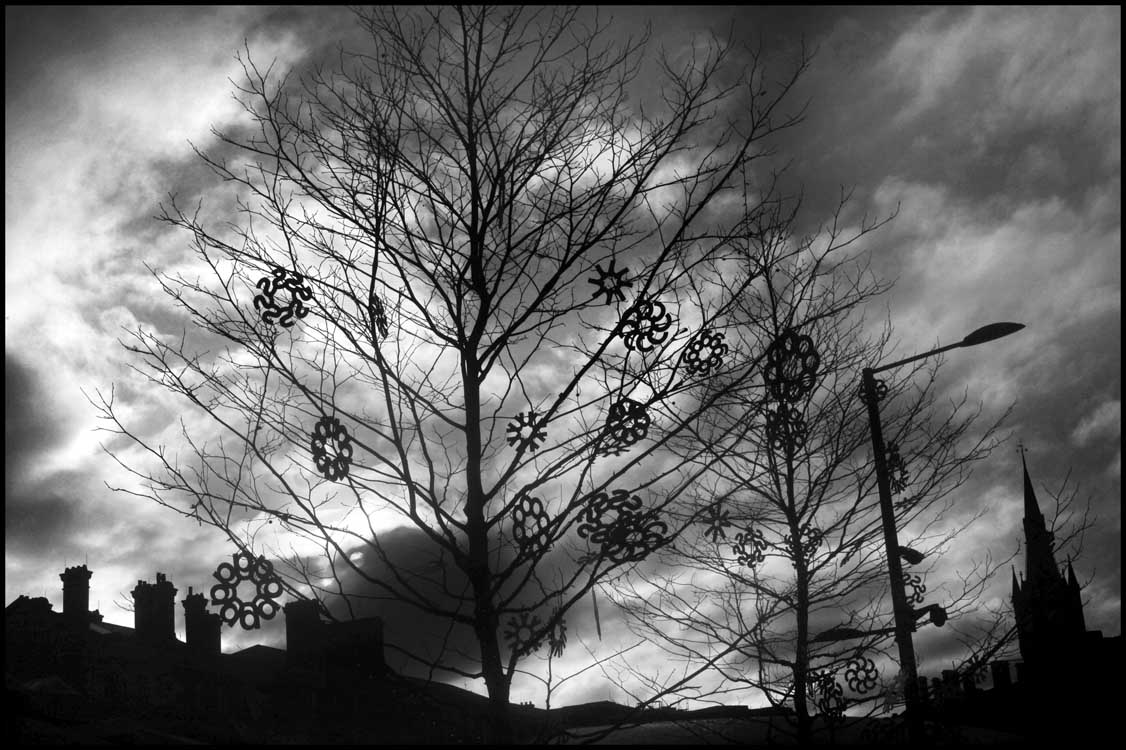
King’s Boulevard. © Tim Marshall.
The house of the old lady, Mrs Wilberforce, tended to flit around a bit. Some of the exteriors were done in Goldington Crescent, which is just as elegant as ever. For her rear garden (from where the bodies of the crooks were dumped onto coal trains) a patch of grass on top of Copenhagen Tunnel was used, and if you go along to the end of Vale Royal, off York Way, you can see the very spot. A man keeps horses there. The top of the tunnel is all black, cracked Gothic battlements, and the trains still thunder underneath towards the mass of X’s that form the points leading into King’s Cross.
I do hope this prospect is preserved. If not…well, The Ladykillers is just out on DVD.
© Andrew Martin. His new novel The Night Train to Jamalpur is published by Faber on 7 of November. Tim Marshall‘s album King’s Cross Stories is on his Tumblr site.
Two buildings on Fleet Street.
Posted: September 27, 2013 Filed under: Architectural, Fictional London, Literary London, Street of Shame | Tags: Art Deco in London, Daily Express Building, Evelyn Waugh, old Fleet Street, Owen Williams, Scoop, Telegraph Building Comments Off on Two buildings on Fleet Street.
Telegraph Building, Fleet Street. Photo © David Secombe 2010.
From Scoop by Evelyn Waugh:
The bells of St.Bride’s chimed unheard in the customary afternoon din of the Megalopolitan Building. The country edition had gone to bed; below traffic level, in grotto-blue light, leagues of paper ran noisily through the machines; overhead, where floor upon floor rose from the dusk of the streets to the clear air of day, ground-glass doors opened and shut; on a hundred lines reporters talked at cross purposes; sub-editors busied themselves with their humdrum task of reducing to blank nonsense the sheaves of misinformation which whistling urchins piled before them; beside a hundred typewriters soggy biscuits lay in a hundred tepid saucers. At the hub and still centre of all this animation, Lord Copper sat alone in splendid tranquility. His massive head, empty of thought, rested in sculptural fashion upon his left fist. He began to draw a little cow on his writing pad.
David Secombe: Scoop was published in 1938 and is, of course, a literary monument to the glory days of inter-war Fleet Street, drawing on Waugh’s brief 1935 stint as a Daily Mail war correspondent in Abyssinia. The novel’s monstrous Lord Copper is usually described as being an admixture of the proprietor of the Daily Express, Lord Beaverbrook, and The Times’s Lord Northcliffe, with the Mail‘s Lord Rothermere somewhere in the mix as well. The immense power of these men reflected the vast circulations and influence of the titles at their disposal; and, for all its comic genius, the paragraph from Waugh’s novel speaks of the glamour and excitement of old Fleet Street.
The Telegraph Building, designed by Elcock & Sutcliffe and finished in 1928, is a fine example of serious-minded Deco, with sculptural detailing typical of the era’s public buildings (e.g. London Underground’s 55 Broadway, BBC’s Broadcasting House), whilst the clock and detailing of the facade speaks of the 1920s’ infatuation with all things Egyptian. Alfred Oakley’s dynamic frieze above the main entrance depicts a brace of Mercuries flying from Britain to despatch news to her dominions and beyond; whilst, at the very top of the facade, two gravely portentous sculptural masks by Samuel Rabinovitch – ‘Past’ and ‘Future’ – offer further proof of the self-importance of the parties who commissioned the building. (However, Oakley and Rabinovitch were not as celebrated as Gill or Epstein, and their work on the Telegraph building was the high-water mark for both of them.) Together the elements add up to a rich, imposing and endearingly absurd edifice, entirely suitable for a sober, venerable newspaper keen to project an engagement with the hectic modern ‘scene’.
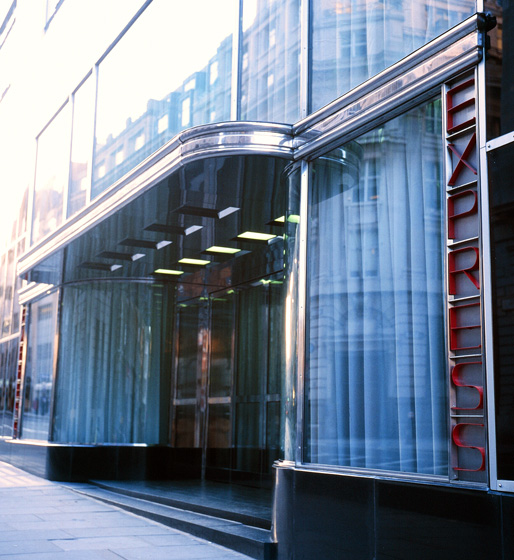
Daily Express Building, Fleet Street. Photo © David Secombe 2010.
A few years later, in 1932, and just four doors away, the new Daily Express Building opened for business and immediately made Elcock & Sutcliffe’s Telegraph design look like something by Augustus Pugin. A self-proclaimed icon of modernity streamlining down inky old Fleet Street, this sleek edifice is as characteristic of the 1930s as the suddenly obsolete Telegraph Building was of the 1920s. Significantly, the building was to a large extent the design of a structural engineer, Owen Williams, who had also advised on the Telegraph Building, and who went on to design Express offices in Manchester and Glasgow in the same fashion as their London prototype. The stark finish common to all three Express buildings – an aggressively moderne melange of black Vitrolite, glass and chrome – may be seen as an expression of the thrusting personality of Beaverbrook: the self-parodic press baron whose considerable political influence derived from the conspicuous popularity of his titles (during its post war zenith, The Daily Express was the biggest-selling newspaper in the world). Reading Scoop, it seems clear that Lord Copper’s Daily Beast is based in a building more like the Express than the Telegraph; quite apart from the architectural stylings, St Bride’s church stands directly opposite the Express Building, its spire reflecting darkly in the inscrutable facade of its upstart neighbour (however much Evelyn Waugh deplored the architecture of his time, he relished its capacity for inadvertent comedy).
Both the Telegraph and Express buildings are now owned by Goldman Sachs, their fabled Deco interiors available for inspection only on rare open days. And ‘The Street of Shame’ remains a street of ghosts, its pristine sense of purpose departing with the newspapers that gave it its unique identity. But for anyone seeking echoes of the giddy aspirations of the 1920s and 30s, these buildings remain evocative and potent, each epitomising the preoccupations of its decade. They are relics of a lost and dizzying world of inter-continental airships, Howard Carter and Tutankhamun, racing at Brooklands, the talkies, the Mitfords, the Blackshirts, Hollywood stars on the Queen Mary, Noel Coward’s Design for Living and Evelyn Waugh in his pomp … factories and temples dedicated to the latest news, expressed in architectural forms as up-to-the-minute as a Clarice Cliff tea-set.

Entrance frieze, Telegraph building, Fleet Street, EC1. Photo © David Secombe 2010.
Fleet Street Portrait – Charles Jennings:
New Life For Doomed Thoroughfare. It Takes All Sorts, Says Cockney. THE HELL OF THE STREET. ‘I was left for minutes on end. My thirst got the better of me.’ Starting today: her unique story. BANKERS WHERE ONCE WERE JOURNALISTS.My Secret Can Be Yours. FAMOUS ARTERY RUNS THROUGH BRITISH LIFE. ‘They were like savages.’ Can you name the missing ingredient? ‘A squalid, dirty and often pathetic affair.’In the space of ten minutes I saw no fewer than seventeen buses.RED-FACED MAN EJECTED FROM EL VINO’S. Why I Did It. ‘It took eight minutes for the police to arrive, by which time the thieves were long gone.’ To bring you this story I have crossed three continents under an assumed name. PREPARE YOURSELF FOR SMELLS GALORE. ‘He claimed it would change our lives’. Mersey House and a tale of neglect. Fantastic New Hunt Is On. Pasty-Faced Office Workers: ‘A Waking Nightmare’. Can 2/6 Really Buy Happiness? WORKSHY MAN CLAIMS TO HAVE FOUND SECRET OF ETERNAL YOUTH. He Was An Actor To The End. This Is The Gutter Press. And This Is The Gutter. Read my remarkable account.
Four streets off Hockley Hole.
Posted: September 12, 2013 Filed under: Amusements, Entertainment, Fictional London, London Places, London Types, The Fleet | Tags: Artful Dodger, Back Hill, bear baiting in London, Fagin's lair, Hockley Hole, John Londei, King of Clerkenwell, old Clerkenwell, Oliver Twist, Saffron Hill, Sally in our alley 2 Comments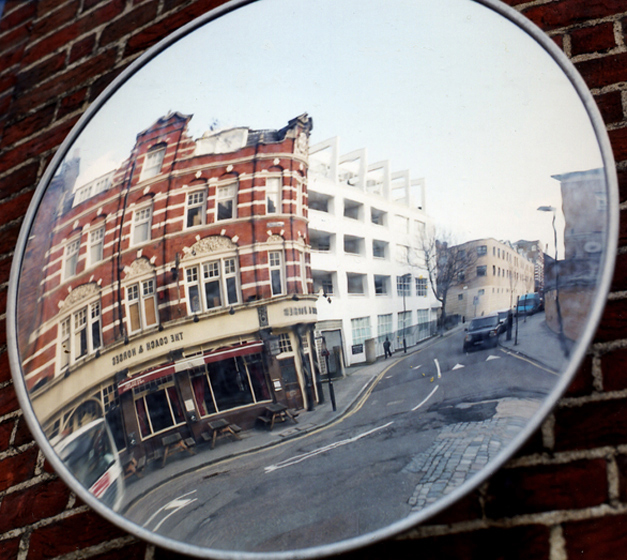
Back Hill and Ray Street, Clerkenwell. © David Secombe 2010
From The Fascination of London: Holborn and Bloomsbury, ed. Sir Walter Besant 1903:
Just here, where Back Hill and Ray Street meet, was Hockley Hole, a famous place of entertainment for bull and bear baiting, and other cruel sports that delighted the brutal taste of the eighteenth century. One of the proprietors, named Christopher Preston, fell into his own bear-pit, and was devoured, a form of sport that doubtless did not appeal to him. Hockley in the Hole is referred to by Ben Jonson, Steele, Fielding, and others. It was abolished soon after 1728.
David Secombe:
The Coach and Horses pub – reflected in the mirror in the picture above – now occupies the site of Hockley Hole, one of the least salubrious entertainment venues in London’s history. The pub rests at the bottom of a curious depression in the heart of Clerkenwell, behind the old Guardian building on Farringdon Road – which itself marks the course of the river Fleet, which Victorian engineers – eventually – paved and tamed into a churning sewer. (Supposedly, the original Coach and Horses afforded access to the Fleet from its cellars, providing Georgian fugitives with an escape route to the Thames.) This dingy, hidden locale is a beacon for anyone of a Psychogeographical persuasion, as three centuries of real and imagined associations intersect here. We have touched upon Hockley Hole before, but a passage in Lucy Inglis’s fine new book Georgian London: Into the Streets prompted us to revisit the immediate environs. In her book, Lucy provides further details of the delights afforded by Hockley Hole (or Hockley-in-the-Hole) :
By the turn of the eighteenth century, baiting had moved north of the river – to Hockley-in-the-Hole, in Clerkenwell. In 1710, there was ‘… a match to be fought by two dogs, one from Newgate-market, against one from Honey-lane market, at a bull … which goes fairest and fastest in, wins all. Likewise, a green bull to be baited, which was never baited before; and a bull to be turned loose with fireworks all over him. Also a mad ass to be baited. With a variety of bull-baiting and bear-baiting, and a dog to be drawn up with fireworks. To begin exactly at three of the clock.’ Hockley was the centre of bull terrier breeding in London, and so perhaps it was natural that the sport would move there. In 1756, Hockley disappeared with the continuing Fleet development, and bull-baiting moved to Spitalfields. Increasingly unpopular, it was soon confined almost exclusively to market towns.
The mirror in the picture above is located on the wall of a huge industrial building (now home to one of Central St Martins design campuses) which straddles Back Hill and lower Saffron Hill. In The Fascination of London, Walter Besant quotes an earlier writer’s description of Saffron Hill as “narrow and mean, full of Butchers and Tripe Dressers, because the Ditch runs at the back of their Slaughter houses, and carries away the filth.” Besant takes the opportunity to add that ‘in later times Italian organ-grinders and ice-cream vendors had a special predilection for the place, and did not add to its reputation’ – but he also acknowledges that ‘all this district is strongly associated with the stories of Dickens’. In Oliver Twist, set in 1838, the year it was written, Dickens describes the Artful Dodger leading Oliver to Fagin’s lair:
‘They crossed from the Angel into St. John’s Road; struck down the small street which terminates at Sadler’s Wells Theatre; through Exmouth Street and Coppice Row; down the little court by the side of the workhouse; across the classic ground which once bore the name of Hockley-in-the-Hole; thence into Little Saffron Hill; and so into Saffron Hill the Great: along which the Dodger scudded at a rapid pace, directing Oliver to follow close at his heels.’
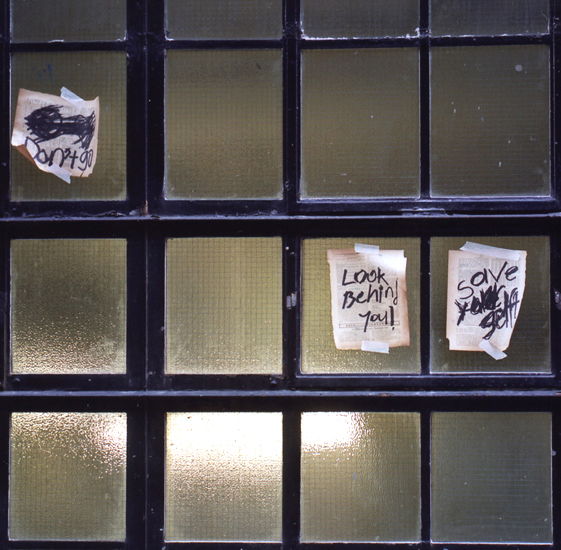
College window, Back Hill. © David Secombe, 2010.
On the same turf 150 years later, a real-life match for Dickens’s characters is described by the late John Londei, a much-missed photographer, writer and contributor to this site. As John wrote in 2011:
Some people might think little Jimmy Cleary eccentric, but to me he was a walking landmark: someone whose presence brings a touch of magic to an area. Whenever I saw Jimmy I knew I was in Clerkenwell. Jimmy’s speciality was annoying motorists. He would not tolerate errant parking; his life seemed devoted to chasing drivers on from yellow lines. And woe betide anymore who ignored his orders! Bringing out a tattered notebook he took their number, and created such a commotion that the poor motorist found himself the centre of attention.
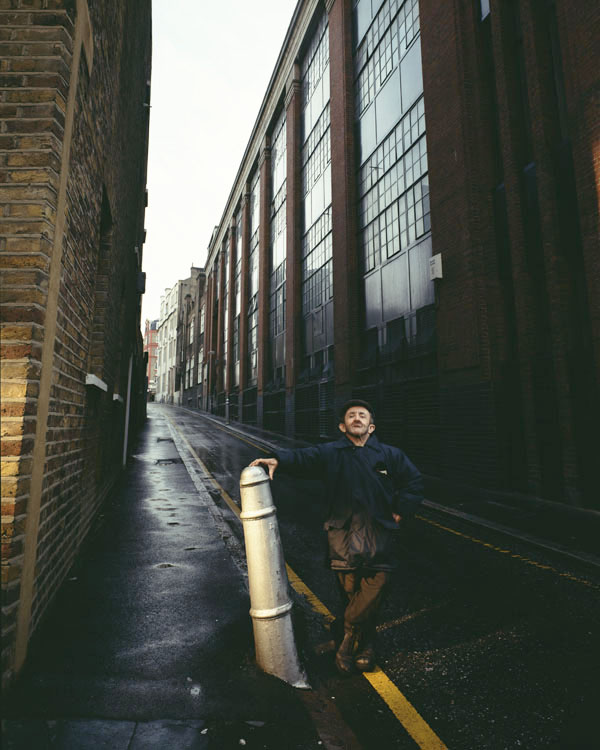
Jimmy Cleary, ‘King of Clerkenwell’, Back Hill. © John Londei 1983.
Returning to the photo at the top of this page, the modern white building in the reflection lies on Warner Street, formerly Great Warner Street. In the 18th Century, this street was the home of Henry Carey, author of Sally in our Alley: ‘one of the very prettiest of old London love songs.’ Walter Thornbury, writing in 1878 (Old and New London Vol.2; Clerkenwell) provides this biographical snippet:
Henry Carey … lived and died at his house in Great Warner Street. Carey, by profession a music-master and song-writer for Sadler’s Wells, was an illegitimate son of the Marquis of Halifax, who presented the crown to William III. The origin of Carey’s great hit, Sally in our Alley, was a ‘prentice day’s holiday, witnessed by Carey himself. A shoemaker’s apprentice making holiday with his sweetheart, treated her with a sight of Bedlam, the puppet-shows, the flying chairs the elegancies of Moorfields, and from thence proceeding to the Farthing Pye House, he gave her a collation of buns, cheesecakes, stuffed beef, and bottled ale; through all of which scenes the author dodged them. Charmed with the simplicity of their courtship, he wrote his song of Sally in our Alley, which has been well described as one of the most perfect little pictures of humble life in the language. Reduced to poverty or despair by some unknown cause, Carey hung himself in 1743. Only a halfpenny was found in his pocket.
In the 19th century, Great Warner Street was bisected by Rosebery Avenue,a Victorian creation forming part of the general ‘ventilation’ of Holborn, clearing away many of the old houses in the area.

Staircase to Rosebery Avenue from Warner Street. © David Secombe 2010.
… for The London Column. Georgian London is published by Penguin.


 The London Column


