Incredible Londoners. Photo & text: David Secombe.
Posted: May 18, 2012 Filed under: Artistic London, London Music, Pubs, Vanishings | Tags: incredible Londoner, Jerusalem Tavern, Johno Driscoll, Thomas Britton 4 Comments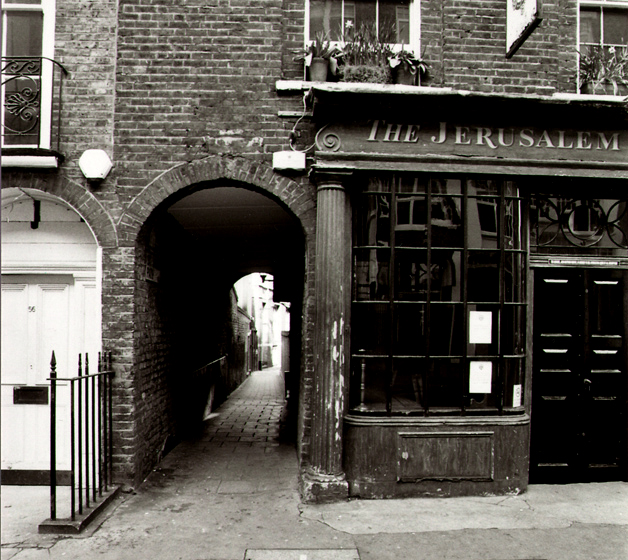
Jerusalem Tavern and Jerusalem Passage, Britton Street, Clerkenwell. Photo © David Secombe 2010.
This week’s sad news has prompted some of us to remember pub crawls with John on his patch, and the names of the hostelries we’d encounter on the way: The Horseshoe in Clerkenwell Close, The Crown on Clerkenwell Green, The Coach and Horses in Ray Street, The Marie Lloyd in Hoxton, The Eagle on Farringdon Road, the Sekforde Arms on Sekforde Street – and, now and again, The Jerusalem Tavern on Britton Street. As this week we have been remembering a great Londoner and champion of art, it seems oddly fitting to add this nugget about an artistic promoter who operated in the same area 300 years ago, and who is now buried in Clerkenwell churchyard. D.S.
From Without the City Wall, Hector Bolitho and Derek Peel, 1951:
Britton Street was named after an incredible Londoner of the late 17th century who walked the streets by day “in his blue frock coat and with his small coal-measure in his hand”, and who by night gave concerts in his humble abode next to Jerusalem Tavern, in what is still Jerusalem Passage. In The London Magazine we read: “On the ground floor was a repository for small coal; over that was a concert room, which was very long and narrow. … Notwithstanding all, this mansion attracted to it as polite an audience as ever the opera did.. … At these concerts Dr. Pepusch and frequently Mr.Handel played the harpsichord.” When passing along the streets with his sack of small-coal on his back, Thomas Britton “was frequently accosted with such expressions as these: ‘There goes the famous small-coal man, who is a lover of learning, a performer in music and a companion for gentleman.’”
Ridgers reminisces. Photo & text: Derek Ridgers (1/5)
Posted: November 28, 2011 Filed under: Bohemian London, London Music, London Places, London Types | Tags: Cheapo Cheapo, Chrissie Hynde, Nick Kent, NME 1 Comment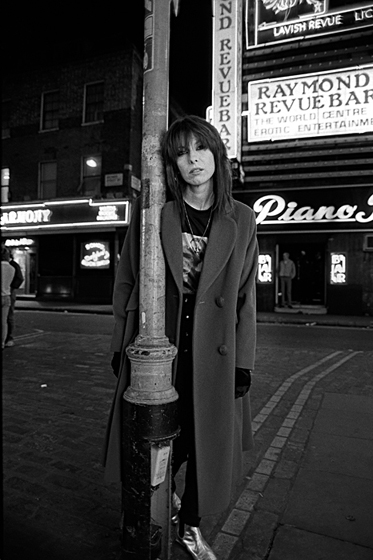
Chrissie Hynde, Soho, 1990. © Derek Ridgers.
Derek Ridgers writes:
In the late ’70s I was working in an ad agency that was slap bang in the middle of Soho and through the first floor windows of said agency, we had a front seat view of the rich pageant of Soho life only a few feet below. The agency was only about 50 yards away from the passage next to Raymond’s Review Bar and we were able to observe the prostitutes, armed policemen, con men, clip girls, drunks, junkies, glue sniffers and all manner of street people. These types were very thick on the ground in the Soho of the ’70s.
One got very used to seeing some of them. There was one guy I used to see a lot. A dyed-black haired, lanky twerp, normally dressed from head to toe in leather, who obviously thought of himself as some sort of covert rock star. He also wore eye-liner. He always looked totally messed up, emaciated and completely out of it. It was not always an appealing sight. I remember being particularly appalled by seeing the lanky twerp walking through Soho market with his scrotum hanging out of a hole in his trousers. He seemed totally oblivious to this.
Working right in the middle of Soho did have it’s advantages though. My office was a 45 second jog away from the best second hand record shop in the country – Cheapo Cheapo – and every Wednesday morning, at about 11.00 o’clock, the new review copies would arrive and be put straight out into the racks. I was, by this time a voracious reader of both Sounds and NME and my heroes were Charles Shaar Murray, Nick Kent and Danny Baker. I pretty much bought everything they gave a decent review too. So, every Wednesday at exactly 10.55, I’d make an excuse at work and run down to Cheapo Cheapo to buy, at about half the RRP, some of the records that had been favourably reviewed in the previous weeks rock papers. I didn’t realise it at the time but there was every likelihood these were exactly the same copies that had been so reviewed. I’d often see the lanky twerp hanging about Cheapo Cheapo at about the same time as me and I assumed he’d worked out what time the review copies arrived too. I always tried to make sure I got to the best records before he did and, for some strange reason, I always seemed to.
I’d been doing this for a few years during the late ‘70s. Until eventually I got the sack from the agency, became a photographer and I met the NME writer Cynthia Rose. Through her, I got a crack at working for NME myself. One day when we were both hanging about Virgin Records, in Oxford Street, she introduced me to my hero, the writer Nick Kent. And I recognised him as the lanky twerp. The very same lanky twerp that I’d seen rather too much of once before.
(And so it dawned on me that he hadn’t been hanging about Cheapo Cheapo waiting to buy the records but rather selling them the ones I’d subsequently been buying).
The above story is just an excuse to recommend Nick Kent’s fantastic book Apathy For the Devil which is a ’70s memoir of his time as a rock writer and it has some absolutely fantastic stuff about the Rolling Stones, Iggy Pop and the Sex Pistols. It’s just about my favourite rock book since his last one The Dark Stuff. I don’t have a photograph of Nick Kent. But his book has quite a lot about the time when he lived with Chrissie Hynde and so I’ve used a photograph of her. Coincidentally it was taken almost right outside Cheapo Cheapo.
And if you should ever read this Nick, I apologise for once calling you a twerp.
© Derek Ridgers. From The Ponytail Pontifications.
Drinker’s London. Photos Paul Barkshire, text David Secombe. (3/5)
Posted: October 20, 2011 Filed under: Bohemian London, London Music, Pubs, Theatrical London | Tags: Brydges Place, Drinking in London, English National Opera, Paul Barkshire, Saffron Burrows, The Harp, The Marquis Comments Off on Drinker’s London. Photos Paul Barkshire, text David Secombe. (3/5)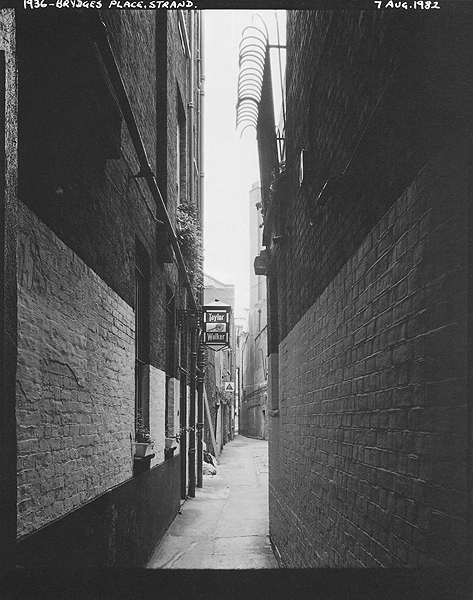
Brydges Place, WC2, 1982. Photo © Paul Barkshire.
Brydges Place – “the narrowest alley in London” – runs between St. Martin’s Lane and Bedfordbury. Paul Barkshire’s photograph shows the view towards St.Martin’s Lane, where the alley narrows with an authentically Victorian oppressiveness before it opens out into the bright lights next to the Coliseum. Ahead, the pub signs denote the back doors of The Marquis and The Harp, the latter being one of the nicest remaining West End pubs; immediately behind where Paul placed his camera is 2 Brydges Place, a civilized drinking club which, like the Harp, is much favoured by actors and theatre people.
This Dickensian little alley – a relic of a time when London was interlaced with innumerable such passages, usually forbidding rather than charming – offers many possibilities for drinking, socialising and making odd connections in general. On a warm night, or just when the pubs are so rammed that they spill into the alley, one can strike up intriguing conversations with strangers. And the stars are more vivid when you can only see a narrow slit of sky (past the sodium yellow of the streetlights, of course).
It is also a good spot to make a fool of yourself. Your correspondent went to English National Opera at the Coliseum earlier this year, and after a couple of sharpeners at the Harp, used Brydges Place as a cut-through – forgetting how crowded it gets on a Saturday when there is a matinee at ENO. As I trundled towards St.Martin’s Lane, I noticed a very beautiful woman waiting for me to clear so she and her friend could enter the alley: I recognised her as being the celebrated actress Saffron Burrows. No sooner had I clocked her and her cheekbones than I heard her say to her companion: “We’ll have to wait for this large man to get out before we can go down here”. A fraction of a second later, I stepped on a loose paving slab and my desert-booted foot dropped into filthy rainwater up to my ankle. Smooth, smooth, smooth. D.S.
Nights at the Opera. Photo & text: David Secombe (3/5)
Posted: August 3, 2011 Filed under: London Music, Theatrical London | Tags: Gawain, Harrison Birtwistle, John Tomlinson Comments Off on Nights at the Opera. Photo & text: David Secombe (3/5)
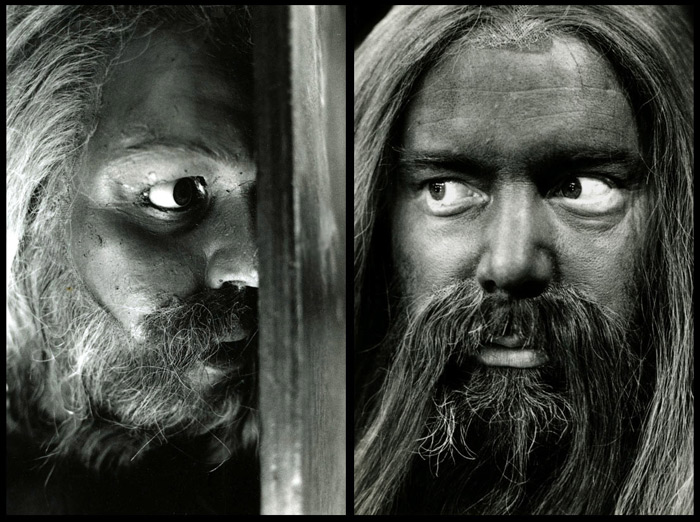
Sir John Tomlinson in make-up, right; model of Sir John’s head, left: Royal Opera House, Covent Garden. Photos © David Secombe, 1994.
Sir Harrison Birtwistle’s 1990s opera Gawain derives from the Middle English romance Sir Gawain and The Green Knight, in which the titular hero avenges the honour of King Arthur by decapitating the mysterious Green Knight who has appeared at court and insulted the King. This being a medieval romance, the Green Knight picks up his severed head and invites Gawain to a return match one year hence.
The Royal Opera House commissioned the opera from Birtwistle, with a libretto by David Harsent. The commission was an ideal match of subject and composer, given Birtwistle’s fondness for using mythic narratives as a foil for his austere, modernist style. In the photograph above right, the great Wagnerian bass John Tomlinson (now Sir John Tomlinson) sits in make-up, having just been transformed into the Green Knight. To facilitate his onstage decapitation, a model of Sir John’s head was made (above left, nestling in its box) commissioned from television’s Spitting Image puppet-making team.
The 1994 revival of Gawain at the Royal Opera House was booed by a group of musicians opposed to all post-romantic developments in classical music; they called themselves ‘The Hecklers’ and went to the opera for the purpose of abusing the work and its composer. Naturally, the publicity drew more attention to the opera and Birtwistle himself, as did the programming of his characteristically uncompromising saxophone concerto Panic at 1995’s Last Night of the Proms. Birtwistle’s music reminds this listener of the best 1960s Brutalist architecture: short on charm, but supremely confident in its structural integrity and expression of purpose. That said, my own attendance at the opera lasted about fifteen minutes, after which I went to the crush bar in search of a gin and tonic. D.S.


 The London Column