East London Song (after Bertolt Brecht & Kurt Weill)
Posted: April 30, 2014 Filed under: Amusements, Class, London Places, London Types | Tags: Alabama Song, Brecht/Weill, Dalston Junction, Jim Morrison, Katy Evans-Bush, Kurt Vile, London Hipsters, Lotte Lenya, nathan barley, stoke newington, Tim Hadrian Marshall Comments Off on East London Song (after Bertolt Brecht & Kurt Weill)
All photos © Tim Marshall 2014.
To the tune of Alabama Song*:
Well, show me the way
to the next hipster bar.
Oh, don’t ask why.
Oh, don’t ask why.
Show me the way
to the next whiskered bard.
Oh, he won’t shave;
oh don’t ask why.
For if we don’t find
the next hipster bar,
in bitcoins we can’t pay;
in Shoreditch we will die.
I tell you, I text you,
I tell you we must die.
Sing me Kurt Vile
in the next hipster bar.
Oh, don’t ask why.
Oh, you know why.
Oh, moon of dear old Hoxton,
We now must say goodbye:
We’ve lost our sense of purpose
And need hipsters to show us why.
Oh, moon of Dalston Junction,
It’s good morning, not goodbye.
We’ve missed our good old night bus,
We need espresso, oh, you know why.
Show me the link
to the best hipster URL,
it will lead the way.
It will lead the way.
Oh, retro moon of London,
How analogue you are!
We lost all our signal,
down in the cellar bar.
Oh, moon of old Stoke Newington,
We ne’er must say goodbye.
You shine on our old-style Instagrams;
We need filters, don’t ask why.
The moon shines over Clapton
and we now must say goodbye.
Some of us live in Walthamstow`
(though others would rather die).
Well, show me the way
to the next lo-fi bar.
The wood’s all ply,
the wood’s all ply.

For if we don’t find
a plaid-shirted earl
I tell you we must lie,
and tell them it’s this guy.
They’ll trust you. I’ll text you.
I tell you we must lie.
Show me the place
where the real hipsters are.
They don’t ask why,
they don’t care why.
Oh, moon of Lea Bridge Roundabout
Like bunting in the sky:
We’ve lost our good old Rastas,
And must have hipsters, oh, who knows why.
* Bertolt Brecht reworked by Katy Evans Bush for The London Column. The photos are from Timothy Hadrian Marshall’s series King’s Cross Stories.
New Year’s Eve.
Posted: December 31, 2013 Filed under: London Places, Monumental, Theatrical London | Tags: Denys Lasdun, Royal National Theatre Comments Off on New Year’s Eve. National Theatre from Waterloo Bridge, December 2013. © David Secombe.
It’s been a smeary, wind-tossed festive season in London and the UK, and I am in a rush to go to a party in Walthamstow – but by way of farewell to 2013, here is an iPhone image of the National Theatre in which Denys Lasdun’s Brutalist masterpiece resembles a giant boiled sweet.
I don’t know about any of you but I am hoping for better things in 2014: let us hope they start tonight. Thanks to all our readers and contributors and a very Happy New Year.
David Secombe.
Four streets off Hockley Hole.
Posted: September 12, 2013 Filed under: Amusements, Entertainment, Fictional London, London Places, London Types, The Fleet | Tags: Artful Dodger, Back Hill, bear baiting in London, Fagin's lair, Hockley Hole, John Londei, King of Clerkenwell, old Clerkenwell, Oliver Twist, Saffron Hill, Sally in our alley 2 Comments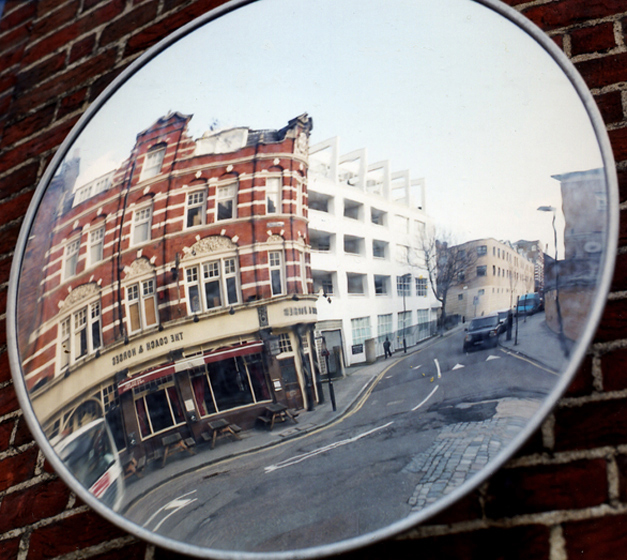
Back Hill and Ray Street, Clerkenwell. © David Secombe 2010
From The Fascination of London: Holborn and Bloomsbury, ed. Sir Walter Besant 1903:
Just here, where Back Hill and Ray Street meet, was Hockley Hole, a famous place of entertainment for bull and bear baiting, and other cruel sports that delighted the brutal taste of the eighteenth century. One of the proprietors, named Christopher Preston, fell into his own bear-pit, and was devoured, a form of sport that doubtless did not appeal to him. Hockley in the Hole is referred to by Ben Jonson, Steele, Fielding, and others. It was abolished soon after 1728.
David Secombe:
The Coach and Horses pub – reflected in the mirror in the picture above – now occupies the site of Hockley Hole, one of the least salubrious entertainment venues in London’s history. The pub rests at the bottom of a curious depression in the heart of Clerkenwell, behind the old Guardian building on Farringdon Road – which itself marks the course of the river Fleet, which Victorian engineers – eventually – paved and tamed into a churning sewer. (Supposedly, the original Coach and Horses afforded access to the Fleet from its cellars, providing Georgian fugitives with an escape route to the Thames.) This dingy, hidden locale is a beacon for anyone of a Psychogeographical persuasion, as three centuries of real and imagined associations intersect here. We have touched upon Hockley Hole before, but a passage in Lucy Inglis’s fine new book Georgian London: Into the Streets prompted us to revisit the immediate environs. In her book, Lucy provides further details of the delights afforded by Hockley Hole (or Hockley-in-the-Hole) :
By the turn of the eighteenth century, baiting had moved north of the river – to Hockley-in-the-Hole, in Clerkenwell. In 1710, there was ‘… a match to be fought by two dogs, one from Newgate-market, against one from Honey-lane market, at a bull … which goes fairest and fastest in, wins all. Likewise, a green bull to be baited, which was never baited before; and a bull to be turned loose with fireworks all over him. Also a mad ass to be baited. With a variety of bull-baiting and bear-baiting, and a dog to be drawn up with fireworks. To begin exactly at three of the clock.’ Hockley was the centre of bull terrier breeding in London, and so perhaps it was natural that the sport would move there. In 1756, Hockley disappeared with the continuing Fleet development, and bull-baiting moved to Spitalfields. Increasingly unpopular, it was soon confined almost exclusively to market towns.
The mirror in the picture above is located on the wall of a huge industrial building (now home to one of Central St Martins design campuses) which straddles Back Hill and lower Saffron Hill. In The Fascination of London, Walter Besant quotes an earlier writer’s description of Saffron Hill as “narrow and mean, full of Butchers and Tripe Dressers, because the Ditch runs at the back of their Slaughter houses, and carries away the filth.” Besant takes the opportunity to add that ‘in later times Italian organ-grinders and ice-cream vendors had a special predilection for the place, and did not add to its reputation’ – but he also acknowledges that ‘all this district is strongly associated with the stories of Dickens’. In Oliver Twist, set in 1838, the year it was written, Dickens describes the Artful Dodger leading Oliver to Fagin’s lair:
‘They crossed from the Angel into St. John’s Road; struck down the small street which terminates at Sadler’s Wells Theatre; through Exmouth Street and Coppice Row; down the little court by the side of the workhouse; across the classic ground which once bore the name of Hockley-in-the-Hole; thence into Little Saffron Hill; and so into Saffron Hill the Great: along which the Dodger scudded at a rapid pace, directing Oliver to follow close at his heels.’
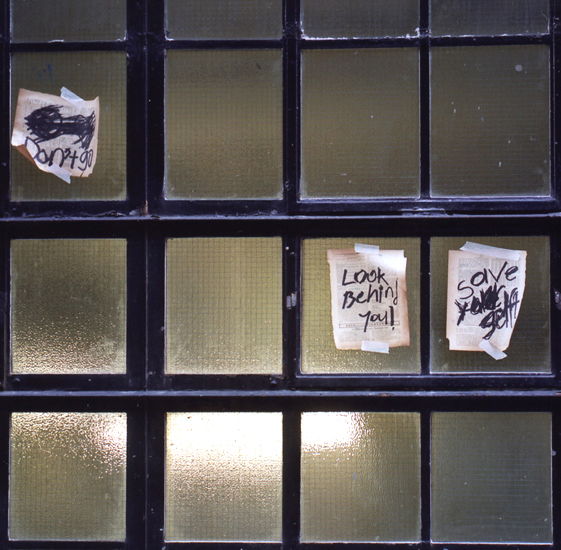
College window, Back Hill. © David Secombe, 2010.
On the same turf 150 years later, a real-life match for Dickens’s characters is described by the late John Londei, a much-missed photographer, writer and contributor to this site. As John wrote in 2011:
Some people might think little Jimmy Cleary eccentric, but to me he was a walking landmark: someone whose presence brings a touch of magic to an area. Whenever I saw Jimmy I knew I was in Clerkenwell. Jimmy’s speciality was annoying motorists. He would not tolerate errant parking; his life seemed devoted to chasing drivers on from yellow lines. And woe betide anymore who ignored his orders! Bringing out a tattered notebook he took their number, and created such a commotion that the poor motorist found himself the centre of attention.
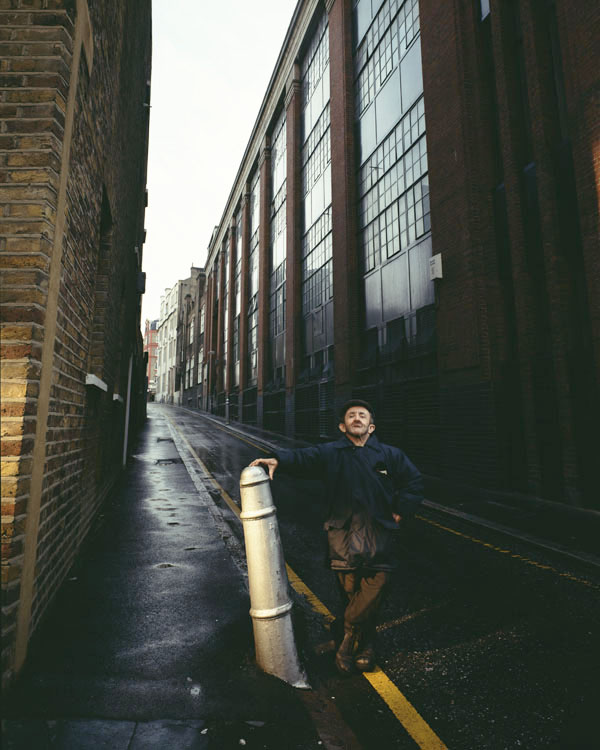
Jimmy Cleary, ‘King of Clerkenwell’, Back Hill. © John Londei 1983.
Returning to the photo at the top of this page, the modern white building in the reflection lies on Warner Street, formerly Great Warner Street. In the 18th Century, this street was the home of Henry Carey, author of Sally in our Alley: ‘one of the very prettiest of old London love songs.’ Walter Thornbury, writing in 1878 (Old and New London Vol.2; Clerkenwell) provides this biographical snippet:
Henry Carey … lived and died at his house in Great Warner Street. Carey, by profession a music-master and song-writer for Sadler’s Wells, was an illegitimate son of the Marquis of Halifax, who presented the crown to William III. The origin of Carey’s great hit, Sally in our Alley, was a ‘prentice day’s holiday, witnessed by Carey himself. A shoemaker’s apprentice making holiday with his sweetheart, treated her with a sight of Bedlam, the puppet-shows, the flying chairs the elegancies of Moorfields, and from thence proceeding to the Farthing Pye House, he gave her a collation of buns, cheesecakes, stuffed beef, and bottled ale; through all of which scenes the author dodged them. Charmed with the simplicity of their courtship, he wrote his song of Sally in our Alley, which has been well described as one of the most perfect little pictures of humble life in the language. Reduced to poverty or despair by some unknown cause, Carey hung himself in 1743. Only a halfpenny was found in his pocket.
In the 19th century, Great Warner Street was bisected by Rosebery Avenue,a Victorian creation forming part of the general ‘ventilation’ of Holborn, clearing away many of the old houses in the area.

Staircase to Rosebery Avenue from Warner Street. © David Secombe 2010.
… for The London Column. Georgian London is published by Penguin.
On the South Bank. (4)
Posted: August 9, 2013 Filed under: London Places, Monumental, The Thames | Tags: disability access, Hungerford Bridge, Saison Poetry Library, The Southbank Centre Comments Off on On the South Bank. (4)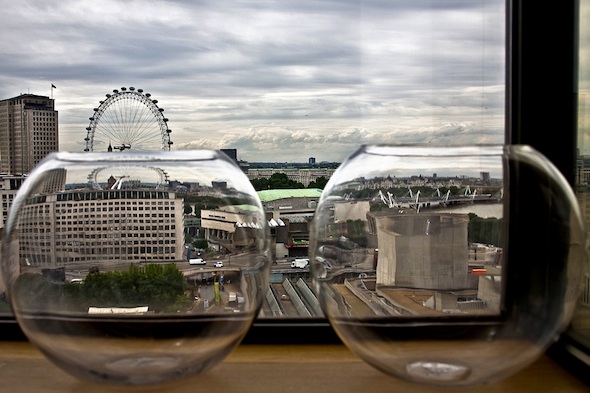
Circles Within Circles: Photo © Mark Granier
Paul Carney: An Odyssey
I have a huge-mungulous love-hate thing going with the South Bank. On the one hand it’s almost the only place to which I ever escape, ergo overwhelming connotations of freedom, restored sanity etc. On t’other, I think it was designed specifically to kill me.
The whole experience is utterly surreal; out from among Embankment station’s gloomy pillars, I’m falling again, down those same four always-forgotten steps. A silhouette thrusts paper at me as I get up. Selling, collecting, petitioning for something. I wave my white stick in a signal that clearly reads please either lend a hand or bugger off. Would a Samurai battle-cry help at this point? Best not. A bit of wild fumbling and here is the handrail at the foot of the Hungerford Bridge.
At the top, I invariably bump (literally) into a man in a wheelchair who seems poised forever at the top of the 42 steps; it’s as though he’s being punished in a Greek myth. At least I haven’t collided with him this week. Halfway over the bridge an old friend and tripping hazard, Tattered Guitar Man, is still endlessly ringing in the Apocalypse with his one weary, toneless chord, and passers-by are always ridiculing him and he just strums all the more. I would drop him a coin, if I could ever see where he lays his hat.
The first time I ever crossed this bridge, there was a man walking ahead of me dressed as a giant green triangle, with scrawny legs in tights of a paler green, and people weren’t giving him a second glance, whereas assorted hot young women were pointing and giggling at me for having a white stick and a hi-viz jacket.
The South Bank Centre itself is allegedly a stunning view, but to Paulish eyes it looks like a cross between a construction site and Eliot’s Waste Land. I pull my baseball cap down and make myself look up. Remember the view! Some of these buildings have won awards… The magazine articles… A shipwreck on a rooftop… But I see no ships. There is no view. Only the Waste Land.
There are, says the legend, doors all over the place here. But only one entrance is my entrance, whence I can feel my remembered way to a lift. And don’t get me started on the indoors of the Royal Festival Hall! Only in the company of a certain genius poetry tutor I know do I brave it…
One thing I’ve never come across is the beleagured skateboard park – I’ve never made it that far – but since it is clearly doing Paul no harm whatsoever (UNlike the new pre-fab restaurant that blocks my route and has caused multiple injuries!), I’m now passionately in favour of letting it be. Why shouldn’t the young’uns have somewhere to whizz about on wheels? It does actually sound like fun.
Pigeons get into this building. Often, the clatter of wings above has startled me. Does some slow-ambling, gently dolorous janitor finally come by night to sweep up their small bones? Should I get out on the wrong floor, he would probably find my bones too, in due course. Elevator, take me straight to the Fifth, and only to the Fifth … There, all will be daylight and space. Windows and pale columns. Got to be wary of those columns, though – inexplicable shelf-things protrude from some of them at vital-organ height. But I am way-wise on the Fifth, now. Ha! Or at least that part of it that is touched by the sun. I was told that the Poetry Library is right here, in this place and on this floor. Down the Dark Stairs, past the Lesser Toilets and farther into the Realm of No Light Whatsoever.
Poetry? Here? Sometimes I have tried picturing poems – I see them as the little frail white moths of childhood – flitting among all the unlovely columns, slabs and balustrades. Can poetry truly live here?
I have a table. I have chairs. I have my back to the sun, the river and the Telecom Tower. I can breathe now, and take off my luminous jacket. I will hang it on the empty chair – it will be my flag, proclaiming this furniture is taken. It is ours alone. She will find me here when she comes, and she will yell out my name, dancing and waving her arms above her head.
© Paul Carney


 The London Column