Speciality Acts.Photos & text: David Secombe (1/3)
Posted: January 11, 2012 Filed under: Entertainment, London Types, Performers, Theatrical London | Tags: Harry Houdini, Larry Barnes, New Variety, Straitjacket escape routine, The Viceroy of Versatility Comments Off on Speciality Acts.Photos & text: David Secombe (1/3)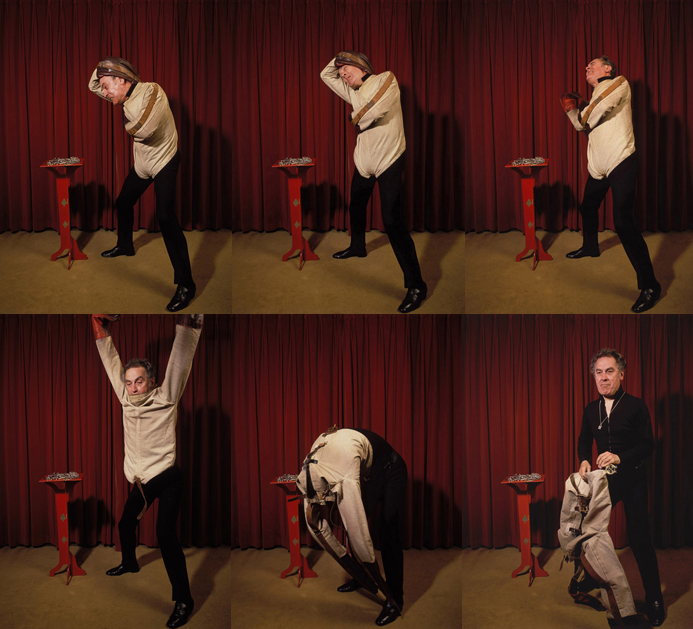
Larry Barnes, ‘The Viceroy of Versatility’, Finchley. © David Secombe 1990.
From the Obituary column of The Stage:
Larry Barnes
Published Monday 15 August 2011 at 17:42 by Richard Anthony Baker
Billed as the Viceroy of Versatility, Larry Barnes lived up to the promise. As one of the variety theatre’s last speciality acts, he was a magician, an escapologist, a balloon sculptor and most famously a paper tearer.
His father introduced him to music hall when he was still a boy and, after only a brief stint at the Italia Conti Academy of Theatre Arts, he made his stage debut at the Adelphi in 1941/42 playing a pirate in Peter Pan with Barbara Mullen in the title role. After serving in the Second World War, he resumed his stage career and also worked as a stunt man in films, including The Colditz Story (1955).
After contracting arthritis following an accident on stage, he furthered his interest in magic and took part in the Tower’s annual music hall shows. He also recreated the escapology act of Houdini, releasing himself from a range of ancient handcuffs and a straitjacket in less than a minute. In addition, he built up a repertoire of songs that he combined with his conjuring and paper tearing. His most famous was If It Wasn’t For the ‘Ouses in Between, originally sung by the Cockney comedian, Gus Elen. Barnes’ gimmick was this – as he reached certain words in the song, such as ‘a ladder’, or ‘a tree’, or ‘a row of houses,’ he would produce his paper representation of them. “Wiv a ladder and some glasses, you could see to ‘Ackney Marshes, if it wasn’t for the ‘ouses in between.”
David Secombe writes:
These photos showing Larry Barnes demonstrating his version of Harry Houdini’s straitjacket routine were made at the home of Larry’s assistant (who was also a Justice of the Peace) in Finchley. The photos were commissioned for a Sunday Times Magazine feature on ‘Speciality Acts’, which were having something of a revival at the time – the term covered old-timers like Larry and the new breed of more outre ‘New Variety’ performers such as the ‘regurgitator’ Stevie Starr, another on my list of subjects. Larry arrived at his assistant’s later than billed, dressed in an extravagant outfit which spoke of the theatricality of an earlier era; unfortunately, his stylish presentation was the reason for his lateness, as he had been mugged on the Victoria Line by some football supporters who took exception to his appearance and stole his carpet-bag of props. The bag was thrown onto the platform at the next stop, but Larry had had to go to Brixton to retrieve them from lost property.
Amongst other things, the bag contained Larry’s prized handcuffs, allegedly the property of Houdini himself – although it has to be said that Larry was a bit vague on their provenance. But Larry’s tour-de-force was his straitjacket escape, which provided this photographer with a sequence of a dozen images which – by accident rather than design – look like some kind of collaboration between Edward Muybridge and Francis Bacon. The pictures only give a hint of the tremendous effort Larry put into this stunt, but I like to think that his expression in the final image gives an indication of the nature of his achievement. Quite literally, Larry shows us what it means to be free.
Larry Barnes, born Islington May 16, 1926; died Hackney, July 2, 2011.
… for The London Column. © David Secombe 2012.
Ridgers reminisces. Photo & text Derek Ridgers (5/5)
Posted: December 2, 2011 Filed under: Crime and Punishment, London Types | Tags: Freddie Foreman, Jack 'The Hat' McVitie, London underworld, Tony Lambrianou Comments Off on Ridgers reminisces. Photo & text Derek Ridgers (5/5)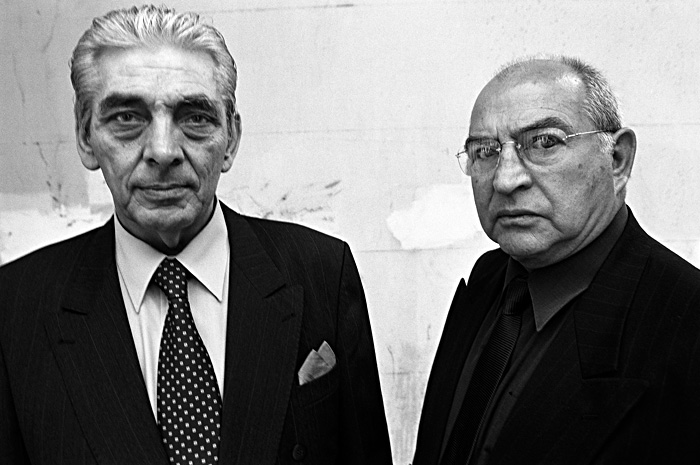
Tony and Freddie, Southwark, 2000. Photo © Derek Ridgers.
Derek Ridgers writes:
This is a portrait of Tony Lambrianou (RIP) and Freddie Foreman commissioned by Vox magazine. Freddie Foreman who is, incidentally, the father of the actor Jamie Foreman, was once known as ‘Brown Bread Fred.‘ If you don’t know your cockney rhyming slang, the significance of this nickname won’t be obvious but save to say they were both once rather dangerous men. They were both associates of the Kray firm and they both served serious prison time for their involvement in the murder of Jack ‘The Hat’ McVitie.
I photographed them around Freddie’s old manor, in the area south of Southwark Bridge in London. I went on a pub crawl with them afterwards and they were very amusing company, with endless stories of the old days and all their friends, euphemistically known as “the chaps.” They were nice but, even in their dotage, I’d be lying if I said that they were completely devoid of any hint of menace. If I’d have met them in their pomp, in the ‘60s, I’d have run a mile.
The thing is, back then, they might not have let me.
© Derek Ridgers. From The Ponytail Pontifications.
Ridgers reminisces. Photo & text: Derek Ridgers (3/5)
Posted: November 30, 2011 Filed under: Bohemian London, Clubs, London Types | Tags: Fetish, Skin Two, Torture Garden Comments Off on Ridgers reminisces. Photo & text: Derek Ridgers (3/5)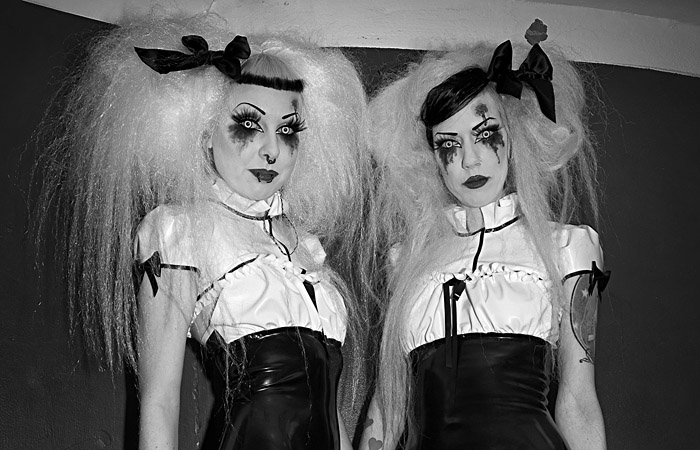
Ann-Sophie and Jenni, The Torture Garden, London, 2010. © Derek Ridgers.
Derek Ridgers writes:
I’ve been taking photographs in London fetish clubs since 1981. And the occasional fetishist in other clubs since about 1978.
To the best of my knowledge, the popularity of fetishism really started in the UK in 1976 with the emergence of punk rock and the appropriation of elements of bondage and fetish wear by many of the punk era designers. Prior to this time, people who wanted to dress in rubber and PVC had to do it behind closed doors, ordering their outfits by mail-order in brown paper parcels.
To begin with it was just a handful of people in a small dingy Soho club called Skin Two, which resided in what was, the rest of the week, a gay club called Stallions. Skin Two was started by an actor called David Claridge. He went on to become famous as the hand up the furry arse of TV star ‘Roland Rat’ and after his nocturnal predilections were exposed by the gutter press, he disappeared from the scene. The atmosphere in the Skin Two club was oppressive and sometimes menacing. Outsiders, especially ones with cameras, were certainly not made to feel welcome. But, pretty soon, big name photographers like Bob Carlos Clarke and several others brought fetish style images into view more and things got a lot more relaxed.
By the mid-’80s PVC and rubberwear was all over fashion magazines and pop videos. By the late ’80s/early ’90s some of the bigger fetish clubs like Submission and Torture Garden could easily attract 3000 people a night and people came from all over the world to get there. And then some of them went back home and started their own fetish clubs. Nowadays, Torture Garden has become very mainstream and it’s not completely unlike any other large club in any other major western city, except sometimes people are dressed very oddly.
In the early days, I got threatened with physical violence in Skin Two several times. One guy seized me by the neck and we nearly came to blows. A couple of women grabbed me one night and tried to drag me over to where one of the dominatrixes was waiting, whip in hand. I had to manhandle them off me and make my getaway. But I was clearly an outsider back then and I would never have even gotten into the early fetish clubs if I hadn’t become friendly with some of the people running them. I know for a fact that most of the old-time fetishists resented my presence. But it was obviously people like me that helped to publicise and promote the scene, so the people who ran the clubs have always been very welcoming. These days you can’t move for photographers in these kind of clubs.
I’m not really sure what it was about the fetish scene that appealed to me. I’m not a fetishist myself and don’t even really like wearing the leather trousers I’m obliged to wear in these clubs. To begin with I had a real compulsion to photograph the way people were dressing and the amount of humour and invention some people put into creating their own, largely home-made, outfits was certainly worth somebody recording. These days, most people in fetish clubs are wearing shop bought, off-the-peg outfits but there are still many remarkable individualists.
Nevertheless, some people say that there’s something badly wrong with any man over 30 who still wears leather trousers, whatever the excuse. In my case, they’re probably right. Exactly what that something “wrong” might be, I’ll leave you to draw you own conclusions.
Anyone who wants to know more about the fetish scene could do a lot worse than go here – http://www.thefetishistas.com/
© Derek Ridgers. From The Ponytail Pontifications.
Ridgers reminisces. Photo & text: Derek Ridgers (1/5)
Posted: November 28, 2011 Filed under: Bohemian London, London Music, London Places, London Types | Tags: Cheapo Cheapo, Chrissie Hynde, Nick Kent, NME 1 Comment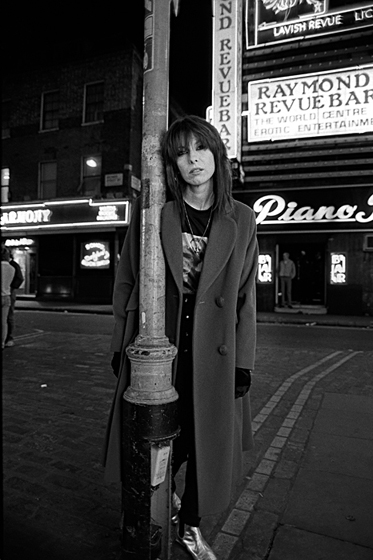
Chrissie Hynde, Soho, 1990. © Derek Ridgers.
Derek Ridgers writes:
In the late ’70s I was working in an ad agency that was slap bang in the middle of Soho and through the first floor windows of said agency, we had a front seat view of the rich pageant of Soho life only a few feet below. The agency was only about 50 yards away from the passage next to Raymond’s Review Bar and we were able to observe the prostitutes, armed policemen, con men, clip girls, drunks, junkies, glue sniffers and all manner of street people. These types were very thick on the ground in the Soho of the ’70s.
One got very used to seeing some of them. There was one guy I used to see a lot. A dyed-black haired, lanky twerp, normally dressed from head to toe in leather, who obviously thought of himself as some sort of covert rock star. He also wore eye-liner. He always looked totally messed up, emaciated and completely out of it. It was not always an appealing sight. I remember being particularly appalled by seeing the lanky twerp walking through Soho market with his scrotum hanging out of a hole in his trousers. He seemed totally oblivious to this.
Working right in the middle of Soho did have it’s advantages though. My office was a 45 second jog away from the best second hand record shop in the country – Cheapo Cheapo – and every Wednesday morning, at about 11.00 o’clock, the new review copies would arrive and be put straight out into the racks. I was, by this time a voracious reader of both Sounds and NME and my heroes were Charles Shaar Murray, Nick Kent and Danny Baker. I pretty much bought everything they gave a decent review too. So, every Wednesday at exactly 10.55, I’d make an excuse at work and run down to Cheapo Cheapo to buy, at about half the RRP, some of the records that had been favourably reviewed in the previous weeks rock papers. I didn’t realise it at the time but there was every likelihood these were exactly the same copies that had been so reviewed. I’d often see the lanky twerp hanging about Cheapo Cheapo at about the same time as me and I assumed he’d worked out what time the review copies arrived too. I always tried to make sure I got to the best records before he did and, for some strange reason, I always seemed to.
I’d been doing this for a few years during the late ‘70s. Until eventually I got the sack from the agency, became a photographer and I met the NME writer Cynthia Rose. Through her, I got a crack at working for NME myself. One day when we were both hanging about Virgin Records, in Oxford Street, she introduced me to my hero, the writer Nick Kent. And I recognised him as the lanky twerp. The very same lanky twerp that I’d seen rather too much of once before.
(And so it dawned on me that he hadn’t been hanging about Cheapo Cheapo waiting to buy the records but rather selling them the ones I’d subsequently been buying).
The above story is just an excuse to recommend Nick Kent’s fantastic book Apathy For the Devil which is a ’70s memoir of his time as a rock writer and it has some absolutely fantastic stuff about the Rolling Stones, Iggy Pop and the Sex Pistols. It’s just about my favourite rock book since his last one The Dark Stuff. I don’t have a photograph of Nick Kent. But his book has quite a lot about the time when he lived with Chrissie Hynde and so I’ve used a photograph of her. Coincidentally it was taken almost right outside Cheapo Cheapo.
And if you should ever read this Nick, I apologise for once calling you a twerp.
© Derek Ridgers. From The Ponytail Pontifications.


 The London Column