London Gothic. Photo & text: David Secombe. (4/5)
Posted: July 5, 2012 Filed under: Pubs, The Thames, Vanishings | Tags: Dickens, J.G. Ballard, joggers of Wapping, our mutual friend, Town of Ramsgate, Wapping High Street, Wapping Old Stairs Comments Off on London Gothic. Photo & text: David Secombe. (4/5)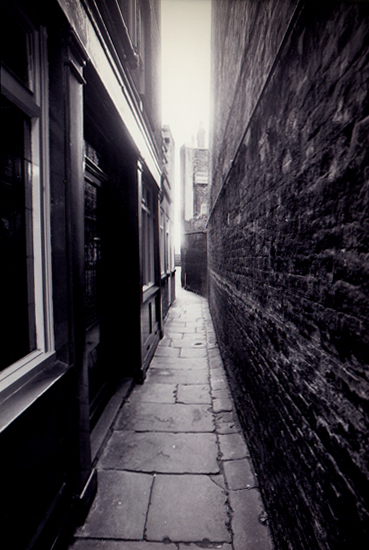
Town of Ramsgate pub, Wapping Old Stairs. Photo © David Secombe 2010.
From Unknown London, W.G. Bell, 1919:
Wapping High Street in the days of Nelson’s wars possessed upwards of one hundred and forty ale-houses. In a recent perambulation I was not able to count ten. Together with these reeking drink shops, inexpressible in their squalor and dirt, were other houses of resort which one may deftly pass by without too curious enquiry. In the gloomy slum area at the back, the inner recesses of the hive, mostly dwelt the people who lived, quite literally upon the sailor, and they formed the greater part of the population that was herded here. Every tavern kept open door to welcome the mariner with wages in his pocket.
You may land at the Old Stairs still … The ‘Town of Ramsgate’ stands at the head of the Stairs, where it has stood these past two centuries or more for the refreshment of sailors. Wapping was the busiest centre of the seafaring life of the port of London. Of the many landing-places, the deserted Old Stairs and the New Stairs, nearer the City, alone survive. And you may tramp Wapping from end to end without recognizing a sailor man.
David Secombe:
Nearly a hundred years later, Bell’s assessment of Wapping remains valid, although these days the eeriness of its riverside enclave has a particularly 21st Century quality. Wapping High Street’s narrow pavements teem with joggers: driven young (or young-ish) men and women who appear from nowhere, pounding behind you silently before speeding past towards … what? Apart from the joggers, you may see a few tourists who make the journey to visit the pubs and riverside sights, and it is undeniably true that at certain times (dusk in November, for example) the environs of Wapping Old Stairs retain an impressive atmosphere: catnip for Dickens-fanciers armed with much-thumbed copies of Our Mutual Friend. However, in cold, hard daylight, the perfectly made-over warehouses and tastefully integrated new-build developments dispel memories of Dickens and recall instead the preoccupations of a more modern London writer: J.G. Ballard. Modern Wapping could be a starting point for one of his forensic studies of fear within insular communities, wherein the hot-house social conditions unleash perversity and violence behind the security gates of the ‘executive development’. In the 1970s, he set such a dystopia downriver, in a tower block that might have been designed by Erno Goldfinger (High Rise); but the make-over of ‘heritage’ environments, the loading-bays transformed into penthouses, offers a more contemporary setting for a Ballardian nightmare.
Ultimately, perhaps, the unnerving quality riverside Wapping possesses today is that of a ghost seen walking in the noonday sun: the ghost of London.
… for The London Column.
Flotsam and jetsam. Photo & text: David Secombe (5/5)
Posted: April 20, 2012 Filed under: The Thames | Tags: Bart Simpson, Canary Wharf, Isle of Dogs construction, joshua bazalgette, London river views, Victorian London sewage, view from Greenwich 5 Comments
The Thames opposite the Royal Hospital, Greenwich. Photo © David Secombe, 2001.
From The Gentleman’s Magazine, January 10, 1832:
The inhabitants of Greenwich were amused by a man walking under the surface of the water in the Thames immediately opposite the Royal Hospital. A craft was moored off the stairs to which was affixed a ladder, down the steps of which the exhibitor descended to the water. He was dressed in a manner so as to exclude the water from penetrating, and upon his head he wore a sort of helmet which covered his face, and in which were two small bull’s eyes, whereby he was enabled to see. During the exhibition he remained under the water nearly twenty minutes.
David Secombe writes:
As far as I can tell, the above photo of a stricken Bart Simpson was taken exactly where the event described in this clipping from The Gentleman’s Magazine took place. One can only imagine the amount of sheer ordure than the intrepid aquanaut would have waded through in the course of his heroic feat, which took place over a quarter century before Joshua Bazalgette began his improvements to London’s sanitation by directing raw sewage underground and downstream.
The buildings under construction on the Isle of Dogs are for Barclays Bank and HSBC, appropriately charmless additions to London’s skyline. What Bart was doing in the Thames, I don’t know.
… for The London Column.
Flotsam and jetsam. Photo & text: David Secombe (4/5)
Posted: April 19, 2012 Filed under: London Types, The Thames, Transport | Tags: Bugsby's Reach, corporate London, London houseboats, London Olympics, Millennium Dome, River Lea, Thames Barrier, young Damien Hirst Comments Off on Flotsam and jetsam. Photo & text: David Secombe (4/5)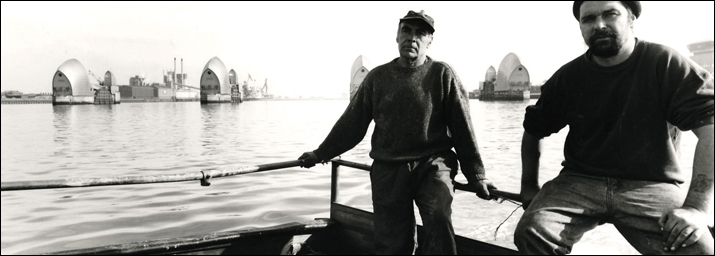
Middle of the Thames, west of the Barrier. Photo © David Secombe, 1997.
David Secombe and Katy Evans-Bush write:
The current wave of Olympic propaganda serves as a reminder of what was lost when the facilities in the Lea Valley were built. A sweetly romantic backwater of the Lea, a wild and mysterious haven for wildlife and Londoners alike, an oasis within the eastern London industrial sprawl, has been swept away in favour of a corporatised theme park. Canal boat dwellers on the River Lea are fighting draconian tightenings of rules and increases in fees from British Waterways that will break up a longstanding community and render them effectively homeless – an attempt to make the river suitably anodyne for the tourists (and presumably pave the way for future commercial ventures).
As usual, the destruction of the irreplaceable is described by its proponents as ‘regeneration’, offering ‘opportunities for business’, etc., etc. Bit by bit, we continue to lose that older, gentler, more open and more intimate city, in favour of a controlled, corporate-sponsored environment.
The new Olympic desert is the second time in recent years that a locally important riverside enclave has been destroyed under the flag of ‘national pride’. In the late 1990s, it was south-east London’s turn to get its sanitised corporate make-over, in the run-up to the Millennial fiasco at ‘North Greenwich’ (i.e. Bugsby’s Reach). The Dome was created on a stretch of industrial wasteland, yet there was an intriguing riverside community thriving in the vicinity – including, ironically (see Tuesday’s post) a young Damien Hirst, planning his bid for domination of the world’s art markets from a ménage-a-trois in a riverside cottage. Clearly, this Ealing comedy-like backwater was going to be out of place next to Blair’s vaulting dome, and was duly vapourised – except for a ‘picturesque’ riverside terrace, which was retained within the Dome’s landscaped environs: thus is young Damien’s home preserved.
The gentlemen in the above photo were members of a boating club located a few hundred yards downriver of the Millennium site. The club was too near the Dome, then under construction, for the comfort of the planners, and was duly cleared as part of the riverside ‘improvements’. And what exactly have been the long-term benefits of the Millennium Village?
(See also: Domeland series, starting here.)
… for The London Column.
Flotsam and jetsam. Photo & text David Secombe. (2/5)
Posted: April 17, 2012 Filed under: Amusements, Artistic London, The Thames, Transport | Tags: Britart, commercial Thames, corporate London, Damien Hirst, Spot paintings, Tate Boat, Tate Britain, Tate Modern, tate to tate 1 Comment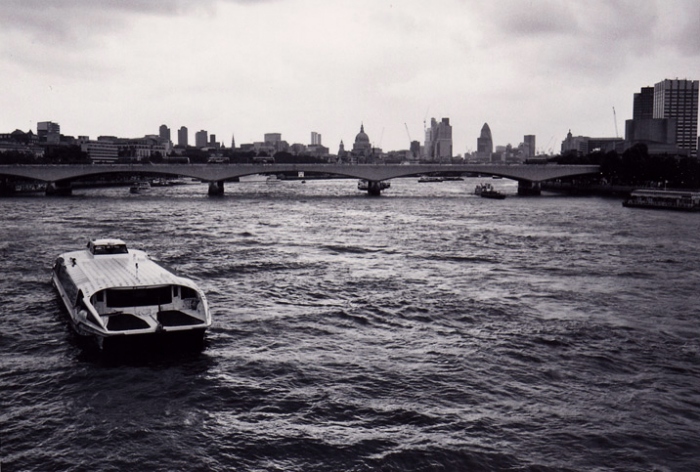
The Thames, looking east from Hungerford Bridge, 2010. Photo © David Secombe.
From Tate Online : 1 May 2003:
From 23 May Tate to Tate, a new boat service on the river Thames, will be available for gallery lovers. The service, which runs every forty minutes during gallery opening hours between Tate Modern and Tate Britain, will be launched on 22 May by The Mayor of London, Ken Livingstone. The boat also stops at the London Eye.
The Tate to Tate boat service, operated by Thames Clippers, is a state-of-the art 220 seat catamaran with specially commissioned exterior and interior designs by leading artist Damien Hirst. The boat is sponsored by St James Homes, a property developer.
David Secombe writes:
Now that Damien Hirst is the richest artist in the world (proof if any were needed of the global success of that strange London-based phenomenon known as ‘BritArt’), it seems entirely fitting that ‘the fastest’ commercial vessel on the Thames, ferrying passengers to and from the world’s most popular – some might say populist – art gallery, bears one of his patented designs. The Tate boat is decorated with Hirst’s bright, multi-coloured dots, and travels between those twin bastions of culture, Tate Modern and Tate Britain – the former fashioned from a derelict power station, the latter built on the site of a penitentiary.
For good or ill, Hirst seems to be the artist who best embodies his time; one can’t imagine a Bacon Barge or a Rothko Raft, whereas our Damien’s spotty pleasure cruiser – made possible by a property consortium – seems completely, depressingly, apt.
(The London Column has not yet felt the siren call of the current Hirst exhibition at the Tate, but you can read a response to the Sotheby’s extravaganza of 2008 on Baroque in Hackney. For another view of Hirst and his influences, see: http://www.stuckism.com/Hirst/StoleArt.html.)


 The London Column