Metro-Land.
Posted: January 10, 2013 Filed under: Architectural, Fictional London, Housing, Literary London, Meteorological, Transport | Tags: Art Deco, Edward Mirzoeff, John Betjeman, Metroland, Metropolitan Line 1 Comment
Pinner Station at dusk. © David Secombe 2011.
From Murder at Deviation Junction by Andrew Martin*:
‘Londoner,’ said Bowman, shaking his head, ‘born in some tedious spot like … I don’t know… Pinner’.
From Pennies from Heaven by Dennis Potter:
ACCORDION MAN: We’re all going to hell. We’re all going to burn in hell. Thank you very, very much, sir. Thank you very, very much, madam. Thank you very, very much, sir.
David Secombe:
Today marks the 150th birthday of The Tube – and for The London Column’s modest contribution to this anniversary I would like to draw our readers’ attention to the BBC4 repeat at 10 pm tonight of TLC contributor Edward Mirzoeff’s classic 1973 documentary Metro-Land, written and presented by John Betjeman. For anyone that hasn’t seen it, this film is a glorious relic of the golden age of the British television documentary, and takes as its subject the early 20th Century suburbs that grew up alongside the Metropolitan Line as it extended deep into rural Middlesex. As the poet laureate of inter-war suburbia and the Met line in particular, Betjeman is the ideal tour guide for this trip from Baker Street to Neasden, Wembley, Harrow, Pinner and beyond.
Pinner is the quintessence of inter-war residential development: serried rows of polite, cheerful villas and semi-detached houses spreading outwards from the remnants of an ancient hamlet. So whilst Pinner Village contains some very old houses indeed, the Metropolitan Line is the reason we are here: Met Line trains from Pinner station take just 25 minutes to reach Baker Street. Pinner’s tidy crescents and avenues were intended as havens from the dirt and clamour of the city – with desirable residences, clean air, the Met Line to take you into town, and the shops and cinema of the new parade just a few steps away, what more could life offer? Naturally, Metro-Land’s quasi-rural calm came at the expense of Middlesex’s actual rural landscape, which entirely disappeared beneath the streamlined semis, but this is a very English approach to Moderne living (as opposed to Modernism, which the British didn’t exactly take to their hearts) – tidy, domesticated, and hungry for acreage. Metro-Land is not so much a place as a state of mind, a dream of what life might be; a bucolic idyll with all the benefits that the Tube, the ring roads, the wireless and state-of-the-art plumbing could bring.
But the near-identical streets of Pinner, Eastcote, Ruislip, Rayners Lane and their neighbours are also an expression of a state of unease. The cosy, complacent sprawl of these suburbs comes at a price. The new suburban landscape goaded and inspired Betjeman (‘Your lives were good and more secure/Than ours at cocktail time in Pinner’), as it did George Orwell (Coming up for Air), Louis MacNeice ( ‘But the home is still a sanctum under the pelmets’), Graham Greene (‘a sinless, empty, graceless, chromium world’), Patrick Hamilton (The Plains of Cement) and other writers of the period. They saw fear behind the Deco stained glass. In Dennis Potter’s 1930s-set masterpiece Pennies from Heaven, his doomed travelling-salesman hero Arthur Parker lives in just such a suburb, and oscillates between a joyous fantasy life and an actual life of frustration and anguish. Metro-Land is a perennially vanishing landscape of promise. Close the windows and draw the curtains, a storm is coming.
… for The London Column.
* You can read Andrew Martin‘s hymn of praise to the Tube here – and buy his wonderful history of same here.
See also: Pepys Estate, Nights at the Opera, St Pancras, Jubilee, Dmitri Kasterine, Underground, Overground, London Gothic, Trainspotters, Halloween, The Haunted House, A Haunted Bus.
A Haunted Bus. Photo: David Secombe, text: Andrew Martin.
Posted: November 2, 2012 Filed under: Amusements, Literary London, Tall Tales, Transport | Tags: haunted bus, L.P. Hartley, Walter de la Mare Comments Off on A Haunted Bus. Photo: David Secombe, text: Andrew Martin.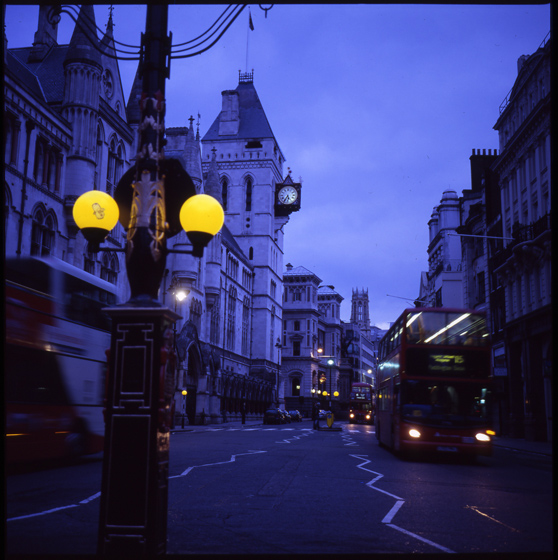
Strand, looking towards Temple Bar. © David Secombe 2010.
An attempt at Putting on a Brave Face
In A Visitor from Down Under by L.P. Hartley, which was published in a collection called The Ghost Book, edited by Walter de la Mare in 1932, we are on the top decl of an open-topped bus ‘making its last journey through the heart of London before turning in for the night’. The loquacious bus conductor encounters a silent, pale passenger with hat pulled down and collar up. ‘Jolly evening,’ says the conductor. (He is being ironic; it is wet and foggy.) There is no reply from the passenger, who holds up his fare between the fingers of stiff, apparently immobile fingers. The conductor takes the money and goes back downstairs. Later, the mysterious passenger is not there. The conductor never saw him come down the stairs, but he rationalises the situation with a very good example of sceptical wishful thinking: ‘He must have got off with that cup-tie crowd’.
From Ghoul Britannia by Andrew Martin, published by Short Books. © Andrew Martin 2009.
Trainspotters. Photo: Dmitri Kasterine, text: Andrew Martin.
Posted: October 25, 2012 Filed under: London Types, Transport Comments Off on Trainspotters. Photo: Dmitri Kasterine, text: Andrew Martin.
Trainspotters, Clapham Junction, 1979. © Dmitri Kasterine.
The Death of Trainspotting by Andrew Martin:
It took me a day and a half of searching before I found any trainspotters in London. They were standing at the far end of platform eight at King’s Cross. David Burrell carried a camera, Paul Rea a notebook. They were both in their sixties, both down from Manchester, and staying at West Hampstead, which they found convenient for Willseden Junction. Our conversation was hampered by several modern railway blights. There was nowhere to sit, and then there was nowhere to dispose of our cardboard coffee cups; we kept being interrupted by announcements telling us not to lose sight of our belongings. Our conversation was in fact a study in melancholia, covering many of the causes of the decline of trainspotting, including the latest and deadliest of all …
Paul told me he’d started trainspotting in the fifties ‘by standing on a bit of unadopted track near Newton Heath maintenance depot. We weren’t supposed to stand there but nobody minded.’ In the early eighties he’d regularly come down to London on spotting trips with the Lancashire Locomotive Society, and I asked if this body was thriving. ‘Thriving! We used to fill up a fifty-two eater coach every time. Now it’s a mini bus with twelve at the most.’
The three of us were standing next to a typical sort of modern train: a ‘multiple unit’. It would strike the casual passer-by as a series of carriages with no locomotive. “Not very interesting is it?’ I suggested. ‘Not really’, he conceded, ‘but in my mind this place is still full of Atlantics [big steam engines]. I still see it the way it was in The Ladykillers’. I asked the two whether they’d had any trouble from the railway authorities. ‘Two years ago’, said David, ‘when I was taking pictures on Manchester station, I was questioned by a station official. Nothing came of it, but it was, you know, close questioning.’
Others have been more greatly inconvenienced by the increased security across the network, and it appears that one unexpected result of the villainy of Osama bin Laden could be the death of trainspotting. It come down to a question of identity. Who is to say that the three blokes on the end of the platform with their notebooks, cameras, flasks of coffee and Blue Riband biscuits might not be members of Al Qaeda?
The June issue of The Railway Magazine reports an ‘alarming’ increase in the number of letters from readers complaining about the heavy-handed policing of stations. It also draws attention to a poster recently published by the British Transport Police urging the public to look out for photographers who seem in any way ‘odd’. The Railway Magazine magnanimously concedes that photographers of trains might look odd to some. But haven’t we Britons always prided ourselves on our oddness?
‘It’s not a systematic persecution’ says Chris Milner, deputy editor of the Magazine. ‘You just get these pockets of jobsworths who don’t know the guidelines’. After the London Tube bombings of July 7th 2005, Mr Milner was party to the drawing up of guidelines intended for people wanting to take photographs on railway stations. They are accepted by Network Rail and the British Transport Police, who indeed publish them on their websites. Photographers are expected to report to station staff, and say what they’re about. They are of course expected to keep away from the platform edge. Given the nanny-ish mindset of modern railways (which determines that all train fronts and rears must be painted a revolting yellow) it comes as no surprise that railway photographers are asked not to wear high visibility jackets – this for fear that they will be confused with station staff.
Mr. Milner detects an irony in the implicit wariness of railway photographers. ‘On the day of the London tube bombings, sir Ian Blair was asking for people to come forward with any pictures they might have taken.’ Austin Mitchell, MP and keen amateur photographers, sees another irony: ‘We are all photographed dozens of times every day on CCTV, so while the government can photograph us, we can’t photograph anything else.’ According to Mr. Mitchell, who was recently stopped from taking pictures at Leeds station, ‘Photography is a public right, and that should be made absolutely clear.’
… an extract from a longer article written for The Times in 2008.
The discreet charm of the A102M. Photo & text: David Secombe.
Posted: September 13, 2012 Filed under: Literary London, London Places, Transport | Tags: blackwall tunnel, charles dickens, Special Patrol Group Comments Off on The discreet charm of the A102M. Photo & text: David Secombe. Blackwall Tunnel southern approach, SE10. Photo © David Secombe 1988.
From Night Walks by Charles Dickens, from The Uncommercial Traveller, 1861:
Some years ago, a temporary inability to sleep, referable to a distressing impression, caused me to walk about the streets all night, for a series of several nights. The disorder might have taken a long time to conquer, if it had been faintly experimented on in bed; but, it was soon defeated by the brisk treatment of getting up directly after lying down, and going out, and coming home tired at sunrise. In the course of those nights, I finished my education in a fair amateur experience of houselessness. My principal object being to get through the night, the pursuit of it brought me into sympathetic relations with people who have no other object every night in the year.
David Secombe writes:
The above photo was taken in just such a mood as Dickens described: unable to sleep, and with guests sleeping in the living room of my one-bedroom flat, I drove around south-east London looking for images. The sheer emptiness of the industrial hinterland of the Greenwich Peninsula was eerie and unsettling, although I took the photo above; a lambent nocturnal scene, seen from the vantage point of the ‘Tunnel Palladium‘. The stillness was unnerving and it wasn’t long before I moved on to Blackheath Village. There, whilst looking at the exhibits in a taxidermist’s window, I was interrogated by two officers from the Metropolitan Police’s Special Patrol Group. The conversation went as follows:
DS and two PLAIN CLOTHES OFFICERS in front of a taxidermist’s window. About 3 a.m.
PLAIN CLOTHES 1: Who are you then?
DS: (produces card) That’s me.
PLAIN CLOTHES 1: So what are you doing? We saw you walking out of that alley.
DS: I can’t sleep. I have people in my front room, so I thought I’d go for a drive and maybe take some pictures.
PLAIN CLOTHES 1: Bit dark isn’t it?
DS: Well …
PLAIN CLOTHES 1: You ever been arrested?
DS: No …
Pause.
PLAIN CLOTHES 1: Oh all right. (turns to face taxidermist’s window) What do you think of that kestrel? Clever isn’t it? Wouldn’t want it in my house though.
PLAIN CLOTHES 2: That’s not a kestrel. It’s a falcon.
PLAIN CLOTHES 1: What’s the difference?
PLAIN CLOTHES 2: Plumage. A falcon’s got different plumage. And a flatter head.
DS: I’m not very good with birds …
PLAIN CLOTHES 1: Don’t you start.
… for The London Column. © David Secombe.


 The London Column