Flotsam and jetsam. Photo and text David Secombe (3/5)
Posted: April 18, 2012 Filed under: Bohemian London, Entertainment, The Thames and its Tributaries, Vanishings | Tags: Freddie Mercury's cake, malcolm hardee, Tunnel Palladium Comments Off on Flotsam and jetsam. Photo and text David Secombe (3/5)
Blackwall Tunnel southern approach, SE10, 1997. Photo © David Secombe.
David Secombe writes:
The mock-Tudor building in front of the gas holder in the picture above is the former home of the 1980s comedy club The Tunnel Palladium, so called because the building sits only a few yards way from the mouth of the southern entrance to the Blackwall Tunnel. The club was run by the legendary local comic and promoter Malcolm Hardee, and it played host to many key figures in the alternative comedy circuit at the start of their careers.
Amongst the legions of anecdotes concerning Malcolm Hardee, three are worth retelling here . . .
1) At the 1983 Edinburgh Fringe, he became annoyed by excessive noise from an adjacent comedy tent where Eric Bogosian was performing, and retaliated by stealing a tractor and driving it, naked, across Bogosian’s stage during his performance.
2) He stole Freddie Mercury’s 40th birthday cake and gave it to an old people’s home.
3) He pioneered a stage routine (later taken up by Chris Lynam) in which the performer sings There’s No Business like Show Business whilst holding a lit firework between his buttocks.
Malcolm Hardee died in January 2005, drowning in Greenland Dock, where his houseboat was moored; the Coroner’s verdict was that he had fallen into the dock whilst drunk. According to the police constable who retrieved Malcolm’s body from the water, he was found still clutching a bottle of beer in his right hand.
… for The London Column.
London Facades. Photos: Mike Seaborne, text: Charles Jennings.
Posted: March 16, 2012 Filed under: Dereliction, Shops, Vanishings | Tags: abandoned shops, Charles Jennings, Mike Seaborne, pre-corporate London Comments Off on London Facades. Photos: Mike Seaborne, text: Charles Jennings.
Clockwise from top left: Englefield Road, Bethnal Green Road, Willesden High Road, Whitecross Street.
© Mike Seaborne 2005, 2006.
Fag End London by Charles Jennings:
Two geezers in overalls flicking litter into a truck (‘Could’ve bleeding stayed in bed, didn’t know it was only this one’).
Keeping their ends up against the taggers and bomb artists on the main road. ‘That shouldn’t be allowed ’cause they laid out a lot of money’.
You’ve got your haggard local shops, giving out, giving in, ‘Houses & Flats Cleared, Apply Within’, a stupidly optimistic fingerpost.
The coughing of the birds, the single, muted noise of a car driving along in first a block away.
‘Big Reductions on Room Size’, with a tiny old lady picking at some cream-vinyl dining chairs stuck out on the pavement as if they were posionous, a dysfunctional boy pulling at the hair of a girl in a newsagent’s doorway, the sullen rumble of a train. Who’s going to be passing through?
Dead cars, living cars, stuff you do to your car, garages.
Those jaded avenues of small houses, the litter, the small shops, nervy pre-dereliction, the effort to keep up.
The midget shops, the kebabs, the roaming crazies (woman in a tank top scouring the bins: ‘Fucking said to him, “Fucking listen”‘).
This tomb of obscurity.
The dead concrete around the tube station, ruined retail outlets.
Drowning in toxins, grimed-up, catching screams from the estate on the west side, the traffic barrelling to hell on the roundabout.
Sort myself out a nice K-reg Astra.
It’s shy of life, but only because it’s keeling over.
… for The London Column. © Charles Jennings 2012.
Mike Seaborne:
London Facades is a series of photographs about the disappearing face of pre-corporate London. The project is London-wide and embraces a range of different facades, including shops, industrial and commercial buildings and housing.
The pictures are mostly taken in areas of the inner city undergoing regeneration – and in many cases gentrification – and the most suitable subjects are often found on the periphery of such redevelopment schemes where the blight seems more evident than the intentions to renovate or rebuild.
V2 Woolworths disaster, New Cross, 25 November 1944.
Posted: November 25, 2011 Filed under: Anniversaries, Catastrophes, Public Announcements, Vanishings, Wartime London | Tags: Apollo 11, Doodlebug Blitz, Eddie Chapman, V1, V2, Vengeance Weapon, Werner von Braun 1 Comment
Air raid shelter sign, Jerningham Road, New Cross, SE14. Photo © David Secombe 2010.
Today marks the 67th anniversary of the worst single bombing incident of the 2nd World War – when a V2 rocket scored a direct hit on a Woolworths store in New Cross. The V2 hit Woolworths when it was crowded with Saturday morning shoppers: the official death toll was 168, but it was often said that the real figure was much higher – although it seems unlikely that a significantly higher casualty number could have been withheld until now.
The V2 was unlike the earlier ‘Vengeance Weapon’, the V1 (A.K.A. ‘doodlebug’, a cruise missile) in that it was impossible to detect – let alone intercept – before it exploded. The first impact in Chiswick in September 1944 was first thought to have been caused by a gas explosion. Their sudden deployment was a source of grave concern to Churchill, and prompted the construction of deep-level air raid shelters in Bloomsbury, Clapham and Stockwell. South and east London received a disproportionately high number of V-strikes, largely because of a British intelligence coup: the double agent Eddie Chapman managed to convince his Nazi ‘handlers’ that V1s were overshooting the centre of London (they weren’t), hence the rocket launchers recalibrated and bombs began falling on Brockley, Woolwich, Deptford, Catford, Barking, Ilford, etc., and across Kent and Surrey.
The literal impact of these weapons may still be seen in London, where pockets of undeveloped bombsites remain – like the dead spot on Tottenham Court Road opposite Heals, final destination of a V2. South London is peppered with anomalous green spaces or abrupt changes in architectural style on a residential street, characteristic traces of Vengeance weapons. Perhaps the most bizarre legacy of the V2 campaign was the subsequent career of the project’s architect, Werner von Braun. The majestic Saturn V rocket which took Neil Armstrong towards the Moon was von Braun’s creation, the end result of his wartime experiments in rocketry and ballistics. As for Woolworths, they’ve put up a plaque. There is an Iceland store there now.
(The Londonist has a fascinating map of V2 bombsites on London; and further information may be found on the site flyingbombsandrockets.com.)
David Secombe.
Days and Nights in W12. Photographs and Text: Jack Robinson (4/4)
Posted: July 2, 2011 Filed under: Literary London, Vanishings | Tags: CB Editions, Crossing the Border, Days and Nights in W12 Comments Off on Days and Nights in W12. Photographs and Text: Jack Robinson (4/4)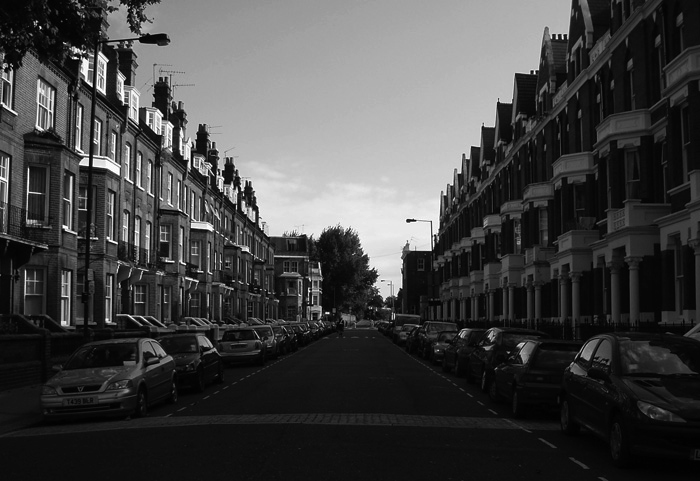
Photo: © Jack Robinson 2007.
From Days and Nights in w12* by Jack Robinson:
VANISHING POINT
Kieran, the youngest son of a wealthy Irish family – the one who never got punished, whose shoulders were never expected to bear burdens – lived in this street in the 1970s in a house that belonged to his parents. He rented out rooms to foreign students, and there were frequent parties, and always people coming and going. He told exaggerated stories about his work and love affairs, and every few months he went back to Ireland for the peace and quiet he needed to work on his novel – which was set at the time of the Great Famine in the 1840s; or was based, with her blessing, on the life of an American film actress. The first six chapters were with an agent; the entire first draft had been lost on a train. In the early 1980s, a few weeks after IRA bombs had exploded in Regent’s Park and Hyde Park, killing eight soldiers and seven horses, Kieran’s novel was published. Crossing the Border was a political thriller set in contemporary Northern Ireland. Kieran went over to Ireland to publicise the book at a literary festival. He was seen leaving his hotel and getting into a waiting taxi, but he never arrived at the festival venue. In London his house was broken into and his diaries and files stolen. The students who had lived in his house and who were traced by the police remembered him fondly: there was something both promising and insubstantial about Kieran, as if he was always about to depart.
© Jack Robinson.2011.
* CB Editions 2010.


 The London Column