A Winter Solstice offering.
Posted: December 14, 2012 Filed under: Anniversaries, Ceremonial, Wildlife | Tags: A Ghost Story for Christmas, M.R. James, Paganism, Wicca, Witchcraft, Yule log Comments Off on A Winter Solstice offering. Pig’s head still life, south London, circa 1982. © David Secombe.
From the Hern’s Tribe website:
Mid-Winter Solstice (Yule): Outdoor Ritual in London
A special ritual to mark the end of one Mayan cycle and beginning of another. Join us for the Journey of the Fool, and quest through the 4 Elements to consecrate a magical Talisman. Anoint the Yule-log (yes a real one) with your wishes & hopes for 2013, and place it in the ritual fire. Then feast with home made bread, mulled Wine, some woodland tribal cooking. Don’t forget the Mistletoe! There will be Wiccan elements to this ritual.
Date: Saturday 22nd December 2012. Venue: Coombe Lane (From East Croydon station, take the `New Addington’ branch of the Tram, and get down at `Coombe Lane’ stop).
From Witchology, the history of Wicca and Witchcraft by Dr. Leo Ruickibie:
Yule celebrations in Wicca date back to the late 1950s. Most Yule rituals will involve the casting of a circle, a ritual symbolising the rebirth of the solar deity, dancing round the circle and the feasting ceremony of ‘cakes and wine’. Other Wiccan covens might base their ritual on the passing of power from the Holly King to the Oak King – a concept derived from British folklore. The festival itself is entirely Pagan in origin. Echoes of old Druidic fertility rites survive in ‘kissing under the mistletoe’. Santa Claus has been Christianized as Saint Nicholas, but the tradition of a gift-bearing man arriving at mid-winter can be traced back to Wotan (Odin) in Germanic folklore.
Feasting is a large part of all Pagan traditions and at Christmas this is still a principle element. The focus of the meal around a specific animal is certainly a residue of animal sacrifice, although the popularity for turkey is a modern development. We should not be squeamish about animal sacrifice, it simply meant butchering an animal for the benefit of the community with a small and usually inedible portion being ‘given’ to the gods. Modern sensibilities are usually too cosseted to even contemplate killing a chicken, so we should not condemn the past on our own rather feeble standards.
David Secombe:
I would like to reassure my readers that the pig in the photo above was not the by-product of any crazed sacrifice, Wiccan or otherwise: it was prosaically acquired from a local butcher for the alleged purpose of making brawn, which was a fatuous attempt to disguise an equally fatuous artistic project. It was the early 1980s and I was an ambitious photographic student, my hunger for success exceeded only by the depth of my cluelessness. This porcine still life was shot on a cold December night in the back garden of my parents’ house in suburban south London, and was a study for – well, I wasn’t quite sure. It seemed like a good idea at the time … The transparency laid undisturbed for decades until it turned up in a cache of forgotten transparencies I found last month. I offer it here as a seasonal offering in a more-than-averagely bleak midwinter; we’ve still got a week to go before the solstice on the 21st, and if the Hern’s Tribe lot are anything to go by, the south London suburbs are going to be where it’s at if paganism is your thing. As for me, I’ll be indoors, watching an old Ghost Story for Christmas on YouTube. Or perhaps this … (and I’m sure you’ll forgive the shameless plug).
… for The London Column.
Blackbird. Photo & text: David Secombe.
Posted: August 30, 2012 Filed under: Wildlife Comments Off on Blackbird. Photo & text: David Secombe.
Stoke Newington. © David Secombe 2009.
The London Column has been a little inactive this month, partially delinquency on the part of your correspondent and partially a feeling that the London Olympics had taken all the air out of the city; small, mordant observations about life in the ‘Great Wen’ seemed out of place in the midst of such frantic flag-waving. But, Paralympics notwithstanding, there is that ‘back to school’ feeling in the air: autumn is nearly upon us, the flags and bunting will fade and get wet, and it will soon be business as usual.
There’s only so much jubilation a city can stand …
Park Life. Photo & text: David Secombe. (1/5)
Posted: August 6, 2012 Filed under: Parks, Wildlife | Tags: Mystic London, quiet city, sheep walker Comments Off on Park Life. Photo & text: David Secombe. (1/5)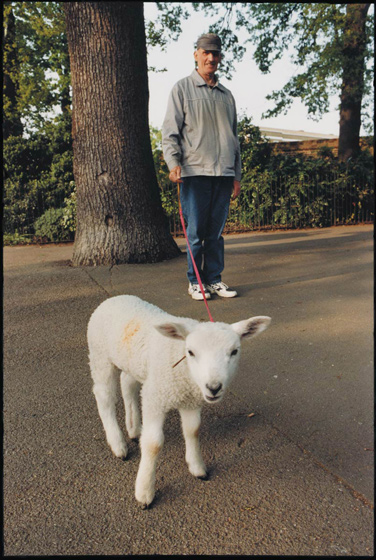
Greenwich Park. Photo © David Secombe, 1998.
From Mystic London, Rev. Charles Maurice Davies, 1875:
When a man’s whole existence has resolved itself into hunting up strange people and poking his nose into queer nooks and corners, he has a sorry time of it in London during August; for, as a rule, all the funny folks have gone out of town, and the queer nooks and corners are howling wildernesses. There is always, of course, a sort of borderland, if he can only find it out, some peculiar people who never go out of town, some strange localities which are still haunted by them; only he has to find them out – people and places – for it is so universally allowed nowadays that all genteel people must be out of London in August . . .
David Secombe:
The Rev. Davies’s observation has acquired a new significance during the 2012 Olympic Games, as the Olympiad has driven a significant number of full-time Londoners into temporary exile. So this week on The London Column we offer a brisk tour of some of the quieter corners of London parks in the company of those Londoners who didn’t make it out of town and who haven’t made it on to a corporate hospitality list.
Before the Blue Wall. Photo: Homer Sykes, text: Katy Evans-Bush. (4/4)
Posted: July 13, 2012 Filed under: Vanishings, Wildlife | Tags: Homer Sykes, Katy Evans-Bush, LeaValley, Olympic legacy, Olympic site, Walthamstow Marshes Comments Off on Before the Blue Wall. Photo: Homer Sykes, text: Katy Evans-Bush. (4/4)
Anglers on the river Lea. © Homer Sykes 2006.
Katy Evans-Bush:
These two men were fishing in this spot in 2006. For all we know, they’d sat there every available Saturday since they were ten. But we know they’re not sitting there now. It’s in the past – that is, it’s in the Olympic ‘Park’.
The website for the adjacent Walthamstow Marshes says: ‘The reserve is one of the few remaining pieces of London’s once widespread river valley grasslands, and a space to treasure for many reasons!’
The Wikipedia page for the Lower Lea Valley, which means roughly the same place, says ‘the Olympic Games… will provide a legacy of facilities for this currently run-down area. There are plans to redevelop all the derelict and underutilised [sic] parts of the valley, which will take until 2020 or beyond’.
… for The London Column.
A selection of pictures from Before the Blue Wall, Homer Sykes’s project documenting the Lea Valley prior to the Olympic redevelopment, may be seen at the Green Lens Gallery (4a Atterbury Road, London N4 1SF) until the 25th of July. Homer’s website is here.


 The London Column