Park Life. Photo & text: David Secombe. (1/5)
Posted: August 6, 2012 Filed under: Parks, Wildlife | Tags: Mystic London, quiet city, sheep walker Comments Off on Park Life. Photo & text: David Secombe. (1/5)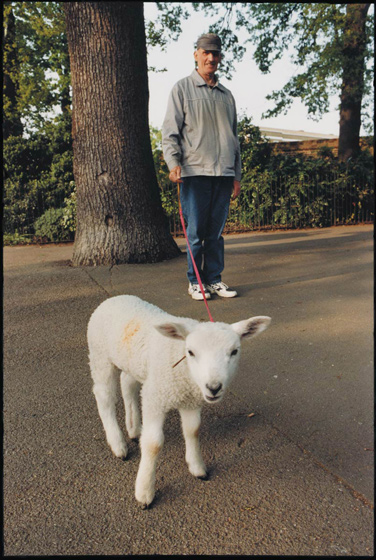
Greenwich Park. Photo © David Secombe, 1998.
From Mystic London, Rev. Charles Maurice Davies, 1875:
When a man’s whole existence has resolved itself into hunting up strange people and poking his nose into queer nooks and corners, he has a sorry time of it in London during August; for, as a rule, all the funny folks have gone out of town, and the queer nooks and corners are howling wildernesses. There is always, of course, a sort of borderland, if he can only find it out, some peculiar people who never go out of town, some strange localities which are still haunted by them; only he has to find them out – people and places – for it is so universally allowed nowadays that all genteel people must be out of London in August . . .
David Secombe:
The Rev. Davies’s observation has acquired a new significance during the 2012 Olympic Games, as the Olympiad has driven a significant number of full-time Londoners into temporary exile. So this week on The London Column we offer a brisk tour of some of the quieter corners of London parks in the company of those Londoners who didn’t make it out of town and who haven’t made it on to a corporate hospitality list.
Olympic Hymn. Photo & text: David Secombe.
Posted: July 27, 2012 Filed under: Sport | Tags: Airstrip One, Barrie Keefe, Deptford Olympics, Harold Shand, London 2012, London Olympics, Lord Coe, Millennium Dome, Newspeak, prolefeed, Team GB, The Long Good Friday, The Shifting History of memory in Spaces, Tony Blair Comments Off on Olympic Hymn. Photo & text: David Secombe.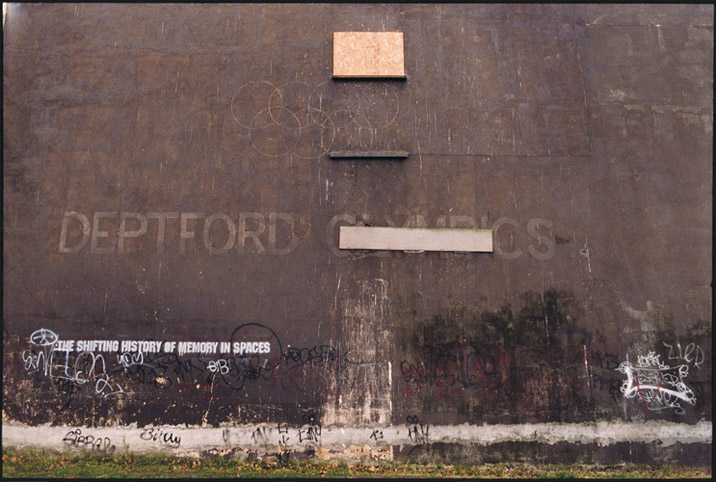
Deptford. © David Secombe 1999.
From Barrie Keefe’s script for The Long Good Friday, 1979:
HAROLD: I’m not a politician. I’m a businessman. And I’m also a Londoner – and today is a day of great historical significance for London. Our country is not an island any more – we’re a leading European state. And I believe that this is the decade in which London will become Europe’s capital. That, ladies and gentlemen, is why you are here today.
Tony Blair speaking at the ‘Beyond Sport’ summit in London, quoted in The Guardian, 26 July 2012:
Of course, £9bn is in one sense a lot of money but, in another sense, you’re regenerating an entire part of the country, creating thousands of jobs and there’s massive amounts of investment coming in. [Asked whether the same figure could simply have been spent on regeneration without the Games:] It’s not quite the same. You’ve got the Olympics! When people start making arguments like this I just have to say ‘Come on guys, this is the biggest sporting event in the world and we’re hosting it.’ A bit of pride there, I think.
From Team GB’s official website:
1: JOIN ONLINE
Send a message
of support to your
Team GB athletes
2: BUY YOUR SCARF
Show your support by
waving and wearing your
Official Team GB Scarf
David Secombe:
Anyone following The London Column recently will have detected a certain creeping cynicism amongst our contributors towards the looming Olympic bunfight. The naysayers in our ranks all have specific objections, but the consensus amongst our group of refuseniks is that the construction of the main Olympic site has obliterated a sylvan wilderness that was a genuine resource for locals; that the corporate stranglehold over any kind of local expression of dissent (or even unauthorised expressions of enthusiasm) relating to the sponsors’ involvement in the Games is anti-democratic and an affront to free speech; and that the militarised nature of its policing serves to emphasise that the host country has acquired a dodgy international reputation for itself. Orwell’s 1984 looms over the festival of sporting prowess and universal brotherhood: the Airstrip One Olympics.
For what it’s worth (and given that this is a site with only a few thousand readers, it may not be worth very much), we might as well ask a big and perhaps fatuous question: why does London need the Olympic Games? The Olympic body has long been discredited by its willingness to accommodate totalitarian regimes (Berlin, Moscow, Beijing) or to ignore local tragedy in the interests of ‘higher sport’ (Mexico City, Munich); and the athletic ideal the Games ostensibly represent has for years been tarnished by the self-doping tactics of class-leading athletes desperate to stay at the top of their game. What’s left is sheer spectacle underwritten by a cold business imperative: so the drive to compete, to achieve upon the world stage is the language of corporations yoked inelegantly to the inarticulate nature of sporting endeavour. Thus the simple and elegant term ‘The British Olympic Team’ is reduced to the ugly signage of ‘Team GB’ – a change they were advised to make to foster corporate sponsorship (it worked). Promoters of the London Games use all the chilling cliches of contemporary corporate language; language which makes Barrie Keefe’s proto-Thatcherite gangster Harold Shand straightforwardly articulate when compared to the likes of Sebastian Coe or Tony Blair.
Speaking of Blair, it was he who gave London the Millennium Dome, a prime example of monumental gesture architecture in search of appropriate content: given the abject failure of that grand project, it is perhaps understandable that such a vain politician would wish to have another go at self-commemoration (‘If you seek my monument, take the Jubilee line to North Greenwich and Stratford’.) No-one could dismiss the Olympic Games as a non-event: but London is a Roman city, and without getting too psychogeographical about it, it’s worth remembering that Caesar also knew how to put on a good show, especially when times were tough.
You can see Richard Strauss conducting his Olympic Hymn for Hitler and the crowds at the 1936 Berlin Olympics here.
… for The London Column.
Before the Blue Wall. Photo: Homer Sykes, text: Katy Evans-Bush. (4/4)
Posted: July 13, 2012 Filed under: Vanishings, Wildlife | Tags: Homer Sykes, Katy Evans-Bush, LeaValley, Olympic legacy, Olympic site, Walthamstow Marshes Comments Off on Before the Blue Wall. Photo: Homer Sykes, text: Katy Evans-Bush. (4/4)
Anglers on the river Lea. © Homer Sykes 2006.
Katy Evans-Bush:
These two men were fishing in this spot in 2006. For all we know, they’d sat there every available Saturday since they were ten. But we know they’re not sitting there now. It’s in the past – that is, it’s in the Olympic ‘Park’.
The website for the adjacent Walthamstow Marshes says: ‘The reserve is one of the few remaining pieces of London’s once widespread river valley grasslands, and a space to treasure for many reasons!’
The Wikipedia page for the Lower Lea Valley, which means roughly the same place, says ‘the Olympic Games… will provide a legacy of facilities for this currently run-down area. There are plans to redevelop all the derelict and underutilised [sic] parts of the valley, which will take until 2020 or beyond’.
… for The London Column.
A selection of pictures from Before the Blue Wall, Homer Sykes’s project documenting the Lea Valley prior to the Olympic redevelopment, may be seen at the Green Lens Gallery (4a Atterbury Road, London N4 1SF) until the 25th of July. Homer’s website is here.
Before the Blue Wall. Photo: Homer Sykes, text: Tim Wells (3/4)
Posted: July 12, 2012 Filed under: Transport, Vanishings | Tags: greasy spoon, Homer Sykes, Joe Public, Olympic Park, Tim Wells Comments Off on Before the Blue Wall. Photo: Homer Sykes, text: Tim Wells (3/4)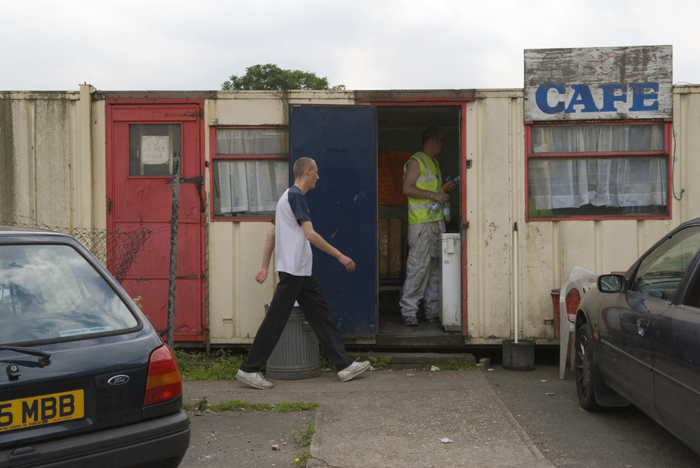
Transport cafe, Hackney Marshes. © Homer Sykes 2006.
My Bitch Up
Burning Geronimo through the East End, the motor skittish at jump, stop, start.
Music blasting out the windows, slapping Joe Public in the face as we roar by.
Tossing the used notes behind us, dirty knees and carpet burn noses.
Each staccato burst spent, surly, and spittin’ in the eye of every pocket money massive.
On Commercial Road some City boy lone ranger races us red light to red light,
every green a pistol shot.
At Limehouse John John faces him and mouths, “Ours is stolen.”
The silence: single mum heavy. Someone drops the sprog.
© Tim Wells.
A selection of pictures from Before the Blue Wall, Homer Sykes’s project documenting the Lea Valley prior to the Olympic redevelopment, may be seen at the Green Lens Gallery (4a Atterbury Road, London N4 1SF) until the 25th of July. Homer’s website is here.


 The London Column