St. Pancras. Photo: Tim Marshall, text John Betjeman.
Posted: November 9, 2011 Filed under: Architectural, Literary London, Transport | Tags: Edward Mirzoeff, John Betjeman, St. Pancras Comments Off on St. Pancras. Photo: Tim Marshall, text John Betjeman.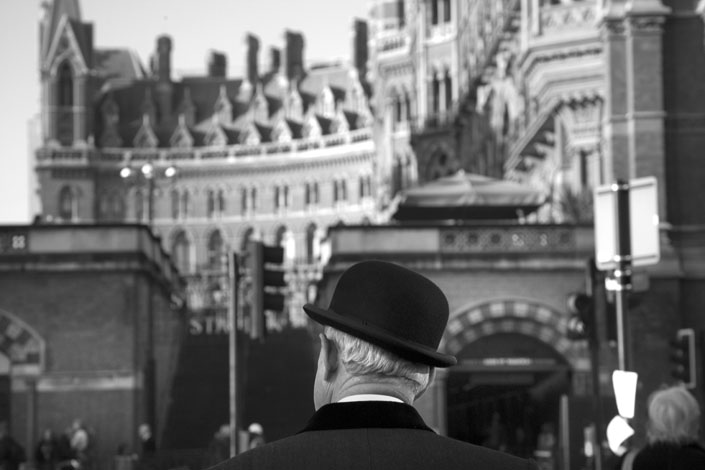
© Tim Marshall 2011.
From London’s Historic Railway Stations, John Betjeman, 1972:
“For the last ninety years almost, Sir Gilbert Scott has had a bad Press. He is condemned as facile, smart, aggressive, complacent and commercial.When at the top of his form Scott was as good as the best of his Gothic contemporaries. He was so firm a believer in the Gothic style as the only true ‘Christian’ style – Scott was a moderate High Churchman – that he was determined to adapt it for domestic and commercial purposes. St. Pancras Station hotel was his greatest chance in London and well he rose to the occasion.
I used to think that Scott was a rather dull architect, but the more I have looked at his work the more I have seen his merits. He had a thorough knowledge of construction, particularly in stone and brick. For St. Pancras the bricks were specially made by Edward Gripper in Nottingham. The decorative iron work for lamp standards and staircases and grilles was by Skidmore of Coventry, who designed the iron screens in some English cathedrals for Scott. The roofs of the hotel are of graded Leicestershire slates; the stone comes mostly from Ketton. Scott’s buildings are so well-built they are difficult to pull down. He had a grand sense of plan and site. The Grand Staircase, which alone survives of the hotel’s chief interior features, ascends the whole height of the building, by an unbelievably rich cast iron series of treads with stone vaulting and painted walls. The chief suites of rooms are on the first floor and the higher the building, the less important the rooms, until the quarters for the servants are reached in the gabled attics – men on one side, women on the other – and separate staircases. Yet even these are large and wide and compare favourably with more modern accommodation. The building has been chopped up and partitioned inside for offices. It is odd that it is not used again as an hotel especially now that hotels are so badly needed in London.”
Edward Mirzoeff writes:
Not long after this book was published I approached British Railways proposing a BBC documentary on London stations, with Betjeman. BR insisted on charging a facility fee at the same daily rate as that for feature films – which killed the idea, doubtless as intended.
Washday. Photo John Londei, text Joanna Blachnio.
Posted: November 4, 2011 Filed under: Fictional London, London Types | Tags: Joanna Blachnio, John Londei, Leather Lane Comments Off on Washday. Photo John Londei, text Joanna Blachnio.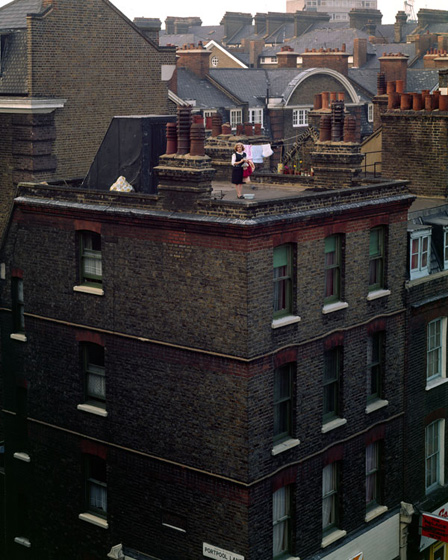
Portpool Lane & Leather Lane. © John Londei.
One – Two – Three by Joanna Blachnio:
One person can’t do it all, I said to my neighbour, Mrs Carlton, the other day. You mustn’t let them rely on you so much, I said, a husband and two grown boys can lend a hand around the house once in a while. My John, he doesn’t shy away from housework, only today he is still sleeping in after the pub.
I always wanted to have three kids. It was a trial when they were small – the whole lot born in less than five years. Mike drives the bus, Katie helps her husband in the shop, and Jenny, my youngest, is still at school. It’s her that comes up here most, even though she doesn’t do as much washing. She wants to be an astronomer. She took me with her one night and explained about the stars, but I couldn’t see half of them. I said to her, what’s the point of looking at them here in the city, with the streetlights and all? Anyway, I prefer it here by day. There’s always so much going on under those roofs across the road. They’re just roofs, like ours, but they look pretty today. You don’t get this kind of light at any other time of the year. You can tell autumn is coming – before long it’ll be too cold to put the washing outside.
Mrs Carlton lives across the road, just there. What would she do if I appeared now, out of the blue – out of the blue sky? It’s always ‘Mrs Carlton’: I’ve been here over twenty years, but close friends I haven’t made. It’s all fine, you talk and talk about the things you like, and suddenly the other person gives you this look. And there it stops, and never goes further. I do have the flowers, though. John says they’re just weeds, getting in the way of our veg, but I always look out for them. Last year the cold came early, and they didn’t appear at all – and now I’ve got three.
There’s Mrs Carlton bustling about the kitchen. I wonder what she’s thinking seeing me hang out my washing in that dress. There was only one like that in the shop, my size, and like tailor-made for me. I looked inside the purse: one – two – and that was all; so for a month I saved a bit of money, bought less food for myself, switched the lights off whenever I could – and when I came back to the shop, my dress was still there! I don’t know why I put it on this morning. It seemed different – everyone asleep or gone, and the house so quiet.
This air, you could swim in this air. I don’t really like washing. Cooking, cleaning, I don’t mind, but washing I’ve never cared for. Except we’ve got the new lines. I bought them only last week, and John put them up here. They’re so smooth, but solid, too. You could almost stand on them. Drop the bag of clips, leave the duvets – sitting in the basin for a little while longer won’t do them harm – prop yourself up, then stand. Now, first one foot, then the other. As long as you get through the first step, you can walk to the other end, and then – who knows?
I know it’s only a washing line. So what?
… for The London Column. © Joanna Blachnio 2011.
Dmitri Kasterine. Text: Joanna Blachnio. (5/5)
Posted: October 28, 2011 Filed under: London Labour, London Types, Markets, Street Portraits Comments Off on Dmitri Kasterine. Text: Joanna Blachnio. (5/5)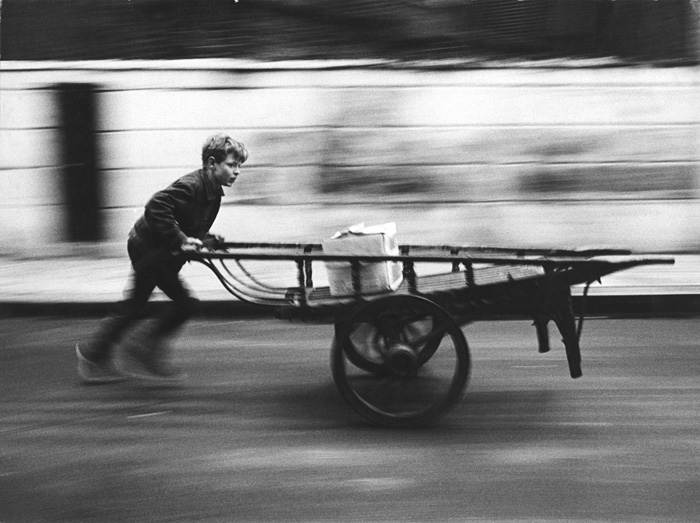
Barrow boy, World’s End, 1963. © Dmitri Kasterine.
Joanna Blachnio writes:
And then he forgets. Clearly. The formula for the circumference of the circle and the length of the arch. How to calculate mass, and how to express vacuum in numbers. He forgets the latchkey, warming slowly in his pocket, the water gathered by one of his wingless shoes. He forgets the order of notes on the musical scale. Even that game of marbles, shamefully lost to Jimmy Croghan. He forgets how mist comes into being – and it rises, contrary to experience, from the ground, spreading sideways. And envelops all except his face.
… for The London Column. © Joanna Blachnio 2011.
Dmitri Kasterine. Text: Tim Turnbull. (4/5)
Posted: October 27, 2011 Filed under: Literary London, London Types, Sartorial, Transport | Tags: London cabbies, The Knowledge, Tim Turnbull Comments Off on Dmitri Kasterine. Text: Tim Turnbull. (4/5)

Hailing a cab, Mayfair, 1965. © Dmitri Kasterine.
Black Cab Blues by Tim Turnbull:
All Hail! All Hail! the cabbies of London,
who are rammed to the gunwales with Knowledge;
so stuffed to the gills with it that it would turn
any lesser bloke’s brains into porridge.
Wave! Wave your brolly! and preen there bespokely,
the cut of your coat won’t persuade them to stop;
they do if they want, and for that reason only –
they’re nothing if not democratic, Old Cock.
Hark! O Hark! to their myriad opinions
but don’t venture yours, they’re never impressed –
you’re not in chambers, they’re not your minions
and so, for all your rhetorical prowess,
you’re bleeding mistaken if you think they might
go sarf uther river at this time o’night.
… for The London Column. © Tim Turnbull 2011.


 The London Column