Dmitri Kasterine. Text: Tim Wells. (3/5)
Posted: October 26, 2011 Filed under: London Types, Sartorial, Shops | Tags: Bespoke tailoring, Dmitri Kasterine, Tim Wells Comments Off on Dmitri Kasterine. Text: Tim Wells. (3/5)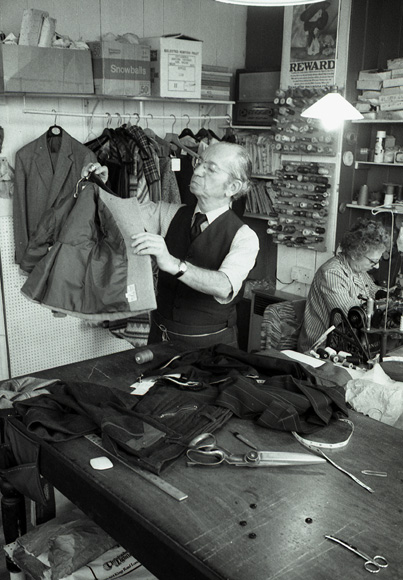
Tailor, Putney. Photo © Dmitri Kasterine.
Dead Man’s Pockets by Tim Wells:
Things found in the pockets of Tim Wells, Saturday Night, 28.02.09
Right coat pocket – mobile phone (Liquidator as ringtone), spectacles.
Ticket pocket – a dozen of his own business cards, business cards for Niall O’Sullivan, Alice Gee and S. Reiss Menswear, return train ticket to Epsom.
Left coat pocket – keys – England fob, poem entitled ‘Self-Portrait as a P G Tips Chimp’, flyer for 14 Hour 14th march show with Karen Hayley, Ashna Sarkar, Amy Blakemore and others.
Inside coat pocket – an Elvis pen.
Right trouser pocket – £8.56 in assorted change.
Left trouser pocket – empty
Hip pocket – Oyster card and wallet
Wallet (black leather) – £160 in twenty pound notes, dry cleaning ticket, Leyton Orient FC membership card from 87/88 season, visa and cash card, picture of Joan Collins in window nook, horoscope stating ‘The first thing you have to ask yourself is what has to go; the second is what is going to take its place; and the third is where will I go to celebrate. Day done.’
© Tim Wells 2009.
Dmitri Kasterine. Text: Andrew Martin. (2/5)
Posted: October 25, 2011 Filed under: Amusements, The Thames | Tags: Andrew Martin, Cabinet War Rooms, James J. Fox, the end of me old cigar 1 Comment
Man with cigar, Putney, 1967. © Dmitri Kasterine.
Andrew Martin writes:
This chap is, to my jaundiced mind, committing the error of smoking outside at a time in history when he could have been smoking inside, so he seems to me complacent, lacking in foresight. I think it was Freud, who said that oral satisfaction of smoking comes from blowing a concentrated stream of smoke, and you can’t do that out of doors, as I know because I am forced to smoke most of my half dozen weekly cigars out of doors, ideally on a fine day in Green Park, where the price of the deckchair adds £1.50 to the cost of my cheap (‘inexpensive’, my tobacconist calls them) Honduran cigars.
My tobacconist is James J. Fox in St James’s Street, one of – I think – half a dozen left in central London, where twenty years ago there were forty. I once asked the man who serves me at Fox when the shop was founded, ‘1730,’ he said, with great trenchancy, but the shop was called Carlin in those days, and sold mainly snuff. It was called Robert Lewis from 1787 to 1991, when Fox moved there from Burlington Arcade. ‘Did you ever supply Churchill?’ I asked my man. ‘Sole supplier, sir, sole supplier.’
To think that in Churchill’s London you could smoke cigars in pubs, restaurants, on Tube trains, in Tube stations. When the subterranean Cabinet War Rooms were being fixed up early in the War, Churchill repaired to the safety of the disused Down Street Tube station, which had been taken over by the Railway Executive. He smoked cigars there, and it was said the fumes from them – and from his rich food and brandy – floated along the tunnel to the shelterers at Green Park station, and tormented them.
The only place I now smoke an indoor cigar in London, is in the upper room at Fox, where it is allowed providing you are sampling one to buy a larger amount, or providing you say that’s what you say you’re doing. I listen to a lot of plutocrats in there, as they drink coffee and smoke fifty quid double coronas. (Double coronaries, more like). The other day, one of the millionaires was Australian, and he was saying you can’t smoke outdoors in many places in his country. So I shouldn’t moan really.
… for The London Column. Andrew Martin’s book, Underground, Overground – A Passenger’s History of the Tube is published by Profile Books in May 2012.
Dmitri Kasterine. Text: David Secombe (1/5)
Posted: October 24, 2011 Filed under: Amusements, London Types, Sartorial, Sport | Tags: croquet, Dmitri Kasterine, Existentialism, H.M. Bateman, Hurlingham Club, shorty mac Comments Off on Dmitri Kasterine. Text: David Secombe (1/5)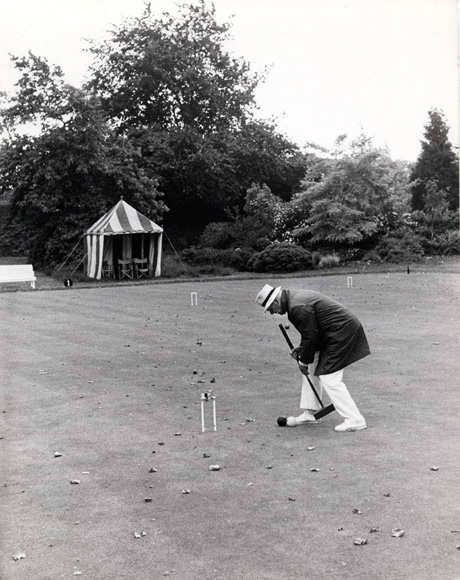
Croquet, Hurlingham Club, 1980. © Dmitri Kasterine.
This week, The London Column is featuring the work of Dmitri Kasterine. Before leaving London for New York thirty years ago, Kasterine was a sympathetic and perceptive commentator on the English scene: his portraits of artists and writers (including Samuel Beckett, Graham Greene, Tom Stoppard, etc.) are familiar and definitive images for posterity – and his social documentary work, which we are showing, is impeccably witty and elegant.
In this photograph, we see a croquet player in a shortie raincoat (clothes are important in Kasterine’s pictures) braving inclement weather to play against – whom? The field is empty, autumn leaves strewn across the lawn; summer is over, the spectators have left, hours or possibly days earlier. His grip on the mallet is assured yet faintly desperate. He is playing against himself and no-one cares – except the photographer. This is croquet transformed into an existential game – or, perhaps, a nightmare from an H.M. Bateman cartoon: The Man Who Played Croquet After the Pleasure Garden Had Shut. D.S.
Drinker’s London. Photos Paul Barkshire, text David Secombe. (5/5)
Posted: October 23, 2011 Filed under: London on film, London Places, Markets, Pubs | Tags: 'Lovely! Lovely!', Barry Foster, covent garden, Frenzy, Hitchcock, Paul Barkshire, The Cross Keys 1 Comment Cross Keys, Endell Street, Holborn, 1980. Photo © Paul Barkshire.
According to Paul Barkshire’s caption, this much-loved pub is situated in Holborn; this might be technically true, but Endell Street is more commonly associated with Covent Garden, and the porters’ barrows outside the pub suggest the vegetable market which once dominated the whole area. The fruit and veg moved to Nine Elms in 1974, and in the year this picture was taken the retail fun park familiar to Londoners today opened on the site of the defunct market. Inigo Jones’ gracious 17th Century Piazza – threatened with wholesale redevelopment as recently as the early 1970s – was retained at the cost of its enshrinement as the heart of a remorselessly consumerist zone, much to the dismay of residents who had campaigned so hard for the area’s preservation.
We should be grateful that the area was not flattened, or London would now be saddled with something like ‘Forum des Halles’ in Paris, a deadening, subterranean 1970s shopping arcade where once flourished Les Halles, ‘the belly of Paris’, the city’s market since the middle ages. Les Halles was unceremoniously eviscerated in 1971, the same year Alfred Hitchcock filmed his lurid – and anachronistic – serial killer thriller Frenzy in Covent Garden. Looking at the film now, so much is wrong and fantastically dated, but the location shooting in the market was for real: despite its flaws, it manages to capture an environment that now seems as distant as the coaching inns of Dickens’ youth. Barry Foster may strangle Barbara Leigh-Hunt with an old school tie, (Foster’s unwanted catchphrase “Lovely! Lovely!” – was chanted at him ever after by drunks of all stripes) but the ambience of the market is as vivid as the muscat grapes he gives to Jon Finch.
The Cross Keys was slightly off my own map when I was a regular drinker in WC2 – the Opera Tavern on Catherine Street and the Coach and Horses on Wellington Street were more convenient. But those pubs have been made over into anonymous, tourist-service outlets that might be anywhere. Luckily, the Cross Keys is largely unchanged since Paul Barkshire photographed it thirty+ years ago (although the foliage is more exuberant these days) and remains a very charming spot to lose an afternoon. I am intrigued by the gent looking out of the window: is he waiting for a delivery? A visitor? Inspiration? And those barrows look a bit like props. Maybe he’s waiting for the shade of Hitchcock to shout ‘Action!’ D.S.


 The London Column