At Home With The Furries.
Posted: May 16, 2016 Filed under: Wildlife | Tags: Furries, Laura Noble Gallery, Summerisle, Tom Broadbent 1 Comment
Moon, a deer in Sheffield. © Tom Broadbent courtesy of the Laura Noble Gallery.
From Wikipedia entry Furry fandom:
The furry fandom is a subculture interested in fictional anthropomorphic animal characters with human personalities and characteristics. Examples of anthropomorphic attributes include exhibiting human intelligence and facial expressions, the ability to speak, walk on two legs, and wear clothes. Furry fandom is also used to refer to the community of people who gather on the Internet and at furry conventions.

Sticks the fox and Terry, Wimbledon. © Tom Broadbent courtesy of the Laura Noble Gallery.
D.S.: Tom Broadbent has been photographing members of the ‘furry’ community for the past seven years, following a chance meeting with a six-foot wolf called Smirnoff. Tom speaks warmly about the furries and their acceptance of him is fully evidenced by the photographs. Furries inhabit a world of elaborate fantasy, albeit one with a curiously quotidian aspect. They might be in revolt from the mundane but they find release in performing ordinary tasks in the personas of their animalistic alter-egos (or fursonas).
I suppose you could call it a form of living theatre, or lifestyle as theatre. As Tom says, ‘There’s no one reason why people identify as furry; and in terms of ‘costume play’ (or cosplay) most of them create their own characters, drawing on a wide range of Fantasy and Sci-Fi influences, from classic Disney cartoons to Star Wars’.

Marshall, a border collie, Woking. © Tom Broadbent courtesy of the Laura Noble Gallery.
In Tom’s photographs, we often see his furry subjects in their domestic settings. The ‘at home’ scenes are as sweet as one could wish: a rabbit tending his garden in east London, a Glam Rock border collie playing his Les Paul in his bedroom on a 1960s estate in Woking, and so on. These images speak of tidy, ordered lives which just happen to incorporate a bit of dressing up. And although the fetish undertow is always present to some degree (bit of a touchy subject for the furry community) that isn’t the top note here: Tom’s furry friends are endearingly wholesome.

Edward Fuzzypaws shares a moment with labradoodle Teddy, Richmond. © Tom Broadbent courtesy of the Laura Noble Gallery.
Furries are an international phenomenon, but there is a quintessential Englishness about the activity as presented in Tom’s photos. These characters might be bit players in an unproduced film by Alan Bennett or Victoria Wood. But what makes Broadbent’s pictures more than just another showcase for native eccentrics are the moments where the photographer accompanies his subjects through the looking glass into the realm of private myth. That’s when the child-like delight in costume gives way to something wilder.

Bhavvels Bunny, Barking. © Tom Broadbent courtesy of the Laura Noble Gallery.
A nod to Lewis Carroll isn’t inappropriate, given that the furry domain shares some of the dreamy charm, transformative power and moral complexity that he represents. That seems obvious enough. But the image of the stag invokes the iconography of the pre-civilized mind and a time when woods were feared and venerated. This stag is a forest god; one that might be worshipped as part of the sacred, time-honoured rituals of Summerisle.

Fangorn, a Jedi tiger, in his living room, Swansea. © Tom Broadbent courtesy of the Laura Noble Gallery.
As for the Jedi tiger, he inhabits a different galaxy to the one you or I live in. He’s about to climb into his own Swansea-moored spaceship and leave for somewhere very far away. Nothing cosy about him. And I am afraid that stag will come to stalk me in my dreams.
Tom Broadbent‘s Furry portraits may be seen at FIX Photo, part of Photo London, at the Bargehouse, Oxo Tower Wharf, Bargehouse St., SE1 9PH, until 22 May. Thanks to Laura Noble.
Corgi and pipes.
Posted: April 21, 2016 Filed under: Anniversaries, Ceremonial, Class, Wildlife | Tags: Buckingham Palace, HMQ 90, Queen's official birthday, The Queen at 90 2 Comments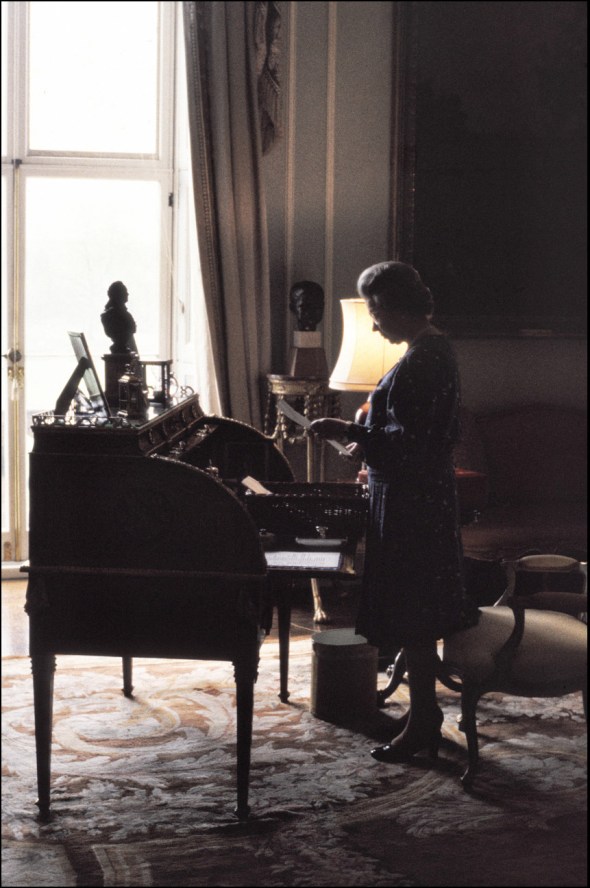
HM the Queen at her desk, Buckingham Palace, February 1991.
DS: About a thousand years ago (1991) I spent a few months working with a BBC film crew – it really was film – making a documentary to mark the Queen’s 40th year on the throne. The camera/sound team of Philip Bonham-Carter and the late Peter Edwards, and the director Edward Mirzoeff (a sometime contributor to this blog) – had formidable reputations. I did not have a formidable reputation. I was hired in haste, the production already rolling, to take ‘stills’ and not get in anyone’s way. Naturally, I got in everyone’s way – most often in the viewfinder of Philip’s Arriflex – but somehow managed to avoid being fired.
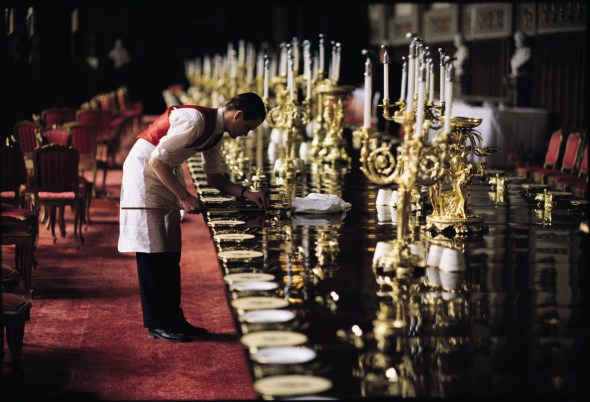
Footman laying a table for 200 guests, St George’s Hall, Windsor Castle, May 1991.
My chief recollection of the project is fear: fear of getting in Philip’s shot, fear of missing my shot (the sound-proof camera housing I had to use denied easy access to the camera), fear of under-exposure in huge rooms lit by dim lamps, fear of saying the wrong thing … I even discovered a new kind of fear: that my Moss Bros penguin suit was about to collapse in front of royalty. At Windsor Castle photographing a state banquet I suddenly felt the elastic in my waistband give out; my trousers began heading south just as Lech Walesa was greeting the Queen Mother. The nightmares still recur.
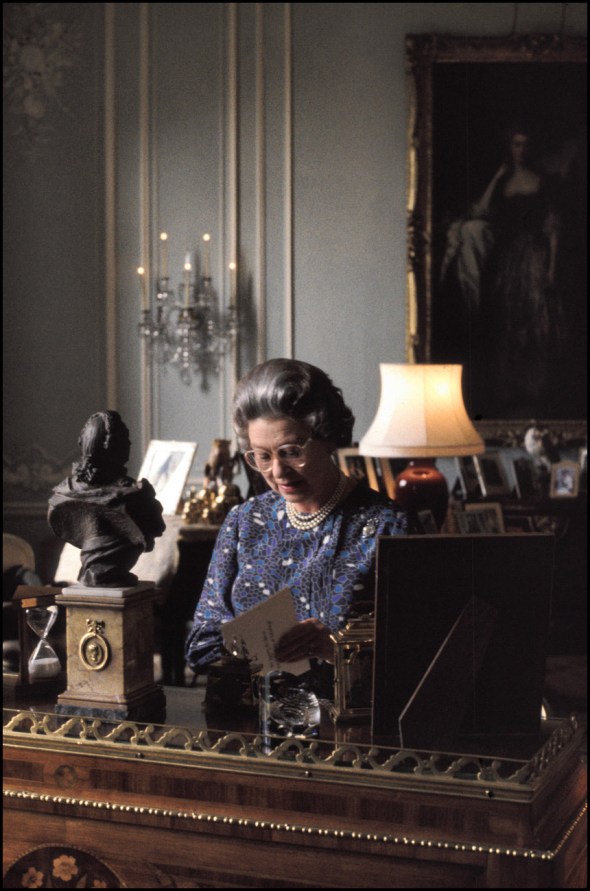
I finally overcame my fears and managed to complete the project, salvaging some dignity in the process. Looking back, these images are souvenirs of a time that has become so distant. Who would have thought that 1991 would seem like such an innocent time?
Anyway, this blog post constitutes The London Column’s 90th birthday greeting to Her Majesty. Please be upstanding, and cue music:
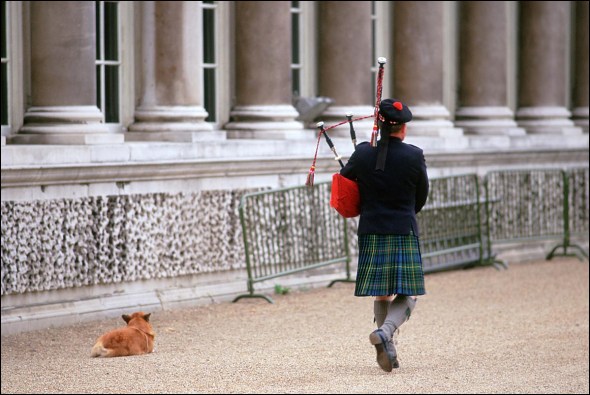
Morning serenade at Buckingham Palace, June 1991.
All photos © David Secombe.
The Empty Office (for Peter Marlow).
Posted: March 11, 2016 Filed under: Interiors, Transport, Vanishings | Tags: Katy Evans-Bush, Peter Marlow Comments Off on The Empty Office (for Peter Marlow).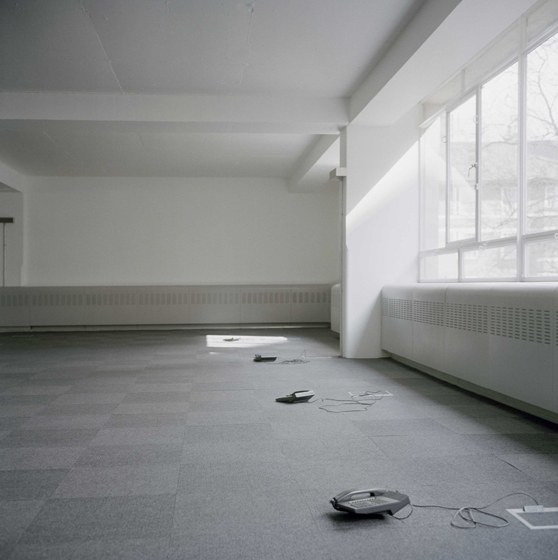
Empty Office, Clerkenwell, 2002. Photo © Peter Marlow.
Katy Evans-Bush:
The office as its redundant workers move out is spotted with relics of human degradation: that is, of the letdown from future perfect to mere life.
The screw stuck in the wall, reminder of that award for the old campaign that no one still here now remembers – although it was great work and targets were exceeded – surrounded by nails that hold their heads proud, knowing they held up the proofs of its successes.
Comfortable tea stains, paper clips wedged where the desk didn’t quite meet the wall, a blotched photo of Sarah who worked here half a decade ago, with a small child; she’d be wanting that back, if anyone knew where to find her now. Bits of phone chargers. A chocolate egg in foil. A bit of silk ribbon, some one-legged scissors, a dusty old bottle of Bristol Cream: why is it blue? Are they really that colour? A sad pile of paperbacks no one will ever read: Windows for Dummies and guides to blogging for businesses. Blu-Tack smears where no one thought they’d matter. Sticker-marks on the phones, where someone put the new supplier’s number. Dirt on the sills from the plants the receptionist had to water, because optimism always wins out. Optimism and sheer daily labour.
Things can’t stay clean forever. People are people and every negotiation will be tarnished. Its spreading spots will eat at your blind belief in silver and grey and the functional streamline that bypasses doubt and loops back to the bank, via mobile phones, and suits with reinforced shoulders, and platinum cardholders.
Forget your cheap tiles screaming masculine thrust from the Carpetland down on the roundabout. This office was made for pink fluffy sweaters, cake crumbs, to-do lists, pictures of cats, the darkening water in a vase, nail files and overstuffed folders.
… this is a reprise of one of The London Column’s early posts, from June 2011, in tribute to the English photographer Peter Marlow who died last month.
See also: Point of Interest (2), Point of Interest (3).
Hawksmoor and the city.
Posted: February 18, 2016 Filed under: Architectural, Churches, Dereliction, Monumental, Pavements, Street Portraits | Tags: Ackroyd's Hawksmoor, Christopher Wren's London, Hawksmoor churches, Nicholas Hawksmoor, Owen Hopkins Comments Off on Hawksmoor and the city.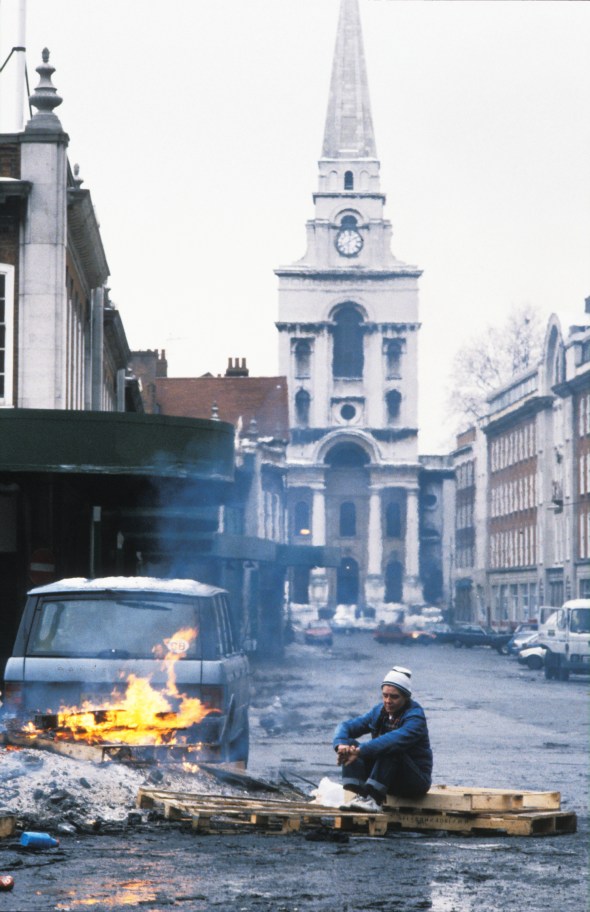
Christ Church Spitalfields from Brushfield St., 1990. (This and all photos on this page © David Secombe.)
Owen Hopkins:
Ever since they began to rise over London just over 300 years ago, the churches of Nicholas Hawksmoor (1662–1736) have had an ambiguous – even paradoxical – relationship to the city that made them and which they have in turn remade. On the one hand, the churches of St Anne, Limehouse, Christ Church, Spitalfields and St George-in-the-East in the old parish of Stepney, St. Alfege in Greenwich, St Mary Woolnoth in the City of London and St George, Bloomsbury are inextricably bound up with the history of London. On the other, they stand apart, somehow belonging to a rather different time and place, almost as fragments of Ancient Rome transplanted into London.
 St Alfege, Greenwich, 1988.
To understand Hawksmoor’s churches and their relationship to the city, one has to go back to the aftermath of the Great Fire of 1666. Even as the fire still smouldered, Hawksmoor’s later master, Christopher Wren, was working up a plan for London’s rebuilding that would replace its narrow and irregular medieval streets with grand boulevards. Most importantly, and taking direct inspiration from what he had learned in Paris the year before, Wren’s plan would have imposed a clear spatial order and control on the dangerous and unruly metropolis.
Hawksmoor’s approach to city planning was different. Hawksmoor never created a plan for London in the way his master had done, but he did produce (unbuilt) designs for re-planning Oxford and Cambridge, and parts of London around St Paul’s Cathedral, Greenwich, and Westminster. The easiest way to understand how these would have worked is to look to contemporary landscape gardens: manufactured landscapes littered with classically-inspired temples and follies, structures that dominate the vistas and embody the estate owner’s authority.
 St George-in-the-East, Wapping, 2010.
Similarly, in Hawksmoor’s idea of the city, spatial order and control extended not from the street layout, but from monumental buildings that would physically dominate their surroundings. In all Hawksmoor city plans we see a recurring strategy of clearing the areas around important buildings – both old and new – so that they might express their spatial dominion over the surrounding cityscape. What happened in between was of far less importance. It’s hard to imagine the effect of these unbuilt plans when described in the abstract, but to see their principles in action we only need look as far as Hawksmoor’s churches.
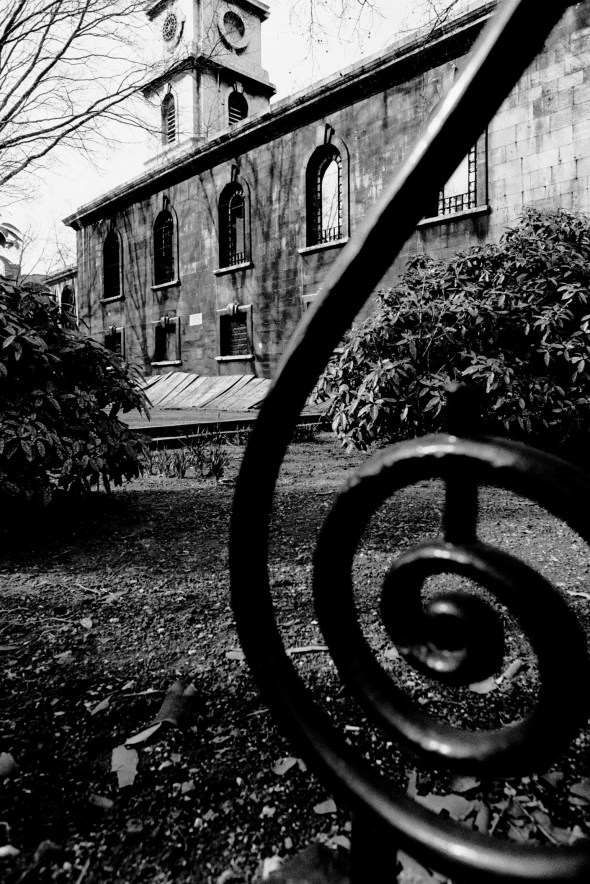 St Luke’s Old St. (Hawksmoor & John James), photographed before its 21st century restoration, 1988.
Even now, the areas around Hawksmoor’s three churches in the old parish of Stepney still retain the ‘edge-lands’ feel they must have had when they first grew up in the decades following the Great Fire. Today that energy is manifested in the clash of different cultures and economies as the City of London encroaches on East End communities. In the early eighteenth century the energy arose through the rise of dissenting religious groups, outside the orbit of central Anglican control, with all the social and political ramifications that that held. As a result, Hawksmoor’s churches were conceived from the off as outlying beacons of the city’s spiritual and political centre – monuments of state and Church authority in areas that had none.
 Entrance to Bank tube station showing part of the crypt of St Mary Woolnoth, City of London, 1988.
All three of Hawksmoor’s Stepney churches are colossal structures, deliberately sited to be seen in the round, that dominate their environment by sheer scale. Not surprisingly, their overbearing size has played a part in their subsequent neglect. In a 1975 letter to The Times, the then Bishop of Stepney, Trevor Huddlestone, was at great pains ‘to make it clear that the state of disrepair of Christchurch, Spitalfields is in no sense due to the failure of the local Christian community, nor, in my opinion, to neglect by the authorities of the Church of England’. Such a building of ‘cathedral-like proportions’ was, he argued, an ‘appalling responsibility for the Church’.
In addition to their size, Hawksmoor was able to make his churches stand out by his choice of material: white Portland stone, as opposed to the red brick of the surrounding city. Hawksmoor’s churches appear as if fully formed from a single gigantic block of stone. There’s the sense that this is the form the stone wants to be – a testament to their design, the final and most enduring aspect of their differentiation from the surrounding city.
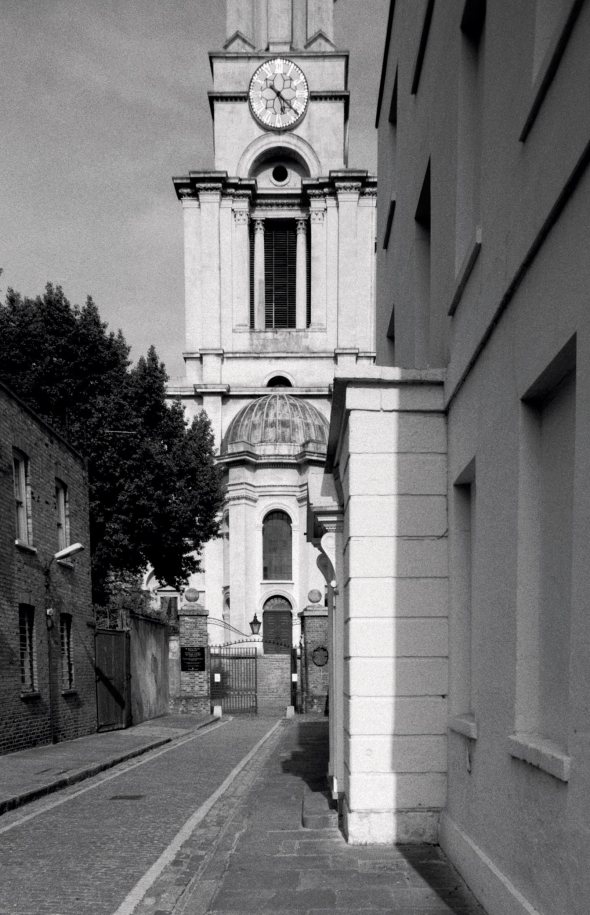 St Anne’s Limehouse, 2010.
Having risen up through Wren’s office in the 1680s and 90s, by the beginning of the eighteenth century Hawksmoor was arguably the best-trained architect Britain had ever seen. Classical architecture was his intellectual and aesthetic bedrock, but he was also fascinated by Gothic architecture and in particular its origins – as he saw them – in the churches of the early Christians of the near east. Hawksmoor’s genius was to bring all this learning to bear in creating a series of church designs rich in reference, resonance and allusion. The result was a series of buildings in which architecture was taken back to its very origins, with ideas and references built up in complex layers of masonry, imbuing these structures with the authority of the architectural past. This is architecture conceived through a sculptural sensibility to create buildings that speak to us but indirectly: through our senses and our emotions.
 St George Bloomsbury, 2016.
There are few buildings in London that look back to the past while at the same time prefigure the future. While part of London’s history, Hawksmoor’s churches exist in the future too, yielding ever more secrets as the city changes around them.
… for The London Column. Owen Hopkins’s book From The Shadows: The Architecture and Afterlife of Nicholas Hawksmoor is published by Reaktion Books.
© Owen Hopkins. All photos © David Secombe.
See also: Bluegate Fields, The London Nobody Knows, Spitalfields market.


 The London Column