Drinker’s London. Photos Paul Barkshire, text David Secombe. (2/5)
Posted: October 19, 2011 Filed under: Artistic London, Bohemian London, Literary London, Pubs | Tags: Ezra Pound, London bohemia, Sam Smiths pubs, The Princess Louise, The Rhymers Club, W.B. Yeats Comments Off on Drinker’s London. Photos Paul Barkshire, text David Secombe. (2/5)
Princess Louise, Holborn,1986. Photo © Paul Barkshire.
The Princess Louise is one of those carefully time-locked London pubs where one is invited to experience a idealised ‘heritage’ drinking experience: the Louise escaped post-war redevelopment and refurbishment and has survived into the 21st century as an authentically preserved/recreated Victorian boozer. At time of writing, the only beer on offer in the Louise is Sam Smiths, a rather dense, tawny ale brewed in Yorkshire; its main appeal is that it is remarkably cheap, but it is perhaps no coincidence that Sam Smiths currently lay claim to several other historic London pubs: these include the legendary Fitzrovia hangouts The Wheatsheaf and The Fitzroy Tavern, both much-frequented by the likes of Augustus John, Dylan Thomas, George Orwell, etc. – and also The Cheshire Cheese on Fleet Street, known to writers from Samuel Johnson (allegedly) and Charles Dickens up to Oscar Wilde, W.B. Yeats and Ezra Pound. (The Cheese was where Wilde came to hear John Gray, the model for Dorian Gray, read his poems, and where Pound demonstrated his impeccable Modernist credentials by eating two red tulips during a recital by Yeats.)
Since Paul Barkshire’s photo was taken in the 80s, the Princess Louise has had another make-over, reinstating ‘authentic’ Victorian mahogany & etched glass partitions, the original purpose of which was to divide up the patrons according to class and occupation. The end result is undoubtedly charming, and Sam Smiths should be congratulated for the sensitivity of their management of these historic pubs. The problem is that the loving restoration reinforces the sense of theme park, that creep of ‘Heritage’ (a tainted word if ever there was one) which imprisons London. The ghosts of the past are marooned amongst the tourists, and the centre of town is closed off to the truly louche and experimental. The Fitzroy Tavern and the Wheatsheaf can never be what they were in the 1920s and 40s; and where would The Rhymers’ Club, that austere flower of the Aesthetic movement which met at the Cheshire Cheese from the 1890s up to 1914, attracting Wilde, Yeats, Dowson, Pound, etc., meet today? A loft in Peckham or Dalston, probably. D.S.
… for The London Column.
Nights at the Opera. Photo & text: David Secombe. (5/5)
Posted: August 5, 2011 Filed under: Artistic London, Performers, Theatrical London | Tags: curtain call, Macmillan's Romeo and Juliet, Royal Ballet, Viviana Durante Comments Off on Nights at the Opera. Photo & text: David Secombe. (5/5)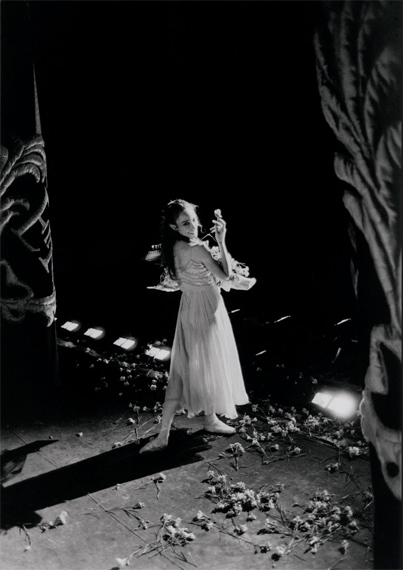
Viviana Durante taking her curtain call. Photo © David Secombe 1994.
To a Dancer by Arthur Symons:
Intoxicatingly,
Her eyes across the footlights gleam,
(The wine of love, the wine of dream)
Her eyes that gleam for me!
The eyes of all that see
Draw to her glances stealing fire
From her desire that leaps to my desire
Her eyes that gleam for me!
(There are two more verses of this awful poem, but I think we’ve heard enough.)
Viviana Durante is seen here taking a final bow at the end of Kenneth MacMillan’s acclaimed staging of Prokofiev’s Romeo and Juliet. This was the last concert of the season, a hot June night, and dance fans in the gods indulged in the agreeably cheesey custom of throwing flowers on to the stage as the principals took their calls. Ms Durante appears to be looking into the lens in this picture – this is likely, as the next frame shows her getting a fit of giggles as she looks at someone standing on my right. So you get it both ways: a poised ballerina straight from Symons’ coy imaginings, who sends up the entire form with a lethally witty gesture. Only someone seriously good can get away with that.
The London Column takes its own break for a week or so; material will be amassing in the mean time, so join us again later in the month.
David Secombe
Days and Nights in W12. Photographs and text: Jack Robinson (3/4)
Posted: July 1, 2011 Filed under: Artistic London, Bohemian London, Catastrophes, Transport | Tags: CB Editions, Days and Nights in W12, minicab, W.K. Teevald Comments Off on Days and Nights in W12. Photographs and text: Jack Robinson (3/4)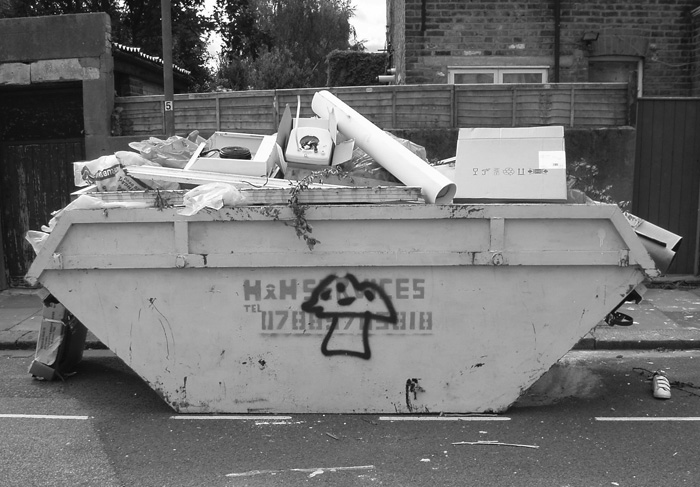
Batson Street, W12, 2007. Photo: © Jack Robinson.
From Days and Nights in w12* by Jack Robinson:
SKIP
The white roll in this skip is not posters for a film that’s no longer showing or rejected samples from an advertising agency but drawings of a Macedonian girl who speaks almost no English but has a body to die for. The drawings were made by the American artist W. K. Teevald; during his month-long stay in London, where he’d come to supervise the hanging of a retrospective exhibition of his work, he checked out of his hotel and moved in with this girl, and he considers the drawings to be the best work he’s done for years. On the day of his return flight to Los Angeles the taxi he’d ordered didn’t arrive, so he loaded his bags into the only car available from the nearest minicab office. The drawings were strapped onto the roofrack. ‘No problem, mister, the Lord is good, he will take best care,’ said the driver as he yanked on the rope and knotted it. He looked about twelve years old and was grinning; he could have been making a joke, except that the Virgin Mary was stickered all over the dashboard and a crucifix dangled from the rear-view mirror. When they arrived at the airport the roofrack was bare: not even a shred of rope was clinging to the metal frame. The driver demanded twice the fare that had been agreed before they’d set out and followed Teevald into the departures hall, pleading for justice and if not justice then charity, until he was turned away by security guards.
© Jack Robinson.2011.
* CB Editions 2010.
Old and New Soho. Photo John Claridge, text Sebastian Horsley (3/5)
Posted: May 25, 2011 Filed under: Artistic London, Bohemian London | Tags: John Claridge, Sebastian Horsley, The French House Comments Off on Old and New Soho. Photo John Claridge, text Sebastian Horsley (3/5)
Sebastian Horsely, The French House, Soho, 2002. Photo © John Claridge.
Clearly God loves ugly people. He makes so many of them. He shows his contempt for life by the kind of person he selects to receive it. Crawling from primeval waters you waddled, slaves, cripples, imbeciles, the simple and the mighty, fighting for the right to breathe oxygen. It was a mistake but you did it. Little did it matter to you that the earth was a vale of tears, of horrid sufferings, of torturous sickness and death. You wanted life little worm. You got it.
And what did you do with it when you got it? Celebrate? Have fun? No. You moaned. Equal rights! Equal pay! Equal Equal! Equal is a dead word. No man who says “I am as good as you” believes it. The shark never says it to the sardine, nor the intelligent to the stupid, nor the rich to the poor, nor the beautiful to the plain. The claim to equality is made only by those who feel themselves to be in some way inferior.
And inferior they are. With beautiful classical things like me the Lord finished the job. Ordinary ugly people know they’re deficient and they go on looking for the pieces, moaning and complaining. Don’t you realise my darlings that if you have any complaints, they would be theistic : – they should be about your maker , who lets face it, hasn’t done that great a job.
Physical beauty is the sign of an interior beauty, a spiritual and moral beauty. The handsome are not merely blessed with their looks, they are somehow better than the plain and ugly : they are wittier, more intelligent, even tempered and socially competent. Ms Sappho put it more bluntly : “What is beautiful is good”
What I hate most about ugliness is that it shows such bad judgement. Much as I loathe ugly people our sympathies should not, however, be for them after all. I mean their faces they are behind – they can’t see their revolting selves. We, the public, on the other hand, are in front of them and can see all too clearly. And its simply not good enough. No its not. How dare they look like that? Don’t they realise that their right to look revolting ends where it meets my eye?
[From Sebastian Horsley‘s blog, October 05, 2008. Horsely died of a drug overdose at his house in Meard Street, Soho, in June 2010.]


 The London Column