Drinker’s London. Photos Paul Barkshire, text David Secombe. (2/5)
Posted: October 19, 2011 Filed under: Artistic London, Bohemian London, Literary London, Pubs | Tags: Ezra Pound, London bohemia, Sam Smiths pubs, The Princess Louise, The Rhymers Club, W.B. Yeats Comments Off on Drinker’s London. Photos Paul Barkshire, text David Secombe. (2/5)
Princess Louise, Holborn,1986. Photo © Paul Barkshire.
The Princess Louise is one of those carefully time-locked London pubs where one is invited to experience a idealised ‘heritage’ drinking experience: the Louise escaped post-war redevelopment and refurbishment and has survived into the 21st century as an authentically preserved/recreated Victorian boozer. At time of writing, the only beer on offer in the Louise is Sam Smiths, a rather dense, tawny ale brewed in Yorkshire; its main appeal is that it is remarkably cheap, but it is perhaps no coincidence that Sam Smiths currently lay claim to several other historic London pubs: these include the legendary Fitzrovia hangouts The Wheatsheaf and The Fitzroy Tavern, both much-frequented by the likes of Augustus John, Dylan Thomas, George Orwell, etc. – and also The Cheshire Cheese on Fleet Street, known to writers from Samuel Johnson (allegedly) and Charles Dickens up to Oscar Wilde, W.B. Yeats and Ezra Pound. (The Cheese was where Wilde came to hear John Gray, the model for Dorian Gray, read his poems, and where Pound demonstrated his impeccable Modernist credentials by eating two red tulips during a recital by Yeats.)
Since Paul Barkshire’s photo was taken in the 80s, the Princess Louise has had another make-over, reinstating ‘authentic’ Victorian mahogany & etched glass partitions, the original purpose of which was to divide up the patrons according to class and occupation. The end result is undoubtedly charming, and Sam Smiths should be congratulated for the sensitivity of their management of these historic pubs. The problem is that the loving restoration reinforces the sense of theme park, that creep of ‘Heritage’ (a tainted word if ever there was one) which imprisons London. The ghosts of the past are marooned amongst the tourists, and the centre of town is closed off to the truly louche and experimental. The Fitzroy Tavern and the Wheatsheaf can never be what they were in the 1920s and 40s; and where would The Rhymers’ Club, that austere flower of the Aesthetic movement which met at the Cheshire Cheese from the 1890s up to 1914, attracting Wilde, Yeats, Dowson, Pound, etc., meet today? A loft in Peckham or Dalston, probably. D.S.
… for The London Column.
London Monumental. Photo & text: David Secombe (3/5)
Posted: September 7, 2011 Filed under: Bohemian London, Monumental | Tags: 55 Broadway, Jacob Epstein Comments Off on London Monumental. Photo & text: David Secombe (3/5)
Night by Jacob Epstein, 55 Broadway, Westminster. Photo © David Secombe 2011.
55 Broadway was built in the late 1920s to house the headquarters of the Underground Electric Railways of London, which later became London Underground. Fittingly, the edifice looms above St. James’s Park tube station, and the shopping mall at ticket hall level still contains much delightful Deco detailing. The building was designed by Charles Holden, who also designed the University of London’s Senate House in Bloomsbury. The building is further distinguished by the presence of sculptures and reliefs commissioned from some of Britain’s leading sculptors of the time, including the ‘big three’: Eric Gill, Henry Moore and Jacob Epstein.
Epstein carved his two contributions – Day and Night – directly into the Portland stone of no. 55. Predictably, Epstein’s brand of modernism went down badly and the male nudity of Day proved particularly controversial. There was a typically British outcry in the popular press, and Frank Pick, head of the Underground at the time, resigned over the affair. Epstein was eventually forced to shorten a penis on one of his figures by one and a half inches, but the furore impacted badly on his career, commissions being in short supply throughout the 1930s.
© David Secombe 2011.
Days and Nights in W12. Photographs and text: Jack Robinson (3/4)
Posted: July 1, 2011 Filed under: Artistic London, Bohemian London, Catastrophes, Transport | Tags: CB Editions, Days and Nights in W12, minicab, W.K. Teevald Comments Off on Days and Nights in W12. Photographs and text: Jack Robinson (3/4)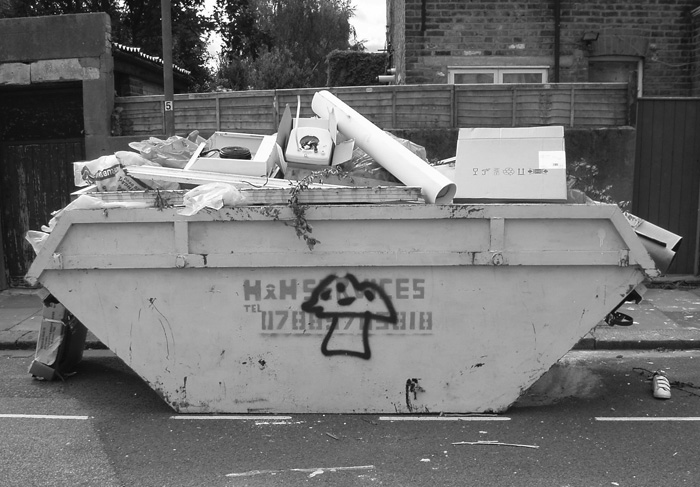
Batson Street, W12, 2007. Photo: © Jack Robinson.
From Days and Nights in w12* by Jack Robinson:
SKIP
The white roll in this skip is not posters for a film that’s no longer showing or rejected samples from an advertising agency but drawings of a Macedonian girl who speaks almost no English but has a body to die for. The drawings were made by the American artist W. K. Teevald; during his month-long stay in London, where he’d come to supervise the hanging of a retrospective exhibition of his work, he checked out of his hotel and moved in with this girl, and he considers the drawings to be the best work he’s done for years. On the day of his return flight to Los Angeles the taxi he’d ordered didn’t arrive, so he loaded his bags into the only car available from the nearest minicab office. The drawings were strapped onto the roofrack. ‘No problem, mister, the Lord is good, he will take best care,’ said the driver as he yanked on the rope and knotted it. He looked about twelve years old and was grinning; he could have been making a joke, except that the Virgin Mary was stickered all over the dashboard and a crucifix dangled from the rear-view mirror. When they arrived at the airport the roofrack was bare: not even a shred of rope was clinging to the metal frame. The driver demanded twice the fare that had been agreed before they’d set out and followed Teevald into the departures hall, pleading for justice and if not justice then charity, until he was turned away by security guards.
© Jack Robinson.2011.
* CB Editions 2010.
Comics. Photo John Claridge, text Spike Milligan (1/5)
Posted: June 20, 2011 Filed under: Amusements, Bohemian London, Performers, Theatrical London | Tags: Hackney Empire, John Claridge, Spike Milligan, The Goons, The Grafton Arms Comments Off on Comics. Photo John Claridge, text Spike Milligan (1/5)
Spike Milligan, The French House, Soho, 1989. Photo © John Claridge.
[The first Goon Show was broadcast in May 1951.]
Excerpts from Peace Work* (1991) by Spike Milligan:
I must get up to London. Harry has a week out from Variety, I can get him on Gerrard 0081. I dial out, a lady answers ‘Kidston Villas’.
‘Can I speak to Harry Secombe?’
‘Just a minute.’
I hear her call Mr. Secombe – Mr. Secombe – I hear his distant chattering.
‘Coming- Coming – Hello, Hello, Secombe here.’ His voice is expectant. ‘Hello, Hello,’ he repeats in a police voice.
I say, ‘Mr. Selcon, it’s about this thirteen year-old girl’
We arrange to meet at Jimmy’s that evening. When we do arrive Jimmy [Grafton] invites us up to his lounge for dinner – his wife Dorothy serves us. ‘What’s the matter with your face?’ says Jimmy.
I said, ‘I shaved.’
Jimmy laughed, ‘Well, I shave but that doesn’t happen to my face.’
‘Well, it bloody happened to mine’
‘I told you you shouldn’t have let him come’ giggled Secombe.
‘You Secombe, I pointed with a quivering finger, ‘you shall be accursed, all your sons will have wives with moustaches and three legs.’
Dinner now proceeded. ‘Is he always like this dear?’ said Dot to her husband.
Jimmy is acting as Harry’s manager with an agent called Frank Barnard. Harry is doing Variety whenever he can, his name very small on the bill.
Jimmy is writing scripts for an ex-Geraldo singer called Derek Roy, who fancied himself as a comic. Somehow or other I found myself sleeping in Jimmy’s attic office and whenever, writing scripts; it was a pretty mad establishment, with two young children James and Sally whom I told stories to. To add to it there was a rhesus monkey, ‘Jacko’ and a bulldog, Buller, plus Minty, a Siamese cat. The pub [The Grafton Arms, Strutton Ground, Victoria] was very popular and served meals, Jacko seemed a bit dispossessed, so I put a rug atop a hot water tank and it became his refuge. Alas, it was right over the kitchen stove, a lethal position when food for the pub lunches was simmering on top, and I actually saw Jacko pee – and watched it land, of all things – in the Pea Soup where Louis the cook stirred it in: mind you, this wasn’t a regular occurrence.
Harry is due to appear at the Hackney Empire so all of us arrange to see him including Hall and Mulgrew. However, Hall says no. ‘I’m not going to that fucking death hole – I’ll never forget how we died the bloody death there.’ Cheer up, woeful fellow, come and see Harry Secombe die there. But no. In the bar I meet Peter Sellers again; he is plump-faced and wearing gloves, all a cut above the rest of us tramps.
‘Oh Jimmy’ I say, is it worth £10 scriptwriting for Derek Roy, the man who kills 99 per cent of all known jokes?’
Jimmy said, ‘Patience, it can lead to bigger things.’
I tell him I don’t need bigger things, mine are big enough, ask any heavy plant operator.
‘There could be a series’ says Jimmy.
‘What of disasters? Roy is not funny.’
‘It’ll put money in your shatteringly hollow account,’ he says.
So when he’s in the bar serving I bang away at the jokes.
Jimmy organises a night with The Goons, as we have decided to call ourselves. So one evening, after hours, we have an ad-lib session. [Michael] Bentine starts the ball rolling, ‘Gentleman, now you know why I’ve called you here?’
‘No we don’t’ we murmur.
‘Very well, we’ve been besieged in this fort for, does anybody know?’
‘Forty days’ says one.
‘Fifty’ says another.
‘Any advance on fifty?’
Seventy.
‘Right, we’ve been besieged forty, fifty and seventy days. Gentlemen, you will synchronise watches.’
They all adjust their watches, but never say a word, the phones supposedly rings, Secombe answers. ‘Hello, Fort Agra, hello? Just a minute.’ He holds his hand over the phone, ‘Does a Mrs Gladys Stokes live here?’ No sorry Mrs Stokes doesn’t live here.
SELLERS: Someone has to go and get reinforcements.
ME: Yes, someone has to.
SECOMBE: Yes gentlemen, someone has to go and get reinforcements.
Pause
SELLERS: Good, well that’s settled.
I suppose it would only be a matter of time before someone in the BBC might use us. There was one enlightened producer streets ahead in perspicacity, Pat Dixon, totally unrevered by the BBC but directly responsible for giving us the break. Already we had produced the first comedy show on the new Third Programme (for unknown reason now called Radio 3), they can’t leave alone can they, using Harry Secombe, Peter Sellers, Benny Hill. It was the first comedy show without an audience, I used to go and listen through the studio door, I was desperate to be given a break as such on the media; Secombe, Sellers, Bentine are all working and earning. If I hadn’t written myself into The Goon Show, I’d never have been heard of.
© Spike Milligan Productions
[The London Column would like to thank Jane Milligan and the Milligan family for the above.]
* Penguin Books.


 The London Column