Derby Day Dozen.
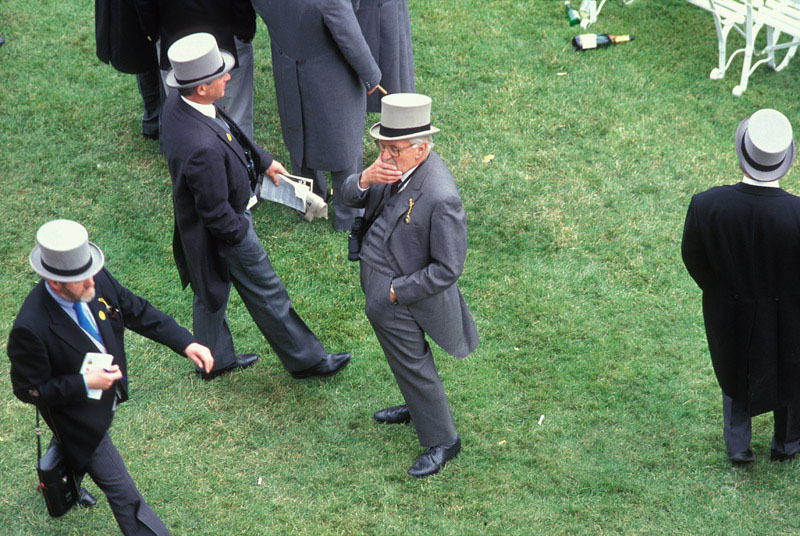
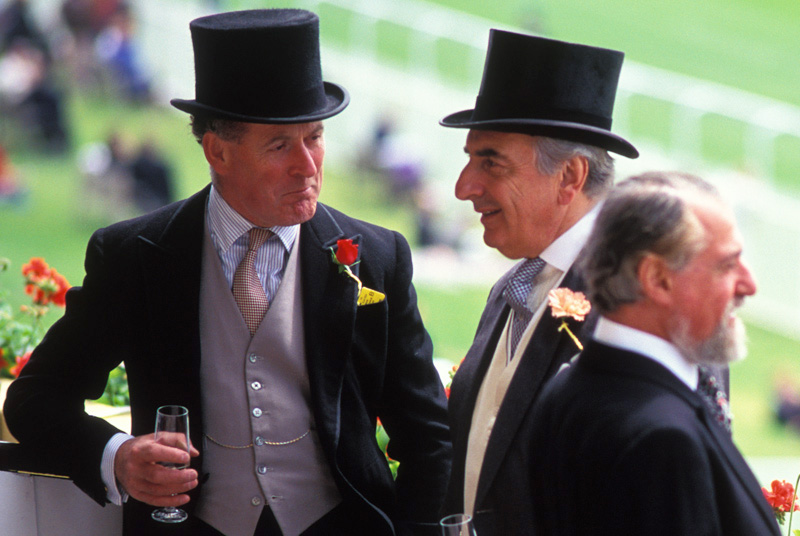
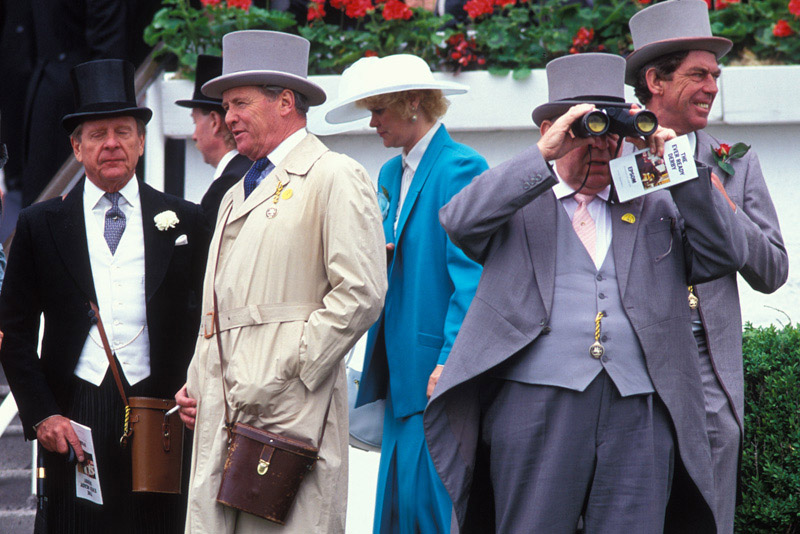
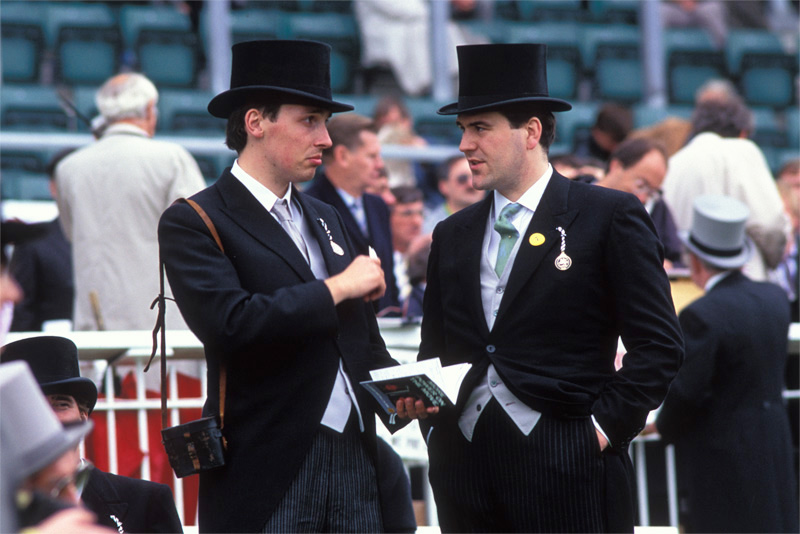
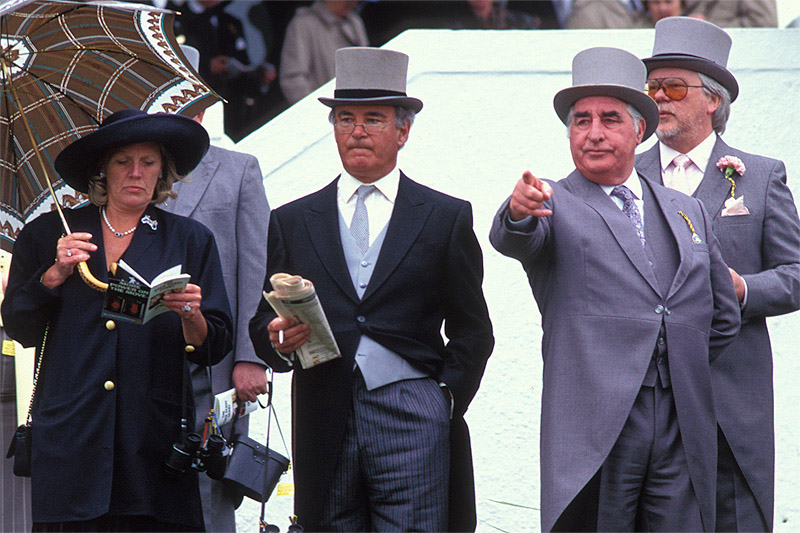
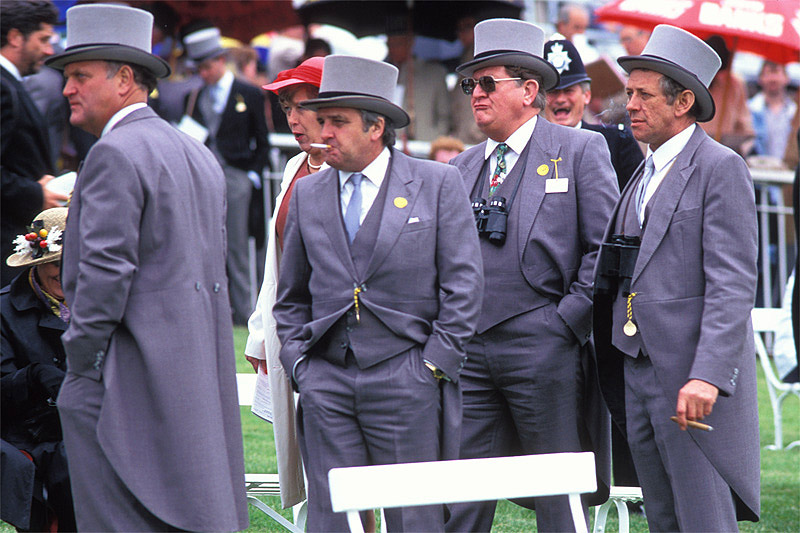
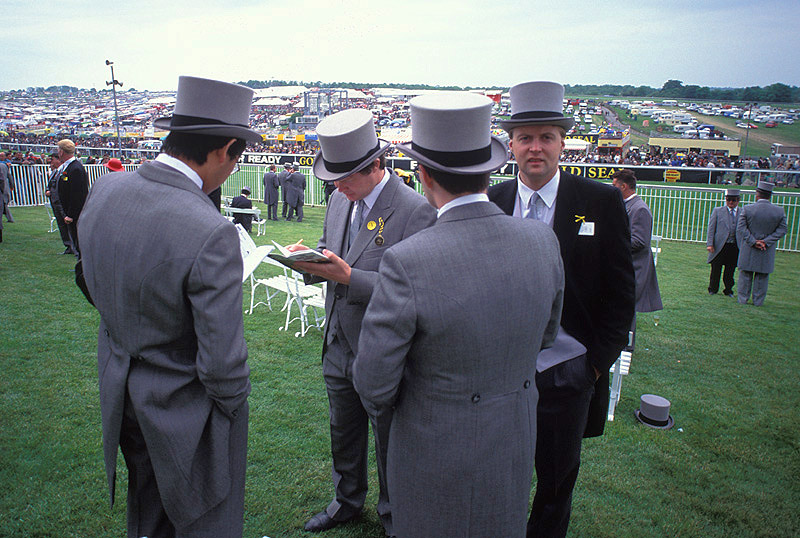
Posted: June 6, 2014 Filed under: Class, Out Of Town, Sartorial, Sport | Tags: Charlie Squires, Derby Day, Epsom Derby, Epsom Downs, Francis Frith, Generous, Lester Piggott, Nijinsky Comments Off on Derby Day Dozen. Member’s enclosure, Derby Day, Epsom. © David Secombe 1991.
Interview with Alfred Hitchcock, New York Times, 19 March 1939*:
Apparently no Hitchcock interview is ever complete without Mr. Hitchcock’s latest idea for a picture he would like to make – some time. Today he has in mind a picture built around the English Derby – Derby Day. “Can there be anything more exciting or dramatic than a million people all gathered together in one afternoon – all sorts of people, from top to bottom – just to witness the running of a race? I always liken it to the Judgment Day. Well, I should like to sift, say, a dozen characters from that crowd and, within the limits of an hour and a half on that fatal afternoon, tell their stories, climaxed by the finish of the race.” It sounds like a great idea – maybe too great, because, unfortunately, Mr. Hitchcock never seems to get around to doing those pictures he dreams about.
 © David Secombe 1991.
 © David Secombe 1991.
 © David Secombe 1991.
 © David Secombe 1991.
 © David Secombe 1991.
 © David Secombe 1991.
 © David Secombe 1991.
 © David Secombe 1991.
 © David Secombe 1991.
 © David Secombe 1991.
 Runners on their way to the starting gate, Epsom Derby, 1991. © David Secombe 1991.
DS: Tomorrow sees the running of The Derby at Epsom, the original Derby anything, founded in 1780, and still the richest horse race in Britain. Once run mid-week, since 1995 it has been a Saturday fixture, the rescheduling an indication of its decline as an event. No-one seems entirely sure why it has lost its popularity. Hitchcock’s comment reflects the notion of the Derby current in the Victorian and Edwardian eras: London on the Downs, the city decamping en masse for a day at the races. This was the Derby Day of Dickens, William Frith, or the doomed suffragette Emily Davison. As a schoolboy in Epsom during the 1970s, I recall the frightening volume of humanity that appeared on the first Wednesday in June … but that excitement and sense of occasion has simply withered. These images are of Derby Day in 1991, taken whilst working alongside Eddie Mirzoeff’s documentary team (see below) and show only the elaborately hatted zone of the grandstand. The modern version of Frith’s Victorian painting is a glorious documentary by Charlie Squires of the 1970 Derby: I have hunted YouTube to locate this but to no avail. I would dearly love to see that film again: instead, here is footage of the 1970 race, won in legendary fashion by Lester Piggott on Nijinsky:
The 1991 Derby was won by ‘Generous’, ridden by Alan Munro. From Elizabeth R, prod. E, Mirzoeff, BBC, 1992 – video no. 3 in sequence:
* Thanks to The Hitchcock Zone.
East London Song (after Bertolt Brecht & Kurt Weill)
Posted: April 30, 2014 Filed under: Amusements, Class, London Places, London Types | Tags: Alabama Song, Brecht/Weill, Dalston Junction, Jim Morrison, Katy Evans-Bush, Kurt Vile, London Hipsters, Lotte Lenya, nathan barley, stoke newington, Tim Hadrian Marshall Comments Off on East London Song (after Bertolt Brecht & Kurt Weill)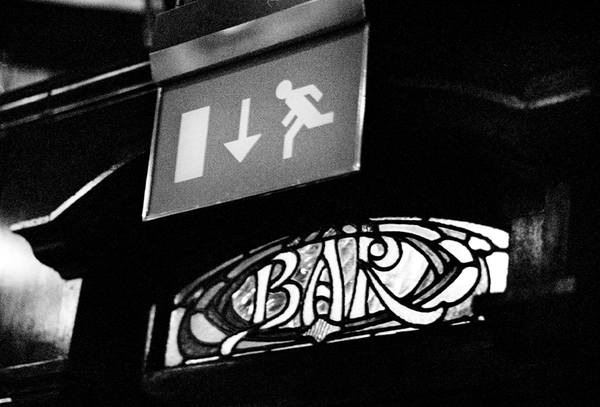
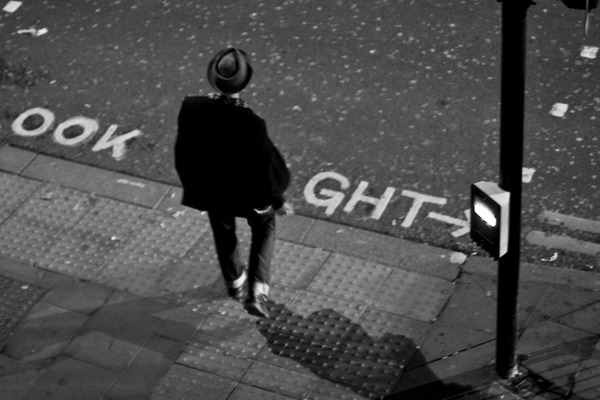
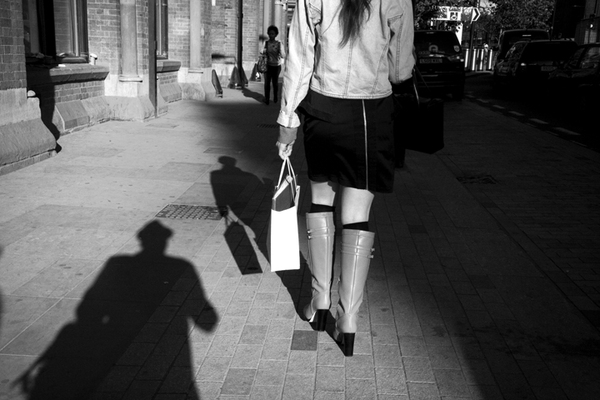
All photos © Tim Marshall 2014.
To the tune of Alabama Song*:
Well, show me the way
to the next hipster bar.
Oh, don’t ask why.
Oh, don’t ask why.
Show me the way
to the next whiskered bard.
Oh, he won’t shave;
oh don’t ask why.
For if we don’t find
the next hipster bar,
in bitcoins we can’t pay;
in Shoreditch we will die.
I tell you, I text you,
I tell you we must die.

Sing me Kurt Vile
in the next hipster bar.
Oh, don’t ask why.
Oh, you know why.
Oh, moon of dear old Hoxton,
We now must say goodbye:
We’ve lost our sense of purpose
And need hipsters to show us why.
Oh, moon of Dalston Junction,
It’s good morning, not goodbye.
We’ve missed our good old night bus,
We need espresso, oh, you know why.
Show me the link
to the best hipster URL,
it will lead the way.
It will lead the way.
Oh, retro moon of London,
How analogue you are!
We lost all our signal,
down in the cellar bar.
Oh, moon of old Stoke Newington,
We ne’er must say goodbye.
You shine on our old-style Instagrams;
We need filters, don’t ask why.
The moon shines over Clapton
and we now must say goodbye.
Some of us live in Walthamstow`
(though others would rather die).
Well, show me the way
to the next lo-fi bar.
The wood’s all ply,
the wood’s all ply.

For if we don’t find
a plaid-shirted earl
I tell you we must lie,
and tell them it’s this guy.
They’ll trust you. I’ll text you.
I tell you we must lie.
Show me the place
where the real hipsters are.
They don’t ask why,
they don’t care why.
Oh, moon of Lea Bridge Roundabout
Like bunting in the sky:
We’ve lost our good old Rastas,
And must have hipsters, oh, who knows why.
* Bertolt Brecht reworked by Katy Evans Bush for The London Column. The photos are from Timothy Hadrian Marshall’s series King’s Cross Stories.
Recessional.
Posted: March 10, 2014 Filed under: Catastrophes, Class, Conspiracies, Corridors of Power, Housing, London scandals, London Types | Tags: banking crisis, CB Editions, filthy rich, housing crisis, Jack Robinson, Mayfair squatters Comments Off on Recessional.Jack Robinson:
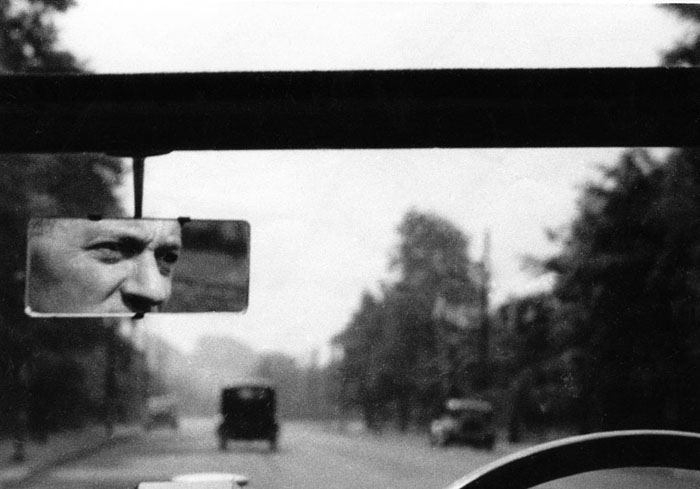
This is my father driving in the 1940s, before I was born.
He left school at fourteen to work in an iron foundry his own father had helped establish; he eventually became joint managing director. We had a comfortable life without my mother having to work; single-income households were common then. He liked cars: I remember waiting at the front-room window one afternoon, when I was four or five years old, to see him arrive home in a brand-new olive-green Riley. Fifty years on from pressing my face against that window, I know that at no time has my own income been sufficient to raise a family in similar comfort, nor will I ever own a brand-new car; and my children will, if they go to college, be already mired in debt before they even begin to earn their own money.
The ignorance of the experts concerning the financial products they were using our money to buy is hardly new. James Buchan, in the late 1980s: ‘In London and New York I met people who invested fortunes in financial enterprises they simply could not describe or explain. No doubt quite soon, a bank would discover it had lost its capital in those obscure speculations; other banks would fail in sympathy . . .’ The politicians were even more ignorant. It’s as if for years we’ve been going with our tummy-aches to doctors who can’t tell the difference between a blister and a cancerous tumour. No wonder we’re ill.
The derivatives market conjured into existence in the 1990s was a virtual world, enabling speculation not in real assets but in the risk of speculation itself. It is addictive: the rush, the buzz, the winning streak. The opposite of which is the losing nose-dive – lose your job and you’re well on your way to losing your (real) house, marriage, health and dog.
An investment banker, quoted in the Standard: ‘In most cases they know their wives despise them for enslaving their lives to money, and they know that the moment they lose their job their wives will walk and take the kids, and their £3 million home, and divorce them.’ A lonely-hearts ad, placed on a literary website at the time the axe started to chop: ‘Ex-banker, 33 . . . Seeking woman not interested in money, fast cars, champagne, holidays, fleecing innocent hard-working gullible twats, whilst telling them you love them. Bitch.’

The above house in Mayfair, London, was squatted in January 2009 by a group that offered free workshops on welding, yurt-building, bookbinding, song-writing and de-schooling society. Hundreds of buildings are squatted; what made the press interested in this one was the stark disparity between the poshness of the building (alleged to be worth £22.5 million) and the presumed poverty of the squatters.
Bookbinding and yurt-building won’t change the world for the better overnight, but nor will sending out 400,000 repossession orders (Centre for Policy Studies estimate, February 2009) to households that have lost jobs and can’t keep up the mortgage payments.

I had a dream in which I punched the keys to withdraw money from a cash machine and it paid out in cowrie shells, rattling down a metal chute into the canvas bag I’d thoughtfully brought with me. As I walked to the supermarket the shells clacked satisfyingly in the bag by my side – I felt rich, rich. And then I woke up and went to my real bank and there was nothing there for me at all, they’d completely run out of money. Not a bean.
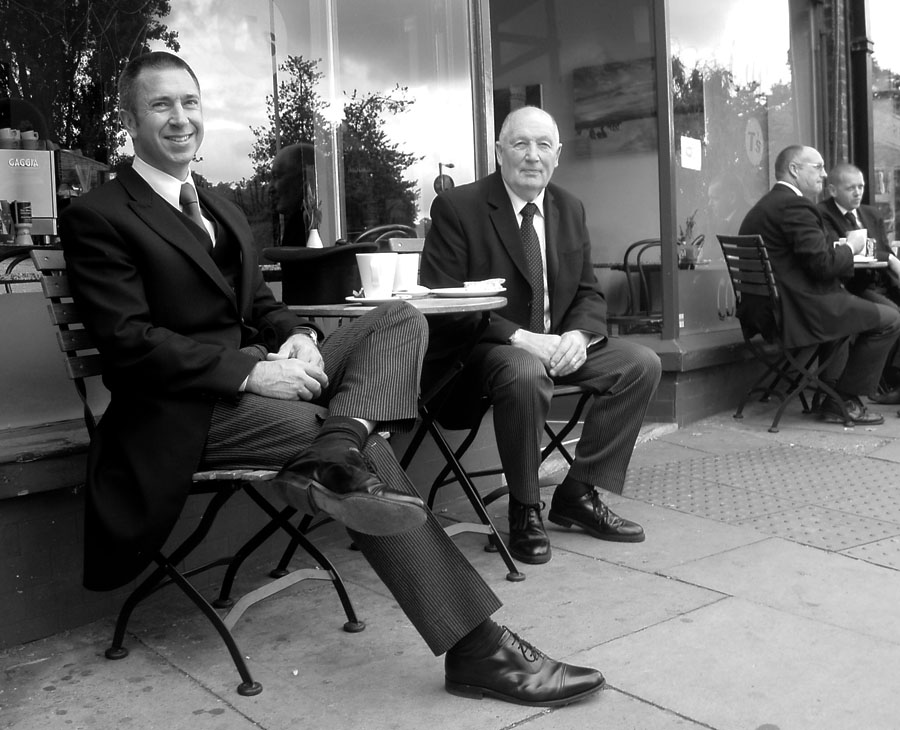
Ou sont les magasins d’antan? As well as the big ones, the small ones too. The place at the end of the road where I used to get my shoes re-heeled – where did that go? The café with over-priced food but a garden at the back where I could smoke? The minicab office in the next street? With the deadpan Somali driver who’d stop the car and get out and look up at the sky: he said he navigated by the stars, and I never knew whether he was taking the piss. Even with no office to return to, I hope that somewhere he’s still driving. There are very few recession-proof businesses; here is one of them.

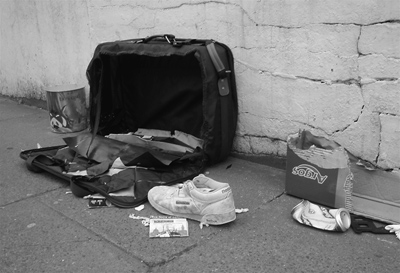
The intensive factory farming of money makes it prone to many diseases, some of which can be transmitted to humans. There are government regulations concerning the application of biotechnology to the breeding of money, and there are also ways around them.In the last fifty years that part of the human brain dedicated to devising ways of getting money away from others and into your own hands has increased in size by 4 per cent.
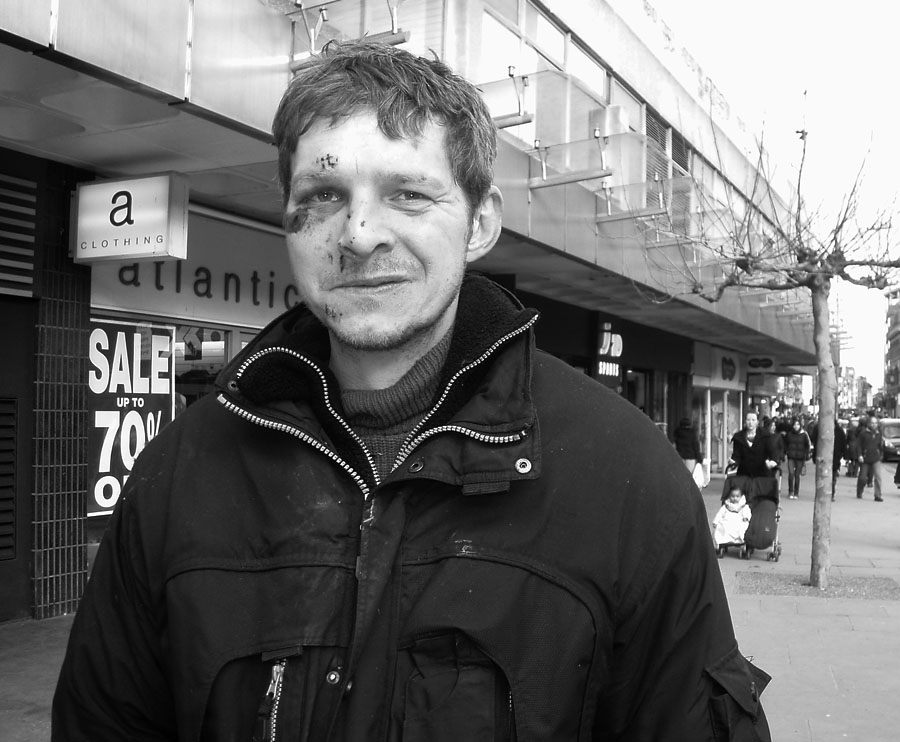
He fell down the stairs. He slipped on the ice. He was coming home from work on Friday night when he got mugged – they took his money, his cards, his identity papers. They flung back his wallet, empty except for the photo of his kids – his kids to whom he’ll say, on Saturday morning, that he fell down the stairs, that he slipped on the ice
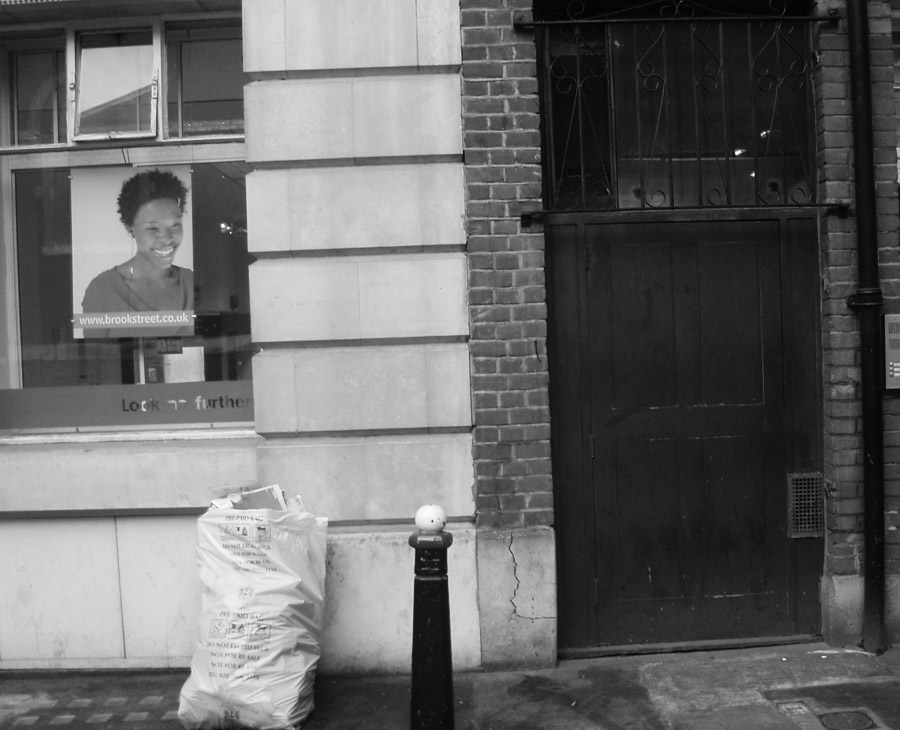
Behind this door – which is in a yard in the City of London – is the secret meeting place of a group of underground bankers. (There’s no external handle; you have to whisper the password through the grille on the right.) This group is deeply suspect: they buy books and music, not yachts and ski chalets, and their vocabulary extends beyond that of company reports. They are regarded by the rest of the banking world as heretics – because the whole point of being a banker is to speak in clichés, to have a single-track mind, to buy only the most predictable goods: that way they remain anonymous, almost invisible, and are left alone to get on with their thing.

God is dead (so can’t bail us out). Or couldn’t afford the heating bills for a place this big, or had had it up to here with the regular early-hours racket outside the lap-dancing club at the end of the street. Whatever the reason, he’s gone. But he left no forwarding address, so the mail just keeps piling up inside the door.
A selection from Recessional by Jack Robinson, published by CB Editions. © Jack Robinson 2009.
A Short Walk Down The Old Kent Road.
Posted: October 14, 2013 Filed under: Class, Public Art, Pubs, Tall Tales | Tags: Andrew Martin, Dun Cow, gentrification, Old Kent Road, only fools and horses, Pink Tank, Thomas A Becket 5 Comments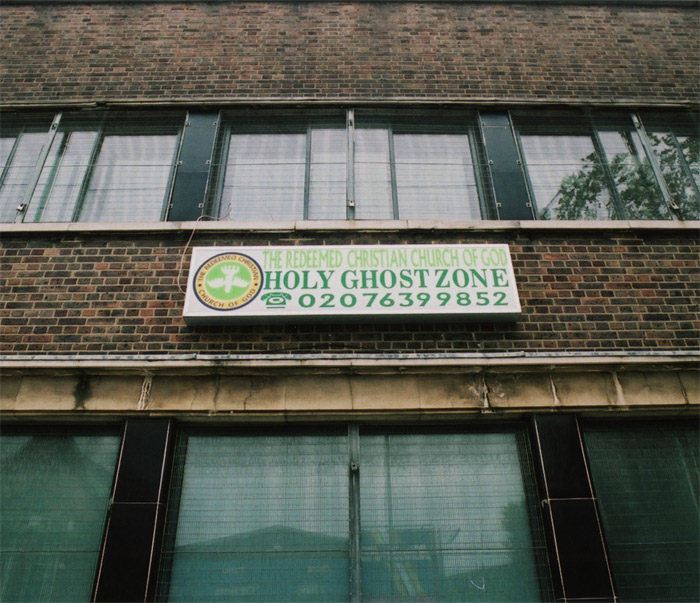
Holy Ghost Zone, Old Kent Road. © David Secombe 2008.
Andrew Martin:
When playing Monopoly my father was always determined to acquire Old Kent Road and Whitechapel, and to build on them as soon as possible. It’s the most modest portfolio on the board, with houses on Old Kent Road, as I remember, costing little more than a hotel on Mayfair. ‘You might laugh,’ my father would tell us in baleful tones, ‘but everybody always lands on Old Kent Road.’
I’m interested in the Old Kent Road as a sort of social counterweight to Hampstead, but my friend David, a South London partisan, is a genuinely keen on it, and gave me a guided tour this week.

Tesco, Old Kent Road. © David Secombe 2004.
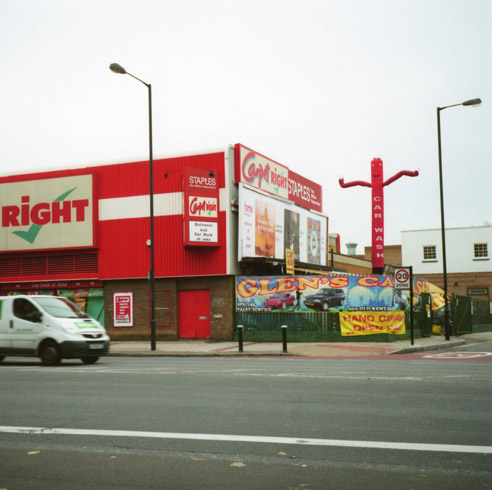
‘When the evening sun’s like this,’ he said cheerfully, as we skirted a sofa that had been thoughtfully set out on the pavement, ‘it’s got a sort of I’m-in-a-scary-part-of-LA charm.’ We were walking past the Old Kent Road’s array of cosmopolitan food shops, beauty parlours, international cash transfer places, evangelical ministries, van washing businesses. As the cars screamed by, David would stop every now and again to photograph the lowering clouds over some light industrial unit or brutalist block of flats. He seemed particularly taken with the visual possibilities of the flyover at the southern end of the Road. ‘A friend of mine owns a flat that looks right on to that,’ he said enviously.
 .
.
Carpet Right, Old Kent Road. © David Secombe 2008.
I looked at a price list outside one of the Road’s pubs: it advertised a cocktail called a Slippery Nipple, consisting of Sambuca, Bailey’s and Grenadine. You could have a jug of Slippery Nipple for £12.50. Another sign forbade anybody wearing a hat to enter the pub. You knew there was some insight into human behaviour behind this, and that it had been won the hard way.
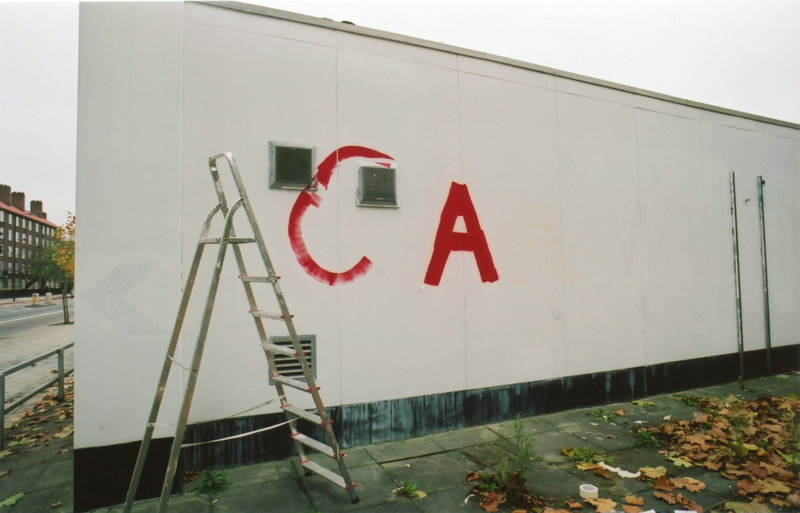
Re-branding exercise, Old Kent Road. © David Secombe 2008.
‘If Dickens were alive today he’d be down here all the time,’ said David as car came crawling noisily down the Road with only two of its tyres inflated. David then attempted, with windmilling arms, to direct the dazed-looking driver to a nearby sprawling depot called Madhouse Tyres.
As he did so, I reflected that the Old Kent Road does have the look of suburban LA or Chicago – that rangy wildness – and it occurred to me that this is what happens to British streetscapes when middle class vigilance is reduced and planning controls relaxed: they begin to look American.
………….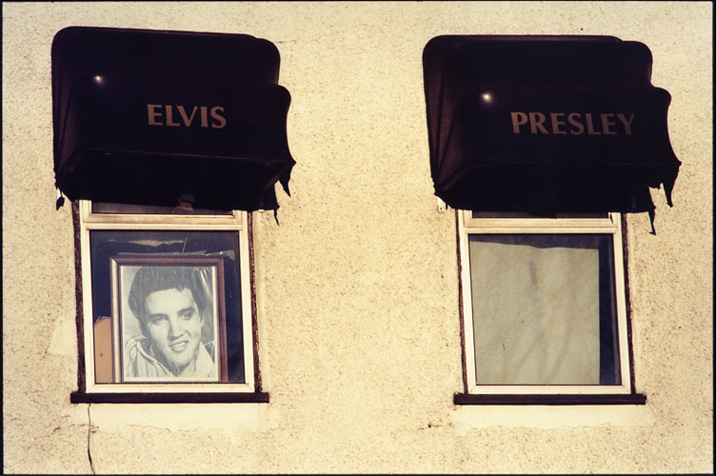
Chinese Elvis restaurant, Old Kent Road. © David Secombe 2002.
David pointed out East Street, which goes off the Old Kent Road. Its market features in the opening credits of ‘Only Fools and Horses’, in which Rodney and Del Boy inhabit a tower block inevitably called Nelson Mandela House. David took me to Mandela Way, which intersects with Old Kent Road, and where there is a small patch of green space occupied by a tank that has been painted pink and decorated repeatedly with the stencilled word ‘Scab’. ‘If this was North London,’ I marvelled, ‘there would be letters in the Hampstead and Highgate Express every week until it was taken away.’ ‘Really?’ said David, snapping away, ‘it’s been here for years.’*

Tank, Mandela Way. © David Secombe 2004.
In the streets off Old Kent Road, you never know what you’ll find: a battered looking Georgian house with an ice cream van parked in the front drive and a lone security camera staring at it; a tiny house with a sign saying ‘This property is protected by guard dogs’ – that’s dogs, plural; sudden bombsites with rampant buddleia, the scars of the Second World War still seemingly fresh. There are also surprising runs of pristine Georgian and Victorian houses with obviously middle class occupants.
……..
Almshouses, Asylum Road, SE15. © David Secombe 2008.
You could argue that Old Kent Road is going upmarket. The famous old Dun Cow pub is now the Dun Cow Surgery, and the Thomas A Becket, the even more famous boxing pub, built on one of the many sites where the Canterbury pilgrims took liquid refreshment, is now an estate agency, a sign of the times to an extent almost ridiculous. ‘You’d think there’d be a plaque acknowledging what it used to be,’ I said to David. But he frowned and shook his head, ‘That’s one of the great things about the Old Kent Road,’ he said, as we trudged on, ‘a profound lack of sentimentality.’
.. .
.
Andrew Martin outside the Asylum Tavern, Asylum Road, off the Old Kent Road, at the end of the trip described in the foregoing article. © David Secombe 2004.
© Andrew Martin. This article originally appeared in Andrew’s Class Conscious column for The New Statesman in 2004.
(*The tank is a Soviet T-34 placed on Mandela Way as a protest by a disgruntled property developer following the rejection of a planning application.)


 The London Column
