The discreet charm of the A102M. Photo & text: David Secombe.
Posted: September 13, 2012 Filed under: Literary London, London Places, Transport | Tags: blackwall tunnel, charles dickens, Special Patrol Group Comments Off on The discreet charm of the A102M. Photo & text: David Secombe. Blackwall Tunnel southern approach, SE10. Photo © David Secombe 1988.
From Night Walks by Charles Dickens, from The Uncommercial Traveller, 1861:
Some years ago, a temporary inability to sleep, referable to a distressing impression, caused me to walk about the streets all night, for a series of several nights. The disorder might have taken a long time to conquer, if it had been faintly experimented on in bed; but, it was soon defeated by the brisk treatment of getting up directly after lying down, and going out, and coming home tired at sunrise. In the course of those nights, I finished my education in a fair amateur experience of houselessness. My principal object being to get through the night, the pursuit of it brought me into sympathetic relations with people who have no other object every night in the year.
David Secombe writes:
The above photo was taken in just such a mood as Dickens described: unable to sleep, and with guests sleeping in the living room of my one-bedroom flat, I drove around south-east London looking for images. The sheer emptiness of the industrial hinterland of the Greenwich Peninsula was eerie and unsettling, although I took the photo above; a lambent nocturnal scene, seen from the vantage point of the ‘Tunnel Palladium‘. The stillness was unnerving and it wasn’t long before I moved on to Blackheath Village. There, whilst looking at the exhibits in a taxidermist’s window, I was interrogated by two officers from the Metropolitan Police’s Special Patrol Group. The conversation went as follows:
DS and two PLAIN CLOTHES OFFICERS in front of a taxidermist’s window. About 3 a.m.
PLAIN CLOTHES 1: Who are you then?
DS: (produces card) That’s me.
PLAIN CLOTHES 1: So what are you doing? We saw you walking out of that alley.
DS: I can’t sleep. I have people in my front room, so I thought I’d go for a drive and maybe take some pictures.
PLAIN CLOTHES 1: Bit dark isn’t it?
DS: Well …
PLAIN CLOTHES 1: You ever been arrested?
DS: No …
Pause.
PLAIN CLOTHES 1: Oh all right. (turns to face taxidermist’s window) What do you think of that kestrel? Clever isn’t it? Wouldn’t want it in my house though.
PLAIN CLOTHES 2: That’s not a kestrel. It’s a falcon.
PLAIN CLOTHES 1: What’s the difference?
PLAIN CLOTHES 2: Plumage. A falcon’s got different plumage. And a flatter head.
DS: I’m not very good with birds …
PLAIN CLOTHES 1: Don’t you start.
… for The London Column. © David Secombe.
London Gothic. Photo & text: David Secombe. (1/5)
Posted: July 2, 2012 Filed under: Dereliction, Literary London, Vanishings, Wildlife | Tags: Arthur Machen, Camden, Holloway, London Gothic, Peter Ackroyd, tea party Comments Off on London Gothic. Photo & text: David Secombe. (1/5)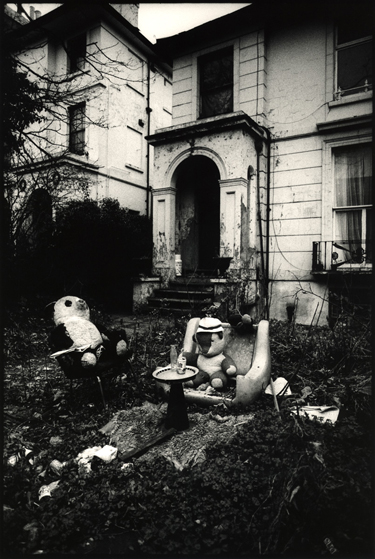
Camden Road. © David Secombe 1987.
From London The Biography by Peter Ackroyd, 2000:
Whole areas can in their turn seem woeful or haunted. Arthur Machen had a strange fascination with the streets north of Gray’s Inn Road – Frederick Street, Percy Street, Lloyd Baker Square – and those in which Camden Town melts into Holloway. They are not grand or imposing; nor are they squalid or desolate. Instead they seem to contain the grey soul of London, that slightly smoky and dingy quality which has hovered over the city for many hundreds of years. He observed ‘those worn and hallowed doorsteps’, even more worn and hallowed now, and ‘I see them signed with tears and desires, agony and lamentations’. London has always been the abode of strange and solitary people who close their doors upon their own secrets in the middle of the populous city; it has always been the home of ‘lodgings’, where the shabby and the transient can find a small room with a stained table and a narrow bed.
David Secombe:
In the midst of our jingoistic Olympic summer, I thought it might refreshing to explore the aspect of London so eloquently evoked by Peter Ackroyd in the passage above. A city of silent yet inhabited houses, anonymous windswept streets, overgrown front lawns, strange objects on the back seats of abandoned cars, forbidding municipal playgrounds, etc. (This is essentially the same territory explored by Geoffrey Fletcher in The London Nobody Knows, and as the last series on The London Column was a revisiting of Fletcher’s book, this one may be seen as a continuation of the same theme.) ‘London Gothic’ is becoming increasingly rare; most of the streets that Arthur Machen thought of as woeful are now exemplars of prosperous gentrification. London is a cleaner, neater place: even King’s Cross is a landscaped zone now. The photo above was taken a quarter of a century ago, and Holloway has come up in the world since then. The specific, shabby London charm that Machen and Ackroyd describe may still be found, but one has to look harder. As a small boy visiting the city from the suburbs, I was amazed by the soft enveloping greyness which made the occasional bursts of colour all the more striking. That quiet visual texture is vanishing, when even municipal housing wears screaming day-glo colours, as 1960s & 70s blocks are clad in blue, yellow, or turquoise panels. London wears its dread in brighter shades these days.
… for The London Column.
The London Nobody Knows – revisited. Photos & text: David Secombe (1/4)
Posted: June 19, 2012 Filed under: Dereliction, Literary London, Shops, Vanishings | Tags: Geoffrey Fletcher, limehouse, superior funerals, The London Nobody Knows, undertaker Comments Off on The London Nobody Knows – revisited. Photos & text: David Secombe (1/4)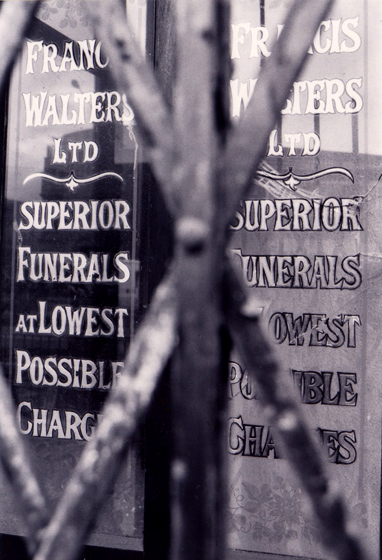
Limehouse. Photo © David Secombe 2010.
From The London Nobody Knows, Geoffrey Fletcher, 1962:
My chief pleasures in Limehouse are confined to a small area, centering on the church of St. Anne. The undertaker’s opposite the church is a rare example of popular art. Even today, East End funerals are often florid affairs – it is only a few years since I saw a horse-drawn one – but such undertaker’s as [the one in the above photo] must be becoming rare, so it is worth study. It is hall-marked Victorian. The shop front is highly ornate and painted black, gold and purple. Two classical statues hold torches, and there achievements of arms in the window and also inside the parlour. The door announces ‘Superior funerals at lowest possible charges’. On one side of the window is a mirror on which is painted the most depressing subject possible – a female figure in white holding on (surely not like grim death?) to a stone cross and below her are the waves of a tempestuous sea. Inside the shop are strip lights – the only innovation to break up the harmony of this splendid period piece – a selection of coffin handles and other ironmongery and a photograph of Limehouse church. As I looked, a workman, with a mouthful of nails, was hammering at a coffin. An unpleasant Teutonic thought occurred to me that, at this very moment, the future occupant of the coffin might well be at home enjoying his jellied eels . . . Undertaker’s parlours of such Victorian quality must be enjoyed before it is too late. This one mentioned is, I believe, the best in London. People stare through the windows of undertakers – at what? Unless they are connoisseurs of Victoriana there seems to me little beyond the elaboration of terror and a frowsy dread that has no name.
David Secombe:
The shop Geoffrey Fletcher rhapsodised over fifty years ago remains in situ opposite St. Anne’s, but is now derelict. When I took this photo a couple of years ago, it was possible to see the remnants of the shopfront, but a matter of days later the entrance was boarded up and the last remnant of the Victorian throwback that Fletcher described with such relish disappeared from view. This week we are running a small selection of excerpts from Fletcher’s classic, alongside contemporary views of the sights he delineated so lovingly. Fletcher’s book is a kind of requiem for an older, more private city – and although his fears about the fate of many individual buildings proved to be unfounded, Londoners are faced with a new wave of monolithic redevelopment. In our current era of corporate-sponsored ‘regeneration’, the final words of the book seem truer than ever: ‘Off-beat London is hopelessly out of date, and it simply does not pay. I hope, therefore, that this book will be a stimulus to explore the under-valued parts of London before it is too late, before it vanishes as if it had never been. The old London was essentially a domestic city, never a grandiose or bombastic one. Its architecture was therefore scaled to human proportions. Of the new London, the London of take-over bids and soul-destroying office blocks, the less said, the better’.
… for The London Column.
Pinteresque. Photo David Secombe, text Charles Jennings (1/3)
Posted: March 6, 2012 Filed under: Literary London, Theatrical London | Tags: Betrayal, black eye, Charles Jennings, Harold Pinter, National Theatre, rattling crates 2 Comments
Long bar, Olivier foyer, Royal National Theatre, SE1. Photo © David Secombe 2010.
A Fragment of Bar Life by Charles Jennings:
The main bar in the Olivier foyer. Late 1970’s. The start of the evening shift. Things are quiet. Three part-time bar staff fumble with peanut packets and bottles of mixers. GARY, the head barman, comes in carrying a crate of soft drinks, which he bangs down on the floor. He is 27 years old; wears tattoos.
PART-TIMER ONE (looking at GARY’s face, which sports a glowering black eye): What happened to your eye, Gary?
GARY says nothing, goes to fetch another crate. The PART-TIMERS shrug. GARY returns and crashes the fresh crate down.
GARY: Pinter.
PART-TIMER TWO: Harold Pinter?
GARY: Fucking stuck one on me.
Pause
PART-TIMER ONE: He stuck one on you?
GARY: I hate that fucking bloke.
Pause
PART-TIMER TWO: Why?
GARY: What?
PART-TIMER TWO: You hate him?
GARY: He can stick one on me, I can’t hit him back. Cause he’s Pinter.
Pause
PART-TIMER THREE: Why’d he stick one on you?
Pause
GARY: I was making too much noise with the crates. He was in the theatre, listening. He said he could hear the crates out here during all those fucking pauses. Fucking Betrayal.
Pause
He came out and smacked me.
Pause
I could have fucking killed him. I’d have fucking laid him out. He’s a cunt, Pinter.
The PART-TIMERS affect a keen interest in their work. GARY stands in the centre of the bar, looking out into the empty foyer.


 The London Column