The Heath: Photo: Andy Sewell, text: Katy Evans-Bush (2/5)
Posted: August 24, 2011 Filed under: Amusements, Literary London, Parks | Tags: Andy Sewell, Fanny Brawn, hampstead heath, John Keats, Katy Evans-Bush Comments Off on The Heath: Photo: Andy Sewell, text: Katy Evans-Bush (2/5)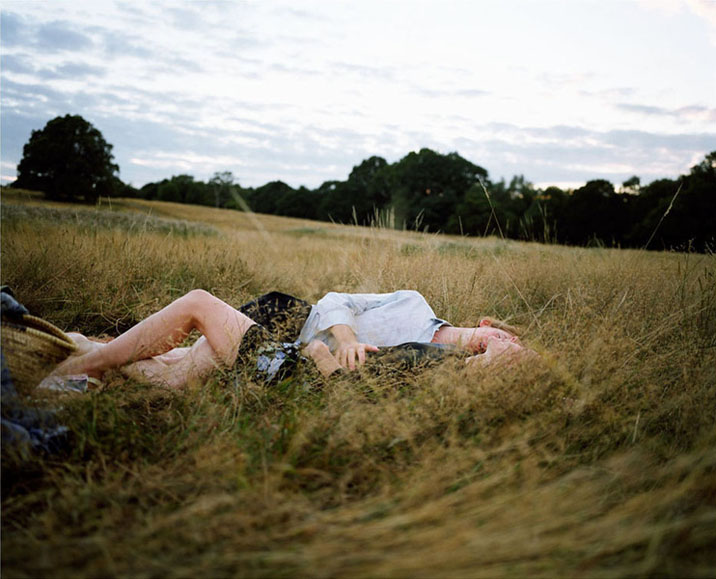 © Andy Sewell.
To Fanny Brawne,Wentworth Terrace, Hampstead
cFeb 1820
My dearest Girl,
I continue much the same as usual, I think a little better. My Spirits are better also, and consequently I am moew resign’d to my confinement. I dar not think of you much or write much to you. Remember me to all.
Ever your affectionate
John Keats.
To Fanny Brawne, Wentworth Terrace, Hampstead
cMarch 1820
Sweetest Fanny,
You fear sometimes, I do not love you so much as you wish? My Dear Girl I love you ever and ever and without reserve. The more I have known you the more have I lov’d. In e;ry way – even my jealousies have been agonies of Love, in the hottest fit I ever had I would have died for you. I have vex’d you too much. But for Love! Can I help it? You are always new. The last of your kisses was ever the sweetes; the last smile the brightest; the last movement the gracefullest…
Your affectionate
J. Keats.
To Fanny Brawne, Wentworth Terrace, Hampstead
cMarch 1820
My dearest Fanny, I slept well last night and am no worse this morning for it. Day by day if I am not deceived I get a more unrestrain’d use of my Chest. The nearer a racer gets to the Goal the more his anxiety becomes, so I lingering upon the borders of health feel my impatience increase. Perhaps on your accounbt I have imagined by illnessmore serious than it is: how horrid was the chance of slipping into the ground instead of into your arms – the difference is amazing Love. Death must come at last; Man must die, as Shallow says; but before that is my fate I feign would try what more pleasures then you have given, so sweet a creature as you can give. Let me have another opportunity of years before me and I will not die without being remember’d. Take care of yourself dear that we may both be well in the Summer…
Your affectionate
J.K–
Andy Sewell’s book The Heath may be purchased here.
London Perceived. Text V.S. Pritchett, photos Evelyn Hofer (1/5)
Posted: July 25, 2011 Filed under: Clubs, Eating places, Literary London, London Types | Tags: Evelyn Hofer, Garrick Club, London Perceived, V.S. Pritchett 1 Comment
Head waiter, Garrick Club, 1962. Photo © Estate of Evelyn Hofer
V.S. Pritchett writing in London Perceived*, 1962:
And what happens in square and pubs goes on in clubs, all the thousands of drinking clubs, the luncheon clubs, the dining clubs, the sporting clubs, the dance clubs, to the great clubs around Pall Mall and St. James’s. You are a Londoner, ergo you are a member. You are proposed and seconded; that done, you are among a few friends; you have your home from home. In none of these clubs is any utility of purpose frankly admitted. It is true that Bishops and Fellows of the Royal Society gather at the Atheneaeum; actors, publishers, and the law at the Garrick; the aristocracy and the top politicians at Boodle’s, White’s, or Brooks’s; that, following Stevenson and Kipling, a lot of bookish, professorial and civil wits are at the Savile, and professional eminences at the Reform, where Henry James had a bedroom with a spy hole cut in the door so that the servant could see whether the master was sleeping and refrain from disturbing him. (The hole is still there.)
Clubs change. London is made for males and its clubs for males who prefer armchairs to women. The great clubs are in difficulties. Their heyday was the Victorian age, when men did not go home early in the evenings; now at night they are empty of all but a few bachelors, sitting in the drying leather chairs. Some clubs have tried allowing ladies to dine in the evening, but the ladies, after the first riush of curiosity, in which they hoped to find out what happy vices their men were comfortably practising there, tend to be appalled by these mausoleums of inactive masculinity, even when they are elegant, and tend to be depressed by the gravy-coloured portraits on the walls. The architecture, gratifying to male self-esteem, does nothing for the sex, and the boredom that hangs like old cigar smoke in the air is a sad reminder of the most puzzling thing in the sex war: that men lie each other, rather as dogs like each other. The food is dull, but a point that the ladies overlook is that the wine is excellent and cheap.
How did this taste for clubs begin? Did it start with the witenagemot or the monasteries? Did it sprout from the guilds – for what are the Drapers’, the Fishmongers’, the Armourers’, the Watermens’, the Grocers’ companies, with their medieveal robes and seremonies, but medieval guilds turned into clubs for the Annual Dinner? The clubs start, as the whole of visible London does, except the Tower and Westminster Abbey, St. Bartholomew and the Elizabethan buildings in Staple Inn – the clubs start with the greatest of all london inventions: modern mercantile capitalism. They began with the coffee houses in the City. “We now use the word ‘club'”, Pepys wrote, “for a sodality in a tavern”. Lloyds was a coffee house, the place where one could read a paper and hear the news, and the more one sat about there, the more one heard. They were often started by servants – the most domineering of men – by the race of Jeeves, for the Woosters, the masters of the world; fashionable clubs like Boodle’s, Brooks’s, White’s take their names form the servants who founded them. The idea has the ease of Nature, and it is only in the nineteenth century, when industrial wealth came in, that clubs like the Public Schools, became outwardly pretentious and expensive.
* © 1962 and renewed 1990 by V.S. Pritchett. Used by permission of David R. Godine, Publisher, Inc.
[Special thanks in assembling this week’s feature are due to: Jim McKinniss; Mark Giorgione of the Rose Gallery in Santa Monica, California; Andreas Pauly at the Hofer Estate; and Carl Scarbrough at David Godine. D.S.]
38 Special. Photo: Tim Marshall, text Susan Grindley (3/5)
Posted: July 13, 2011 Filed under: Literary London, Transport 1 Comment
Exmouth Market, 2002. © Tim Marshall.
The Man in the Violet Polo Shirt by Susan Grindley
Like a mime-artist performing brain-surgery,
the man in the violet polo-shirt –
seeing that neither driver would back down and back up,
and after a final, ‘Why should I?’ from each –
coaxed the Vauxhall between the 277 and the steel cage
enclosing the road works.
At spitting-range there was another bout of shouting
but, from the bus, the street and the cars,
backed-up, hooting, in Frampton Park Road
and Well Street, we could see it was a win-win situation,
so when the man in the violet polo-shirt came back onto the bus,
some of us clapped.
[This poem first appeared in Rising magazine.]
Days and Nights in W12. Photographs and Text: Jack Robinson (4/4)
Posted: July 2, 2011 Filed under: Literary London, Vanishings | Tags: CB Editions, Crossing the Border, Days and Nights in W12 Comments Off on Days and Nights in W12. Photographs and Text: Jack Robinson (4/4)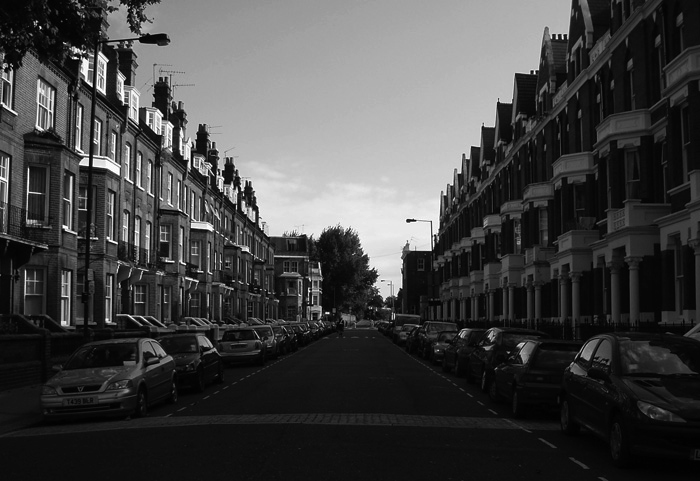
Photo: © Jack Robinson 2007.
From Days and Nights in w12* by Jack Robinson:
VANISHING POINT
Kieran, the youngest son of a wealthy Irish family – the one who never got punished, whose shoulders were never expected to bear burdens – lived in this street in the 1970s in a house that belonged to his parents. He rented out rooms to foreign students, and there were frequent parties, and always people coming and going. He told exaggerated stories about his work and love affairs, and every few months he went back to Ireland for the peace and quiet he needed to work on his novel – which was set at the time of the Great Famine in the 1840s; or was based, with her blessing, on the life of an American film actress. The first six chapters were with an agent; the entire first draft had been lost on a train. In the early 1980s, a few weeks after IRA bombs had exploded in Regent’s Park and Hyde Park, killing eight soldiers and seven horses, Kieran’s novel was published. Crossing the Border was a political thriller set in contemporary Northern Ireland. Kieran went over to Ireland to publicise the book at a literary festival. He was seen leaving his hotel and getting into a waiting taxi, but he never arrived at the festival venue. In London his house was broken into and his diaries and files stolen. The students who had lived in his house and who were traced by the police remembered him fondly: there was something both promising and insubstantial about Kieran, as if he was always about to depart.
© Jack Robinson.2011.
* CB Editions 2010.


 The London Column