Pepys Estate, Deptford. Photo Tony Ray-Jones, text Robert Elwall. (3/3)
Posted: May 19, 2011 Filed under: Architectural, Eating places, Interiors, London Types | Tags: Architectural Review, Manplan, Pepys Estate, RIBA, Tony Ray Jones Comments Off on Pepys Estate, Deptford. Photo Tony Ray-Jones, text Robert Elwall. (3/3)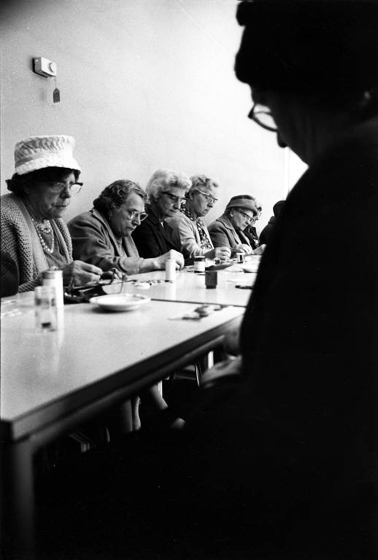
Canteen for the elderly, Pepys Estate, Deptford, 1970. Photo Tony Ray-Jones © RIBA Photographs Library.
Robert Elwall writes:
In 1969 Hubert de Cronin Hastings, owner of the Architectural Press and editor of its leading journal, the Architectural Review, decided to experiment with a new look for the magazine. He accordingly launched the ‘Manplan’ series published in eight themed issues between September 1969 and September 1970. Rather than being illustrated by the Review’s usual staff photographers, Hastings commissioned photographs from some of the leading photojournalists of the day asking them to cast their lenses in judgement on the contemporary state of architecture and town planning. Thus Ian Berry illustrated two issues on communications and health and welfare while his Magnum colleague, Peter Baistow, also supplied the images for two, those on religion and local government. Other contributors were Tom Smith on education; Tim Street-Porter on industry and Tony Ray-Jones on housing. The series kicked off with a typically hard-hitting issue on ‘Frustration’ with photographs by Patrick Ward.
These images were totally unlike anything that had been seen in the Review before. Ironically the Review had done much to formulate the norms of mainstream architectural photography with dramatically hagiographic renditions of pristinely new buildings set beneath sunlit skies and photographed with large format cameras. Instead it now offered its readers harsh, grainy, 35mm images of a grimly dystopian world the photographers argued that architects and planners had created. The unrelenting grimness and claustrophobic intensity of the photographs was magnified by the use of wide-angle lenses which had the effect of thrusting the viewer into the frame; by the reproduction of the photographs in a specially devised matt-black ink; and by the provision of hard-hitting captions that sometimes were printed over the images. Not surprisingly the series proved too much for many of the Review’s architect subscribers and in the face of falling circulation figures Hastings was forced to admit defeat and abandon his experiment.
Despite being short-lived, ‘Manplan’ can be regarded as the high watermark of photojournalism applied to architectural photography. During the 1960’s this had been pioneered by magazines such as Architectural Design, which in September 1961 had published a special issue on Sheffield illustrated by the great photojournalist Roger Mayne and by photographers such as John Donat (1933-2004) who, much influenced by Mayne’s example, took advantage of the smaller format cameras and faster films then appearing on the market to show how buildings interacted with, and were experienced by, their users and the public. For so long banished from the architectural photographer’s frame, real people going about real tasks, rather than merely included to give a sense of scale, now became the norm. By the 1970s, however, this application of the tenets of photojournalism and street photography to architecture was drawing to a close. There were two main reasons for this. Firstly, owing to the slow speed of large format colour films and the elaborate lighting set-ups they often required, the explosion in colour photography placed a renewed emphasis on architecture’s more formal qualities at the expense of human activity. In addition the increased commissioning of photography by architects themselves rather the more independently-minded magazines inevitably premiated eye-catching imagery that would show architects’ works in the best light. However, it is pleasing to reflect that today ‘Manplan’ has found favour once again as photographers once more seek to deviate from the norms.
… for The London Column. © Robert Elwall 2011
[Robert Elwall is Assistant Director, Photographs, Imaging & Digital Development of the British Architectural Library at the Royal Institute of British Architects.]
Welcoming smiles … (3/3)
Posted: May 6, 2011 Filed under: London Music, London Places, London Types | Tags: Dave Hendley, Travellers, Westway Comments Off on Welcoming smiles … (3/3)
Travellers’ community, Westway. Photo © Dave Hendley 1972.
Dave Hendley writes:
The picture was made one Saturday in the late summer of 1972 at the other end of my working life and in a very different world. I was on a job for Time Out and the mission was to photograph a free music festival in what was then a grassed area under the Westway by Latimer Road. My brief was to photograph stock pictures of musicians for future inclusion in the magazine’s gig guides. The concert was a small and very comfy affair with an audience of around 150 – 200 people.
A short distance away, under what is now the West Cross interchange, there was a cluster of caravans and I spotted a group of traveller men-folk observing the event with curiosity and great amusement.
I wandered over and asked to take a photograph. These were times when being photographed was something of a compliment and the lads posed willingly. I suspect in today’s suspicious climate I would have met with a more hostile reaction. I took just two frames as was my normal procedure back then, film was a precious commodity and consequently I always shot very concisely. After all why would you want more than one or two shots of a particular subject?
Later in the afternoon the Time Out picture editor Rebecca John (the granddaughter of the painter Augustus John) came to say hello and I abandoned my duties for a visit to a nearby pub. Rebecca was a very lovely person and it is is one of my great regrets that we subsequently lost touch over the years.
I returned to photograph a few more bands, including a musician called Steve Hillage, a strange hippie type in a pixie hat. As I was shooting away a scruffy but very polite and gently spoken young man approached me and enquired if he could buy some pictures. He wrote his name, Richard, and contact details on the back of a crumpled flyer. On the following Monday I made my way to the Virgin shop in Notting Hill Gate where I sold Richard Branson a couple of frames for a tenner.
© Dave Hendley 2011
Welcoming smiles … (1/3)
Posted: May 4, 2011 Filed under: Eating places, London Types, Public Announcements Comments Off on Welcoming smiles … (1/3)
Belgo, Camden. © David Secombe 1992
From Gumtree, 27th February 2010:
French waiter is looking for a summer job …
hi my name is jean, i’ll be graduated in france at the end for may. i need for my job to practis my english. i’m totally able to speak with english guest and anderstand what they need. …
David Secombe writes:
Welcome to the London Column. This site is dedicated to photography and writing from London.
The site is edited by myself and will feature contributions from some of the best writers and photographers from the past sixty years.
Now read on …


 The London Column