Christmas in the city.
Posted: December 24, 2013 Filed under: London Types, Pubs | Tags: Christmas Comments Off on Christmas in the city.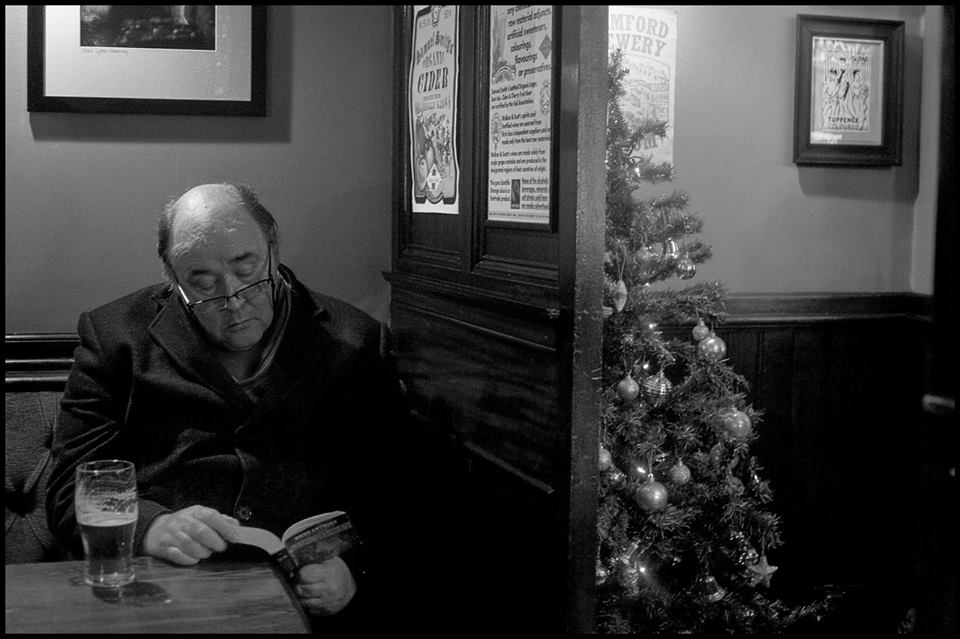
The Crown, New Oxford Street. Photo: © Tim Marshall 2013.
Merry Christmas from The London Column.
Four streets off Hockley Hole.
Posted: September 12, 2013 Filed under: Amusements, Entertainment, Fictional London, London Places, London Types, The Fleet | Tags: Artful Dodger, Back Hill, bear baiting in London, Fagin's lair, Hockley Hole, John Londei, King of Clerkenwell, old Clerkenwell, Oliver Twist, Saffron Hill, Sally in our alley 2 Comments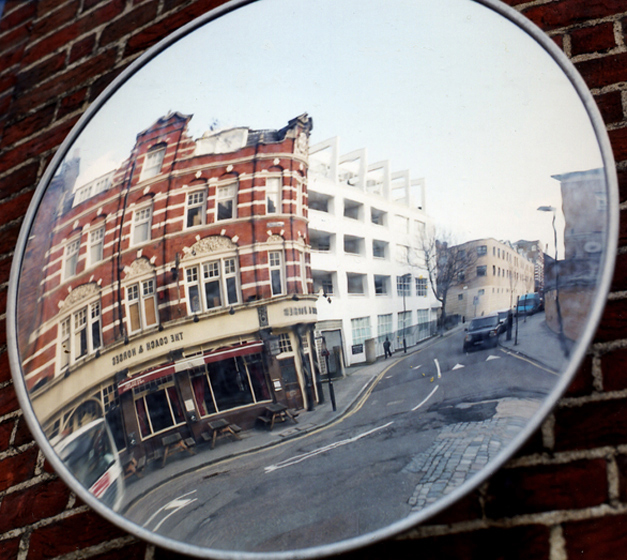
Back Hill and Ray Street, Clerkenwell. © David Secombe 2010
From The Fascination of London: Holborn and Bloomsbury, ed. Sir Walter Besant 1903:
Just here, where Back Hill and Ray Street meet, was Hockley Hole, a famous place of entertainment for bull and bear baiting, and other cruel sports that delighted the brutal taste of the eighteenth century. One of the proprietors, named Christopher Preston, fell into his own bear-pit, and was devoured, a form of sport that doubtless did not appeal to him. Hockley in the Hole is referred to by Ben Jonson, Steele, Fielding, and others. It was abolished soon after 1728.
David Secombe:
The Coach and Horses pub – reflected in the mirror in the picture above – now occupies the site of Hockley Hole, one of the least salubrious entertainment venues in London’s history. The pub rests at the bottom of a curious depression in the heart of Clerkenwell, behind the old Guardian building on Farringdon Road – which itself marks the course of the river Fleet, which Victorian engineers – eventually – paved and tamed into a churning sewer. (Supposedly, the original Coach and Horses afforded access to the Fleet from its cellars, providing Georgian fugitives with an escape route to the Thames.) This dingy, hidden locale is a beacon for anyone of a Psychogeographical persuasion, as three centuries of real and imagined associations intersect here. We have touched upon Hockley Hole before, but a passage in Lucy Inglis’s fine new book Georgian London: Into the Streets prompted us to revisit the immediate environs. In her book, Lucy provides further details of the delights afforded by Hockley Hole (or Hockley-in-the-Hole) :
By the turn of the eighteenth century, baiting had moved north of the river – to Hockley-in-the-Hole, in Clerkenwell. In 1710, there was ‘… a match to be fought by two dogs, one from Newgate-market, against one from Honey-lane market, at a bull … which goes fairest and fastest in, wins all. Likewise, a green bull to be baited, which was never baited before; and a bull to be turned loose with fireworks all over him. Also a mad ass to be baited. With a variety of bull-baiting and bear-baiting, and a dog to be drawn up with fireworks. To begin exactly at three of the clock.’ Hockley was the centre of bull terrier breeding in London, and so perhaps it was natural that the sport would move there. In 1756, Hockley disappeared with the continuing Fleet development, and bull-baiting moved to Spitalfields. Increasingly unpopular, it was soon confined almost exclusively to market towns.
The mirror in the picture above is located on the wall of a huge industrial building (now home to one of Central St Martins design campuses) which straddles Back Hill and lower Saffron Hill. In The Fascination of London, Walter Besant quotes an earlier writer’s description of Saffron Hill as “narrow and mean, full of Butchers and Tripe Dressers, because the Ditch runs at the back of their Slaughter houses, and carries away the filth.” Besant takes the opportunity to add that ‘in later times Italian organ-grinders and ice-cream vendors had a special predilection for the place, and did not add to its reputation’ – but he also acknowledges that ‘all this district is strongly associated with the stories of Dickens’. In Oliver Twist, set in 1838, the year it was written, Dickens describes the Artful Dodger leading Oliver to Fagin’s lair:
‘They crossed from the Angel into St. John’s Road; struck down the small street which terminates at Sadler’s Wells Theatre; through Exmouth Street and Coppice Row; down the little court by the side of the workhouse; across the classic ground which once bore the name of Hockley-in-the-Hole; thence into Little Saffron Hill; and so into Saffron Hill the Great: along which the Dodger scudded at a rapid pace, directing Oliver to follow close at his heels.’
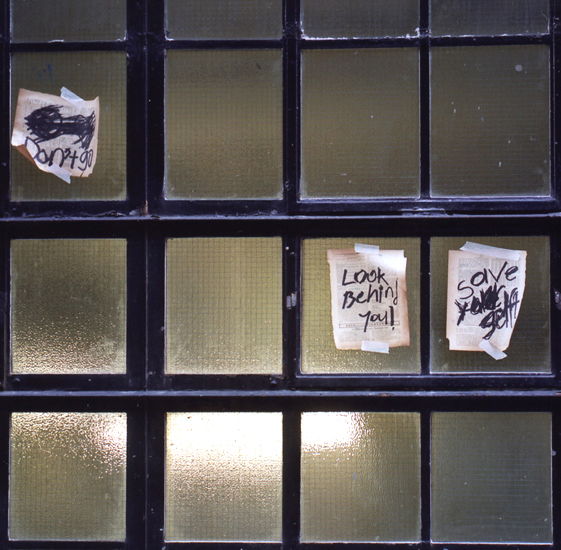
College window, Back Hill. © David Secombe, 2010.
On the same turf 150 years later, a real-life match for Dickens’s characters is described by the late John Londei, a much-missed photographer, writer and contributor to this site. As John wrote in 2011:
Some people might think little Jimmy Cleary eccentric, but to me he was a walking landmark: someone whose presence brings a touch of magic to an area. Whenever I saw Jimmy I knew I was in Clerkenwell. Jimmy’s speciality was annoying motorists. He would not tolerate errant parking; his life seemed devoted to chasing drivers on from yellow lines. And woe betide anymore who ignored his orders! Bringing out a tattered notebook he took their number, and created such a commotion that the poor motorist found himself the centre of attention.
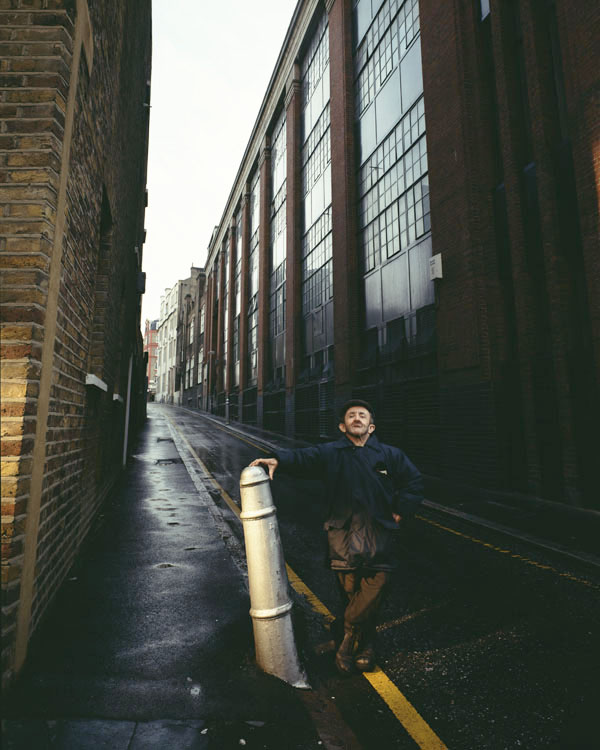
Jimmy Cleary, ‘King of Clerkenwell’, Back Hill. © John Londei 1983.
Returning to the photo at the top of this page, the modern white building in the reflection lies on Warner Street, formerly Great Warner Street. In the 18th Century, this street was the home of Henry Carey, author of Sally in our Alley: ‘one of the very prettiest of old London love songs.’ Walter Thornbury, writing in 1878 (Old and New London Vol.2; Clerkenwell) provides this biographical snippet:
Henry Carey … lived and died at his house in Great Warner Street. Carey, by profession a music-master and song-writer for Sadler’s Wells, was an illegitimate son of the Marquis of Halifax, who presented the crown to William III. The origin of Carey’s great hit, Sally in our Alley, was a ‘prentice day’s holiday, witnessed by Carey himself. A shoemaker’s apprentice making holiday with his sweetheart, treated her with a sight of Bedlam, the puppet-shows, the flying chairs the elegancies of Moorfields, and from thence proceeding to the Farthing Pye House, he gave her a collation of buns, cheesecakes, stuffed beef, and bottled ale; through all of which scenes the author dodged them. Charmed with the simplicity of their courtship, he wrote his song of Sally in our Alley, which has been well described as one of the most perfect little pictures of humble life in the language. Reduced to poverty or despair by some unknown cause, Carey hung himself in 1743. Only a halfpenny was found in his pocket.
In the 19th century, Great Warner Street was bisected by Rosebery Avenue,a Victorian creation forming part of the general ‘ventilation’ of Holborn, clearing away many of the old houses in the area.

Staircase to Rosebery Avenue from Warner Street. © David Secombe 2010.
… for The London Column. Georgian London is published by Penguin.
In St. James’s Park. Photo: Dave Hendley, text: David Secombe.
Posted: November 15, 2012 Filed under: London Types, Parks, Street Portraits | Tags: Andre Kertesz, Dave Hendley, David Hockney, Elliott Erwitt, Entertaining Mr Sloane, Harold Pinter, Joe Orton, Robert Frank, The Servant Comments Off on In St. James’s Park. Photo: Dave Hendley, text: David Secombe.
St. James’s Park. © Dave Hendley 1973.
Photography is concerned with appearance rather than truth, and occasionally, one comes across a photograph so mysterious that one is stumped for any sort of comment. One thinks of the Andre Kertesz photo of a shadow behind glass on a balcony in Martinique; of Robert Frank’s picture of a girl running past a hearse and a street sweeper on a drab London street; or Elliott Erwitt’s shot of tourists in a Mexican charnel house, all acknowledged masterpieces. I think the above photo by Dave Hendley has a similar power. Dave offers no insight: he shot it quickly with his Leica as he walked past the men, then moved along before they had time to register that he had taken their photo (‘I was more ruthless back then, I don’t stick my camera in people’s faces any more’.) But it invites speculation, so I am going to offer mine.
There are few clues in Dave’s photo as to the exact period, but somehow we know it belongs to the past: in fact, it is the early 1970s – but it evokes a time slightly earlier than that. I am reminded of the ‘black and white’ 1960s, the lost era of Victim, Pinter’s The Servant, and, especially, Joe Orton’s Entertaining Mister Sloane: a world of furtive encounters afforded a desperately genteel gloss (“the air round Twickenham was like wine”). But I don’t know whether my interpretation is correct and it probably isn’t. More than one photographer has got into trouble because a photo suggested something about its subjects that was misleading or even libellous. Whatever the reality, the picture is simultaneously comic, poignant and slightly disturbing. The sharply assessing gaze of the man on the left is unnerving enough, but I find myself worried by the man on the right, his too-tight tie and his inscrutable smile somehow just wrong. (I am also reminded of this painting.)
As with the photo we ran yesterday, this photograph is a precious survivor of a cull of Dave’s early work which the photographer carried out with youthful ruthlessness. That was many years ago and, needless to say, Dave now regrets this; fortunately, this image survived as a print which Dave recently discovered in his mum’s attic.
… for The London Column.
See also: Welcoming Smiles, Robert Graves.
Trainspotters. Photo: Dmitri Kasterine, text: Andrew Martin.
Posted: October 25, 2012 Filed under: London Types, Transport Comments Off on Trainspotters. Photo: Dmitri Kasterine, text: Andrew Martin.
Trainspotters, Clapham Junction, 1979. © Dmitri Kasterine.
The Death of Trainspotting by Andrew Martin:
It took me a day and a half of searching before I found any trainspotters in London. They were standing at the far end of platform eight at King’s Cross. David Burrell carried a camera, Paul Rea a notebook. They were both in their sixties, both down from Manchester, and staying at West Hampstead, which they found convenient for Willseden Junction. Our conversation was hampered by several modern railway blights. There was nowhere to sit, and then there was nowhere to dispose of our cardboard coffee cups; we kept being interrupted by announcements telling us not to lose sight of our belongings. Our conversation was in fact a study in melancholia, covering many of the causes of the decline of trainspotting, including the latest and deadliest of all …
Paul told me he’d started trainspotting in the fifties ‘by standing on a bit of unadopted track near Newton Heath maintenance depot. We weren’t supposed to stand there but nobody minded.’ In the early eighties he’d regularly come down to London on spotting trips with the Lancashire Locomotive Society, and I asked if this body was thriving. ‘Thriving! We used to fill up a fifty-two eater coach every time. Now it’s a mini bus with twelve at the most.’
The three of us were standing next to a typical sort of modern train: a ‘multiple unit’. It would strike the casual passer-by as a series of carriages with no locomotive. “Not very interesting is it?’ I suggested. ‘Not really’, he conceded, ‘but in my mind this place is still full of Atlantics [big steam engines]. I still see it the way it was in The Ladykillers’. I asked the two whether they’d had any trouble from the railway authorities. ‘Two years ago’, said David, ‘when I was taking pictures on Manchester station, I was questioned by a station official. Nothing came of it, but it was, you know, close questioning.’
Others have been more greatly inconvenienced by the increased security across the network, and it appears that one unexpected result of the villainy of Osama bin Laden could be the death of trainspotting. It come down to a question of identity. Who is to say that the three blokes on the end of the platform with their notebooks, cameras, flasks of coffee and Blue Riband biscuits might not be members of Al Qaeda?
The June issue of The Railway Magazine reports an ‘alarming’ increase in the number of letters from readers complaining about the heavy-handed policing of stations. It also draws attention to a poster recently published by the British Transport Police urging the public to look out for photographers who seem in any way ‘odd’. The Railway Magazine magnanimously concedes that photographers of trains might look odd to some. But haven’t we Britons always prided ourselves on our oddness?
‘It’s not a systematic persecution’ says Chris Milner, deputy editor of the Magazine. ‘You just get these pockets of jobsworths who don’t know the guidelines’. After the London Tube bombings of July 7th 2005, Mr Milner was party to the drawing up of guidelines intended for people wanting to take photographs on railway stations. They are accepted by Network Rail and the British Transport Police, who indeed publish them on their websites. Photographers are expected to report to station staff, and say what they’re about. They are of course expected to keep away from the platform edge. Given the nanny-ish mindset of modern railways (which determines that all train fronts and rears must be painted a revolting yellow) it comes as no surprise that railway photographers are asked not to wear high visibility jackets – this for fear that they will be confused with station staff.
Mr. Milner detects an irony in the implicit wariness of railway photographers. ‘On the day of the London tube bombings, sir Ian Blair was asking for people to come forward with any pictures they might have taken.’ Austin Mitchell, MP and keen amateur photographers, sees another irony: ‘We are all photographed dozens of times every day on CCTV, so while the government can photograph us, we can’t photograph anything else.’ According to Mr. Mitchell, who was recently stopped from taking pictures at Leeds station, ‘Photography is a public right, and that should be made absolutely clear.’
… an extract from a longer article written for The Times in 2008.


 The London Column