Incredible Londoners. Photo & text: David Secombe.
Posted: May 18, 2012 Filed under: Artistic London, London Music, Pubs, Vanishings | Tags: incredible Londoner, Jerusalem Tavern, Johno Driscoll, Thomas Britton 4 Comments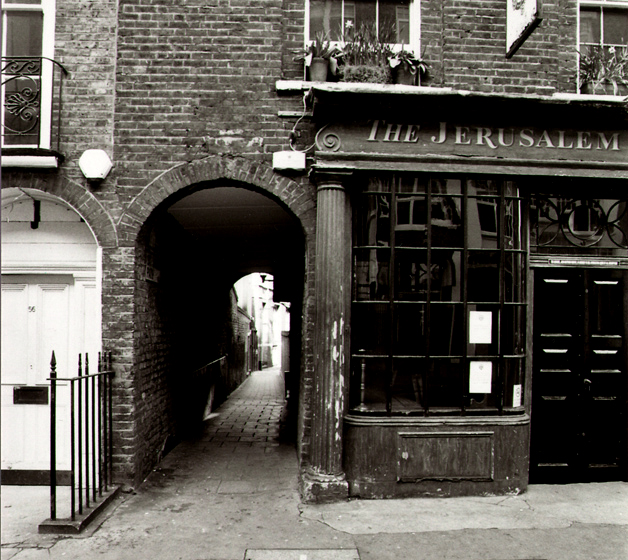
Jerusalem Tavern and Jerusalem Passage, Britton Street, Clerkenwell. Photo © David Secombe 2010.
This week’s sad news has prompted some of us to remember pub crawls with John on his patch, and the names of the hostelries we’d encounter on the way: The Horseshoe in Clerkenwell Close, The Crown on Clerkenwell Green, The Coach and Horses in Ray Street, The Marie Lloyd in Hoxton, The Eagle on Farringdon Road, the Sekforde Arms on Sekforde Street – and, now and again, The Jerusalem Tavern on Britton Street. As this week we have been remembering a great Londoner and champion of art, it seems oddly fitting to add this nugget about an artistic promoter who operated in the same area 300 years ago, and who is now buried in Clerkenwell churchyard. D.S.
From Without the City Wall, Hector Bolitho and Derek Peel, 1951:
Britton Street was named after an incredible Londoner of the late 17th century who walked the streets by day “in his blue frock coat and with his small coal-measure in his hand”, and who by night gave concerts in his humble abode next to Jerusalem Tavern, in what is still Jerusalem Passage. In The London Magazine we read: “On the ground floor was a repository for small coal; over that was a concert room, which was very long and narrow. … Notwithstanding all, this mansion attracted to it as polite an audience as ever the opera did.. … At these concerts Dr. Pepusch and frequently Mr.Handel played the harpsichord.” When passing along the streets with his sack of small-coal on his back, Thomas Britton “was frequently accosted with such expressions as these: ‘There goes the famous small-coal man, who is a lover of learning, a performer in music and a companion for gentleman.’”
Drinker’s London. Photos Paul Barkshire, text David Secombe. (5/5)
Posted: October 23, 2011 Filed under: London on film, London Places, Markets, Pubs | Tags: 'Lovely! Lovely!', Barry Foster, covent garden, Frenzy, Hitchcock, Paul Barkshire, The Cross Keys 1 Comment Cross Keys, Endell Street, Holborn, 1980. Photo © Paul Barkshire.
According to Paul Barkshire’s caption, this much-loved pub is situated in Holborn; this might be technically true, but Endell Street is more commonly associated with Covent Garden, and the porters’ barrows outside the pub suggest the vegetable market which once dominated the whole area. The fruit and veg moved to Nine Elms in 1974, and in the year this picture was taken the retail fun park familiar to Londoners today opened on the site of the defunct market. Inigo Jones’ gracious 17th Century Piazza – threatened with wholesale redevelopment as recently as the early 1970s – was retained at the cost of its enshrinement as the heart of a remorselessly consumerist zone, much to the dismay of residents who had campaigned so hard for the area’s preservation.
We should be grateful that the area was not flattened, or London would now be saddled with something like ‘Forum des Halles’ in Paris, a deadening, subterranean 1970s shopping arcade where once flourished Les Halles, ‘the belly of Paris’, the city’s market since the middle ages. Les Halles was unceremoniously eviscerated in 1971, the same year Alfred Hitchcock filmed his lurid – and anachronistic – serial killer thriller Frenzy in Covent Garden. Looking at the film now, so much is wrong and fantastically dated, but the location shooting in the market was for real: despite its flaws, it manages to capture an environment that now seems as distant as the coaching inns of Dickens’ youth. Barry Foster may strangle Barbara Leigh-Hunt with an old school tie, (Foster’s unwanted catchphrase “Lovely! Lovely!” – was chanted at him ever after by drunks of all stripes) but the ambience of the market is as vivid as the muscat grapes he gives to Jon Finch.
The Cross Keys was slightly off my own map when I was a regular drinker in WC2 – the Opera Tavern on Catherine Street and the Coach and Horses on Wellington Street were more convenient. But those pubs have been made over into anonymous, tourist-service outlets that might be anywhere. Luckily, the Cross Keys is largely unchanged since Paul Barkshire photographed it thirty+ years ago (although the foliage is more exuberant these days) and remains a very charming spot to lose an afternoon. I am intrigued by the gent looking out of the window: is he waiting for a delivery? A visitor? Inspiration? And those barrows look a bit like props. Maybe he’s waiting for the shade of Hitchcock to shout ‘Action!’ D.S.
Drinker’s London. Photos Paul Barkshire, text David Secombe. (4/5)
Posted: October 22, 2011 Filed under: Eating places, Fictional London, Food, London on film, Pubs | Tags: El Vino's, Hugh Grant, Kate Winslet, Old Wine Shades, Richard Curtis Comments Off on Drinker’s London. Photos Paul Barkshire, text David Secombe. (4/5)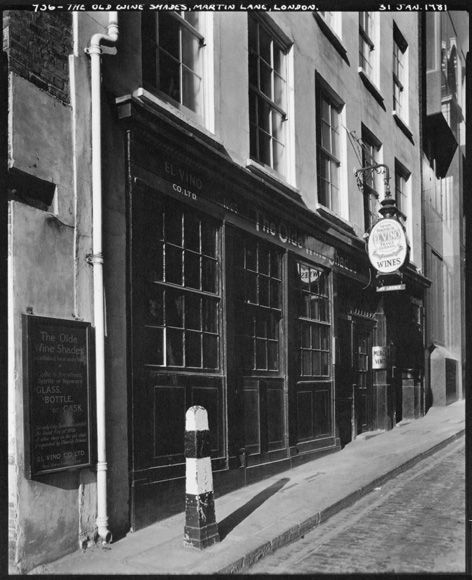
Old Wine Shades, Martin Lane. Photo © Paul Barkshire, 1981.
Old Wine Shades is part of the El Vino group, the venerable drinking chain that branches across the City of London. The one on Fleet Street was a legendary haunt of the local hacks in the days when ‘the Street of Shame’ was thronged with them, and El Vino’s continues to trade on its reputation as a City institution. However, an anonymous reviewer (‘A Customer’) on www.allinlondon.co.uk recently (August 2010) described Old Wine Shades thus:
A dreadful place. I work close by and El Vino’s is noted for rude staff and overpriced food and (especially) drink. On one of my few unavoidable visits (guest of others), my dining partner found a lady’s bracelet at the bottom of his coffee cup. A significantly chunky piece of jewellery. Not even an apology offered, much less anything off the bill. Basically, they trade on their historical connections and for that it’s worth a visit, but only on the way to somewhere better.
I have no idea if this is a fair assessment overall, but it poses several questions: what kind of bracelet was it? Did it have precious stones? What was it doing at the bottom of a coffee cup? Had its owner thrown it there as a protest? (surely you’d notice if your bracelet slipped from your wrist and into your cappuccino). Perhaps it was a prop left over from the filming of a romantic comedy, and the scene is easy to picture: a lunch date goes wrong in an historic London location, Kristin Scott-Thomas chucks her bracelet – a gift from Hugh Grant – in his coffee, leaving him embarrassed as she stalks off. We’d then have a quick bit of comic business with the waiter, a star cameo from Ricky Gervais. Hugh would probably pay another visit to Old Wine Shades at the end of the film, this time blissfully entwined with Kate Winslet or Kate Beckinsale, etc., who then finds the bracelet at the bottom of her coffee cup. I am sure I’ve seen this film. D.S.
Drinker’s London. Photos Paul Barkshire, text David Secombe. (3/5)
Posted: October 20, 2011 Filed under: Bohemian London, London Music, Pubs, Theatrical London | Tags: Brydges Place, Drinking in London, English National Opera, Paul Barkshire, Saffron Burrows, The Harp, The Marquis Comments Off on Drinker’s London. Photos Paul Barkshire, text David Secombe. (3/5)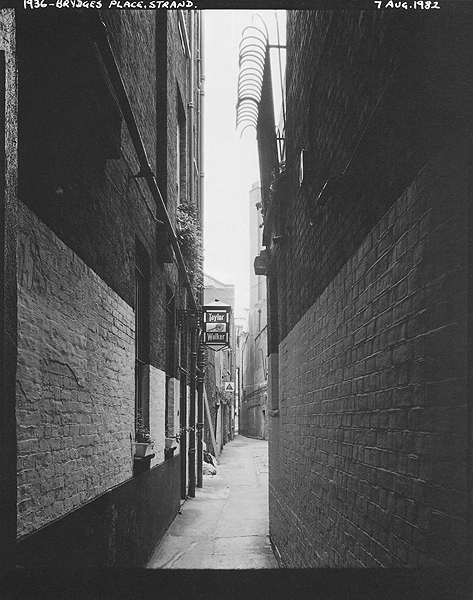
Brydges Place, WC2, 1982. Photo © Paul Barkshire.
Brydges Place – “the narrowest alley in London” – runs between St. Martin’s Lane and Bedfordbury. Paul Barkshire’s photograph shows the view towards St.Martin’s Lane, where the alley narrows with an authentically Victorian oppressiveness before it opens out into the bright lights next to the Coliseum. Ahead, the pub signs denote the back doors of The Marquis and The Harp, the latter being one of the nicest remaining West End pubs; immediately behind where Paul placed his camera is 2 Brydges Place, a civilized drinking club which, like the Harp, is much favoured by actors and theatre people.
This Dickensian little alley – a relic of a time when London was interlaced with innumerable such passages, usually forbidding rather than charming – offers many possibilities for drinking, socialising and making odd connections in general. On a warm night, or just when the pubs are so rammed that they spill into the alley, one can strike up intriguing conversations with strangers. And the stars are more vivid when you can only see a narrow slit of sky (past the sodium yellow of the streetlights, of course).
It is also a good spot to make a fool of yourself. Your correspondent went to English National Opera at the Coliseum earlier this year, and after a couple of sharpeners at the Harp, used Brydges Place as a cut-through – forgetting how crowded it gets on a Saturday when there is a matinee at ENO. As I trundled towards St.Martin’s Lane, I noticed a very beautiful woman waiting for me to clear so she and her friend could enter the alley: I recognised her as being the celebrated actress Saffron Burrows. No sooner had I clocked her and her cheekbones than I heard her say to her companion: “We’ll have to wait for this large man to get out before we can go down here”. A fraction of a second later, I stepped on a loose paving slab and my desert-booted foot dropped into filthy rainwater up to my ankle. Smooth, smooth, smooth. D.S.


 The London Column