Ridgers reminisces. Photo & text: Derek Ridgers (4/5)
Posted: December 1, 2011 Filed under: Out Of Town, Transport | Tags: advertising photography, Mad Men Comments Off on Ridgers reminisces. Photo & text: Derek Ridgers (4/5)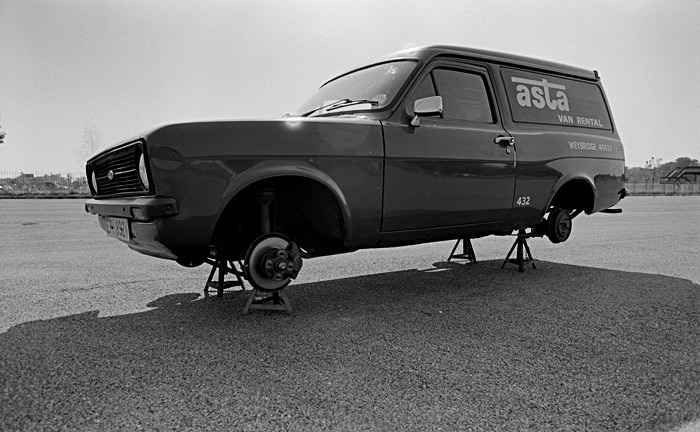
Van without wheels. Feltham, 1981. © Derek Ridgers.
Derek Ridgers writes:
This may look like a van with no wheels but to me it was an epiphany.
I was prostrate, stripped to a pair of shorts in a corner of the car park of Feltham Swimming Baths at the time, so it was an odd position to be seeing the light from. But it was at just about that moment, whilst I was taking that photograph, that I came to realise that I didn’t really want to be doing that sort of thing anymore. By “that sort of thing”, I mean advertising photography. At that moment, I realised that, other than financially, it was never going to amount to a particularly sensible career aspiration for me.
It was in August 1981 and it was only a few months after I’d left work at the London advertising agency Royds, where I’d spent the previous three years working as an art director. Though I say “left” that word isn’t exactly right. I was fired for reasons which, even now, I’m not completely sure about. But it wasn’t the first time I’d been fired from an advertising agency, far from it. In those days, employers never needed much of a reason. Especially in the rather cut-throat advertising business. Thinking back, it might have been because I’d elected not to work on the apartheid era South African Airways account. I don’t honestly know. I’d worked on quite a lot of successful accounts at Royds and I thought I’d done very well. But refusing to work on the South African Airways account may have upset the ultra-Conservative (with a cap C) chairman. I thought I had a choice but maybe I really didn’t. A few weeks later they just said “we’re going to have to let you go” and that was it.
I really enjoyed working as an ad agency art director. At times, it really was a bit like the TV show Mad Men. But with a lot more emphasis on the mad. In the context of 2011, some of the habits and working processes of ad men of the time would seem totally certifiable. Even then we realised much of what we were getting away with was a little excessive. Hugely enjoyable but certainly excessive. But, after ten years, a little voice in my head suggested that maybe I’d be better off out of the ad world. And besides, if you’re in the creative department and you’re not at, or near, the top by the time you’re 30, you’re rapidly reaching your sell-by date anyway.
But my sacking came at a perfect time in my fledgling photography career. I’d just had my second one man show (‘Skinheads’ in the Autumn of 1980) and I was getting my work into print fairly regularly. Plus many of my advertising friends said that they’d give me some photography work, if I decided to try to make a career out of it. And so, a few months after I left Royds, one of my old colleagues called me in and asked me to take a photo of a van with no wheels. They showed me a few layouts and said it could be any van, just as long as it had no wheels. They didn’t want anything much in the background either. That was all. It seemed simple enough.
So that’s how I came to be laying down, half naked, in the grit and grime of Feltham Swimming Baths car park. It was the only place I could find near where I lived that would allow me to take a photo of the van without too many buildings or trees in the background. It seemed like relatively easy money, so I hired a van and four car stands and set about the task. Anyone who’d been watching me that day whilst I did that shoot would have seen someone drive in and park a rental van in the emptiest corner of the car park. Then they’d have seen them jack up and remove all four wheels, remove most their clothes, (it was an extremely hot, humid day) and then go and lie down on the ground about 40 feet away take a few photographs of the wheelless van. Then then they’d have seen that person put the wheels back on, get dressed and drive off…. Anyone watching might have thought it seemed crazy.
As I was laying there sweating, with car park grit sticking to my chest, elbows and legs, it started to dawn on me that maybe I didn’t want to be an advertising photographer after all. I didn’t have an assistant in those days (it would be nearly a decade before I had one) and it simply didn’t occur to me how much stress and bother I would have saved if I’d simply hired an assistant for the day. That is what photographic assistants are for, after all, to do the hard stuff, so you don’t have to. But this was the moment I decided that that kind of photography work just wasn’t for me.
The guys at the agency seemed pleased and the ad itself turned out surprisingly well. But it wasn’t the kind of photograph anyone dreams of taking and if it wasn’t for this blog, this photograph would have been forgotten by all concerned three decades ago.
© Derek Ridgers. From The Ponytail Pontifications.
Croydon. Photo & text: David Secombe.
Posted: November 24, 2011 Filed under: Architectural, Lettering, Literary London, Out Of Town, Transport | Tags: Croydon, Edgeland, Empowerment Centre, J.G. Ballard, John Betjeman, lost idyll Comments Off on Croydon. Photo & text: David Secombe.
Photo © David Secombe 2011.
David Secombe writes:
This photograph was taken on that faceless stretch of The Brighton Road which runs between Purley and the mean streets of downtown Croydon. Technically, I think we are in South Croydon – or perhaps Sanderstead. Purley Oaks maybe? The Empowerment Centre is still listed on Internet databases as ‘a function room and banqueting centre’, but business seemed a bit slow the day I took this picture. ‘Empowerment’ is one of those words that has become tarnished through endlessly repeated misuse, and prompts thoughts of other terms that have become similarly degraded: ‘passionate’ (mandatory for politicians and CEOs); ‘celebrate’ – and its evil cousin, ‘celebrity’; ‘inclusive’; ‘accessible’, ‘iconic’, etc. These words have suffered a migration of meaning that might be said to constitute a failure of language, or perhaps its defeat.
But The Empowerment Centre’s fate seems appropriate to its location. Central Croydon is a pitiful 1960s attempt to construct an international city on the corpse of a Surrey market town. It is particularly anomalous to discover such futuristic pretensions to civic grandeur in that peculiar interzone between the South Circular (A205) and the M25: an aggregate of 20th Century suburban housing, golf clubs, retail parks, and marooned remnants of historic or industrial ‘heritage’ (there’s another one). This ‘edgeland’ has something in common with J.G. Ballard’s beloved west London suburbs, but none of their seedy glamour: the ancient village of Heathrow made way for London’s main air terminal, and the decommissioned rump of Croydon Airport – its Art Deco terminal hall and a shabby, decorative turbo-prop airliner – is a sad and perfunctory reminder of the district’s lost prestige. The airfield – its runways too short for post-war, inter-continental passenger jets – has long been built over, affording a misty, sylvan setting for an array of retail units.
John Betjeman’s poem Croydon evokes memories of a sweeter time, one of his idylls of lost suburban innocence …
Croydon by John Betjeman
In a house like that
Your Uncle Dick was born;
Satchel on back he walked to Whitgift
Every weekday morn.
Boys together in Coulsdon woodlands,
Bramble-berried and steep,
He and his pals would look for spadgers
Hidden deep.
The laurels are speckled in Marchmont Avenue
Just as they were before,
But the steps are dusty that still lead up to
Your Uncle Dick’s front door.
Pear and apple in Croydon gardens
Bud and blossom and fall,
But your Uncle Dick has left his Croydon
Once for all.
St. Pancras. Photo: Tim Marshall, text John Betjeman.
Posted: November 9, 2011 Filed under: Architectural, Literary London, Transport | Tags: Edward Mirzoeff, John Betjeman, St. Pancras Comments Off on St. Pancras. Photo: Tim Marshall, text John Betjeman.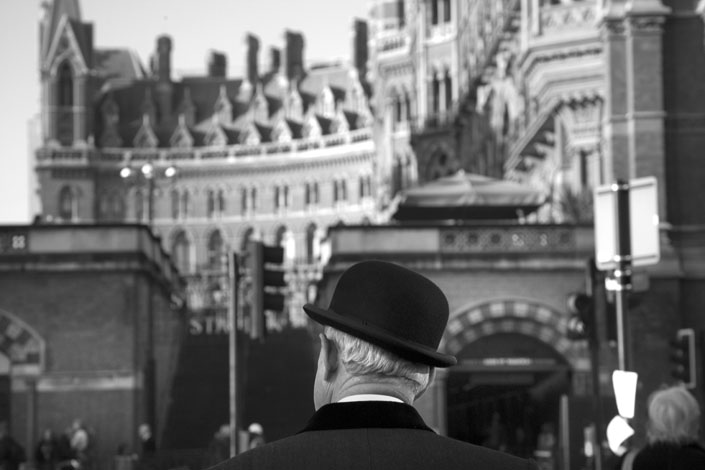
© Tim Marshall 2011.
From London’s Historic Railway Stations, John Betjeman, 1972:
“For the last ninety years almost, Sir Gilbert Scott has had a bad Press. He is condemned as facile, smart, aggressive, complacent and commercial.When at the top of his form Scott was as good as the best of his Gothic contemporaries. He was so firm a believer in the Gothic style as the only true ‘Christian’ style – Scott was a moderate High Churchman – that he was determined to adapt it for domestic and commercial purposes. St. Pancras Station hotel was his greatest chance in London and well he rose to the occasion.
I used to think that Scott was a rather dull architect, but the more I have looked at his work the more I have seen his merits. He had a thorough knowledge of construction, particularly in stone and brick. For St. Pancras the bricks were specially made by Edward Gripper in Nottingham. The decorative iron work for lamp standards and staircases and grilles was by Skidmore of Coventry, who designed the iron screens in some English cathedrals for Scott. The roofs of the hotel are of graded Leicestershire slates; the stone comes mostly from Ketton. Scott’s buildings are so well-built they are difficult to pull down. He had a grand sense of plan and site. The Grand Staircase, which alone survives of the hotel’s chief interior features, ascends the whole height of the building, by an unbelievably rich cast iron series of treads with stone vaulting and painted walls. The chief suites of rooms are on the first floor and the higher the building, the less important the rooms, until the quarters for the servants are reached in the gabled attics – men on one side, women on the other – and separate staircases. Yet even these are large and wide and compare favourably with more modern accommodation. The building has been chopped up and partitioned inside for offices. It is odd that it is not used again as an hotel especially now that hotels are so badly needed in London.”
Edward Mirzoeff writes:
Not long after this book was published I approached British Railways proposing a BBC documentary on London stations, with Betjeman. BR insisted on charging a facility fee at the same daily rate as that for feature films – which killed the idea, doubtless as intended.
Dmitri Kasterine. Text: Tim Turnbull. (4/5)
Posted: October 27, 2011 Filed under: Literary London, London Types, Sartorial, Transport | Tags: London cabbies, The Knowledge, Tim Turnbull Comments Off on Dmitri Kasterine. Text: Tim Turnbull. (4/5)

Hailing a cab, Mayfair, 1965. © Dmitri Kasterine.
Black Cab Blues by Tim Turnbull:
All Hail! All Hail! the cabbies of London,
who are rammed to the gunwales with Knowledge;
so stuffed to the gills with it that it would turn
any lesser bloke’s brains into porridge.
Wave! Wave your brolly! and preen there bespokely,
the cut of your coat won’t persuade them to stop;
they do if they want, and for that reason only –
they’re nothing if not democratic, Old Cock.
Hark! O Hark! to their myriad opinions
but don’t venture yours, they’re never impressed –
you’re not in chambers, they’re not your minions
and so, for all your rhetorical prowess,
you’re bleeding mistaken if you think they might
go sarf uther river at this time o’night.
… for The London Column. © Tim Turnbull 2011.


 The London Column