38 Special. Photo & text: Tim Marshall (1/5)
Posted: July 11, 2011 Filed under: Transport | Tags: No. 38 bus, Tim Marshall Comments Off on 38 Special. Photo & text: Tim Marshall (1/5)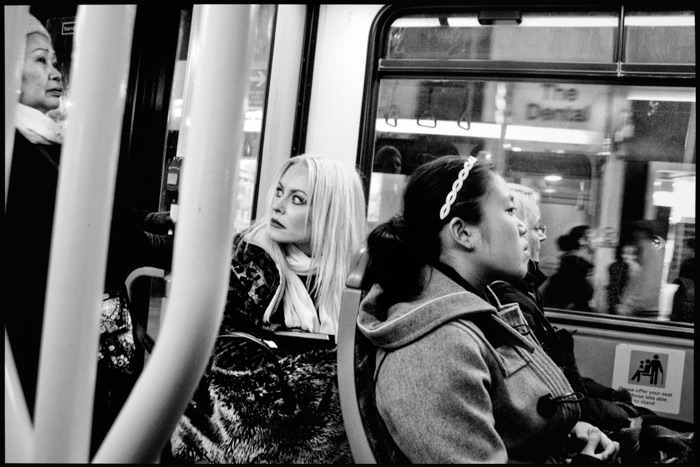
On board a no. 38, Shaftesbury Avenue, 2005. Photo © Tim Marshall.
Timothy Hadrian Marshall writes:
Everybody maps the city in his or her own unique way. My map of London started in 1980 when, as a student, I travelled from Battersea to Leicester Square on the old Number 19 Routemaster, as I made my way to the CSM Graphic Design building in Covent Garden. The characters I encountered on the journey intrigued me and I began making drawings of my fellow passengers. My location eventually changed and I went underground to become a Northern liner for two years, then in 1986 a Piccadilly Line man. The tube became another project, this time photographic, and I rarely travelled by bus anywhere during that time.
On moving to Islington in 2004, the estate agent said “ It’s a great location, only five minutes from Angel.” At the time good public transport connections all seemed terribly important. In my new locality I was pleasantly surprised to see the old Routemaster bus was still running, conjuring up every good thing about London, like a giant dinky toy from my childhood. Everyone appeared happy on the ‘Cliff Richard’ bus. You invariably knew the bus conductor, who would chat and make jokes, and you didn’t have to worry about bus stops, you could just jump off where and when you wanted to (all at your own risk, of course). Then one day, like Triffids in the night, the dreaded ‘Bendy Bus’ appeared.
© Tim Marshall 2011
Days and Nights in W12. Photographs and text: Jack Robinson (3/4)
Posted: July 1, 2011 Filed under: Artistic London, Bohemian London, Catastrophes, Transport | Tags: CB Editions, Days and Nights in W12, minicab, W.K. Teevald Comments Off on Days and Nights in W12. Photographs and text: Jack Robinson (3/4)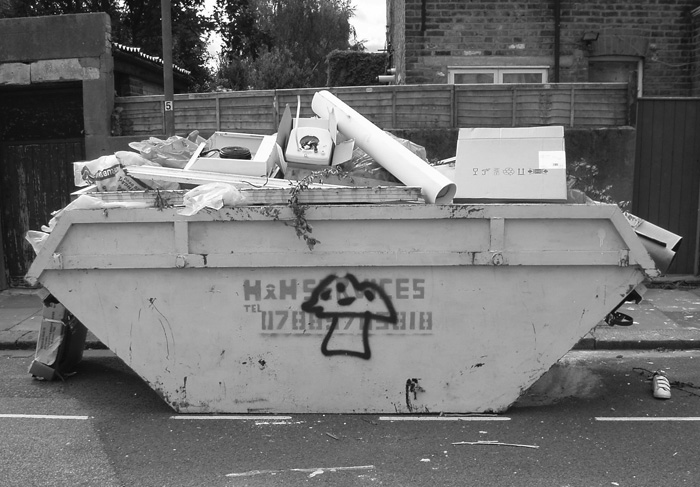
Batson Street, W12, 2007. Photo: © Jack Robinson.
From Days and Nights in w12* by Jack Robinson:
SKIP
The white roll in this skip is not posters for a film that’s no longer showing or rejected samples from an advertising agency but drawings of a Macedonian girl who speaks almost no English but has a body to die for. The drawings were made by the American artist W. K. Teevald; during his month-long stay in London, where he’d come to supervise the hanging of a retrospective exhibition of his work, he checked out of his hotel and moved in with this girl, and he considers the drawings to be the best work he’s done for years. On the day of his return flight to Los Angeles the taxi he’d ordered didn’t arrive, so he loaded his bags into the only car available from the nearest minicab office. The drawings were strapped onto the roofrack. ‘No problem, mister, the Lord is good, he will take best care,’ said the driver as he yanked on the rope and knotted it. He looked about twelve years old and was grinning; he could have been making a joke, except that the Virgin Mary was stickered all over the dashboard and a crucifix dangled from the rear-view mirror. When they arrived at the airport the roofrack was bare: not even a shred of rope was clinging to the metal frame. The driver demanded twice the fare that had been agreed before they’d set out and followed Teevald into the departures hall, pleading for justice and if not justice then charity, until he was turned away by security guards.
© Jack Robinson.2011.
* CB Editions 2010.
Point of Interest. Photos Peter Marlow (2/3)
Posted: June 2, 2011 Filed under: Housing, Transport | Tags: HACAN, Heathrow Airport, Magnum, Peter Marlow Comments Off on Point of Interest. Photos Peter Marlow (2/3)
Approach to Runway 27, West, Heathrow Airport, 2001. © Peter Marlow (from Point of Interest, courtesy of the photographer and The Wapping Project Bankside*).
From Heathrow Noise Damage Across London – a report prepared by Charles Rolls for HACAN (Heathrow Association for the Control of Aircraft Noise), June 1997:
Quotes from the social surveys
The nature of the problems mentioned in the surveys fell into well-defined categories. The majority of people who experienced severe annoyance or said it was unbearable mentioned an impact on Quality of Life (ability to use the garden, have the windows open, listen to music/TV, have dinner parties) or Impairment of some Function (doctor’s inability to think during surgery, sleep deprivation,increased family stress).
Some typical quotes on the impact on Quality of life:
“It affects my ability to listen to music.” Paultons Square
“We have to keep our windows closed, we have spent extra money on noise insulation, and we can’t use the garden” Paultons Square
“Hard to concentrate on reading” Paultons Square
“Deters us from sitting in the garden. The noise is too frequent” Christchurch Street “Severely affects TV reception” Camberwell
“The intrusive effect on an otherwise peaceful environment” Camberwell
Some typical quotes on the Impairment of Function:
“Intrusion on thoughts/conversation/examining patients” MD Paultons Square
“Early morning it wakes me and any visitors” Paultons Square “Loss of sleep is extremely debilitating” Paultons Square
“It disrupts the children’s sleeping patterns and causes stress to all the family” Christchurch Street
“Level of noise in the early morning. Often shakes the windows and invariably wakes the children” Christchurch Street
“When we are trying to relax it causes angst” Christchurch Street
“My sleep pattern has been greatly and increasingly disturbed by it” Camberwell
“You cannot get away from noise, it is very invasive and stressful to live with noise you can do nothing about” Camberwell
“Often woken around 4.30 – 5am then very difficult to sleep again – am very tired as a result but how do you prove this?” Camberwell
What is it about the noise that is most annoying?
“There is an increase to a peak then a lull, but with the certainty of the next cycle being repeated” Paultons Square
“No other capital city has been so foolish as to land itself with this level of aircraft noise pollution” Paultons Square
“Hearing one plane and just waiting for the next” Christchurch Street “We end up shouting at each other in the garden” Christchurch Street
“Engine noise – screaming of the engines” Christchurch Street
“The noise in Camberwell is continuous due to the height of the aircraft” Camberwell
“That an area like Camberwell, miles from the airport but seriously affected by the noise does not feature in any consultation process” Camberwell
“You cannot get away from the noise” “I love my home and neighbourhood but the aircraft noise is literally the only thing which is making me consider moving home” Camberwell
“Couldn’t the flight paths be broader, so spreading the noise?” Camberwell
“BAA say we are outside the area seriously affected – this is quite wrong” Camberwell
* Point of Interest is showing at The Wapping Project Bankside, London SE1, until 2 July 2011.
Domeland. Text Owen Hatherley, photos David Secombe (5/5).
Posted: May 13, 2011 Filed under: Architectural, Transport | Tags: blackwall tunnel, Greenwich Peninsula, Guide to the New Ruins of Great Britain, Owen Hatherley Comments Off on Domeland. Text Owen Hatherley, photos David Secombe (5/5).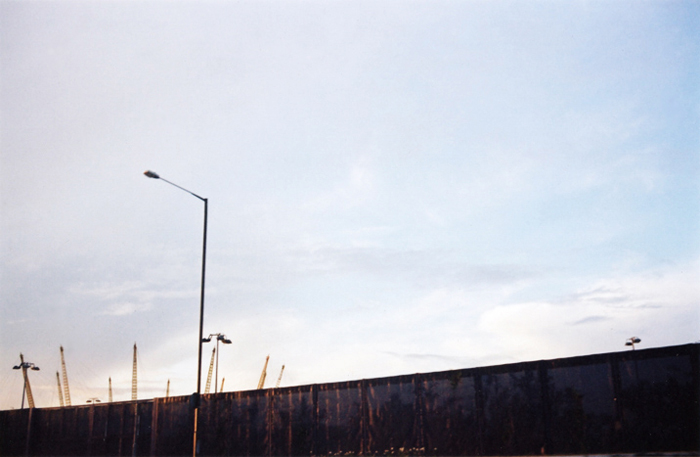
The Dome seen from the Blackwall Tunnel southern approach. Photo © David Secombe 2004.
From A Guide to the New Ruins of Great Britain*, Owen Hatherley 2010:
This place was a Blairite tabula rasa. Faced with an area the size of a small town, freshly decontaminated and waiting to have all manner of ideas laid down upon it, what did they create – or rather, what did the companies and corporations that they subsidized create? A couple of areas of luxury housing (typically, with fairly minisucule apartments) a couple of shopping centres, several car parks, and now a gigantic Entertainment Complex to finally get those car parks filled. Amusingly, given that the area was once so keen to trumpet its eco credentials (a supermarket partly run on wind power), it has since become another of London’s locked traffic grids, as well it might having the Blackwall Tunnel nearby. Blairites, and neoliberals in general, have always posited some sort of ‘force of Conservatism’, some entrenched opposition either from the remnants of organized Labour or woolly traditionalists, that prevents their vision from being realized. Here, there was nothing but blasted wasteland when they got hold of it. Yet a more astounding failure of vision is difficult to imagine. If there is a vision here, it’s of a transplant of America at its worst – gated communities, entertainment hangars and malls criss-crossed by carbon-spewing roads; a vision of a future alienated, blankly consumerist, class ridden and anomic. The ‘corrosive humours’ turned out to be more difficult to erase than might have been imagined.
* published by Verso. © Owen Hatherley 2011.


 The London Column