Drinker’s London. Photos Paul Barkshire, text David Secombe. (4/5)
Posted: October 22, 2011 Filed under: Eating places, Fictional London, Food, London on film, Pubs | Tags: El Vino's, Hugh Grant, Kate Winslet, Old Wine Shades, Richard Curtis Comments Off on Drinker’s London. Photos Paul Barkshire, text David Secombe. (4/5)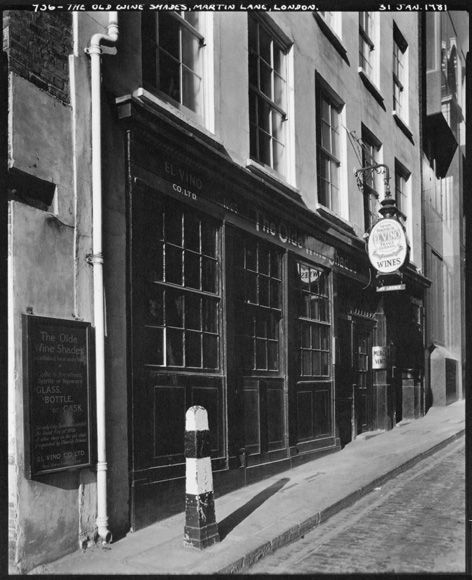
Old Wine Shades, Martin Lane. Photo © Paul Barkshire, 1981.
Old Wine Shades is part of the El Vino group, the venerable drinking chain that branches across the City of London. The one on Fleet Street was a legendary haunt of the local hacks in the days when ‘the Street of Shame’ was thronged with them, and El Vino’s continues to trade on its reputation as a City institution. However, an anonymous reviewer (‘A Customer’) on www.allinlondon.co.uk recently (August 2010) described Old Wine Shades thus:
A dreadful place. I work close by and El Vino’s is noted for rude staff and overpriced food and (especially) drink. On one of my few unavoidable visits (guest of others), my dining partner found a lady’s bracelet at the bottom of his coffee cup. A significantly chunky piece of jewellery. Not even an apology offered, much less anything off the bill. Basically, they trade on their historical connections and for that it’s worth a visit, but only on the way to somewhere better.
I have no idea if this is a fair assessment overall, but it poses several questions: what kind of bracelet was it? Did it have precious stones? What was it doing at the bottom of a coffee cup? Had its owner thrown it there as a protest? (surely you’d notice if your bracelet slipped from your wrist and into your cappuccino). Perhaps it was a prop left over from the filming of a romantic comedy, and the scene is easy to picture: a lunch date goes wrong in an historic London location, Kristin Scott-Thomas chucks her bracelet – a gift from Hugh Grant – in his coffee, leaving him embarrassed as she stalks off. We’d then have a quick bit of comic business with the waiter, a star cameo from Ricky Gervais. Hugh would probably pay another visit to Old Wine Shades at the end of the film, this time blissfully entwined with Kate Winslet or Kate Beckinsale, etc., who then finds the bracelet at the bottom of her coffee cup. I am sure I’ve seen this film. D.S.
Drinker’s London. Photos Paul Barkshire, text David Secombe. (3/5)
Posted: October 20, 2011 Filed under: Bohemian London, London Music, Pubs, Theatrical London | Tags: Brydges Place, Drinking in London, English National Opera, Paul Barkshire, Saffron Burrows, The Harp, The Marquis Comments Off on Drinker’s London. Photos Paul Barkshire, text David Secombe. (3/5)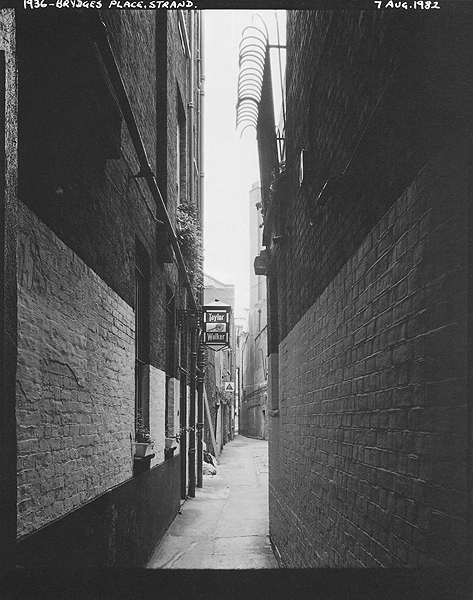
Brydges Place, WC2, 1982. Photo © Paul Barkshire.
Brydges Place – “the narrowest alley in London” – runs between St. Martin’s Lane and Bedfordbury. Paul Barkshire’s photograph shows the view towards St.Martin’s Lane, where the alley narrows with an authentically Victorian oppressiveness before it opens out into the bright lights next to the Coliseum. Ahead, the pub signs denote the back doors of The Marquis and The Harp, the latter being one of the nicest remaining West End pubs; immediately behind where Paul placed his camera is 2 Brydges Place, a civilized drinking club which, like the Harp, is much favoured by actors and theatre people.
This Dickensian little alley – a relic of a time when London was interlaced with innumerable such passages, usually forbidding rather than charming – offers many possibilities for drinking, socialising and making odd connections in general. On a warm night, or just when the pubs are so rammed that they spill into the alley, one can strike up intriguing conversations with strangers. And the stars are more vivid when you can only see a narrow slit of sky (past the sodium yellow of the streetlights, of course).
It is also a good spot to make a fool of yourself. Your correspondent went to English National Opera at the Coliseum earlier this year, and after a couple of sharpeners at the Harp, used Brydges Place as a cut-through – forgetting how crowded it gets on a Saturday when there is a matinee at ENO. As I trundled towards St.Martin’s Lane, I noticed a very beautiful woman waiting for me to clear so she and her friend could enter the alley: I recognised her as being the celebrated actress Saffron Burrows. No sooner had I clocked her and her cheekbones than I heard her say to her companion: “We’ll have to wait for this large man to get out before we can go down here”. A fraction of a second later, I stepped on a loose paving slab and my desert-booted foot dropped into filthy rainwater up to my ankle. Smooth, smooth, smooth. D.S.
Drinker’s London. Photos Paul Barkshire, text David Secombe. (2/5)
Posted: October 19, 2011 Filed under: Artistic London, Bohemian London, Literary London, Pubs | Tags: Ezra Pound, London bohemia, Sam Smiths pubs, The Princess Louise, The Rhymers Club, W.B. Yeats Comments Off on Drinker’s London. Photos Paul Barkshire, text David Secombe. (2/5)
Princess Louise, Holborn,1986. Photo © Paul Barkshire.
The Princess Louise is one of those carefully time-locked London pubs where one is invited to experience a idealised ‘heritage’ drinking experience: the Louise escaped post-war redevelopment and refurbishment and has survived into the 21st century as an authentically preserved/recreated Victorian boozer. At time of writing, the only beer on offer in the Louise is Sam Smiths, a rather dense, tawny ale brewed in Yorkshire; its main appeal is that it is remarkably cheap, but it is perhaps no coincidence that Sam Smiths currently lay claim to several other historic London pubs: these include the legendary Fitzrovia hangouts The Wheatsheaf and The Fitzroy Tavern, both much-frequented by the likes of Augustus John, Dylan Thomas, George Orwell, etc. – and also The Cheshire Cheese on Fleet Street, known to writers from Samuel Johnson (allegedly) and Charles Dickens up to Oscar Wilde, W.B. Yeats and Ezra Pound. (The Cheese was where Wilde came to hear John Gray, the model for Dorian Gray, read his poems, and where Pound demonstrated his impeccable Modernist credentials by eating two red tulips during a recital by Yeats.)
Since Paul Barkshire’s photo was taken in the 80s, the Princess Louise has had another make-over, reinstating ‘authentic’ Victorian mahogany & etched glass partitions, the original purpose of which was to divide up the patrons according to class and occupation. The end result is undoubtedly charming, and Sam Smiths should be congratulated for the sensitivity of their management of these historic pubs. The problem is that the loving restoration reinforces the sense of theme park, that creep of ‘Heritage’ (a tainted word if ever there was one) which imprisons London. The ghosts of the past are marooned amongst the tourists, and the centre of town is closed off to the truly louche and experimental. The Fitzroy Tavern and the Wheatsheaf can never be what they were in the 1920s and 40s; and where would The Rhymers’ Club, that austere flower of the Aesthetic movement which met at the Cheshire Cheese from the 1890s up to 1914, attracting Wilde, Yeats, Dowson, Pound, etc., meet today? A loft in Peckham or Dalston, probably. D.S.
… for The London Column.
Drinker’s London. Photo Paul Barkshire, text David Secombe. (1/5)
Posted: October 18, 2011 Filed under: Clubs, Eating places | Tags: Chez Gerard, covent garden, Garrick Club, L'Estaminet, Le Beaujolais, Le Tartin, merguez sausages Comments Off on Drinker’s London. Photo Paul Barkshire, text David Secombe. (1/5) Floral Street, Rose Street & Garrick Street, 1986. Photo © Paul Barkshire.
This week’s offering on The London Column consists of Paul Barkshire’s limpid photographs of drinking establishments from the 1980s, accompanied by personal observations on city drinking by myself and – if we’re lucky – a few others.
It seems appropriate to begin the week with this picture, which shows the convergence of three Covent Garden streets, the noble facade of the Garrick Club facing towards us, and – the reason for its appearance here – chefs from the kitchen of an establishment fondly remembered by your correspondent. They are standing in the doorway of what used to be the restaurant L’Estaminet, and its downstairs wine bar Le Tartin.
L’Estaminet was established by the remnants of the team who had started the original Chez Gerard, the steak-frites operation on Charlotte Street. I would eat upstairs occasionally, but it was usually easier to stay in the basement bar. Behind the counter downstairs were Bernard and Gerard: the former bespectacled, austere, and slightly forbidding, Gerard an endearingly hectic shambles. A gamine waitress was on hand to smile at the patrons’ terrible jokes and give the middle-aged regulars dreams of a better life. Le Tartin was an oasis of calm amidst the frantic tourist clamour outside, offering a far more intimate experience than any other London bar or club I can think of. Sat at a booth one could drink and dream one’s life away in the gloom, and they would bring you merguez sausages if your reverie made you hungry.
I was a regular there for about seven years, until that sad evening when my regular visit revealed the dead hand of new management (who went on to rename the venue The Forge). Bewildered, my colleague and I retreated to the nearby Le Beaujolais (another venerable French-run wine bar, although a much more raucous affair) where we were told the sorry tale of the departure of Bernard, Gerard et al. The staff of Le Beaujolais were sympathetic to our distress, because they understood what we had become: exiles. D.S.
… for The London Column.
See also: London Perceived no.1


 The London Column