East Ender.
Posted: October 21, 2013 Filed under: Eating places, Graffiti, Health and welfare, Lettering, London Labour, Markets, Public Art, Street Portraits | Tags: Hoxton, Hoxton Mini Press, Joseph Markovitch, Martin Usborne, old East End 2 Comments
© Martin Usborne.
Joseph Markovitch:
I was born right by Old Street roundabout on January 1st, 1927. Some of the kids used to beat me up – but in a friendly way. Hoxton was full of characters in those days. The Mayor was called Mr. Brooks and he was also a chimney sweep. Guess what? Before the coronation, he was putting up decorations and he fell off a ladder and got killed. Well, it happens. Then there was a six-foot tall girl, she was really massive. She used to attack people and put them in police vans. Maria was her name. Then there was Brotsky who used to kill chickens with a long stick. His son’s name was Monty. That’s not a common one is it? ‘Monty Brotsky’.
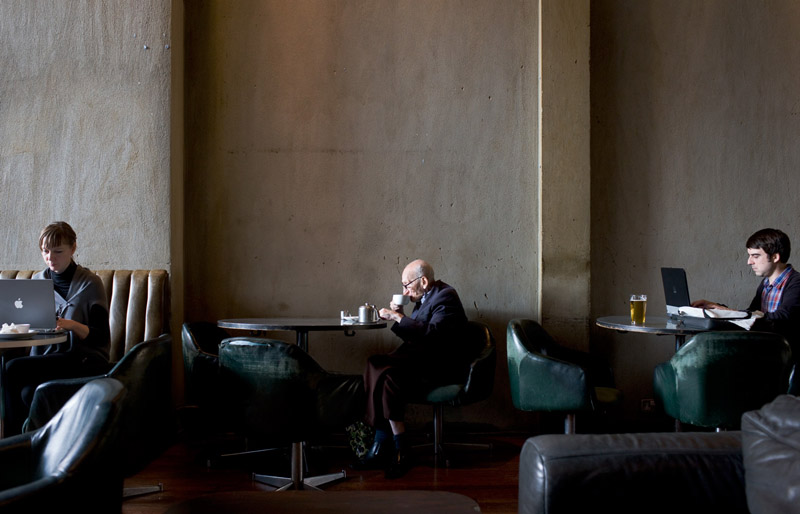
© Martin Usborne
I worked two years as a cabinet maker in Hemsworth Street just off Hoxton market. But when my sinuses got bad I went to Hackney Road putting rivets on luggage cases. For about twenty years I did that job. My foreman was a bastard. Apart from that it was OK. But if I was clever, very clever, then I would have liked to be an accountant. It’s a very good job. And if I was less heavy … you know what I’d like to be? I’d like to be a ballet dancer. That would be my dream.
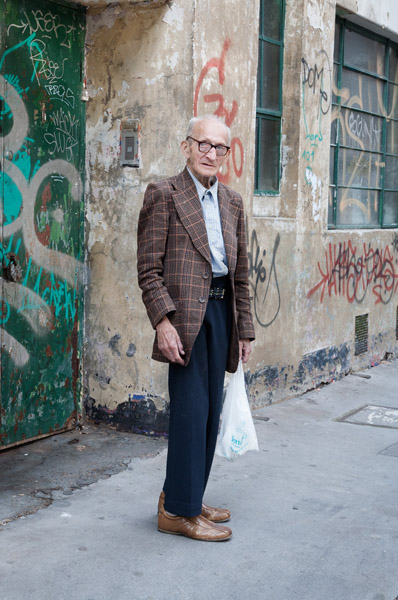
© Martin Usborne
I don’t mind people taking pictures of me. But I wouldn’t let a girl take a picture of me. She might have a boyfriend. I don’t want any trouble. And who knows, he might think she wants to run off with me. You got to be careful where you go nowadays. Martin, if you want to take this picture you had better be quick. I don’t take a good picture when my bladder is full.

© Martin Usborne
If I try, I can imagine the future. It’s like watching a film. Pavements will move, nurses will be robots and cars will get smaller and grow wings … you’ve just got to wait. They will make photographs that talk. You will look at a picture of me and you will hear me say: ‘Hello I’m Jospeph Markovitch’ and then it will be me telling you abut things. Imagine that! I also have an idea that in about fifty years Hoxton Square will have a new market with an amazing plastic rain cover. So if it rains the potatoes won’t get wet. I don’t know what else they will sell. Maybe bowler hats. Nothing much changes round here in the end.

© Martin Usborne.
There’s no point crying about things is there? People don’t see you when you’re sad. Best just to keep walking.
Do you know that I can’t eat lettuce? I’ve got no teeth, not for ten years. It’s hard to like lettuce if you haven’t got teeth.
… taken from I’ve Lived In East London for 86.5 Years, photographs by Martin Usborne, the debut publication of Hoxton Mini Press. More details may be found on their Kickstarter page.
A Short Walk Down The Old Kent Road.
Posted: October 14, 2013 Filed under: Class, Public Art, Pubs, Tall Tales | Tags: Andrew Martin, Dun Cow, gentrification, Old Kent Road, only fools and horses, Pink Tank, Thomas A Becket 5 Comments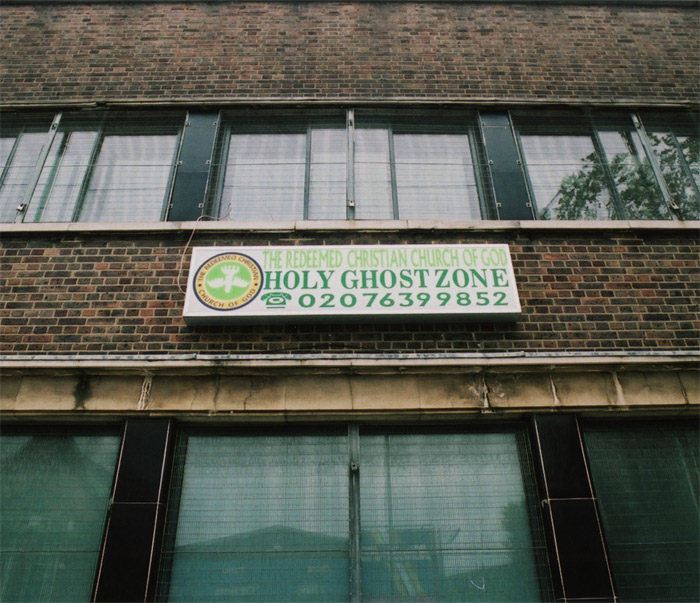
Holy Ghost Zone, Old Kent Road. © David Secombe 2008.
Andrew Martin:
When playing Monopoly my father was always determined to acquire Old Kent Road and Whitechapel, and to build on them as soon as possible. It’s the most modest portfolio on the board, with houses on Old Kent Road, as I remember, costing little more than a hotel on Mayfair. ‘You might laugh,’ my father would tell us in baleful tones, ‘but everybody always lands on Old Kent Road.’
I’m interested in the Old Kent Road as a sort of social counterweight to Hampstead, but my friend David, a South London partisan, is a genuinely keen on it, and gave me a guided tour this week.

Tesco, Old Kent Road. © David Secombe 2004.
‘When the evening sun’s like this,’ he said cheerfully, as we skirted a sofa that had been thoughtfully set out on the pavement, ‘it’s got a sort of I’m-in-a-scary-part-of-LA charm.’ We were walking past the Old Kent Road’s array of cosmopolitan food shops, beauty parlours, international cash transfer places, evangelical ministries, van washing businesses. As the cars screamed by, David would stop every now and again to photograph the lowering clouds over some light industrial unit or brutalist block of flats. He seemed particularly taken with the visual possibilities of the flyover at the southern end of the Road. ‘A friend of mine owns a flat that looks right on to that,’ he said enviously.
 .
.
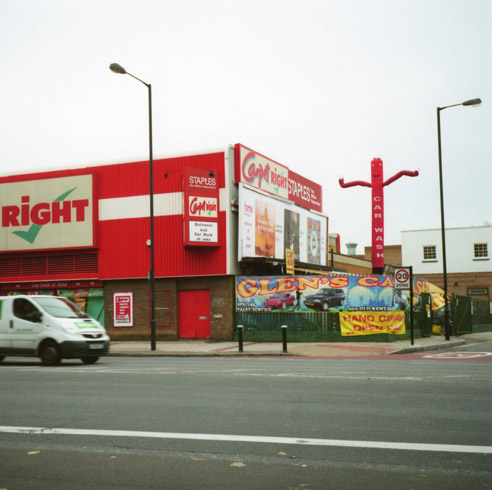
Carpet Right, Old Kent Road. © David Secombe 2008.
I looked at a price list outside one of the Road’s pubs: it advertised a cocktail called a Slippery Nipple, consisting of Sambuca, Bailey’s and Grenadine. You could have a jug of Slippery Nipple for £12.50. Another sign forbade anybody wearing a hat to enter the pub. You knew there was some insight into human behaviour behind this, and that it had been won the hard way.
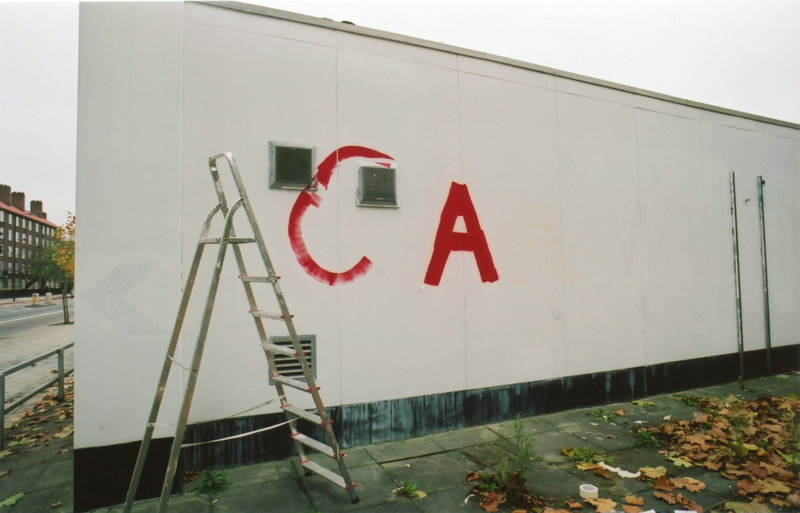
Re-branding exercise, Old Kent Road. © David Secombe 2008.
‘If Dickens were alive today he’d be down here all the time,’ said David as car came crawling noisily down the Road with only two of its tyres inflated. David then attempted, with windmilling arms, to direct the dazed-looking driver to a nearby sprawling depot called Madhouse Tyres.
As he did so, I reflected that the Old Kent Road does have the look of suburban LA or Chicago – that rangy wildness – and it occurred to me that this is what happens to British streetscapes when middle class vigilance is reduced and planning controls relaxed: they begin to look American.
………….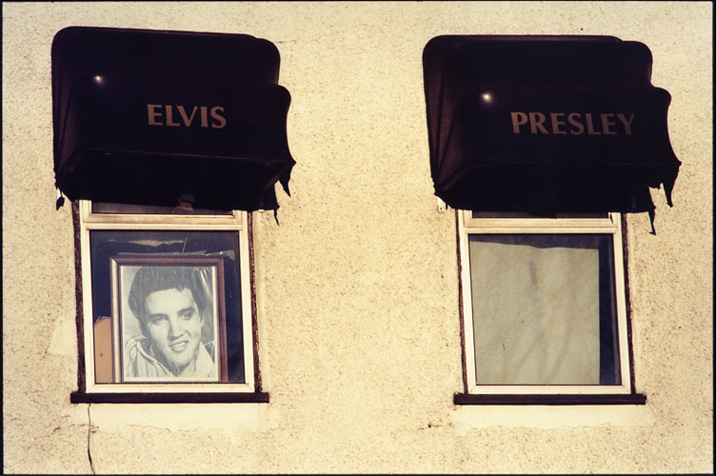
Chinese Elvis restaurant, Old Kent Road. © David Secombe 2002.
David pointed out East Street, which goes off the Old Kent Road. Its market features in the opening credits of ‘Only Fools and Horses’, in which Rodney and Del Boy inhabit a tower block inevitably called Nelson Mandela House. David took me to Mandela Way, which intersects with Old Kent Road, and where there is a small patch of green space occupied by a tank that has been painted pink and decorated repeatedly with the stencilled word ‘Scab’. ‘If this was North London,’ I marvelled, ‘there would be letters in the Hampstead and Highgate Express every week until it was taken away.’ ‘Really?’ said David, snapping away, ‘it’s been here for years.’*

Tank, Mandela Way. © David Secombe 2004.
In the streets off Old Kent Road, you never know what you’ll find: a battered looking Georgian house with an ice cream van parked in the front drive and a lone security camera staring at it; a tiny house with a sign saying ‘This property is protected by guard dogs’ – that’s dogs, plural; sudden bombsites with rampant buddleia, the scars of the Second World War still seemingly fresh. There are also surprising runs of pristine Georgian and Victorian houses with obviously middle class occupants.
……..
Almshouses, Asylum Road, SE15. © David Secombe 2008.
You could argue that Old Kent Road is going upmarket. The famous old Dun Cow pub is now the Dun Cow Surgery, and the Thomas A Becket, the even more famous boxing pub, built on one of the many sites where the Canterbury pilgrims took liquid refreshment, is now an estate agency, a sign of the times to an extent almost ridiculous. ‘You’d think there’d be a plaque acknowledging what it used to be,’ I said to David. But he frowned and shook his head, ‘That’s one of the great things about the Old Kent Road,’ he said, as we trudged on, ‘a profound lack of sentimentality.’
.. .
.
Andrew Martin outside the Asylum Tavern, Asylum Road, off the Old Kent Road, at the end of the trip described in the foregoing article. © David Secombe 2004.
© Andrew Martin. This article originally appeared in Andrew’s Class Conscious column for The New Statesman in 2004.
(*The tank is a Soviet T-34 placed on Mandela Way as a protest by a disgruntled property developer following the rejection of a planning application.)
Urban Myths no.2: Airport Caterpillars.
Posted: October 4, 2013 Filed under: Amusements, Tall Tales, Transport, Wildlife Comments Off on Urban Myths no.2: Airport Caterpillars.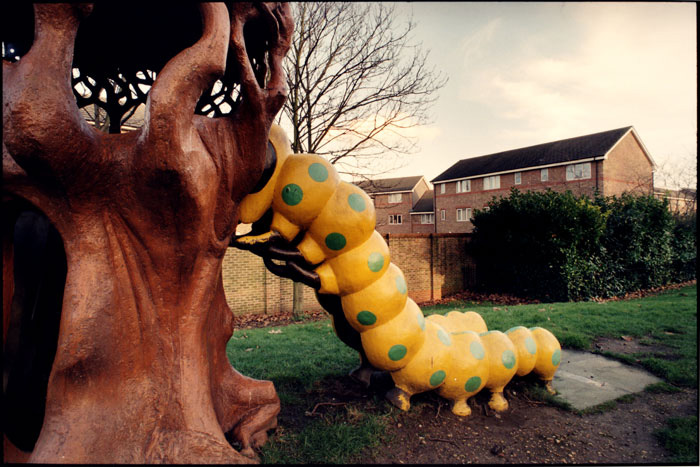
Playground, Rotherhithe. © David Secombe 2003.
Giant Edible Caterpillars Seized at Gatwick*
Customs officers at Gatwick Airport got more than they bargained for when they searched the luggage of a passenger arriving from Nigeria: inside his suitcase they found more than ninety kilograms of giant caterpillars swarming inside a bubble wrap cocoon.
The man told the customs officials that they were for his personal consumption during his stay in Britain. However, the caterpillars are a popular delicacy across Africa and, as such, represent a valuable trading commodity. Customs official Bridget Fumes commented: ‘We get a lot of people trying to smuggle animals into the country – last month we had someone wearing a lizard as a hat and a man with a pair of monkeys down his trousers, but to my knowledge this is the first time we have had giant caterpillars.’
Stavros Wilt, an insect expert at the Natural History Museum, commented: ‘These are likely to be mopane worms, the larvae of emperor moths, which are commonly eaten in Africa. A favoured method of consumption is to pinch the caterpillar at the tail to rupture its innards, followed by a sharp flick to liberate the guts via the burst carapace. The resulting matter may be fried until crisp with onion, tomatoes and chillis. Alternatively, they may be dried and eaten raw as a crunchy snack.’
‘This was an unusual seizure but the vigilance of our officers prevented this consignment of rogue insects from entering the UK, and possibly posing a risk to the health and wellbeing of the populace,’ proclaimed Ms Fumes. ‘I would warn travellers not to attempt to bring any products of animal origin into the UK without a permit, as they may not have been inspected to appropriate standards and may contain diseases. These caterpillars are not something I expect to see in the Gatwick staff canteen any time soon!’
An increasing number of British outlets offer mopane worms for ‘own consumption only’. The online retailer Planet Nosh sells 40g bags for £16.99, saying that the insects are a tasty and nutritious alternative to traditional meat products, and describes them as ‘the ultimate barbecue novelty’. Experts estimate that the caterpillars seized at Gatwick had a street value of £40,000.
The caterpillars are being cared for at an animal rescue shelter in Kent.
* NB: A mostly, if not entirely, genuine news item: a mash-up of reports from International Business Times, The Independent, lepidoptera.pro, etc. The second in an occasional series. See also: The Supermarket Spider (http://wp.me/p1twhU-33W)
Two buildings on Fleet Street.
Posted: September 27, 2013 Filed under: Architectural, Fictional London, Literary London, Street of Shame | Tags: Art Deco in London, Daily Express Building, Evelyn Waugh, old Fleet Street, Owen Williams, Scoop, Telegraph Building Comments Off on Two buildings on Fleet Street.
Telegraph Building, Fleet Street. Photo © David Secombe 2010.
From Scoop by Evelyn Waugh:
The bells of St.Bride’s chimed unheard in the customary afternoon din of the Megalopolitan Building. The country edition had gone to bed; below traffic level, in grotto-blue light, leagues of paper ran noisily through the machines; overhead, where floor upon floor rose from the dusk of the streets to the clear air of day, ground-glass doors opened and shut; on a hundred lines reporters talked at cross purposes; sub-editors busied themselves with their humdrum task of reducing to blank nonsense the sheaves of misinformation which whistling urchins piled before them; beside a hundred typewriters soggy biscuits lay in a hundred tepid saucers. At the hub and still centre of all this animation, Lord Copper sat alone in splendid tranquility. His massive head, empty of thought, rested in sculptural fashion upon his left fist. He began to draw a little cow on his writing pad.
David Secombe: Scoop was published in 1938 and is, of course, a literary monument to the glory days of inter-war Fleet Street, drawing on Waugh’s brief 1935 stint as a Daily Mail war correspondent in Abyssinia. The novel’s monstrous Lord Copper is usually described as being an admixture of the proprietor of the Daily Express, Lord Beaverbrook, and The Times’s Lord Northcliffe, with the Mail‘s Lord Rothermere somewhere in the mix as well. The immense power of these men reflected the vast circulations and influence of the titles at their disposal; and, for all its comic genius, the paragraph from Waugh’s novel speaks of the glamour and excitement of old Fleet Street.
The Telegraph Building, designed by Elcock & Sutcliffe and finished in 1928, is a fine example of serious-minded Deco, with sculptural detailing typical of the era’s public buildings (e.g. London Underground’s 55 Broadway, BBC’s Broadcasting House), whilst the clock and detailing of the facade speaks of the 1920s’ infatuation with all things Egyptian. Alfred Oakley’s dynamic frieze above the main entrance depicts a brace of Mercuries flying from Britain to despatch news to her dominions and beyond; whilst, at the very top of the facade, two gravely portentous sculptural masks by Samuel Rabinovitch – ‘Past’ and ‘Future’ – offer further proof of the self-importance of the parties who commissioned the building. (However, Oakley and Rabinovitch were not as celebrated as Gill or Epstein, and their work on the Telegraph building was the high-water mark for both of them.) Together the elements add up to a rich, imposing and endearingly absurd edifice, entirely suitable for a sober, venerable newspaper keen to project an engagement with the hectic modern ‘scene’.
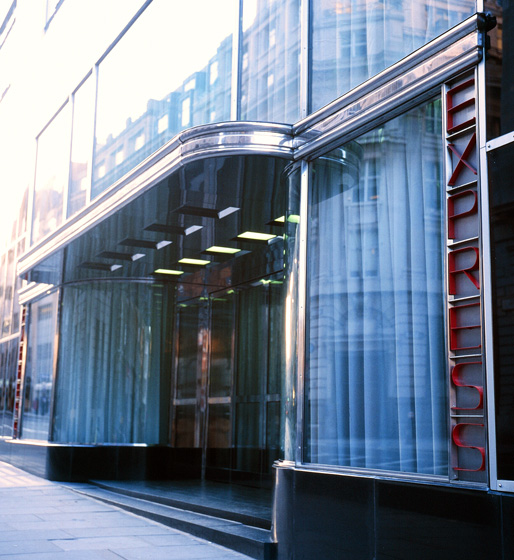
Daily Express Building, Fleet Street. Photo © David Secombe 2010.
A few years later, in 1932, and just four doors away, the new Daily Express Building opened for business and immediately made Elcock & Sutcliffe’s Telegraph design look like something by Augustus Pugin. A self-proclaimed icon of modernity streamlining down inky old Fleet Street, this sleek edifice is as characteristic of the 1930s as the suddenly obsolete Telegraph Building was of the 1920s. Significantly, the building was to a large extent the design of a structural engineer, Owen Williams, who had also advised on the Telegraph Building, and who went on to design Express offices in Manchester and Glasgow in the same fashion as their London prototype. The stark finish common to all three Express buildings – an aggressively moderne melange of black Vitrolite, glass and chrome – may be seen as an expression of the thrusting personality of Beaverbrook: the self-parodic press baron whose considerable political influence derived from the conspicuous popularity of his titles (during its post war zenith, The Daily Express was the biggest-selling newspaper in the world). Reading Scoop, it seems clear that Lord Copper’s Daily Beast is based in a building more like the Express than the Telegraph; quite apart from the architectural stylings, St Bride’s church stands directly opposite the Express Building, its spire reflecting darkly in the inscrutable facade of its upstart neighbour (however much Evelyn Waugh deplored the architecture of his time, he relished its capacity for inadvertent comedy).
Both the Telegraph and Express buildings are now owned by Goldman Sachs, their fabled Deco interiors available for inspection only on rare open days. And ‘The Street of Shame’ remains a street of ghosts, its pristine sense of purpose departing with the newspapers that gave it its unique identity. But for anyone seeking echoes of the giddy aspirations of the 1920s and 30s, these buildings remain evocative and potent, each epitomising the preoccupations of its decade. They are relics of a lost and dizzying world of inter-continental airships, Howard Carter and Tutankhamun, racing at Brooklands, the talkies, the Mitfords, the Blackshirts, Hollywood stars on the Queen Mary, Noel Coward’s Design for Living and Evelyn Waugh in his pomp … factories and temples dedicated to the latest news, expressed in architectural forms as up-to-the-minute as a Clarice Cliff tea-set.

Entrance frieze, Telegraph building, Fleet Street, EC1. Photo © David Secombe 2010.
Fleet Street Portrait – Charles Jennings:


 The London Column