Blind Chivvy.
Posted: August 6, 2015 Filed under: Architectural, Artistic London, Bohemian London, Churches, Eating places, Entertainment, Food, Graffiti, Housing, Literary London, London Music, Performers, Vanishings | Tags: 12 Bar Club, 1890s London, Arthur Machen, Brydges Place, Corpus Christi Maiden Lane, Denmark St., Dennis Nilsen, Ernest Dowson, Larry Parnes, Mariachi at E.N.O., Rules Restaurant, Save Tin Pan Alley, The Port House Strand, The Salisbury 6 Comments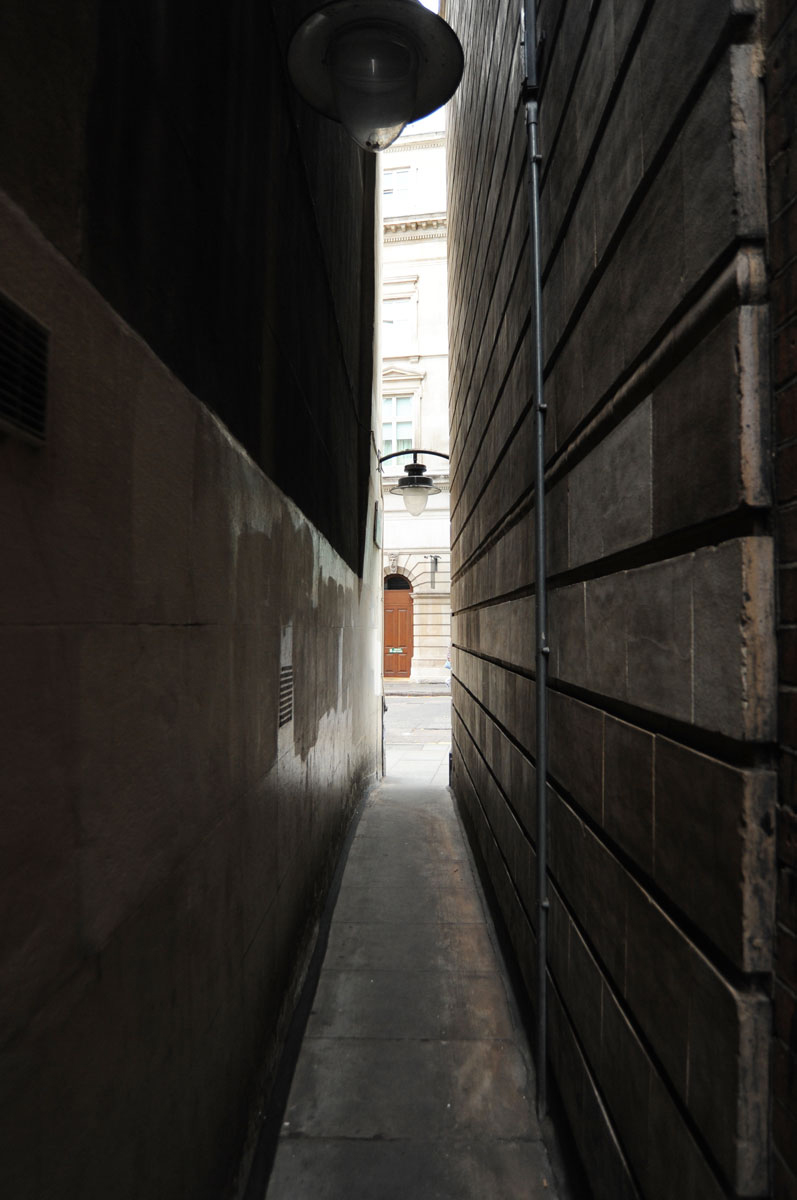 Brydges Place, looking towards St Martin’s Lane. © David Secombe 2015.
From A London Phantom by R. Thurston Hopkins:
I spent many evenings with Dowson in the Bun House. Though the name of this rendezvous has a doughy sound, it never at any time offered buns to its customers. It is just a London tavern, but it was part of the literary and newspaper life of the eighteen-nineties. It was there that I saw Lionel Johnson, the poet, John Evelyn Barlas, poet and anarchist who tried to ‘shoot up’ the House of Commons, Edgar Wallace, just out of a private soldier’s uniform, Arthur Machen in a caped ‘Inverness’ coat which he told me had been his regular friend for twenty years. …
After I had met Dowson a few times at the Bun House we would sometimes rove forlornly about the foggy London streets, initiated bohemians, tasting each other’s enthusiasms. … As we wandered about London at night we often played a sort of game which we called Blind Chivvy. The idea was to find short cuts or round-about-routes from one busy part of London to another by way of slinking alleys and byways which then were not well known to the average London man.
D.S.: We at The London Column like to think of ourselves as being in the vanguard of the Ernest Dowson Revival, but we can’t deny that our Ern remains something of a niche interest. My friend CJ – one half of the award-winning (really) wine blog, Sediment – is unconvinced by my claims for the poet who wrote the quintessential ‘decadent’ poem of the 1890s, Cynara. That said, CJ liked the sound of ‘Blind Chivvy’ and agreed to join me for an afternoon in a bid to play it. Admittedly, we were doing it on a bright July day rather than a murky November evening, and a few things have changed since Dowson’s time, but the promise of some light lunchtime drinking rendered CJ putty in my hands. We met at The Port House on the Strand, an Iberian sherry bar located in the building that was once The Bun House. In the candle-lit gloom, CJ and I munched tapas, drank white wine and attempted to visualise the interior peopled with the bohemian talent of decadent London. We failed. The ambience in the Port House is that of a bodega in Madrid, and there was no way we were going to conjure up the shades of Dowson, Johnson, Machen or anyone else. But it was a start.
 Ernest Dowson has left the building … The Port House, Strand. © David Secombe 2015.
Emerging from the Port House, I led a dubious CJ into a narrow entrance next door. Exchange Court is one of those ancient pathways off the Strand that bears witness to a lost London landscape. Halfway up this remnant of 17th century town planning there is a courtyard behind a new (early 1990s) bar called The Porterhouse. Before the construction of this establishment, it was possible to come here – a spot no-one had any reason to visit – and discover a genuine fragment of the ‘Great Wen’: a desolate cul-de-sac that Dickens would have recognised. When I visited in 1984, you could still see the original box office window of the Adelphi theatre, complete with Victorian London prices, bricked up in an alcove. Then they built the pub and the alcove disappeared. Now they store barrels here and the court seems almost cheerful.
We followed Exchange Court to the end and emerged in Maiden Lane, CJ looking around him like a lost Japanese tourist. ‘Where are we now?’ Doing my best Peter Ackroyd, I replied that Maiden Lane was one of the oldest thoroughfares in the West End – and, in the same mode, indicated a plaque above the Adelphi’s stage door commemorating the murder of William Terriss. ‘Who? What?’ On cue, the shutter of a loading bay was yanked open and for a moment we had a glimpse of the business end of a working theatre. The sight of the vast maw of an empty auditorium brought back memories of other West End venues, not to mention Proustian associations of childhood visits backstage. Me: ‘What’s playing here now?’ CJ: ‘Kinky Boots’. We moved on.
 Your correspondents reflected in the doorway of Rules. © David Secombe 2015.
We crossed the road to look in the window of Rules, ‘the oldest restaurant in London’ (est. 1788). To celebrate the august history of its dining rooms, Rules’s website features a poignantly misjudged piece of copywriting which is worth reproducing here:
As well as being frequented by great literary talents – including Charles Dickens, William Makepeace Thackeray, John Galsworthy and H G Wells – Rules has also appeared in novels by Rosamond Lehmann, Evelyn Waugh, Graham Greene, John Le Carré, Dick Francis, Penelope Lively and Claire Rayner.
Whilst studying the menu I asked CJ if a publisher had ever taken him to Rules and he looked at me beadily, suggesting that I might be confusing him with someone else; Ian McEwan, maybe. Or Marian Keyes, perhaps.
 Bull Inn Court. © David Secombe 2015.
Rules faces Bull Inn Court, another alley where Dowson might have gone to find company (‘absinthe makes the tart grow fonder’ is his line); in July 2015 it is a spot where office workers go to juggle cigarettes and smart phones. But a couple of doors further along, the tone is abruptly elevated by the ecclesiastical majesty of Corpus Christi. Mirroring the promise of the Adelphi, its doors were invitingly open, affording views of ‘the grey twilight of gothic things’ (or the 1870s repro version) in WC2. Dowson converted to Catholicism in the last years of his short life, so it’s at least possible that he took communion in Corpus Christi. In any case, we yielded to the lure of its gilded interior and behaved like a pair of sightseers, taking photographs and lighting candles (25 pence a go).
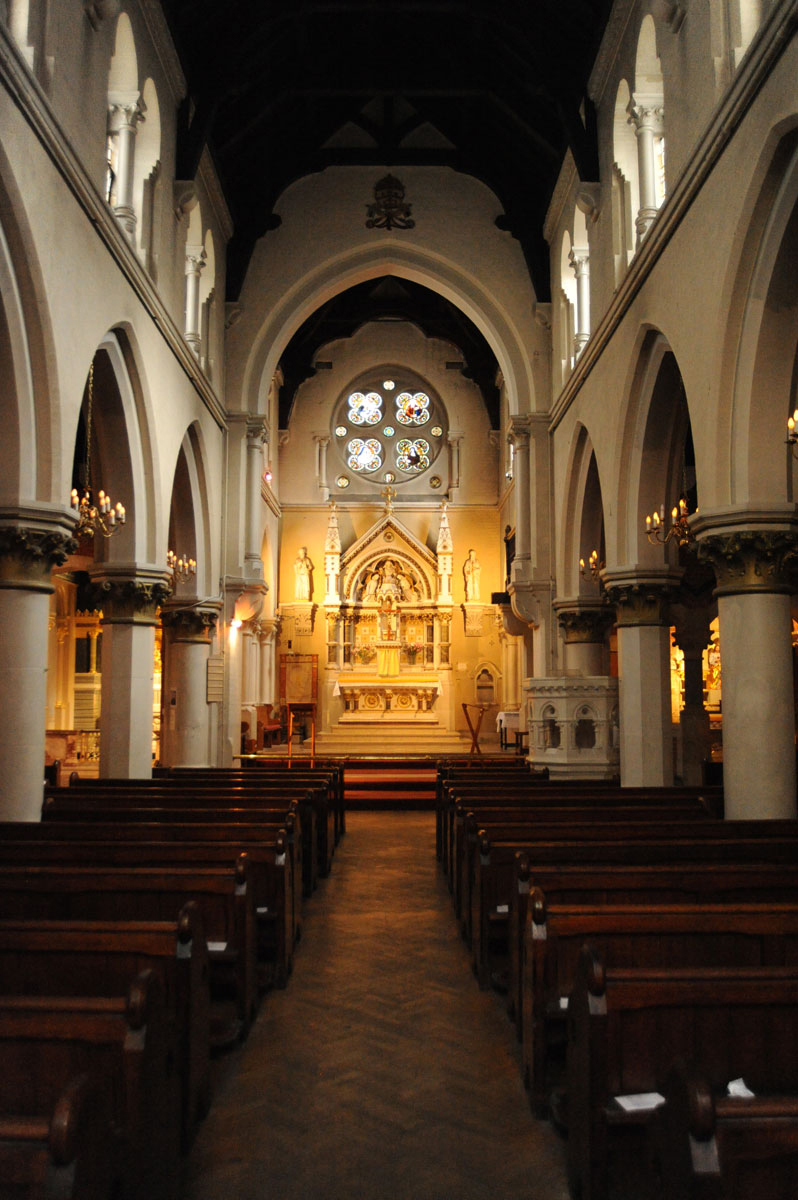 Corpus Christi. © David Secombe 2015.
We backtracked west along Maiden Lane, down Chandos Place and thence into Brydges Place. We have featured Brydges Place on The London Column before, so I won’t dilate on this atmospheric passageway here – except to note that there were more homeless pitches since my last visit and the stink of piss was overwhelming. Brydges Place debouches into St Martin’s Lane next to E.N.O., where we emerged to see a Mariachi band posing on the steps of the Coliseum. Mexican dance music seemed like a bit of a departure for English National Opera, but the band looked fun and an obliging gaucho performed some impressive lasso moves for the cameras. Diverting as it was, this wasn’t the woozy, drink-soaked metropolis we were looking for, so we repaired to The Salisbury to re-group. The Salisbury was once a well-known gay pub, extensively referenced in the Dirk Bogarde film Victim, and where the serial killer Dennis Nilsen cruised in the 1970s and 80s – but any flickers of the city of dreadful night were banished by the holiday crowd ramming the bar. The Salisbury’s ghosts were as lost to us as those at The Bun House. We sat behind an etched glass window, drank London Pride and swapped stories of career disappointment. The phantom of Thurston Hopkins’s essay, who they fear is haunting them on their nocturnal rambles through London, is a man Dowson described as having ‘a face like a wizened bladder of lard’ – but in the noisy saloon of the Salisbury, CJ and I were merely haunting each other.
 Mariachi at English National Opera. © David Secombe 2015.
Opposite The Salisbury is an entrance to another 17th century survival, a passageway called Goodwins Court. Needless to say, Goodwins Court was a surprise to CJ, who remarked upon the beautiful bowed shop-fronts (18th century, I am told, although they are no longer shops, and it is hard to tell exactly what they front now). When I was a boy my parents took me to a show-business party in the house at the end, the one that abuts Bedfordbury. The host was the late Tony Sympson, an actor whose family were instrumental in preserving Goodwin’s Court against destruction. I remember a jewel-box of a house composed of implausibly large rooms, their Regency elegance constituting an act of defiance: as late as 1978, the threat of wholesale demolition still loomed over Covent Garden. The house is still someone’s home; perhaps the most desirable place to live in all the West End. Next door is Giovanni’s, a discreet Italian restaurant popular with old-school actors and producers. I have purple memories of this place too: a lunch with an actor friend which deteriorated into an afternoon lurid enough for me to give up drinking for months afterwards. After mistily reminiscing on all of the above, CJ pointed out, not unreasonably, that those anecdotes are specific to me, and that the state of my liver was of little interest to him.
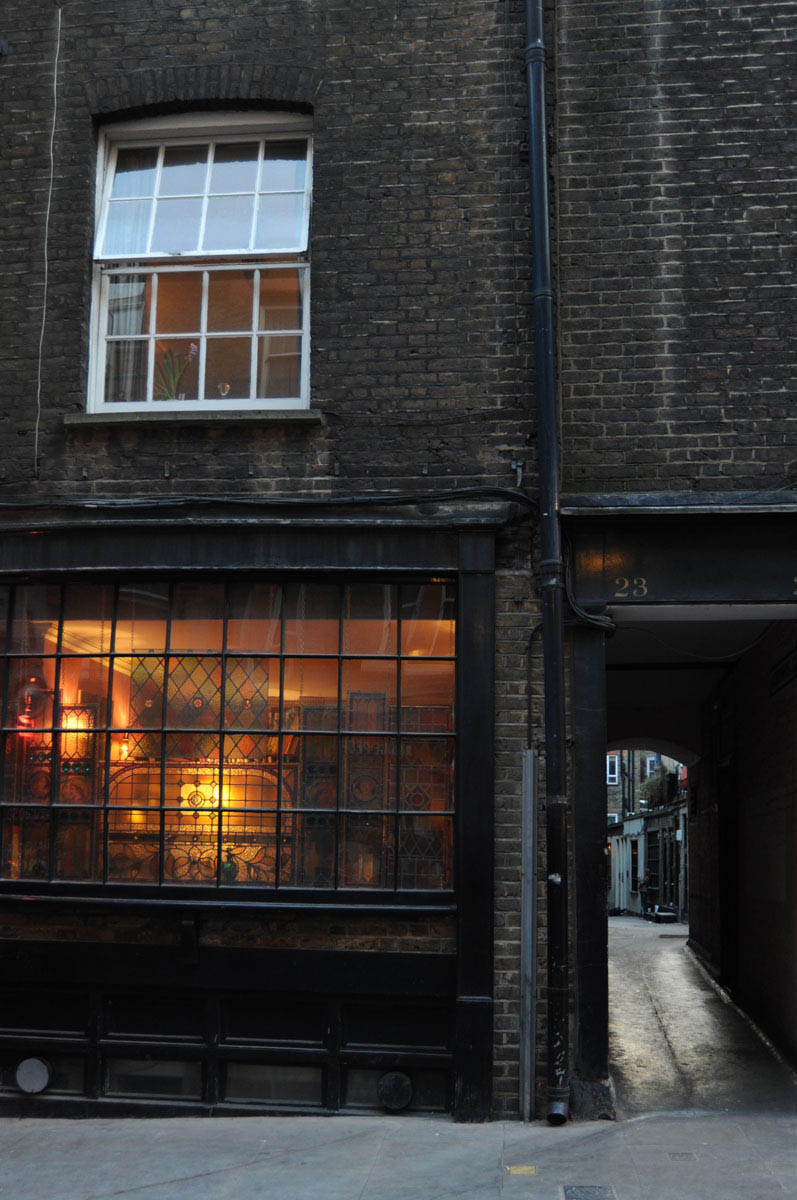 Bedfordbury, looking into Goodwin’s Court. © David Secombe 2015.
Taking the hint, and with time against us – CJ’s dinner beginning to call, in far distant Mortlake – the rest of our dèrive went at something of a galop. By this stage, I had a destination in mind, a spot with more recent associations than the 1890s. We walked swiftly up Garrick Street, crossed Long Acre towards Seven Dials, cut up West Street (past The Ivy and those strangely conjoined twins of tourist theatre-land, The Mousetrap and Stomp), crossed Shaftesbury Avenue, continued north on Stacey Street – alongside the vast bulk of the Covent Garden Odeon and beyond the fragile greensward of Phoenix Garden – and finally arrived in crumbling, doomed Denmark Street.
In the 1950s Denmark Street (‘London’s own Tin Pan Alley!’) was London’s music business quarter, an Expresso Bongo world of post-Suez Britain. Then, the street was the domain of the impresario Larry Parnes, (much-mocked svengali of improbably-named singers like Vince Eager, Dickie Pride, Johnny Gentle, and some others who actually made it), songwriter Lionel Bart (‘King of Denmark Street’), the jingle writer Johnny Johnston (Softness is a thing called Comfort, Beanz Meanz Heinz, and 5000 others), and all the other personalities of the pre-Beatles universe. In the 1960s The Stones, The Who, The Kinks, Donovan, Bowie, Hendrix all came here to record, in studios carved out of 17th-century basements. Ten years later it was the turn of the phlegm-flecked protégés of Malcolm McLaren (the ’70s version of Larry Parnes) The Sex Pistols, who rehearsed and lived here for a while. And, whilst he is unlikely to get a blue plaque, Dennis Nilsen – abovementioned, hanging around the Salisbury – spent the early ’80s working in a jobcentre that used to be on the corner with the Charing Cross Road. This jobcentre’s speciality was the catering industry, and for one Christmas staff party Nilsen made his colleagues punch in a large cooking pot he brought from his home, the same pan he used for boiling his victims’ heads.
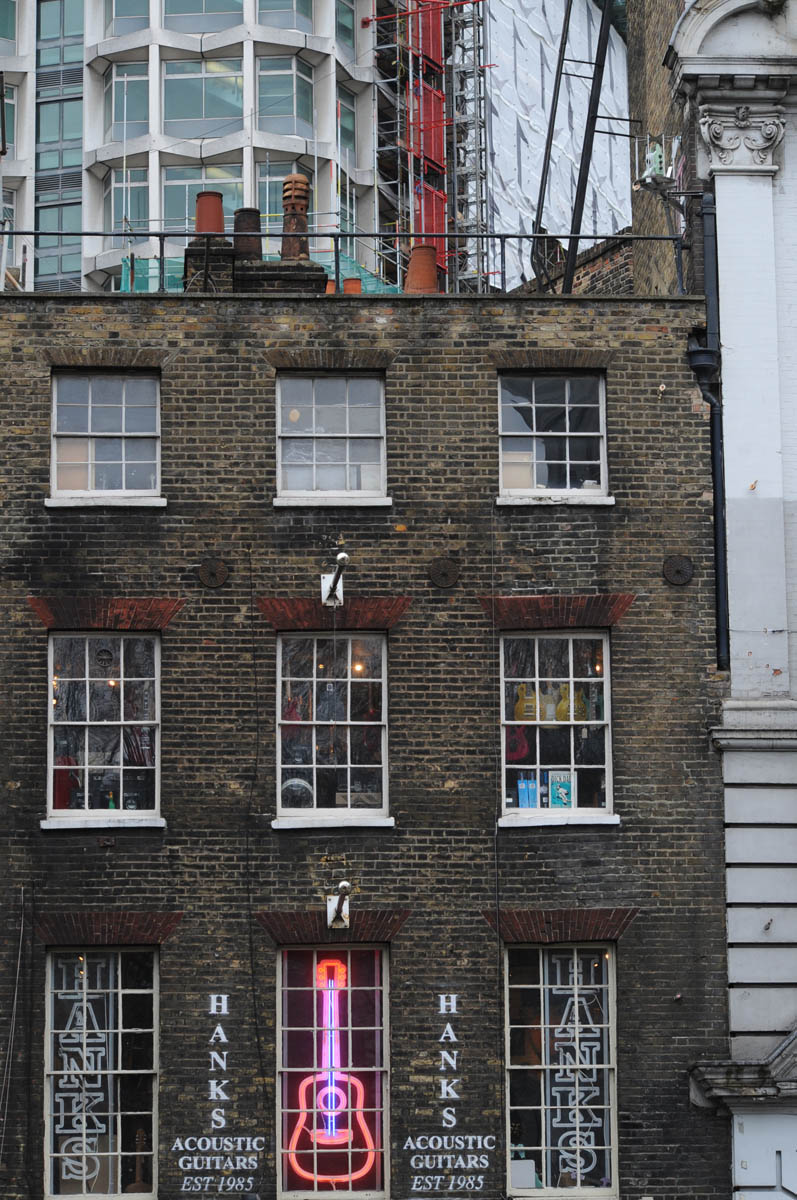 Hanks, Denmark St.; Centre Point behind. © David Secombe 2015.
There are still music shops to be found on Denmark Street, but the redevelopment of St Giles has been the cause of much anguish amongst London’s music lovers, as first the Astoria and then the 12 Bar Club have been laid waste in favour of Crossrail and a looming corporate/retail zone. Around 1900, the year Dowson died, the great loss London suffered was the destruction of Wych St. and environs to create ‘new’ Aldwych and Kingsway (the subject of one of our previous walks). That particular act of civic philistinism didn’t just obliterate some of the prettiest streets in the capital, it cauterized life on the streets – which is exactly what it was intended to do, removing ‘unwholesome’ theatres and booksellers and erasing one of London’s cultural centres. The destruction of the area around Denmark Street is the 21st Century equivalent. How do we characterise it? London dans le style Boris, perhaps, London après Cameron, London sans coeur, etc. Chalked graffiti on the hoarding in front of the remains of the 12 Bar was eloquence itself …
 Hoarding where the 12 Bar Club used to be. © David Secombe 2015.
By now CJ and I were starting to feel generally chivvied out. The day-glo office blocks opposite St.Giles in the Fields measured the gulf between the city of our imaginings and the one we are actually stuck with. Calling it a day, Charles headed for Waterloo and his train to Mortlake, and I boarded a quasi-Routemaster 38 to Hackney. Sitting on the top deck, in an interior as retro as the Orla Kiely catalogue, I considered the dilemma: if Soho is dead, if the West End is dead, if Chelsea is dead, if Shoreditch is dead (no cheering please), what is left? A Bright New World safe for out-of-town consumers to play in – but not somewhere you would want to live, even if you could afford to. Hence London becomes the new Dubai, and Margate the new Peckham. Good for Margate, perhaps, but London as a place of invention and creativity becomes no more than a historical footnote. Don’t look for culture here, mate, only ad agencies can afford the rent. Live music? Try the relocated 12 Bar Club – it’s on the Holloway Road (if you can find it). No call for it round here, pal. The revolution will not be televised – but you can download it as a podcast.
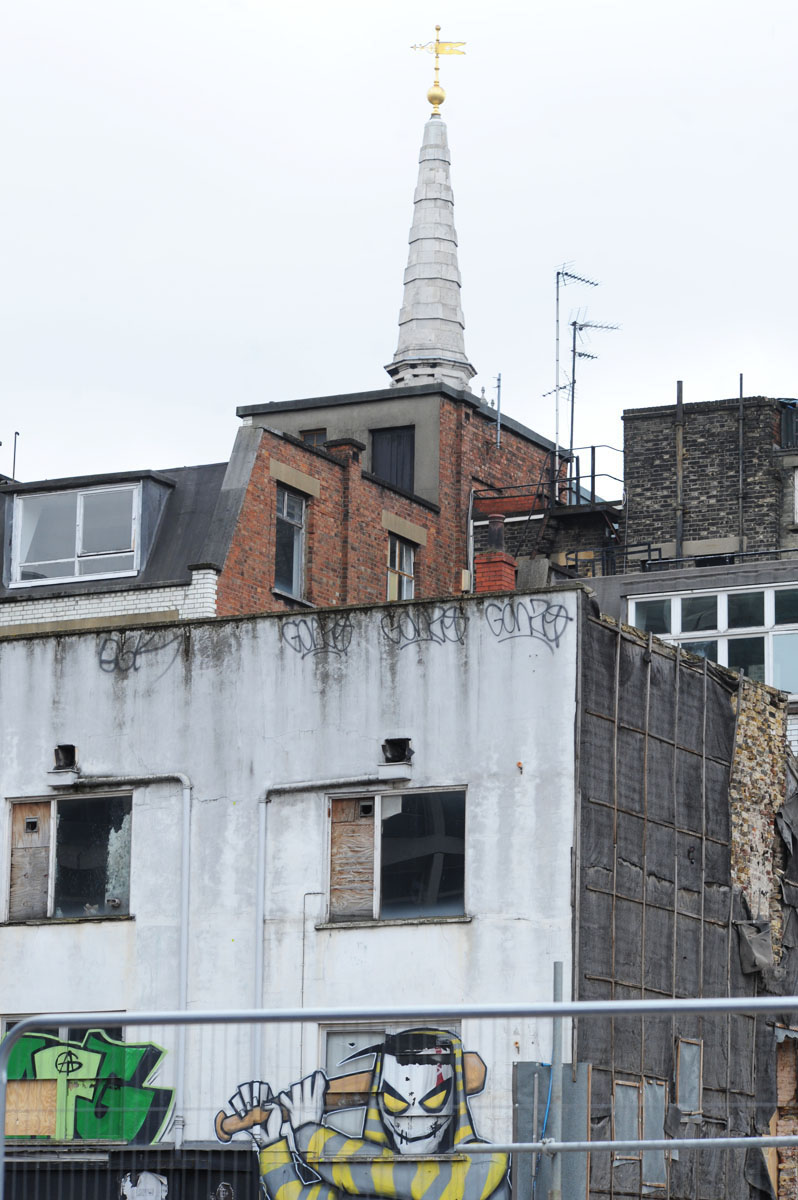 Denmark Place. © David Secombe 2015.
(I have just noticed that this post is the 250th on The London Column. I was going to apologise for the fogeyish tone, but then thought ‘why should I?’)
See also: In Search of Old Wych, The Riverine Strand.
The March.
Posted: June 24, 2015 Filed under: Events | Tags: anti-austerity march, austerity, People's Assembly, people's right to protest, The Strand Comments Off on The March.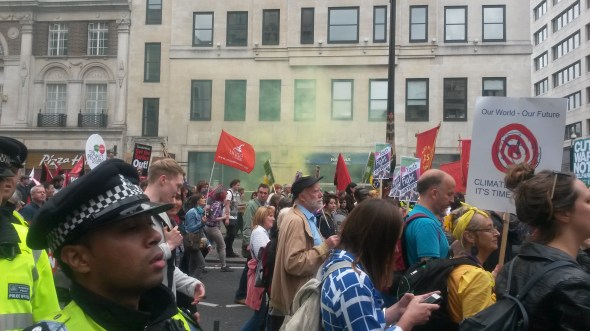
Katy Evans-Bush:
So, a few of us went for a walk the other day. The London Column was there, though we have not exactly been infused with alacrity in putting our pictures up. But we were a bit tired, the day after the march. It had all been rather emotional.
If this seems overblown, consider why we were marching, and who the marchers were. They were our fellow countrymen, women, and children. Many of them were elderly, walking with sticks, and many, many were in wheelchairs. They were marching for their lives, for our lives, for our NHS and schools, for our libraries and jobs.

In the time-honoured tradition, England became – if just for the day – a populace. The crowd filled both sides of the Strand, a street the London Column has always had a soft spot for, and took almost two hours to walk past, singing and blowing horns and chanting and laughing and dealing with their kids. That’s five miles of people.
And what people. They poured in from all over the country. They carried People’s Assembly signs, and banners from everywhere you can think of: Rotherham, Newcastle, Devon, Surrey, the Midlands; from the Trades Council of the Cities of London and Westminster. They came from Wales. The Rhyl Youth Group was there. They were Feminists Against Austerity. Deaf People Against the Cuts. Economists Against Austerity. Musicians, mothers, teachers, retired university professors, the Indian Workers’ Association. The Fire Brigades Union drove a fire engine blaring out eighties hits, and people were literally dancing in the street in front of it as it went past. No one who remembers the men weeping as they were forced out of Clerkenwell Fire Station for the last time could fail to find this joyfulness particularly moving.


in fact, the people, this populace, showed the qualities England is so noted for – all except perhaps shopkeeping, although in truth London was full of tourists and other consumers who were just out shopping; we don’t know what their problem is, but we support their right to it. The real business of the country that day was right here.


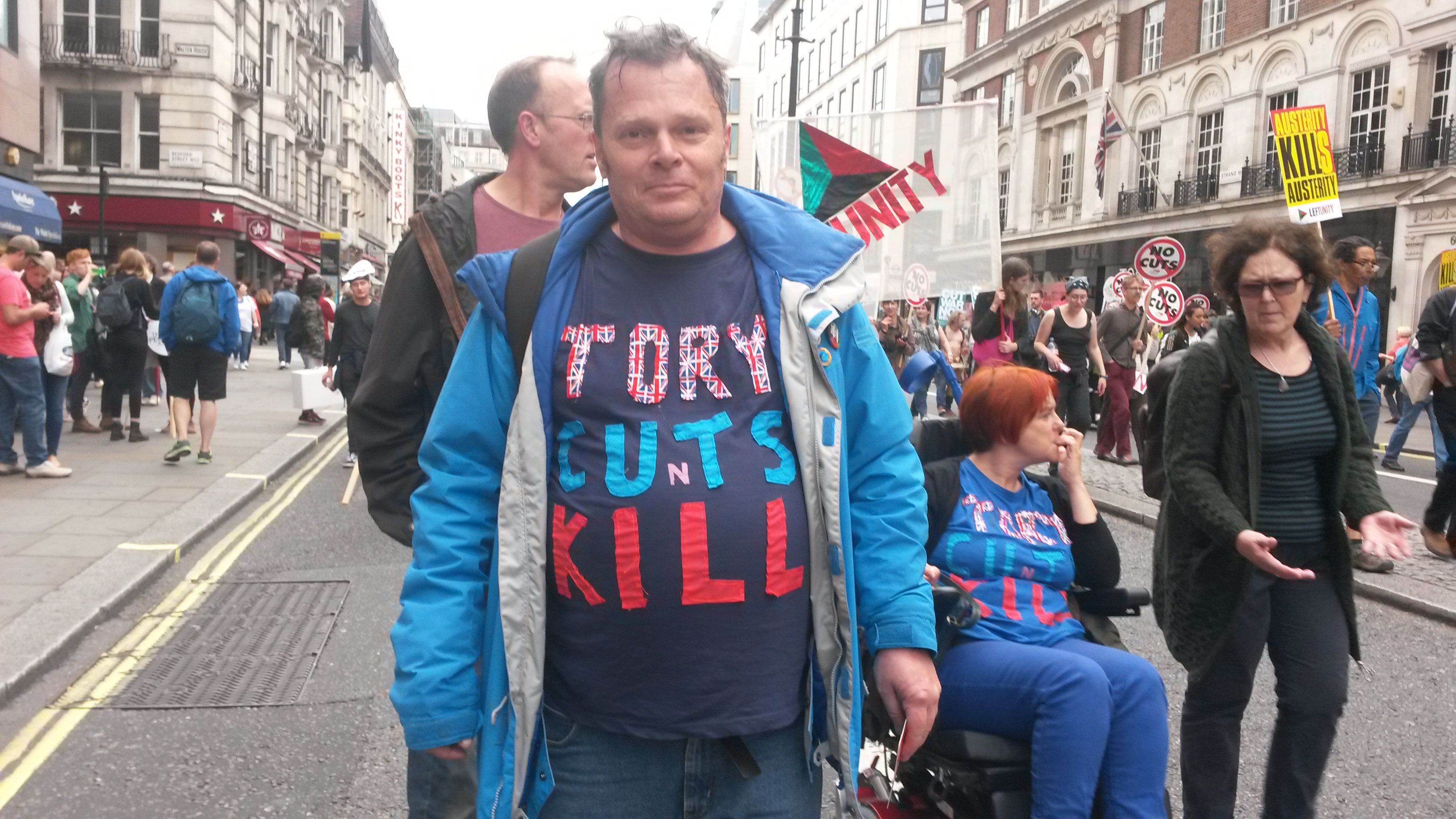


This populace was noisy, cheerful, vulgar. They were ribald and profane, they were angry, they were proud, they were together in solidarity. They were in solidarity with the political prisoners in Egypt, and with Greece (‘Give Greece a chance’). They showed scant respect for those who do not respect them (‘Cameron is a cock’). They were peaceful. They were well-informed, good-humoured, witty. And they were funny: slogans referenced Monty Python, Father Ted, Marx (“I warned you this would happen’). They were exuberant. Some had dressed up, some had dressed down, some had cross-dressed. They were beaten but not bowed, and definitely not defeated. And they knew the government wasn’t going to listen to them, and they came together and engaged in their democratic right to assemble in protest anyway.
The London Column fell in love with them all, every one.
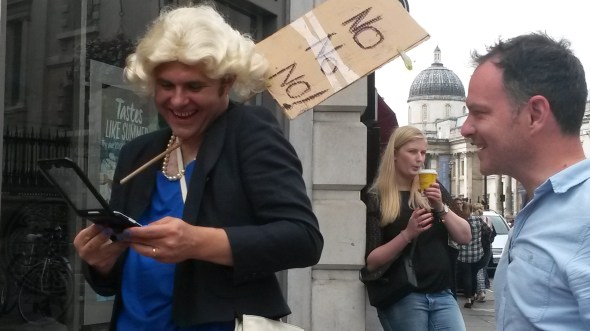
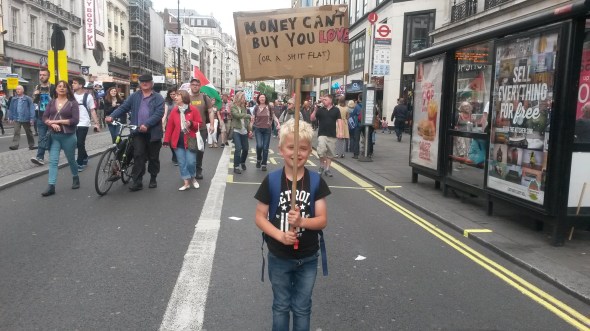
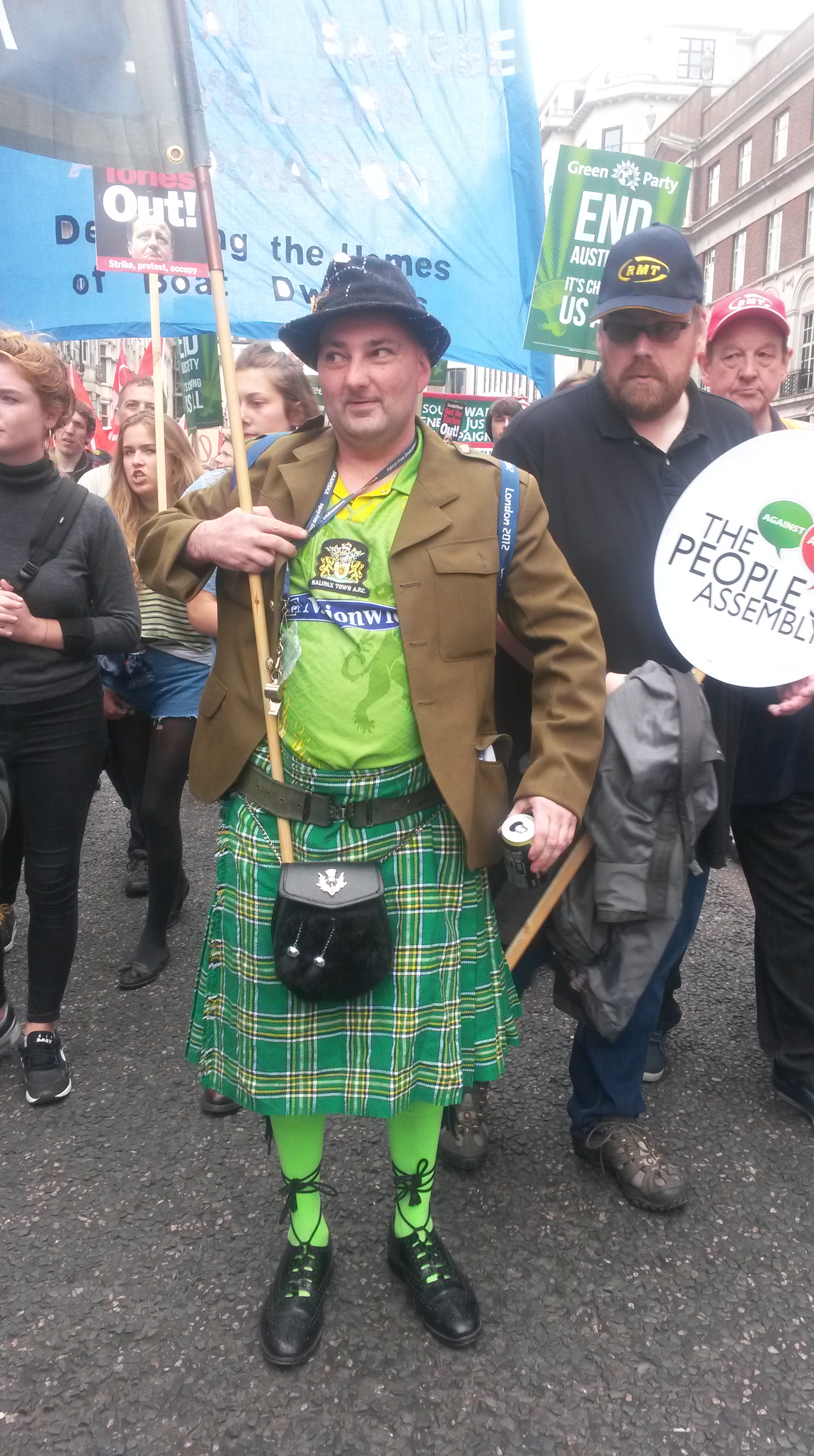 All photos © Katy Evans-Bush, 2015
New River Network.
Posted: May 1, 2015 Filed under: Architectural, Interiors, London Places, Performers, The Thames and its Tributaries | Tags: Alan Cox, Caroline Lennon, Christopher Brand, Dallas Campbell, Eliot Levey, Jack Tarlton, Liam McKenna, Network, Peter Finch, Riverhead, Russell Layton, Sir John Greene's Oak Room Comments Off on New River Network. Boardroom. Photo © Katherine Grice 2015.
Katy Evans-Bush:
Remember that old 70s movie, Network? It’s mainly famous for its catchphrase – ‘I’m as mad as hell and I’m not going to take it any more!’ – and for Peter Finch’s bravura performance (which earned him a posthumous Oscar) as Howard Beale, the newscaster who has a meltdown on television and gets the whole country saying it. On Saturday night I went to a private reading of a stage adaptation of the film, scripted by my friend Chris Brand (a fine actor as well as a writer) and produced by another friend, Peter Finch’s nephew Dallas Campbell. There are several reasons why it was a brilliant evening, and the first of them – before the evening even began – was the surprise of the surroundings.
We were in the old Water Board building in Rosebery Avenue in Clerkenwell. This sounds boring enough, and indeed we had only been told it was going to be in a ‘board room’. But this is grand municipal architecture, and this particular example harbours a secret at its heart.
The Water Board building was built on the site of a previous water company building – the old New River Company building, Water House. The New River is the river you can see a bit of, running through Clissold Park in Stoke Newington; it’s technically more of a canal; built by one Hugh Myddleton to bring water from Hertfordshire to a rapidly growing London. It was completed in 1613. Water House, built in the same year, was originally a ‘cestern house’ adjoining the reservoir, and included accommodation for the site manager.Many people had use of its residential accommodation (including Edward Sadler, who was also probably the founder of next-door Sadler’s Wells). This building grew over the decades to reflect the massive success of the New River company (King James, a key funder, lost money on it, and Hugh Myddelton was created a baronet). It grew larger and larger, and more and more respectable until finally it was a large house. In about 1693, one Sir John Grene, a wealthy shareholder of the New River Company, was living in Water house, and he commissioned an ornately carved set of pannelling for a room that became known as the Oak Room… You can read a long and intensely interesting account on British History Online.
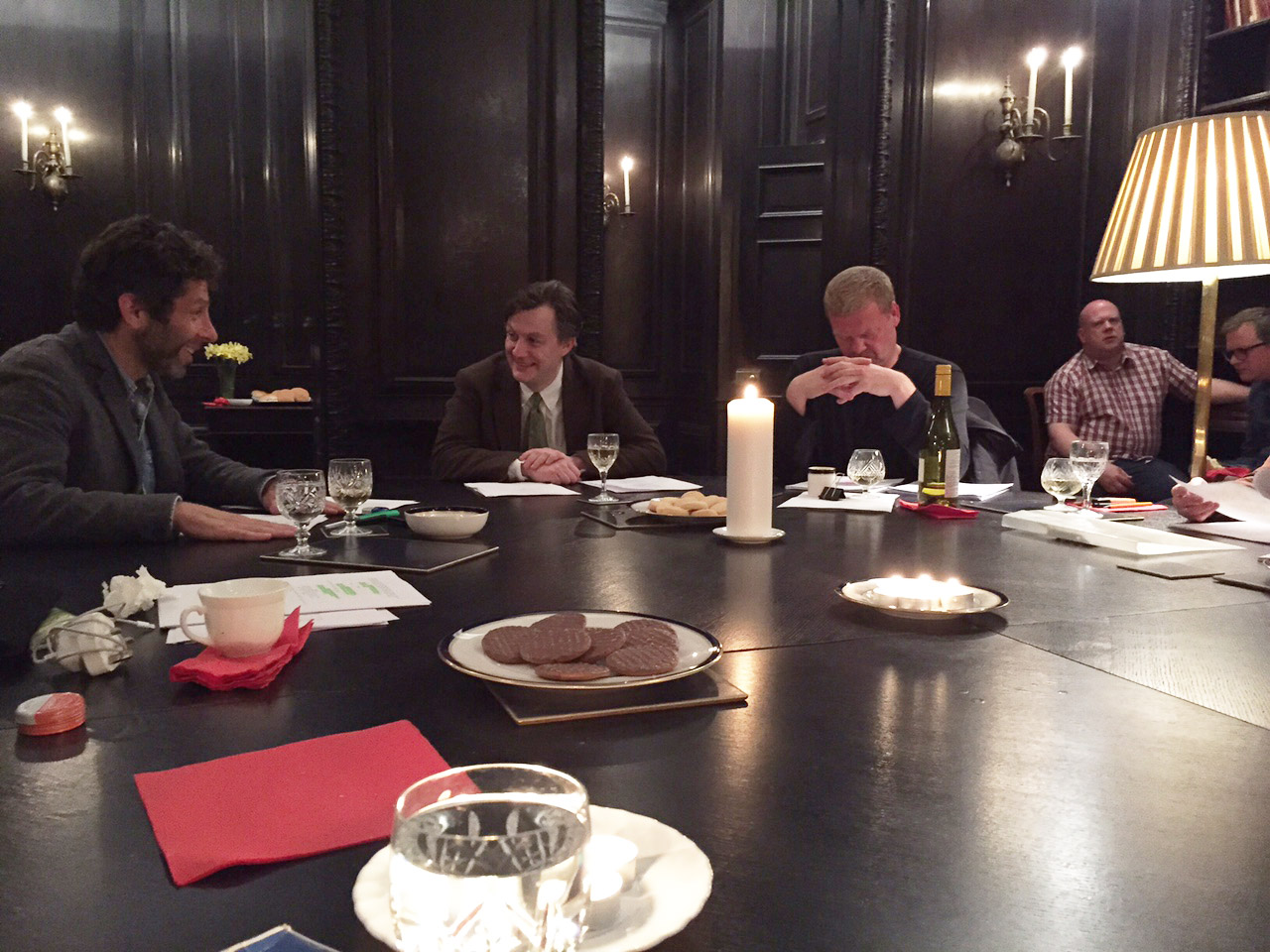 Network cast, L-R: Eliot Levey, Alan Cox, Liam McKenna. Photo © Katherine Grice 2015.
In 1914, London’s water was municipalised and Water House had to go. Work on the new Water Board building began in 1915 – stopping between 1916 and 1919 due to the War – and the building, on a scale commensurate with the ambition of its civic status, was finished in 1920. For the past twenty years it’s been flats. When you walk in through its large stone-clad entrance, it feels plausibly Edwardian – but then the first thing you are confronted with is a grand, glorious, light-filled, pink-painted Art Deco ballroom. (This, however, is the former Rental Ledger Room, and used to host ranks of large oak desks.) The building is awash with light.
Turn left and through large glass doors to a wide, high, sweeping staircase with huge windows. At the top, back through the doors, turn down a little corridor, open another door, and you are suddenly in a rather unexpected time-warp: an oak-carved antechamber, which is the mirror of another oak antechamber, at the two ends of a dark, oak-panelled room. A marble fireplace looms in the middle of the long wall, with bookshelves in the alcoves on the sides, and intricate carvings above. Pride of place belongs to a magnificent lion and unicorn panel, where the unicorn’s horn stands free of the carving.
This is Sir John Grene’s Oak Room – given new ceiling joists in the 1860s, and then carefully dismantled and reassembled in the new Water Board building – a nod to the history of the site. The room was dismantled again in the War and the panelling taken away for safe-keeping, but the ceiling could not be moved again and the central painting had to be restored again after the War. The room is very dark – it makes more sense when you know that in its day it had glorious windows on three sides, giving panoramic views over the Round Pond that was the New River reservoir, and its filter beds. It was even open to the public.
 L-R: Liam McKenna, Fliss Walton, Jack Tarlton. Photo © Katherine Grice 2015.
Accommodations had to be made when it was transplanted into the new building; in one corner we found a door which, opened, revealed only brick. It was on the outside wall of the building. It’s been not-a-door for almost a century, but for two and a half centuries before that, it was a door and people walked through it. And the doorways into the antechambers – two on each end of the room, with a central panel – will have been its other windows.
You could write a whole blog post just about the notion of civic pride and historical awareness, the respect for the past and sense of beauty and historical decency that made a company spend £2,000, back when that was proper money, to keep this in situ. Nowadays, they would more likely put it on display in an airlocked vault under perspex.
In the middle of the room is a giant black oval table. When we were there it was littered with scripts, plates of chocolate biscuits, and numerous large white candles. The room has electric light, too, of course, but the three-dimensional black walls seem to just absorb it. Those three walls of windows have been a bit of a loss, in fact.
So there we were. Friends on chairs around the walls of the room, with glasses of wine or gin & tonics. Around the table sat the actors. And the reading, in due course, began…
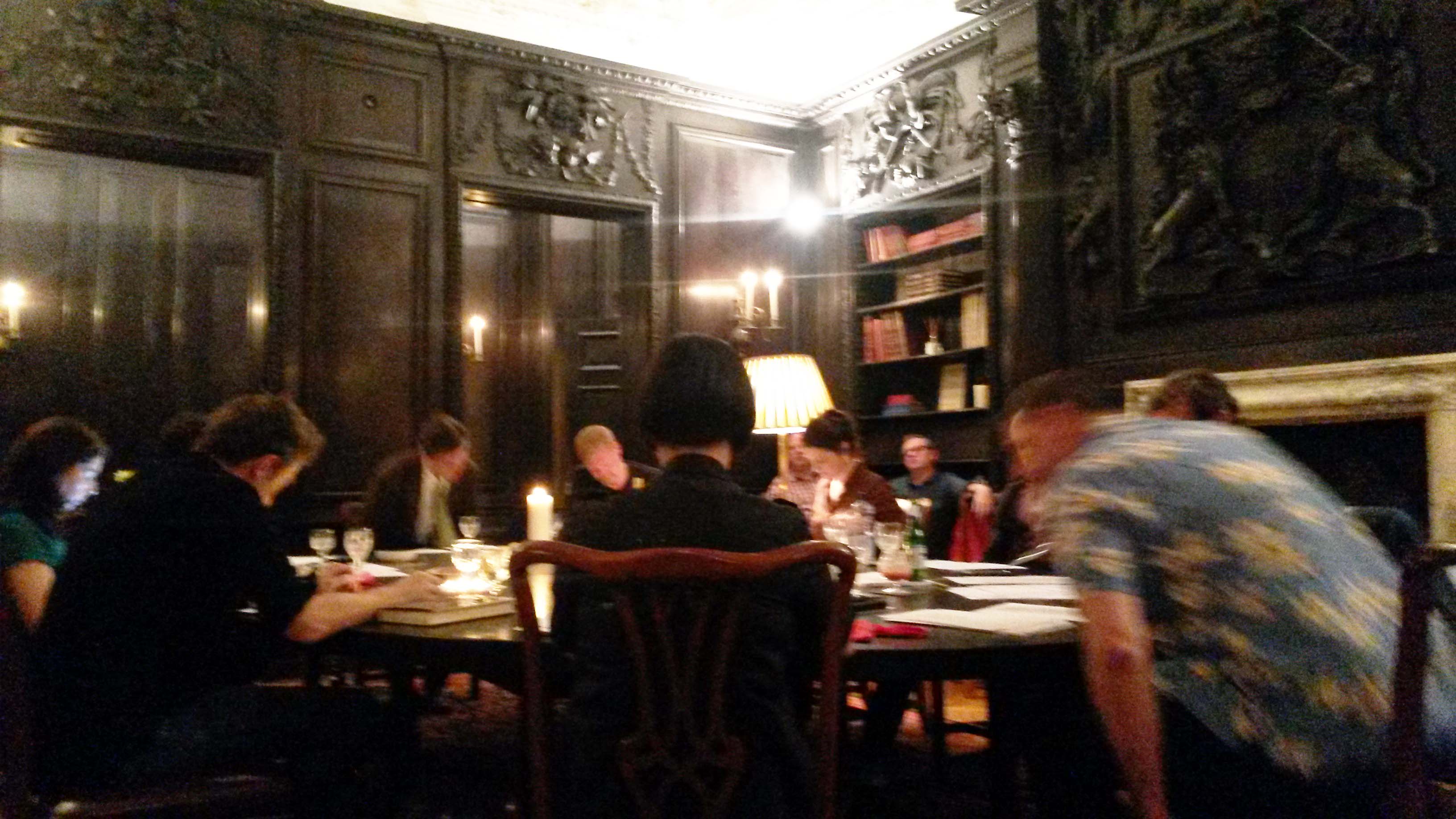 Rest of the Network cast: Caroline Lennon, Dallas Campbell, Saffron Sprackling, Christopher Brand, Russell Layton. Photo © Katy Evans Bush.
(See more here … )
Estates of Mind.
Posted: April 20, 2015 Filed under: Architectural, Class, Hospitals, The Thames, Vanishings | Tags: Isle of Dogs, Michael Mulcahy, Mike Seaborne, Samuda Estate, St John's Estate, Tarling Estate, Transition Group 3 Comments Tarling Estate, 2002. © Mike Seaborne.
Tarling Estate, Shadwell:
Located immediately to the east of Watney Street Market, Shadwell, the Tarling Estate was built c. 1950 to replace overcrowded slums and reduce the population density by half.
The run-down estate was demolished in 2003 and replaced by a higher density mixed-use development intended to both regenerate the area and create what the developer, Toynbee Housing Association, described as ‘a more mixed and balanced community’.
 Tarling Estate 2015. © Mike Seaborne.
Samuda Estate, Isle of Dogs:
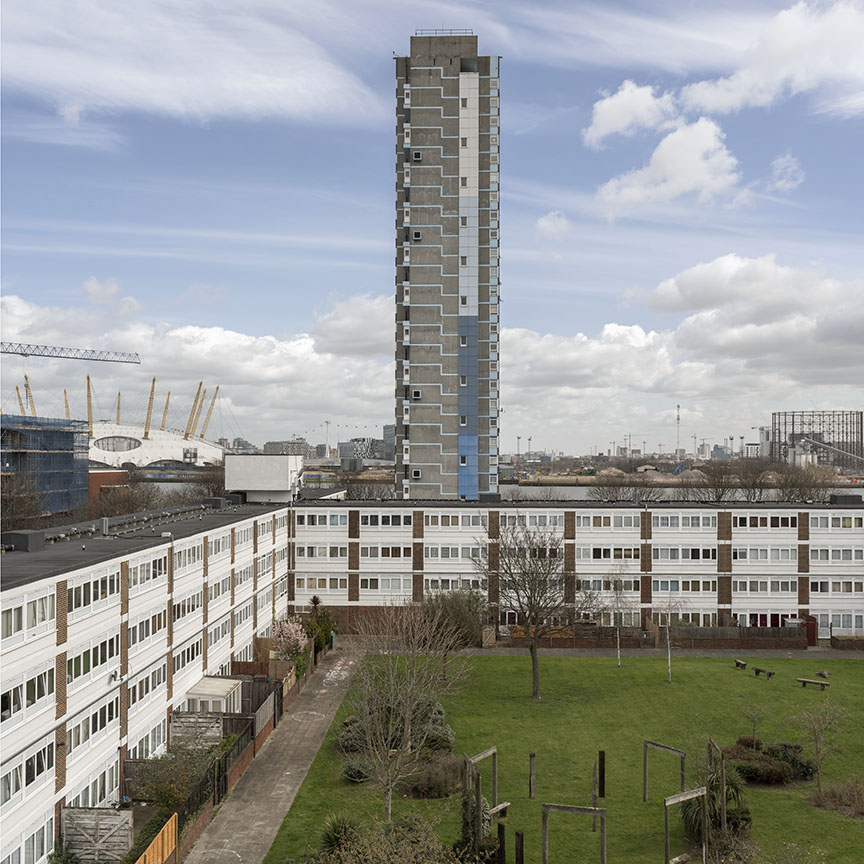 Samuda Estate 2015. © Mike Seaborne.
The Samuda Estate, completed by the Greater London Council in 1967, is mainly comprised of four and six story blocks arranged around a traffic-free square. There is also a 25-storey tower block of maisonettes – Kelson House – situated on a prime site by the river. The estate is in need of refurbishment and some residents believe that the estate’s owner, One Housing Group, are deliberately running it down so it can be demolished to make way for private housing.
St John’s Estate, Isle of Dogs:
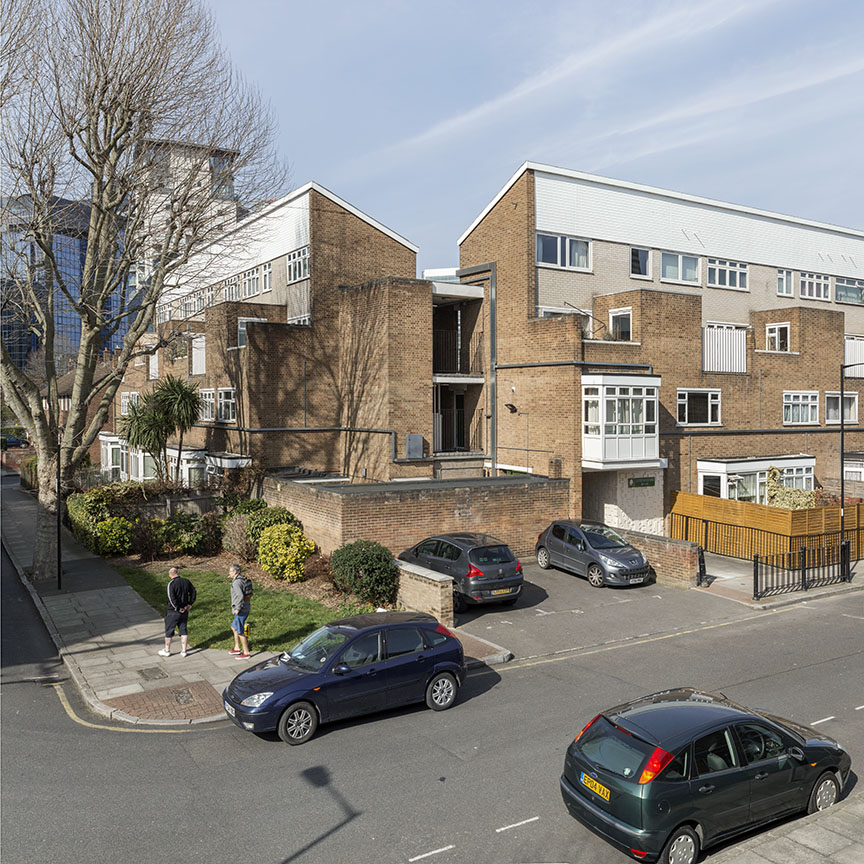 St John’s Estate 2015. © Mike Seaborne.
Planned in 1952 by Poplar Borough Council and described by John Betjeman as ‘one of the best post-war housing estates I have seen’, St John’s Estate was intended as a new self-contained neighbourhood along the lines of the award-winning Lansbury Estate in Poplar. In this it has largely succeeded but One Housing Group, owner of this and three other estates on the island, are considering the possibility of demolition and replacement by new high-density housing which might include several tower blocks of 50+ storeys.
Kingsbridge Estate, Isle of Dogs:
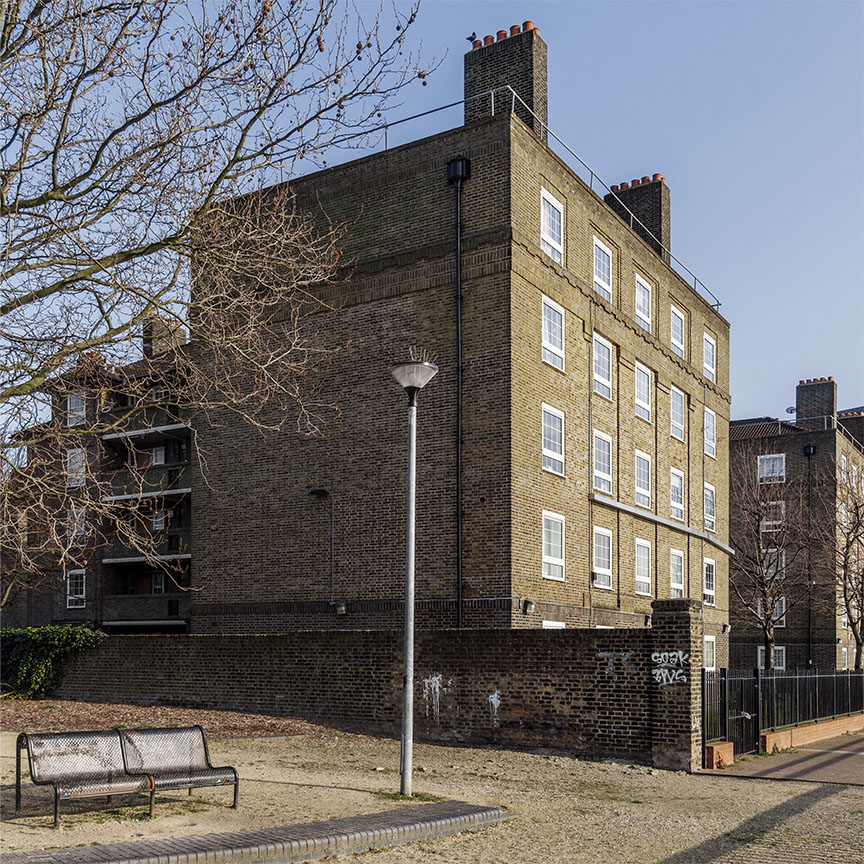 Kingsbridge Estate, 2015. © Mike Seaborne.
Originally known as the Millwall Estate, Kingsbridge was built by the London County Council in 1936-7, with an additional block being added in 1958-60. Despite their age, the blocks are structurally sound and are liked by many of the residents. However, their riverside location means that the value of the land they occupy is very high. The estate’s owner, One Housing Group, is currently consulting on ideas for the future, which may involve replacing the blocks with new housing for private sale.
Photos and text by Mike Seaborne, taken from Estates of Mind, photographs documenting 20th Century social housing by the Transition Group. Twitter feed: @TransitionLDN #TransitionProject. The pictures below are by Michael Mulcahy. Thanks to Mike and Michael.
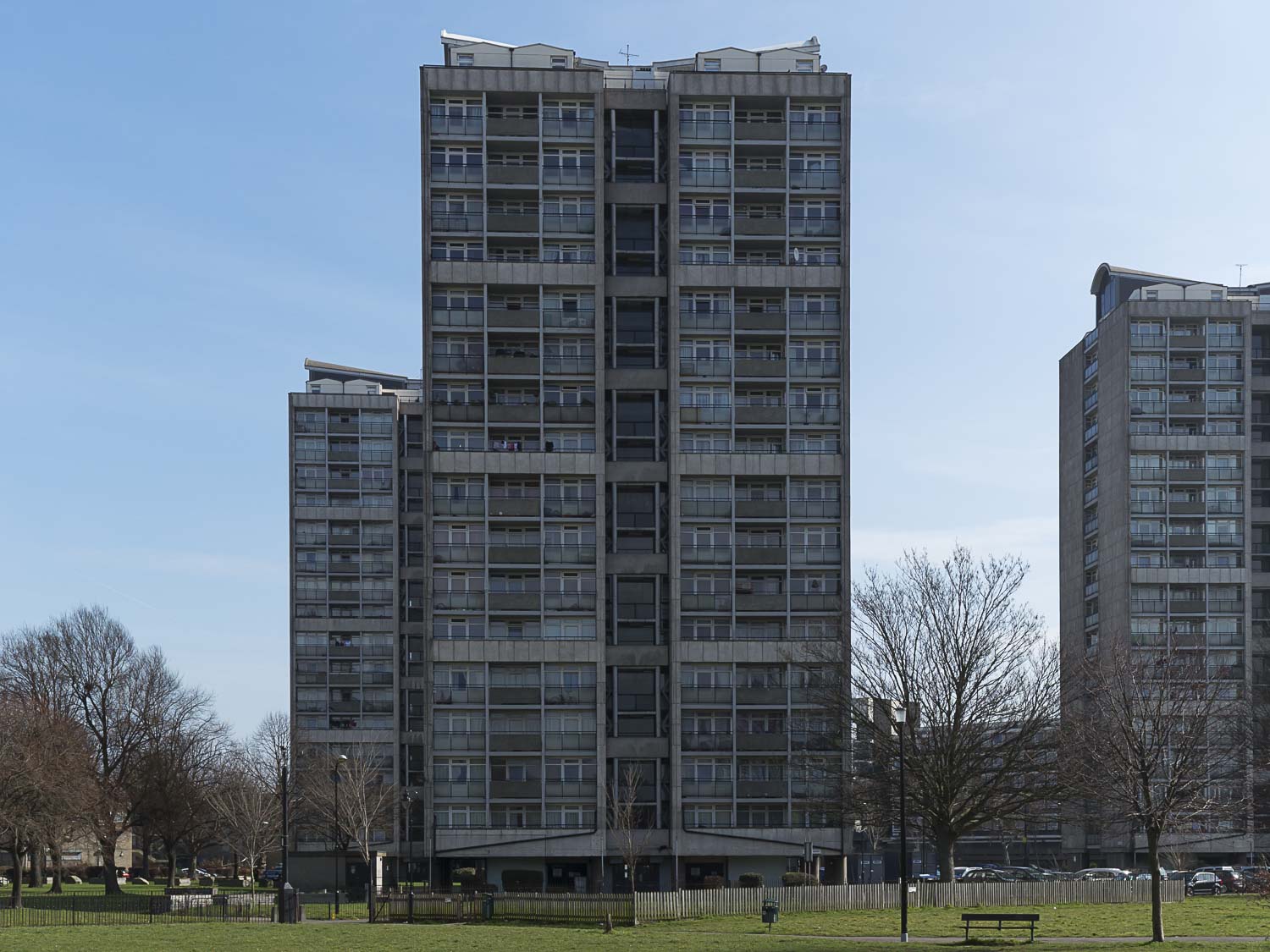 Brandon Estate, Kennington. © Michael Mulcahy.
 Lansbury Estate, Poplar. © Michael Mulcahy.
 Lansbury Estate, Isle of Dogs behind. © Michael Mulcahy.
See also: Balfron Remembered, Balfronism, Robin Hood Gardens, Two Men And A Dog, Pepys Estate.


 The London Column