Before the Blue Wall. Photo: Homer Sykes, text: Henry Newbolt (1862-1938) (2/4)
Posted: July 11, 2012 Filed under: Sport | Tags: Henry Newbolt, Lea Valley, Olympic Park, Play Up and Play the Game 2 Comments
Hackney Marsh sports field. © Homer Sykes 2006.
Vitai Lampada
(“They Pass On The Torch of Life”: 1892)
There’s a breathless hush in the Close to-night
Ten to make and the match to win
A bumping pitch and a blinding light,
An hour to play and the last man in.
And it’s not for the sake of a ribboned coat,
Or the selfish hope of a season’s fame,
But his Captain’s hand on his shoulder smote
‘Play up! play up! and play the game!’
The sand of the desert is sodden red,
Red with the wreck of a square that broke;
The Gatling’s jammed and the Colonel dead,
And the regiment blind with dust and smoke.
The river of death has brimmed his banks,
And England’s far, and Honour a name,
But the voice of a schoolboy rallies the ranks:
‘Play up! play up! and play the game!’
This is the word that year by year,
While in her place the School is set,
Every one of her sons must hear,
And none that hears it dare forget.
This they all with a joyful mind
Bear through life like a torch in flame,
And falling fling to the host behind
‘Play up! play up! and play the game!’
David Secombe:
Henry Newbolt was a popular poet of the late Victorian and Edwardian era, and this once popular poem, with its image of sacrificial glory transferring seamlessly from the cloisters of Clifton College to the Sudan desert, was much reviled after the first World War. In his later years, Newbolt himself became embarrassed by it, but there is no question that in his prime he was the figurehead of nationalistic poetry in England. Its inclusion here was suggested by a poet friend, and she might have invoked it as a bilious response to the current move to incorporate ‘poetry installations’ into the Olympic theme park. Or maybe she was just in an elegiac mood.
Before the Blue Wall. Photos: Homer Sykes, text: David Secombe. (1/4)
Posted: July 10, 2012 Filed under: Vanishings | Tags: 2012 Olympics, Before the Blue Wall, Homer Sykes 1 Comment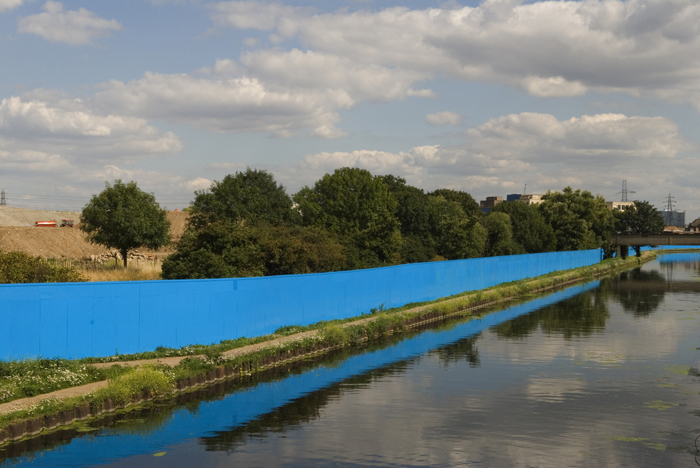
2012 Olympic site perimeter fence, Lea Valley. © Homer Sykes 2007.
David Secombe:
This week we are featuring a few of Homer Sykes’s images of the Lea Valley immediately prior to its transformation into the 2012 Olympic ‘zone’.
In 2006, searching to record for posterity a neglected moment in time, Homer made it his personal mission to explore the future site of the Olympic Park – soon to be encircled by a barrage of hype, and by the anonymous and blandly forbidding Blue Wall. Indeed, the blue wall shown in the picture above was the most visible token of the impending funfair – and it served as an unwittingly potent symbol of loss. In these images, Homer shows what was there before: a curious mix of wildflower meadows alongside neglected sports fields, semi-derelict 19th century industrial buildings sprawling cheek by jowl with unidentifiable dwellings cloaked in ivy – an almost rural atmosphere emanating, against all odds, from the urban blight.
Cities are organic entities, and London has, traditionally, ebbed and flowed as entire districts go in and out of fashion, or are repurposed in the light of changing circumstances. Elsewhere on The London Column, we have railed against the imposition of corporately-sponsored ‘Regeneration’ schemes upon areas that have developed their own post-industrial ecosystems: those intriguing backwaters where town becomes wilderness. Sadly, these romantic urban oases are too easily seen tabula rasa for this or that grand scheme – which are invariably sold in as a boon to the local community. But one only has to look at the dislocated, dystopian landscape of ‘North Greenwich’ to see what happens to an event site after the event has gone.
Homer will be presenting a slideshow of images from Before the Blue Wall at the Green Lens Gallery, 4a Atterbury Road, London N4 1SF, on Wednesday 11 July between 6 and 9 pm. Homer’s website is here.
London Gothic. Photo: David Secombe, text: Charles Jennings & David Secombe (5/5)
Posted: July 6, 2012 Filed under: Architectural, London on film, London Places, Monumental | Tags: Charlton House, Iain Sinclair, Ian Nairn, John Evelyn, walled-up corpse Comments Off on London Gothic. Photo: David Secombe, text: Charles Jennings & David Secombe (5/5)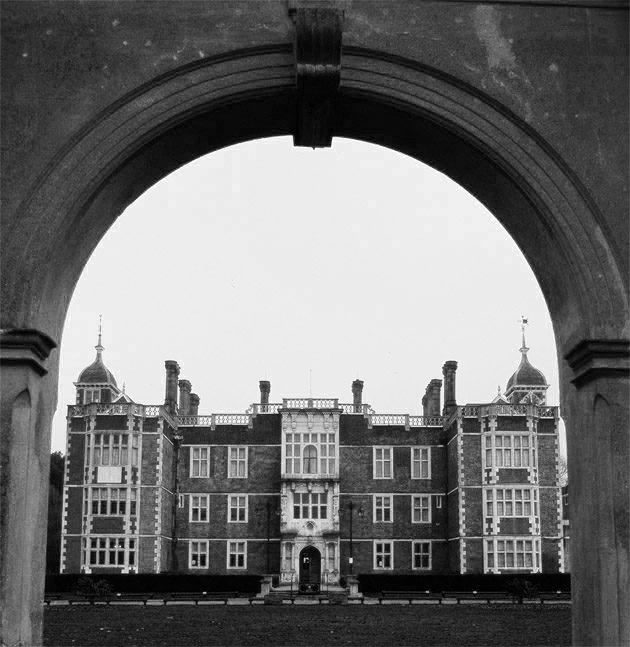
Charlton House. Photo © David Secombe 2010.
Charles Jennings writes:
Nowadays just another stop on the railway line, a part of the sprawl of outer London, Charlton has, to its great and inexplicable glory, one of the most stunning pieces of Jacobean architecture in the whole country. This is Charlton House, dating from 1607 and built for Adam Newton, tutor to Prince Henry, James I’s eldest son and heir to the throne. It is the most wonderful building, made all more wonderful by the drabness of its surroundings.
To get to it from Charlton railway station requires an uninspiring five-minute slog south on Charlton Church Lane before you reach the brow of the hill: a redbrick church – St. Luke’s – on the left, ranks of flats on the right and in the centre, hemmed in by a car park and a stretch of lawn, a fabulous dark red brick Jacobean mansion, decorated with white stone quoins and dressings, and with a great wedding cake frontispiece, involving a huge bay window and the main entrance porch. Sir Niklaus Pevsner claimed that Charlton House contained ‘the most exuberant and undisciplined ornament in all England’; while Ian Nairn drew a metaphor – aptly enough – from Jacobean melodrama, seeing the building as ‘Sinister poetry: the Duchess of Malfi in SE7′. John Evelyn, writing fifty years after the house was built, described the view from the house as ‘one of the most noble in the world, for city, river, ships, meadows, hill, woods and all other amenities’.
David Secombe:
At the end of Lights Out for the Territory, Iain Sinclair’s epic psychogeographical trek across London, the author visits Charlton House and ruminates upon its brooding presence and desirability as a residence for an aristocratic version of himself. Psychogeography is a much-derided concept, and it has been derided in these pages more than once (most recently by Andrew Martin earlier this week), but Charlton House is the kind of place which makes one wonder whether there might be something in it. It just seems monumentally wrong. In the midst of the anonymous south London sprawl it is spectacularly incongruous, but it isn’t just that (in fact, Charlton is the only London village where all the traditional elements remain visibly intact: the big house, the green, the church, the village). There is something else going on.
I once made a short film in which Charlton House featured as the main location. The film was a sort of parody of the English ghost story tradition, three men holding a night-time vigil in the Long Gallery of the House in the hope of seeing ‘something’. When being shown round the building during a recce, we ascended to the Long Gallery in a conspicuously modern elevator. I expressed my surprise at such an unexpected convenience, and was told that when the lift was being installed workmen discovered the body of an adolescent boy walled up behind one of the fireplaces. How long it had been there, no-one could say.
London Gothic. Photo & text: David Secombe. (4/5)
Posted: July 5, 2012 Filed under: Pubs, The Thames, Vanishings | Tags: Dickens, J.G. Ballard, joggers of Wapping, our mutual friend, Town of Ramsgate, Wapping High Street, Wapping Old Stairs Comments Off on London Gothic. Photo & text: David Secombe. (4/5)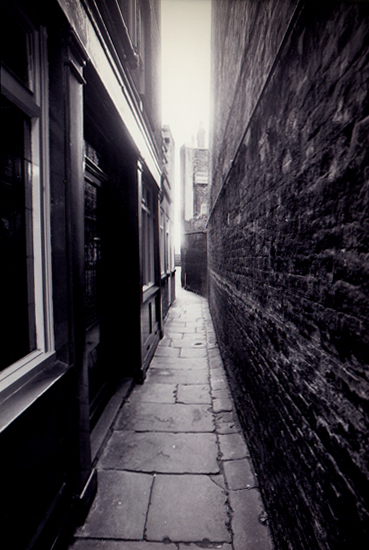
Town of Ramsgate pub, Wapping Old Stairs. Photo © David Secombe 2010.
From Unknown London, W.G. Bell, 1919:
Wapping High Street in the days of Nelson’s wars possessed upwards of one hundred and forty ale-houses. In a recent perambulation I was not able to count ten. Together with these reeking drink shops, inexpressible in their squalor and dirt, were other houses of resort which one may deftly pass by without too curious enquiry. In the gloomy slum area at the back, the inner recesses of the hive, mostly dwelt the people who lived, quite literally upon the sailor, and they formed the greater part of the population that was herded here. Every tavern kept open door to welcome the mariner with wages in his pocket.
You may land at the Old Stairs still … The ‘Town of Ramsgate’ stands at the head of the Stairs, where it has stood these past two centuries or more for the refreshment of sailors. Wapping was the busiest centre of the seafaring life of the port of London. Of the many landing-places, the deserted Old Stairs and the New Stairs, nearer the City, alone survive. And you may tramp Wapping from end to end without recognizing a sailor man.
David Secombe:
Nearly a hundred years later, Bell’s assessment of Wapping remains valid, although these days the eeriness of its riverside enclave has a particularly 21st Century quality. Wapping High Street’s narrow pavements teem with joggers: driven young (or young-ish) men and women who appear from nowhere, pounding behind you silently before speeding past towards … what? Apart from the joggers, you may see a few tourists who make the journey to visit the pubs and riverside sights, and it is undeniably true that at certain times (dusk in November, for example) the environs of Wapping Old Stairs retain an impressive atmosphere: catnip for Dickens-fanciers armed with much-thumbed copies of Our Mutual Friend. However, in cold, hard daylight, the perfectly made-over warehouses and tastefully integrated new-build developments dispel memories of Dickens and recall instead the preoccupations of a more modern London writer: J.G. Ballard. Modern Wapping could be a starting point for one of his forensic studies of fear within insular communities, wherein the hot-house social conditions unleash perversity and violence behind the security gates of the ‘executive development’. In the 1970s, he set such a dystopia downriver, in a tower block that might have been designed by Erno Goldfinger (High Rise); but the make-over of ‘heritage’ environments, the loading-bays transformed into penthouses, offers a more contemporary setting for a Ballardian nightmare.
Ultimately, perhaps, the unnerving quality riverside Wapping possesses today is that of a ghost seen walking in the noonday sun: the ghost of London.
… for The London Column.


 The London Column