The London Nobody Knows – revisited. Photos & text: David Secombe. (2/4)
Posted: June 20, 2012 Filed under: Architectural, Churches, Fictional London, Monumental | Tags: Alan Moore, Eye of Horus, Geoffrey Fletcher, Hawksmoor, Ian Sinclair, limehouse, Nicholas Hawksmoor, Peter Ackroyd, The London Nobody Knows Comments Off on The London Nobody Knows – revisited. Photos & text: David Secombe. (2/4)
St. Anne’s, Limehouse. Photo © David Secombe 2010.
From The London Nobody Knows, Geoffrey Fletcher, 1962:
St. Anne’s, Limehouse, was built by Hawksmoor, 1712-30, one of his three churches in the East End which alone make a worthwhile pilgrimage: the other two are St. George in the East and Christ Church, Spitalfields. All were begun within a few years of each other. As early as the 1730s, overcrowding had become a characteristic of the East End, a process accelerated in the early 19th century by the building of the docks between 1800 and 1830, the demand for unskilled labour, and the arrival of Jews and other refugees from Eastern Europe. These three churches were built as necessities, but there is nothing utilitarian about them. Their originality continues to surprise us. Hawksmoor’s architecture, imbued with Baroque rhythms, is massive yet solid, like Johnson’s prose. Characteristic of how little we really value them is the fact that, at time of writing, Christ Church, Spitalfields, is under threat of demolition, though thousands of pounds are uselessly thrown away in every conceivable direction.
David Secombe:
Christ Church, Spitalfields, was not demolished and has in recent years been the beneficiary of grants to restore the fabric of the building after decades of neglect. Hawksmoor’s six London churches have experienced a revival in general, and have become talismans for those who seek to pursue a hidden or mystical history of the city. Peter Ackroyd’s 1985 novel Hawksmoor elaborates upon ideas proposed by Ian Sinclair that Hawksmoor’s churches map an Eye of Horus upon the capital, whilst Alan Moore’s graphic novel From Hell links the Jack the Ripper murders to the looming presence of Christ Church over Whitechapel. Psychogeography aside, the massiveness and intensity of Hawksmoor’s designs have a slightly forbidding quality– and his monumental East End churches must have appeared anomalous and strange to those living in the surrounding Georgian and Victorian slums. In the 21st century, however, Christ Church looks anomalous for a different reason: the deadly corporatised make-over of Spitalfields market has transformed the area into Covent Garden East, and Hawksmoor’s magnificent creation now looms over a retail theme park safe for hipsters and their friends.
… for The London Column.
Croydon. Photo & text: David Secombe.
Posted: November 24, 2011 Filed under: Architectural, Lettering, Literary London, Out Of Town, Transport | Tags: Croydon, Edgeland, Empowerment Centre, J.G. Ballard, John Betjeman, lost idyll Comments Off on Croydon. Photo & text: David Secombe.
Photo © David Secombe 2011.
David Secombe writes:
This photograph was taken on that faceless stretch of The Brighton Road which runs between Purley and the mean streets of downtown Croydon. Technically, I think we are in South Croydon – or perhaps Sanderstead. Purley Oaks maybe? The Empowerment Centre is still listed on Internet databases as ‘a function room and banqueting centre’, but business seemed a bit slow the day I took this picture. ‘Empowerment’ is one of those words that has become tarnished through endlessly repeated misuse, and prompts thoughts of other terms that have become similarly degraded: ‘passionate’ (mandatory for politicians and CEOs); ‘celebrate’ – and its evil cousin, ‘celebrity’; ‘inclusive’; ‘accessible’, ‘iconic’, etc. These words have suffered a migration of meaning that might be said to constitute a failure of language, or perhaps its defeat.
But The Empowerment Centre’s fate seems appropriate to its location. Central Croydon is a pitiful 1960s attempt to construct an international city on the corpse of a Surrey market town. It is particularly anomalous to discover such futuristic pretensions to civic grandeur in that peculiar interzone between the South Circular (A205) and the M25: an aggregate of 20th Century suburban housing, golf clubs, retail parks, and marooned remnants of historic or industrial ‘heritage’ (there’s another one). This ‘edgeland’ has something in common with J.G. Ballard’s beloved west London suburbs, but none of their seedy glamour: the ancient village of Heathrow made way for London’s main air terminal, and the decommissioned rump of Croydon Airport – its Art Deco terminal hall and a shabby, decorative turbo-prop airliner – is a sad and perfunctory reminder of the district’s lost prestige. The airfield – its runways too short for post-war, inter-continental passenger jets – has long been built over, affording a misty, sylvan setting for an array of retail units.
John Betjeman’s poem Croydon evokes memories of a sweeter time, one of his idylls of lost suburban innocence …
Croydon by John Betjeman
In a house like that
Your Uncle Dick was born;
Satchel on back he walked to Whitgift
Every weekday morn.
Boys together in Coulsdon woodlands,
Bramble-berried and steep,
He and his pals would look for spadgers
Hidden deep.
The laurels are speckled in Marchmont Avenue
Just as they were before,
But the steps are dusty that still lead up to
Your Uncle Dick’s front door.
Pear and apple in Croydon gardens
Bud and blossom and fall,
But your Uncle Dick has left his Croydon
Once for all.
St. Pancras. Photo: Tim Marshall, text John Betjeman.
Posted: November 9, 2011 Filed under: Architectural, Literary London, Transport | Tags: Edward Mirzoeff, John Betjeman, St. Pancras Comments Off on St. Pancras. Photo: Tim Marshall, text John Betjeman.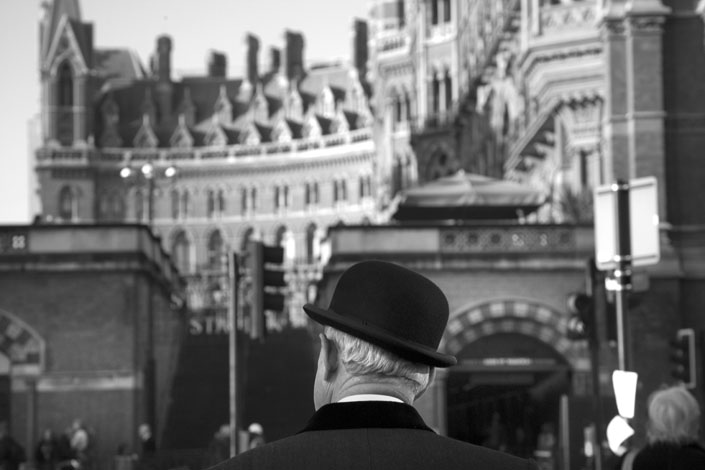
© Tim Marshall 2011.
From London’s Historic Railway Stations, John Betjeman, 1972:
“For the last ninety years almost, Sir Gilbert Scott has had a bad Press. He is condemned as facile, smart, aggressive, complacent and commercial.When at the top of his form Scott was as good as the best of his Gothic contemporaries. He was so firm a believer in the Gothic style as the only true ‘Christian’ style – Scott was a moderate High Churchman – that he was determined to adapt it for domestic and commercial purposes. St. Pancras Station hotel was his greatest chance in London and well he rose to the occasion.
I used to think that Scott was a rather dull architect, but the more I have looked at his work the more I have seen his merits. He had a thorough knowledge of construction, particularly in stone and brick. For St. Pancras the bricks were specially made by Edward Gripper in Nottingham. The decorative iron work for lamp standards and staircases and grilles was by Skidmore of Coventry, who designed the iron screens in some English cathedrals for Scott. The roofs of the hotel are of graded Leicestershire slates; the stone comes mostly from Ketton. Scott’s buildings are so well-built they are difficult to pull down. He had a grand sense of plan and site. The Grand Staircase, which alone survives of the hotel’s chief interior features, ascends the whole height of the building, by an unbelievably rich cast iron series of treads with stone vaulting and painted walls. The chief suites of rooms are on the first floor and the higher the building, the less important the rooms, until the quarters for the servants are reached in the gabled attics – men on one side, women on the other – and separate staircases. Yet even these are large and wide and compare favourably with more modern accommodation. The building has been chopped up and partitioned inside for offices. It is odd that it is not used again as an hotel especially now that hotels are so badly needed in London.”
Edward Mirzoeff writes:
Not long after this book was published I approached British Railways proposing a BBC documentary on London stations, with Betjeman. BR insisted on charging a facility fee at the same daily rate as that for feature films – which killed the idea, doubtless as intended.
Pepys Estate, Deptford. Photo Tony Ray-Jones, text Robert Elwall. (3/3)
Posted: May 19, 2011 Filed under: Architectural, Eating places, Interiors, London Types | Tags: Architectural Review, Manplan, Pepys Estate, RIBA, Tony Ray Jones Comments Off on Pepys Estate, Deptford. Photo Tony Ray-Jones, text Robert Elwall. (3/3)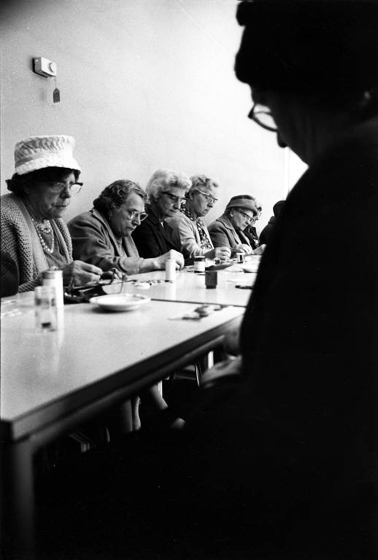
Canteen for the elderly, Pepys Estate, Deptford, 1970. Photo Tony Ray-Jones © RIBA Photographs Library.
Robert Elwall writes:
In 1969 Hubert de Cronin Hastings, owner of the Architectural Press and editor of its leading journal, the Architectural Review, decided to experiment with a new look for the magazine. He accordingly launched the ‘Manplan’ series published in eight themed issues between September 1969 and September 1970. Rather than being illustrated by the Review’s usual staff photographers, Hastings commissioned photographs from some of the leading photojournalists of the day asking them to cast their lenses in judgement on the contemporary state of architecture and town planning. Thus Ian Berry illustrated two issues on communications and health and welfare while his Magnum colleague, Peter Baistow, also supplied the images for two, those on religion and local government. Other contributors were Tom Smith on education; Tim Street-Porter on industry and Tony Ray-Jones on housing. The series kicked off with a typically hard-hitting issue on ‘Frustration’ with photographs by Patrick Ward.
These images were totally unlike anything that had been seen in the Review before. Ironically the Review had done much to formulate the norms of mainstream architectural photography with dramatically hagiographic renditions of pristinely new buildings set beneath sunlit skies and photographed with large format cameras. Instead it now offered its readers harsh, grainy, 35mm images of a grimly dystopian world the photographers argued that architects and planners had created. The unrelenting grimness and claustrophobic intensity of the photographs was magnified by the use of wide-angle lenses which had the effect of thrusting the viewer into the frame; by the reproduction of the photographs in a specially devised matt-black ink; and by the provision of hard-hitting captions that sometimes were printed over the images. Not surprisingly the series proved too much for many of the Review’s architect subscribers and in the face of falling circulation figures Hastings was forced to admit defeat and abandon his experiment.
Despite being short-lived, ‘Manplan’ can be regarded as the high watermark of photojournalism applied to architectural photography. During the 1960’s this had been pioneered by magazines such as Architectural Design, which in September 1961 had published a special issue on Sheffield illustrated by the great photojournalist Roger Mayne and by photographers such as John Donat (1933-2004) who, much influenced by Mayne’s example, took advantage of the smaller format cameras and faster films then appearing on the market to show how buildings interacted with, and were experienced by, their users and the public. For so long banished from the architectural photographer’s frame, real people going about real tasks, rather than merely included to give a sense of scale, now became the norm. By the 1970s, however, this application of the tenets of photojournalism and street photography to architecture was drawing to a close. There were two main reasons for this. Firstly, owing to the slow speed of large format colour films and the elaborate lighting set-ups they often required, the explosion in colour photography placed a renewed emphasis on architecture’s more formal qualities at the expense of human activity. In addition the increased commissioning of photography by architects themselves rather the more independently-minded magazines inevitably premiated eye-catching imagery that would show architects’ works in the best light. However, it is pleasing to reflect that today ‘Manplan’ has found favour once again as photographers once more seek to deviate from the norms.
… for The London Column. © Robert Elwall 2011
[Robert Elwall is Assistant Director, Photographs, Imaging & Digital Development of the British Architectural Library at the Royal Institute of British Architects.]


 The London Column