Balfronism.
Posted: September 10, 2014 Filed under: Architectural, Fictional London, Housing, London Places, Public Art | Tags: 007, 28 Days Later, Anthony Gormley, blackwall tunnel, Catherine Yass, east end, Erno Goldfinger, Goldfinger, High Rise, Hipster London, Ian Fleming, J.G. Ballard, Owen Hatherley, Robin Hood Gardens, Trellick Tower Comments Off on Balfronism. Red jumper, west flank, Balfron Tower. © David Secombe 2014.
From Urbanism and Spatial Order by Erno Goldfinger, 1931:
From the point of view of the town, the individual is a mere brick in the spatial order of the street or square.
Thus sprach Erno Goldfinger, doyen of the Modern Movement, Brutalist visionary, Marxist voluptuary, and namesake of James Bond’s most memorable antagonist. (The story goes that Ian Fleming was unimpressed by the house Goldfinger built for himself in Hampstead, whose construction required the demolition of some pretty Victorian cottages. In revenge, Fleming appropriated the architect’s name for 007’s next outing; Goldfinger is supposed to have considered legal action.)
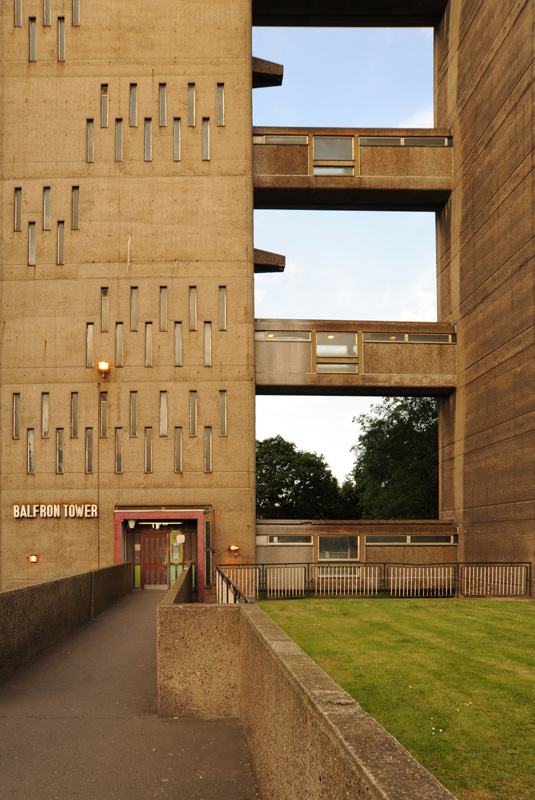 Service tower entrance, service corridors, Balfron Tower. © David Secombe 2014
Goldfinger’s most conspicuous buildings in London are Elephant and Castle’s Metro Central Heights (formerly Alexander Fleming House, no relation), West Kensington’s Trellick Tower, and Trellick’s almost-identical East End counterpart Balfron Tower in Poplar. Trellick and Balfron are often cited as inspirations for J.G. Ballard’s dystopian classic High Rise, wherein the denizens of an exclusive tower block turn feral.
To some extent, Trellick Tower saw this narrative played out in reverse. Commissioned in 1967 as social housing for the London County Council, upon completion in 1972 Trellick quickly became a ‘problem’ estate. There was talk of demolition, it became a byword for urban grit (name-checked in The Sweeney no less) – but, facilitated by the gentrification of seedy/glamorous West London and an increased appreciation of the charms of ‘mid-century modern’, the tower gradually became a suitable address for aspirational professionals, and was Grade II listed in 1998 – two years after Balfron was.
 Balfron Tower. © David Secombe 2014
Now it is east London’s turn. Balfron appeared first, topped-out in 1967 in an environment even more forbidding than old West Kensington. The location is still uncompromising: Balfron abuts the churning A12, feeding the Blackwall Tunnel just two hundred yards to the south. This piece of civic engineering affords majestic views of Balfron from the east and south but blights the lower floors facing the motorway. Balfron’s unprecedented height, hammered concrete finish, and stand-alone service tower with flying corridors and arrow-slit windows combine to give it a distinctly pugnacious aspect. The overall impression is of an urban fortress – a building fit to shelter the last bastions of humanity against marauding zombies (a role it plays in Danny Boyle’s 28 Days Later).
 Balfron Tower west flank, from Chrisp St. © David Secombe 2014
Balfron and its sister block, low-rise Carradale House (also by Goldfinger), are relics of a lost civic culture. There was a time not that long ago when modernity was a form of social utopianism. The East End had been blitzed, the residual housing stock was seen as Dickensian, and a clean, futuristic solution (Le Corbusier’s Unité d’habitation in Docklands) was an irresistible prospect for the ambitious bods at the LCC.
Balfron Tower was a brave project, and it took a fearless architect to see it through. It was intended to herald a dawn of new, better housing. Its flats meander up and down different levels, and the interiors are full of sensitive detailing. Goldfinger himself spent two months living in one of its penthouse flats, to evaluate the building; this led to important technical variations at Trellick when it was built a few years later. Amongst other things, he made sure Trellick had three lists instead of just two, after finding himself waiting twenty minutes for a lift to Balfron’s 27th floor.
Faced with accusations that his building constituted social engineering, he was robust: ‘I have created nine separate streets, on nine different levels, all with their own rows of front doors. The people living here can sit on their doorsteps and chat to the people next door if they want to. A community spirit is still possible even in these tall blocks, and any criticism that it isn’t is just rubbish.’
 Balfron Tower from the east. © David Secombe 2014.
For all its elegance, sincerity, attention to detail, and integrity of construction, Balfron suffers from design flaws which mitigate the modernist dream: the lifts don’t serve every floor, concrete decay is an issue, and the uninsulated solid walls suffer from heat loss. However, the East End is being relentlessly gentrified, and Balfron is about to be transformed into a block fit for the well-heeled and design-conscious (let us call them hipsters). The old tenants have been decanted elsewhere for the works to begin, and before the tower gets its upscale makeover, Balfron has become a sort of temporary sink estate for artists – this in response to special cheap deals on the rent – who are softening the place up for a bourgeois and executive future.
 Balfron Tower east flank (in the rain). © David Secombe 2014.
The accepted rubric is that the artists ‘inject new life into communities’; and in recent times Balfron has itself become something of an installation. In 2010 it hosted an ’empowering’ photographic project, and this year has seen, amongst other things, a site-specific production of Macbeth, not to mention a bid by a Turner-prize nominated artist to throw a piano off its roof (abandoned after protests from residents that someone could get killed).
All this corporately-licensed conceptual ‘playfulness’ masks the fact that an important piece of public housing is being very deliberately annexed by the private sector. No longer a vision of better housing for a better future, Balfron is now the deadest of things: a design icon, a beacon for those who crave tokens of retro-urbanism. Owen Hatherley has coined the term ‘Gormleyism’ to describe the use of Antony Gormley’s solitary figures as cultural embroidery in bland civic developments; perhaps ‘Balfronism’ will become shorthand for the use of artists en masse as a form of social cleansing.
 iPhone triptych, Balfron Tower from traffic on the A12. © David Secombe 2014.
The patina of time makes quaint what was once brave, difficult, or merely awful. It won’t be long before ‘Ballardian’ is a term used by estate agents. D.S.
At least ten fanlights.
Posted: July 3, 2014 Filed under: Architectural, Churches, Class, Corridors of Power, Dereliction, Housing, London Places, Transport | Tags: 10 Downing St., Citroen DS, Doughty St., Doughty Street, Edward Heath, Nicholas Hawksmoor, royal opera house, St Anne's Limehouse 1 Comment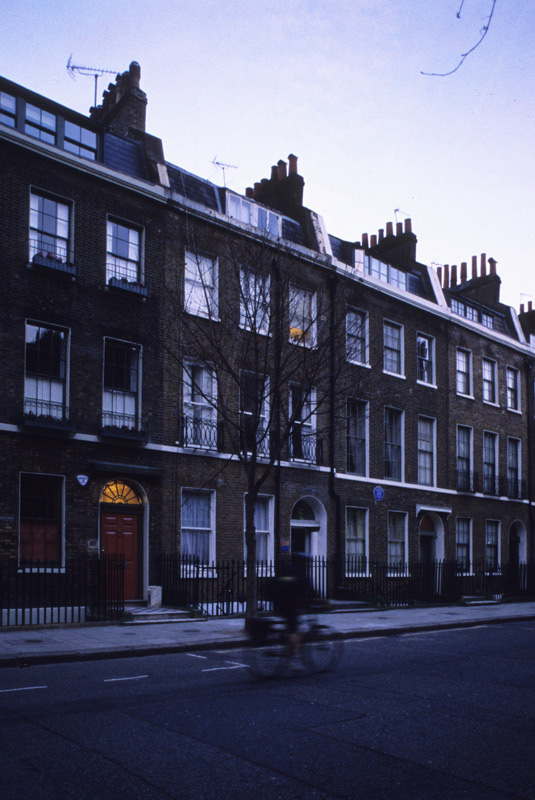 Doughty St., WC1. © David Secombe 2010.
 Southwark Bridge Rd.,SE1 © David Secombe 2009.
 Cable St., E1. © David Secombe 2010.
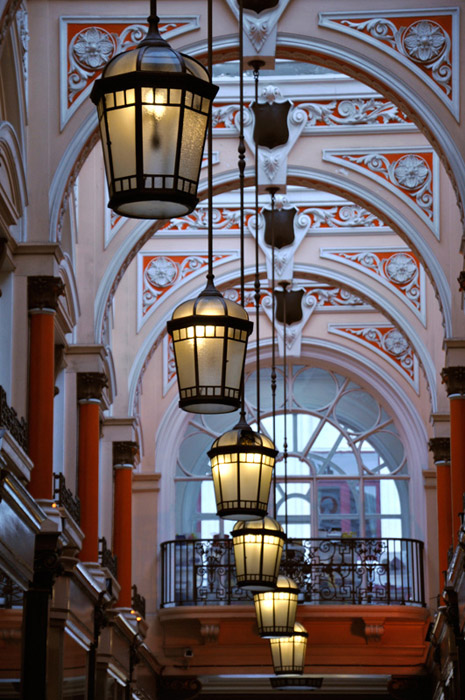 Royal Arcade, Albemarle St., W1. © David Secombe 2011.
 St. Anne’s Limehouse. © David Secombe 2010.
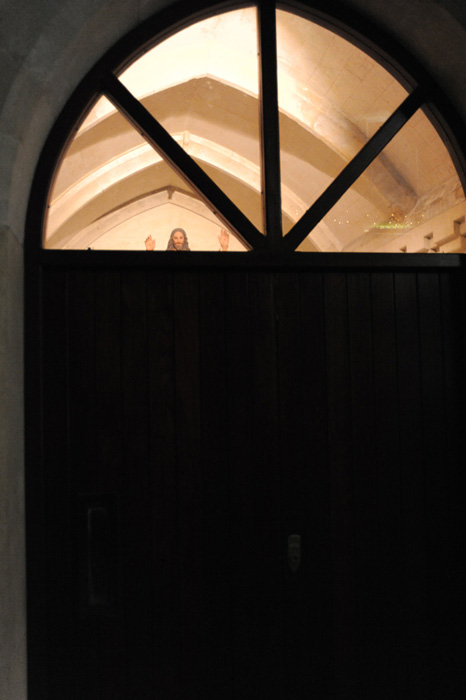 Corpus Christie, Maiden Lane, WC2. © David Secombe 2014.
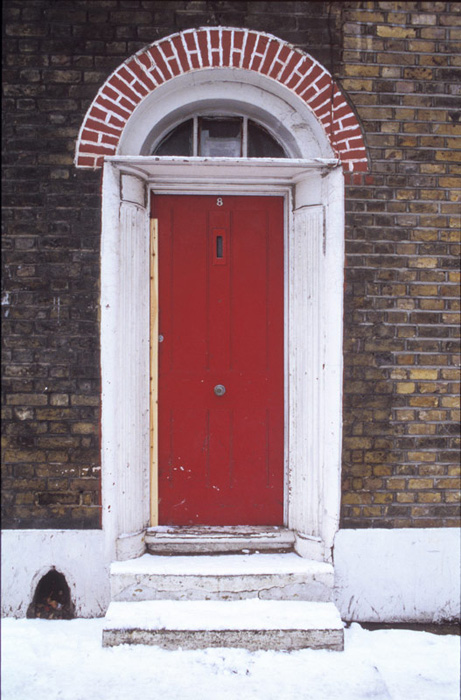 Sidney St., Whitechapel. © David Secombe 2011.
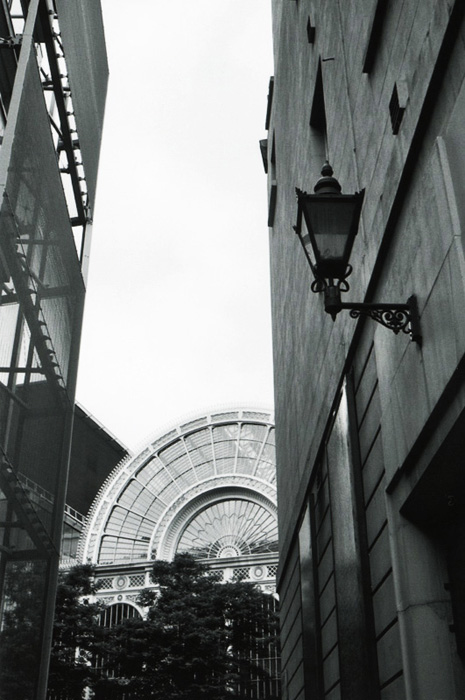 Royal Opera House from Marlett Court. © David Secombe 2010.
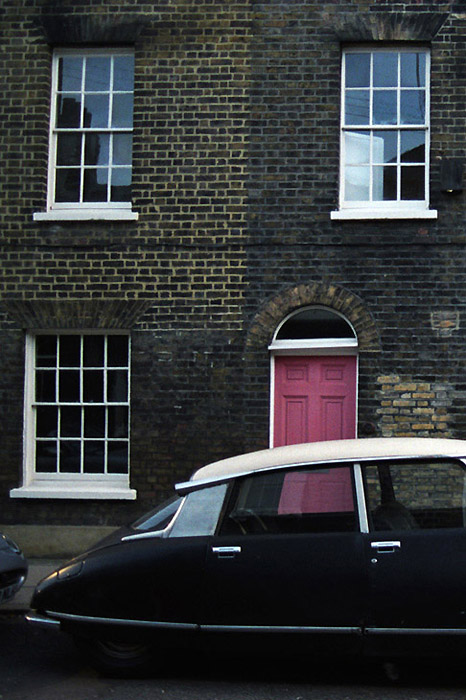 Citroen DS, Roupell St., Waterloo. © David Secombe 2012.
 Edward Heath, 10 Downing St., June 1970. © Angus Forbes 1970.
See also: Edward Heath’s Feet
Traffic on the Lea.
Posted: June 19, 2014 Filed under: Bohemian London, Graffiti, Housing, The Thames and its Tributaries, Transport, Vanishings | Tags: 2012 Olympics, Foxtons, Ian Sinclair, Lea Bridge Road, Lea River, London houseboats, malcolm hardee, Viv Stanshall Comments Off on Traffic on the Lea. River Lea towpath, under the East Cross Route. © David Secombe 2014.
A Sunday in May, on the towpath by the River Lea, just south of Lea Bridge Road:
Ding! … Ding! … Ding! … Ding! Ding! Ding!
The cyclist (mid-20s, jutting beard, sickly smile, deeply hittable face) steered his vintage eBay treasure inches between myself and my young son. Fifteen minutes into what was supposed to be a leisurely Sunday outing on the first really sunny weekend of the year and I was reduced to hissing violent epithets at various types of cyclist. Hipster cyclists, as above; Spandexed cyclists, often in entire family groups; unnervingly swift and purposeful cyclists with business on their minds; kids on mountain bikes; even a brace of fancy-dress cyclists, decked out in Edwardian gear – bowlers, waistcoats, plus-fours, spats – on authentically recalcitrant machines. Whatever their costume, they were all united by their fondness for those little silver bells, their peremptory tinkle an indication of assumed moral right. As a pedestrian on the towpath, on the Lea or a London canal, it’s hard to avoid the feeling that cyclists see you as merely a car-driver deprived of your vehicle. (Suggested collective noun: an entitlement of cyclists.)
 © David Secombe 2014
Not that long ago, this stretch of the Lea was a backwater; and the landscape still offers those with a taste for brownfield-rural the opportunity to participate in an Ian Sinclair-ish topographical narrative in a lush setting. There are overgrown meadows, deserted municipal sports facilities, mysterious structures to negotiate, structures often covered in an abundance of picturesque graffiti (whilst photographing the uncharacteristically polite cyclists walking their bikes under the East Cross Route, I noticed a young man posing his girlfriend for snaps on the other side of the decorated pillars). Of course, this riverside has been ravaged in recent years by the Alphaville of the Olympic Park, and the new residential developments that line the western bank south of Lea Bridge are testament to the burgeoning popularity of East London-lite: Hipster London, Foxtons London, Fatuous London.
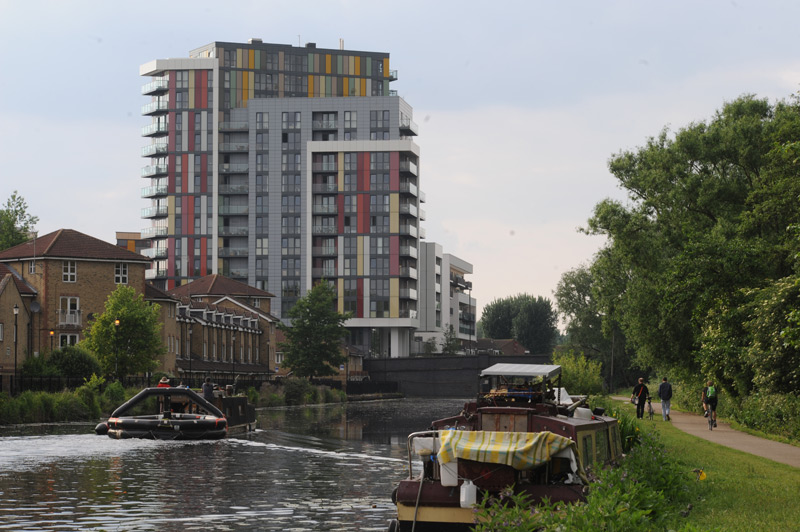 © David Secombe 2014.
Yet somehow, the houseboats remain aloof from it all; and the beauty of the Lea leads to daydreams of buying one, the idyll of having your very own piece of river within (distant) earshot of the churning city. A friend of mine has his own boat, a proper sea-going job, which he occasionally sails from Lowestoft to Limehouse Basin, where he moors it as his London base. This always struck me as simultaneously butch and civilised, an impression only slightly marred by a desperate call I once received from him en route, somewhere near Sheerness, asking if I’d heard the Shipping Forecast because his radio was broken. Several of the vessels moored on the Lea have all the appurtenances of the riverside ‘luxury apartments’ touted by Foxtons and their ilk, and it is not too exotic to imagine some of them actually sailing somewhere. A London houseboat might be the nearest thing to bucolic living anywhere within the M25; but a cursory inspection of some of the more ramshackle examples give one pause. More than a couple appear to be actually sinking, invoking thoughts of Viv Stanshall’s houseboat foundering on the Thames near Chertsey. A houseboat is not a very safe place to store a life’s work, and much of Viv’s life sank with The Searchlight. Even if your boat is watertight, there are other dangers: Malcolm Hardee drowned in Greenland Dock during a drunken attempt to access his houseboat after a night out. (Eddie Mirzoeff has just pointed out to me that Penelope Fitzgerald’s Chelsea Reach-moored houseboat sank not once but twice in the early 1960s, inspiring her Booker Prize-winning novel Offshore.)
 © David Secombe 2014.
Still the temptations persist … walking south, we encountered a riverine barbecue-cum-jam session, two barges lassooed together, a party of expert folk musicians playing together in an atmosphere of easy familiarity and home-brewed ale. I’m generally allergic to the claims of folk music but even I was charmed and wondered whether the water offered a better way of life for those in the know … but only a few yards further south, jungle was being played at industrial-noise level from a flat in a new block, obliterating the reels from upstream and putting paid to idyllic wonderings. Any remaining notions of hippie-ish promise were soon trashed as we reached the East Cross Route, where the aggressive post-Olympic new builds proved demoralising enough for us to turn back. Perhaps there is no such thing as a backwater in London any more; a sage with a tin of spray paint helped articulate this thought by stating the obvious on a bridge …
 © David Secombe 2014
Back at Lea Bridge, the Prince of Wales was doing brisk business as football played on the TV. A massive new development is under construction on the north of the Lea Bridge Road. For real peace, you have to go further upstream, way beyond Springfield Park and up into Tottenham Marshes; if you moored there, maybe you would have a shot at a life of tranquility. If you saw a naked cyclist, it would be someone who did it every day. And that would be fine. Just an unpretentious houseboat, not too big, easy to manage through the locks, kitted out with obsolete technology – VHS tapes, audio cassettes – and overflowing with old paperbacks you could read by paraffin lamp. You know where to find me …
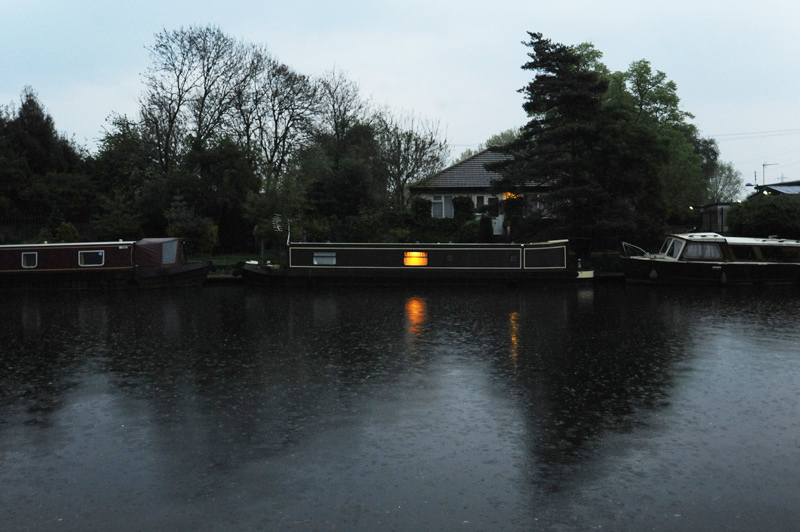 © David Secombe 2014.
… for The London Column.
See also: Before the Blue Wall.
The Riverine Strand.
Posted: May 12, 2014 Filed under: Architectural, Bohemian London, Churches, Housing, Literary London, Vanishings | Tags: Adelphi Terrace, Bob Dylan, Gordon's Wine Bar, John and Robert Adam, oscar wilde trial, Peter Ackroyd, Samuel Pepys, Savoy Chapel, Savoy Hotel, Subterranean Homesick Blues 2 Comments
 Royal Society of Arts, Robert St., Adelphi. © David Secombe 2010.
David Secombe: Thirty years ago, I accepted an assignment to illustrate a book of ‘London Walks’; I might have approached this task with more enthusiasm if I hadn’t known that I was offered the brief because the publisher didn’t have the money to pay the author’s preferred photographer. I lost my own copy of the finished item long ago, but recently came across one whilst helping my girlfriend clear an elderly aunt’s house. Looking at it now, it’s obvious that it was a formative experience for me, and that my photos were terrible. In an attempt to expiate former sins, this is the first of two posts revisiting the territory in a bid to see if a grizzled hack can improve upon a callow youth.
On a wet evening last week, I traced the steps of the ‘Riverine Strand’ walk in the company of TLC contributor and bad wine specialist CJ of the Sediment blog. We met outside Gordon’s Wine bar at the bottom of Villiers Street, both of us soaked through and longing for a glass of anything a notch above foul. Gordon’s advertises itself as ‘London’s oldest wine bar’, and it remains an atmospheric place to drink, although it has become more of a corporate playground in recent years. On this occasion our way to the bar was barred by thronging suits, which is why this piece lacks a picture of the vaulted cellar which is Gordon’s USP. We moved on …
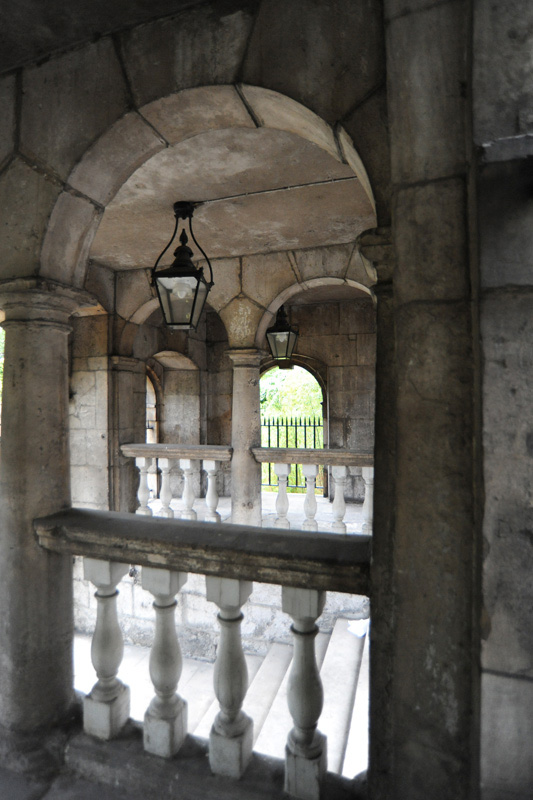
York Watergate. © David Secombe 2014
Opposite Gordon’s is a surviving fragment of the lost, pre-Embankment riverside landscape that once constituted this area: York Watergate, landing for York House, a palazzo which bordered the river for over 500 years. York House’s final, broke, owner, George Villiers, 2nd Duke of Buckingham, flogged it to developers for thirty grand. As Wikipedia gelidly states: ‘He made it a condition of the sale that his name and full title should be commemorated by George Street, Villiers Street, Duke Street, Of Alley, and Buckingham Street. Some of these streets are extant …’. For CJ’s benefit I pointed out that Samuel Pepys lived in a couple of houses on Buckingham Street, and that he also lived in the building where Gordon’s is now. CJ observed that it was still raining.
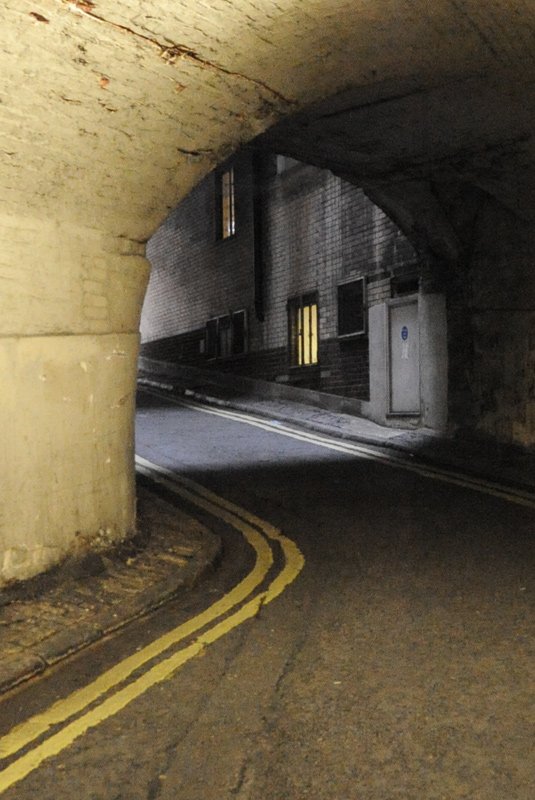
Lower Robert Street, Adelphi. © David Secombe 2014.
Lower Robert Street is an odd, subterranean thoroughfare that runs through what was once the undercroft of Adelphi Terrace, the centrepiece of the Adam Brothers’ Adelphi development. From The Encyclopedia of London:
In 1867 the Adelphi vaults were ‘in part occupied as wine cellars and coal wharves, their grim vastness, a reminder of the Etruscan Cloaca of old Rome’. Here, according to Tombs, ‘the most abandoned characters have often passed the night, nestling upon foul straw; and many a street thief escaped from his pursuers in these dismal haunts before the introduction of gaslight and a vigilant police’.
Dickens has David Copperfield wandering through this vanished maze, ‘a mysterious place with those dark arches’, which we can assume was an autobiographical reference. When I visited Lower Robert Street in the ’80s, for the purpose of illustrating the guidebook, it was still possible to see a dark courtyard beyond an iron gate: the basement of an Adam townhouse, seen from the POV of Victorian low-life … but that gate is bricked up now. (I dilated upon this factoid to an increasingly glazed CJ as drops of rainwater fell from his rimless spectacles.)
Above, the Adam houses reportedly were – as the houses that remain still are – a toy-town vision of elegance and grace. Of the Adelphi Terrace, E.V.Lucas wrote in 1916: ‘The Adelphi is still a favourite abode of men of letters, for it is central yet retired, and the brothers Adam planned rooms of peculiar comfort’. David Garrick, Richard D’Oyly Carte, Bernard Shaw, Thomas Hardy, all lived there, making it a sort of riverside version of The Albany.
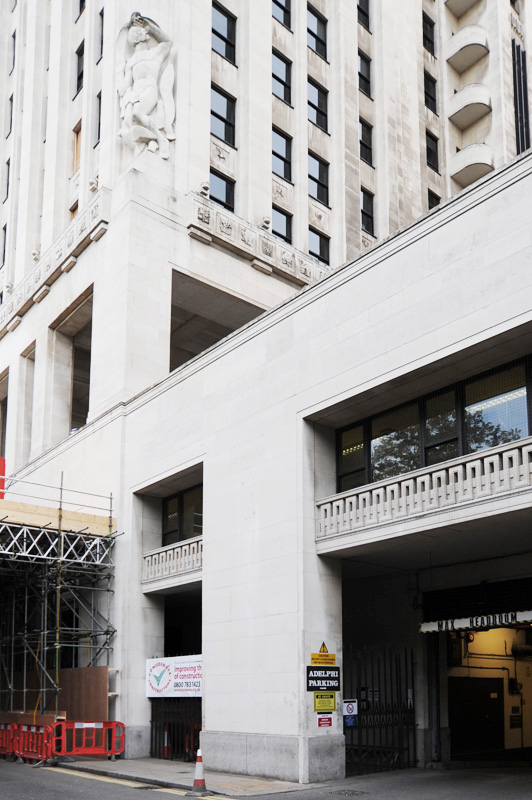 Collcutt & Hemp Adelphi, riverside frontage. © David Secombe 2014.
Adelphi Terrace was demolished by London County Council in 1936 and replaced by Collcutt and Hemp’s vast Deco block. The Adams’ Adelphi was the first neoclassical building in London, whereas Collcutt and Hemp’s edifice – grotesquely named ‘Adelphi’ – has been described by Ed Glinert (in The London Compendium) as ‘London’s most authentic example of totalitarian 1930s architecture’. Like Bush House at the other end of the Strand, it is a permanent reminder of loss, of a wrong inflicted upon the city. (NB: we are currently working on a survey of Boris Johnson’s skyscraper-nurturing programme.) In 1951, London County Council installed a plaque on one of the pillars of the ‘new’ Adelphi to commemorate the one they had connived to destroy. (The photo at the top of this post is of the Adam house which remains on Robert Street, facing Collcutt and Hemp, home to the Royal Society of Arts.)

Savoy Way. © David Secombe 2014
At this point, CJ wanly suggested going for a drink at the Savoy; but I reminded him that the last time we did that was five years ago, when both of us had money. Instead, we contented ourselves with a cursory inspection of the hotel’s rear quarters, a paragon of rationality, clad in the glazed tiles the Victorians reserved for only the filthiest urban environments.
At Oscar Wilde’s first trial, the following exchange took place between prosecution witness Charles Parker and prosecutor Charles Gill:
PARKER: Subsequently Wilde said to me. ‘This is the boy for me! Will you go to the Savoy Hotel with me?’ I consented, and Wilde drove me in a cab to the hotel. Only he and I went, leaving my brother and Taylor behind. At the Savoy we went first to Wilde’s sitting room on the second floor.
GILL: More drink was offered you there?
PARKER: Yes, we had liqueurs. Wilde then asked me to go into his bedroom with him.
(In an early draft of The Importance of Being Earnest, a solicitor arrives to remove Algernon to Holloway Prison for non-payment of restaurant bills at the Savoy, whereupon Algie retorts: ‘I am not going to be imprisoned in the suburbs for dining in the West End. It is ridiculous.’ Prior to his first trial, Wilde found himself held on remand at Holloway.)
It is tempting to imagine Oscar and Bosie hustling rent boys past the laundry bins and crates of vegetables on Savoy Way. CJ wondered whose laundry the gent in the photo might be carrying.
Savoy Chapel, Savoy Lane. © David Secombe 2014.
Adjacent to the Savoy stands one of those anomalous bits of medieval London marooned amongst anonymous offices. Savoy Palace, a vast 13th Century manor, once sprawled across the foreshore here; the Palace was entirely destroyed during the Peasants’ Revolt but the chapel was later rebuilt as part of Henry VII’s Savoy Hospital, of which it is now the only survivor. I don’t know whether Oscar and Bosie ever came here to ‘cool [their] hands in the grey twilight of Gothic things’, but this happens to be the spot where another Savoy resident, the newly-electric Bob Dylan, telegraphed Subterranean Homesick Blues for D.A. Pennebaker’s camera, as Allen Ginsberg and Tom Wilson loitered meaningfully in the background.
CJ and I emerged from Savoy Lane onto the Strand whereupon it started raining again, so we redoubled our efforts to find a sane place to drink. Dodging umbrellas and puddles by the corner of Waterloo Bridge, we chanced to see Peter Ackroyd alight elegantly from a cab and dive into a Tesco Express. We thought of waiting to see what the biographer of London would do when he emerged, entertaining the wistful hope that he might pop into Maplin’s for some fuses or a remote-controlled helicopter … but my boot was leaking, so we went to the Lamb and Flag, where we stood outside and drank our beers in the rain.
© David Secombe … for The London Column.
See also: A short walk down the Old Kent Road, Four streets off Hockley Hole.


 The London Column
