Ridgers reminisces. Photo & text: Derek Ridgers (1/5)
Posted: November 28, 2011 Filed under: Bohemian London, London Music, London Places, London Types | Tags: Cheapo Cheapo, Chrissie Hynde, Nick Kent, NME 1 Comment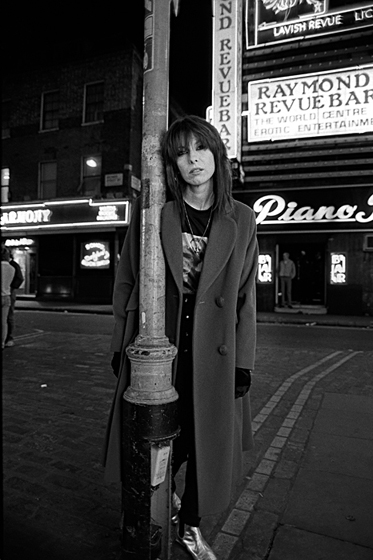
Chrissie Hynde, Soho, 1990. © Derek Ridgers.
Derek Ridgers writes:
In the late ’70s I was working in an ad agency that was slap bang in the middle of Soho and through the first floor windows of said agency, we had a front seat view of the rich pageant of Soho life only a few feet below. The agency was only about 50 yards away from the passage next to Raymond’s Review Bar and we were able to observe the prostitutes, armed policemen, con men, clip girls, drunks, junkies, glue sniffers and all manner of street people. These types were very thick on the ground in the Soho of the ’70s.
One got very used to seeing some of them. There was one guy I used to see a lot. A dyed-black haired, lanky twerp, normally dressed from head to toe in leather, who obviously thought of himself as some sort of covert rock star. He also wore eye-liner. He always looked totally messed up, emaciated and completely out of it. It was not always an appealing sight. I remember being particularly appalled by seeing the lanky twerp walking through Soho market with his scrotum hanging out of a hole in his trousers. He seemed totally oblivious to this.
Working right in the middle of Soho did have it’s advantages though. My office was a 45 second jog away from the best second hand record shop in the country – Cheapo Cheapo – and every Wednesday morning, at about 11.00 o’clock, the new review copies would arrive and be put straight out into the racks. I was, by this time a voracious reader of both Sounds and NME and my heroes were Charles Shaar Murray, Nick Kent and Danny Baker. I pretty much bought everything they gave a decent review too. So, every Wednesday at exactly 10.55, I’d make an excuse at work and run down to Cheapo Cheapo to buy, at about half the RRP, some of the records that had been favourably reviewed in the previous weeks rock papers. I didn’t realise it at the time but there was every likelihood these were exactly the same copies that had been so reviewed. I’d often see the lanky twerp hanging about Cheapo Cheapo at about the same time as me and I assumed he’d worked out what time the review copies arrived too. I always tried to make sure I got to the best records before he did and, for some strange reason, I always seemed to.
I’d been doing this for a few years during the late ‘70s. Until eventually I got the sack from the agency, became a photographer and I met the NME writer Cynthia Rose. Through her, I got a crack at working for NME myself. One day when we were both hanging about Virgin Records, in Oxford Street, she introduced me to my hero, the writer Nick Kent. And I recognised him as the lanky twerp. The very same lanky twerp that I’d seen rather too much of once before.
(And so it dawned on me that he hadn’t been hanging about Cheapo Cheapo waiting to buy the records but rather selling them the ones I’d subsequently been buying).
The above story is just an excuse to recommend Nick Kent’s fantastic book Apathy For the Devil which is a ’70s memoir of his time as a rock writer and it has some absolutely fantastic stuff about the Rolling Stones, Iggy Pop and the Sex Pistols. It’s just about my favourite rock book since his last one The Dark Stuff. I don’t have a photograph of Nick Kent. But his book has quite a lot about the time when he lived with Chrissie Hynde and so I’ve used a photograph of her. Coincidentally it was taken almost right outside Cheapo Cheapo.
And if you should ever read this Nick, I apologise for once calling you a twerp.
© Derek Ridgers. From The Ponytail Pontifications.
V2 Woolworths disaster, New Cross, 25 November 1944.
Posted: November 25, 2011 Filed under: Anniversaries, Catastrophes, Public Announcements, Vanishings, Wartime London | Tags: Apollo 11, Doodlebug Blitz, Eddie Chapman, V1, V2, Vengeance Weapon, Werner von Braun 1 Comment
Air raid shelter sign, Jerningham Road, New Cross, SE14. Photo © David Secombe 2010.
Today marks the 67th anniversary of the worst single bombing incident of the 2nd World War – when a V2 rocket scored a direct hit on a Woolworths store in New Cross. The V2 hit Woolworths when it was crowded with Saturday morning shoppers: the official death toll was 168, but it was often said that the real figure was much higher – although it seems unlikely that a significantly higher casualty number could have been withheld until now.
The V2 was unlike the earlier ‘Vengeance Weapon’, the V1 (A.K.A. ‘doodlebug’, a cruise missile) in that it was impossible to detect – let alone intercept – before it exploded. The first impact in Chiswick in September 1944 was first thought to have been caused by a gas explosion. Their sudden deployment was a source of grave concern to Churchill, and prompted the construction of deep-level air raid shelters in Bloomsbury, Clapham and Stockwell. South and east London received a disproportionately high number of V-strikes, largely because of a British intelligence coup: the double agent Eddie Chapman managed to convince his Nazi ‘handlers’ that V1s were overshooting the centre of London (they weren’t), hence the rocket launchers recalibrated and bombs began falling on Brockley, Woolwich, Deptford, Catford, Barking, Ilford, etc., and across Kent and Surrey.
The literal impact of these weapons may still be seen in London, where pockets of undeveloped bombsites remain – like the dead spot on Tottenham Court Road opposite Heals, final destination of a V2. South London is peppered with anomalous green spaces or abrupt changes in architectural style on a residential street, characteristic traces of Vengeance weapons. Perhaps the most bizarre legacy of the V2 campaign was the subsequent career of the project’s architect, Werner von Braun. The majestic Saturn V rocket which took Neil Armstrong towards the Moon was von Braun’s creation, the end result of his wartime experiments in rocketry and ballistics. As for Woolworths, they’ve put up a plaque. There is an Iceland store there now.
(The Londonist has a fascinating map of V2 bombsites on London; and further information may be found on the site flyingbombsandrockets.com.)
David Secombe.
Croydon. Photo & text: David Secombe.
Posted: November 24, 2011 Filed under: Architectural, Lettering, Literary London, Out Of Town, Transport | Tags: Croydon, Edgeland, Empowerment Centre, J.G. Ballard, John Betjeman, lost idyll Comments Off on Croydon. Photo & text: David Secombe.
Photo © David Secombe 2011.
David Secombe writes:
This photograph was taken on that faceless stretch of The Brighton Road which runs between Purley and the mean streets of downtown Croydon. Technically, I think we are in South Croydon – or perhaps Sanderstead. Purley Oaks maybe? The Empowerment Centre is still listed on Internet databases as ‘a function room and banqueting centre’, but business seemed a bit slow the day I took this picture. ‘Empowerment’ is one of those words that has become tarnished through endlessly repeated misuse, and prompts thoughts of other terms that have become similarly degraded: ‘passionate’ (mandatory for politicians and CEOs); ‘celebrate’ – and its evil cousin, ‘celebrity’; ‘inclusive’; ‘accessible’, ‘iconic’, etc. These words have suffered a migration of meaning that might be said to constitute a failure of language, or perhaps its defeat.
But The Empowerment Centre’s fate seems appropriate to its location. Central Croydon is a pitiful 1960s attempt to construct an international city on the corpse of a Surrey market town. It is particularly anomalous to discover such futuristic pretensions to civic grandeur in that peculiar interzone between the South Circular (A205) and the M25: an aggregate of 20th Century suburban housing, golf clubs, retail parks, and marooned remnants of historic or industrial ‘heritage’ (there’s another one). This ‘edgeland’ has something in common with J.G. Ballard’s beloved west London suburbs, but none of their seedy glamour: the ancient village of Heathrow made way for London’s main air terminal, and the decommissioned rump of Croydon Airport – its Art Deco terminal hall and a shabby, decorative turbo-prop airliner – is a sad and perfunctory reminder of the district’s lost prestige. The airfield – its runways too short for post-war, inter-continental passenger jets – has long been built over, affording a misty, sylvan setting for an array of retail units.
John Betjeman’s poem Croydon evokes memories of a sweeter time, one of his idylls of lost suburban innocence …
Croydon by John Betjeman
In a house like that
Your Uncle Dick was born;
Satchel on back he walked to Whitgift
Every weekday morn.
Boys together in Coulsdon woodlands,
Bramble-berried and steep,
He and his pals would look for spadgers
Hidden deep.
The laurels are speckled in Marchmont Avenue
Just as they were before,
But the steps are dusty that still lead up to
Your Uncle Dick’s front door.
Pear and apple in Croydon gardens
Bud and blossom and fall,
But your Uncle Dick has left his Croydon
Once for all.
Royal Hospital, Chelsea. Photo & text: John Londei.
Posted: November 11, 2011 Filed under: Anniversaries, Hospitals, London Types, Wartime London | Tags: 11th hour of the 11th day of the 11th month, Armistice Day, Chelsea Pensioners, lest we forget Comments Off on Royal Hospital, Chelsea. Photo & text: John Londei.
© John Londei 1998.
John Londei writes:
This photograph features Chelsea Pensioners – or ‘Gentlemen’ to give them their correct title – and was taken in the Chapel of the Royal Hospital Chelsea in 1998 to mark the 80th anniversary of the Armistice that, on the “eleventh hour of the eleventh day of the eleventh month”, brought the First World War to an end.
Charles II founded the Royal Hospital in 1681. Sir Christopher Wren was commissioned to design and erect the building. The painting of the Resurrection on the domed ceiling of the Chapel, by the Italian artist Sebastiano Ricci, dates from 1714 and it’s believed to be a donation from Queen Anne. Back then compulsory services were held twice daily in the Chapel.
Seventeen of the Gentlemen in the shot were jokingly called ‘The Spice Boys’ because they always volunteered for such events. Nine days earlier they’d taken part in the Lord Mayor of London’s annual parade appearing on a float depicting The Royal Hospital’s history. But for me the real ‘star’ of this photo was Albert Alexandre, the last veteran of the First World War still resident at the Royal Hospital [the centre row of floor squares point directly to him sitting in the 1st row].
Albert was born in Jersey. Both his parents died when he was six, and he went to live in an orphanage. In 1917 Albert, who looked older than his years, lied about his age (he was 15) and enlisted in the Guernsey Light Infantry. He saw action at Passchendaele, outstanding among the battles of the war not only for its cost in life and limb (almost half a million allied casualties), but also for the weather. In the heaviest rain for 30 years, men, horses and pack mules drowned in the deep shell holes caused by constant bombardment. He witnessed men being blown to pieces all around him, and took part in hand-to-hand fighting. A phrase from one of Siegfried Sassoon’s poems sums it up: ”I died in hell – They called it Passchendaele”.
Albert was discharged in 1919, but re-enlisted into the Royal Garrison Artillery serving in India during World War Two. When Alfred’s wife died in 1992 he moved to the Royal Hospital where he remained until his death in January 2002 aged 100.
A large framed print of this sitting now hangs in the Gentlemen’s Ward at the Royal Hospital. With the passing of time that print, like those old soldiers therein, will just fade away…
© John Londei 2011.


 The London Column