Swansong.
Posted: May 1, 2019 Filed under: London Music, London Types, Performers, Vanishings | Tags: Andrew Martin, Angus Forbes, Charles Jennings, Christopher Reid, Dave Hendley, David Hoffman, Dmitri Kasterine, Don McCullin, Homer Sykes, John Londei, Katy Evans-Bush, Marketa Luskacova, old East End, Owen Hatherley, Owen Hopkins, Peadar O'Donaghue, Spitalfields, Tate Britain, Tim Marshall, Tim Turnbull, Tim Wells, Tony Ray Jones 6 Comments Street singer, Brick Lane, 1982. © Marketa Luskacova.
I have not found a better place than London to comment on the sheer impossibility of human existence. – Marketa Luskacova.
Anyone staggering out of the harrowing Don McCullin show currently entering its final week at Tate Britain might easily overlook another photographic retrospective currently on display in the same venue. This other exhibit is so under-advertised that even a Tate steward standing ten metres from its entrance was unaware of it.
I would urge anyone, whether they’ve put themselves through the McCullin or not, to make the effort to find this room, as it contains images of limpid insight and beauty. The show gathers career highlights from the work of the Czech photographer Marketa Luskacova, juxtaposing images of rural Eastern Europe in the late 1960s with work from the early 1970s onwards in Britain. There are overlaps with the McCullin show, notably the way that both photographers covered the street life of London’s East End in the early ‘70s. Their purely visual approaches to this territory are remarkably similar: both shoot on black and white and, apart from being magnificent photographers, both are master printers of their own work. The key difference between them is that Don McCullin’s portraits of Aldgate’s street people are of a piece with his coverage of war and suffering — another brief stop on his international itinerary of pain — whereas Marketa’s pictures are more like pages from a diary, which is essentially what they are.
Marketa went to the markets of Aldgate as a young mother, baby son in tow, Leica in handbag, to buy cheap vegetables whilst exploring the strange city she had made her home. This ongoing engagement with her territory gives Marketa’s pictures their warmth, which allows her subjects to retain their dignity. They knew and trusted her.
Marketa’s photos of the inhabitants of Aldgate hang directly opposite her pictures of middle-European pilgrims and the villagers of Sumiac, a remote Czech hill village — a place as distant from the East End as can be imagined. Seeing these sets alongside each other illustrates her gift for empathy, and some fundamental truths about the human condition.
Two images on this page are of men singing: the second is of a man singing in church as part of a religious pilgrimage in Slovakia. This is what Marketa has to say about it:
During the pilgrimage season (which ran from early summer to the first week in October), Mr. Ferenc would walk from one pilgrimage to another all over Slovakia. He was definitely religious, but I thought that for him the main reason to be a pilgrim was to sing, as he was a good singer and clearly loved singing. During the Pilgrimage weekend the churches and shrines were open all night and the pilgrims would take turn in singing during the night. And only when the sun would come up at about 4 or 5 a.m., they would come out of the church and sleep for a while under the trees in the warmth of the first rays of the sun [see pic below]. I was usually too tired after hitch-hiking from Prague to the Slovakian mountains to be able to photograph at night, but in Obisovce, which was the last pilgrimage of that year, I stayed awake and the picture of Mr Ferenc was my reward.
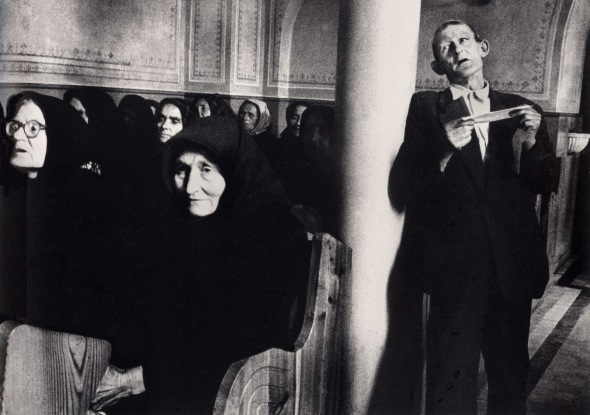 Mr. Ferenc, Obisovce, Slovakia, 1968. © Marketa Luskacova
Marketa’s pictures are the kind of photographs that transcend the medium and assume the monumental power of art from the ancient world. As it happens, they are already relics from a lost world, as both central Europe and east London have changed beyond recognition. Spitalfields today is more like a sort of theme park, a hipster annexe safe for conspicuous consumers. In Marketa’s pictures we see London as it was, an echo of the city known by Dickens and Mayhew. And the faces in her pictures …
 Spitalfields, 1976. © Marketa Luskacova.
 Sleeping Pilgrim, Levoca, 1968. © Marketa Luskacova.
 Spitalfields, 1979. © Marketa Luskacova.
 Sumiac, 1967. © Marketa Luskacova.
 Tailors, Spitalfields, 1975. © Marketa Luskacova.
 Bellringers, Sumiac, 1967. © Marketa Luskacova.
The photo at the top, of a man singing arias for loose change in Brick Lane, has featured on The London Column before. It is one of the greatest photographs of a performer that I know. We don’t know if this singer is any good, but that really doesn’t matter. He might be busking for a chance to eat – or perhaps, like Mr. Ferenc, he just loves singing – but his bravura puts him in the same league as Domingo or Carreras. As with her picture of Mr. Ferenc, Marketa gives him room and allows him his nobility.
As they say in showbiz, always finish with a song: this seems like a good point for me to hang up The London Column. I have enjoyed writing this blog, on and off, for the past eight years; but other commitments (including another project about London, currently in the works) have taken precedence over the past year or so, and it seems a bit presumptuous to name a blog after a city and then run it so infrequently. And, as might be inferred from my comments above, my own enthusiasm for London has suffered a few setbacks. My increasing dismay at what is being done to my home town has diminished my pleasure in exploring its purlieus (or what’s left of them).
It seems appropriate to close The London Column with Marketa’s magical, timeless images. I’ve been very happy to display and write about some of my favourite photographs, by photographers as diverse as Marketa, Angus Forbes, Dave Hendley, David Hoffman, Dmitri Kasterine, John Londei, Homer Sykes, Tim Marshall, Tony Ray Jones, etc.. It has been a great pleasure to work with writers like Andrew Martin, Charles Jennings, Katy Evans-Bush (who has helped immensely with this blog), Owen Hatherley, Owen Hopkins, Peadar O’Donaghue, Christopher Reid, Tim Turnbull, Tim Wells, and others. But now, as they also say in showbiz: ‘When you’re on, be on, and when you’re off, get off’.
So with that, thank you ladies and gents, you’ve been lovely.
David Secombe, 30 April 2019.
Marketa Luskacova’s photographs may be seen on the main floor of Tate Britain until 12 May.
Resist.
Posted: July 13, 2018 Filed under: Catastrophes, Conspiracies, Corridors of Power, Events, London scandals | Tags: Brexit fiasco, Brexit the Game Show, Impeach Trump, Joke nation, peaceful protest, Trump blimp 4 Comments
Ah! What a beautiful day for having a cup of tea in your garden, watching the birds scatter in fear at the approach of a convoy of US military aircraft. Fran Isherwood, after the late Ken Dodd.
I’m not sure who is going to be reading this, as I have totally neglected The London Column this year. My lack of attentiveness is down to a combination of factors, but can be roughly summarised as: 70% personal crises; 20% working on a different version of this material; and 10% depression at the state of the subject under discussion.
However …
It is Friday 13th and Donald Trump is in town. This morning’s news headlines make for a bleach-in-the-eyes experience and one struggles to think of historical parallels. How about Suez ? That’s a humiliating episode of Britain’s history that isn’t part of the national myth (a bit of a downer between winning the war and the Beatles) and showed the extent to which we were constrained by American power; but at least Suez showed a U.S. president acting sensibly by reining in Anthony Eden’s anachronistic imperial folly.
No, the current mess has a toxic dynamic all its own. A fragile PM attempting to carry out a pitiful act of national self-harm (trying to limit the damage whilst maintaining the preposterous rhetoric to appease the loons in her own cabinet) is hosting a gleefully destructive, authoritarian president who openly despises her weakness.
Clearly, Trump despises lots of things – including the mayor of London and the multi-culturalism that the city represents. But, proving that a decent joke – or even a puerile one – can reach the parts that sober analysis cannot reach, a giant Trump baby blimp has taken to London’s skies this morning. The fact that people have been worried about how this inflatable cartoon will impact Caesar’s mood is a black joke in itself.
Anyway, there’s a real summer festival mood this weekend, what with the Wimbledon and World Cup finals, the continuing heatwave (due to end soon), The Latitude Festival in Suffolk (where a good friend is performing Brexit – the Game Show) and a host of anti-Trump protests to choose from up and down the country. So let’s enjoy the summer whilst we can; a joyous pleasure cruise to the edge of the abyss. DS.
Festively South London …
Posted: December 24, 2017 Filed under: Anniversaries, Architectural, London Places, Vanishings | Tags: Crystal Palace, Crystal Palace transmitter, London in winter 2 Comments
Transmitter, Crystal Palace, © David Secombe.
Merry Christmas everybody. D.S.
Unknowns and Unknowns.
Posted: October 31, 2017 Filed under: Entertainment, Fictional London, Tall Tales | Tags: Doomwatch, Gnomes of Dulwich, Guy Fawkes night, Into the Unknown, Out of the Unknown, The New Yorker's best Halloween cover 1 Comment
It is a warm Sunday evening in 1969. I am seven. I have somehow managed to avoid going to bed long enough to glimpse the start of the scariest thing on television: a scene of a night-time funfair, brilliantly illuminated, the rides in full swing … but there is no-one there except me. I know I am there because the camera took me through the turnstile. I know it’s Battersea Funfair because I went there once with my family. But now I am there at night, alone.
The above clip has Proustian associations for your correspondent. As a child of seven these opening titles were an introduction to a world of terrors comfortingly remote from my Surrey childhood. It took me several decades to discover out the name of the TV programme that haunted my dreams, and when YouTube finally unlocked the key I discovered that the opening retained something of the power I recalled from childhood. The series was an Anglo-American co-production and featured stories of a supernatural or macabre nature that were filmed in Britain but produced by Los Angeles personnel (the producers had worked on Hitchcock’s TV series) and financed by U.S. cash; the legend ‘In Color’ at the start of the titles gives the game away. Unfortunately, the titles are the best thing about Journey to the Unknown: the dramas that followed failed to deliver on the delicious promise set up by that atmospheric introduction. I know this because I acquired a bootleg DVD of the entire series and discovered to my intense disappointment that most of the stories were flaccid and weak, starring waning Hollywood turns marooned in UK settings, a sop to the American market at which the series was targeted.
The other Unknown is a BBC Science Fiction series from roughly the same period, an entirely British project this time – although it cast its net wide in terms of the writers it showcased. Out of the Unknown began as a vehicle for ‘straight’ SF – hence the likes of Asimov, J.G. Ballard and John Wyndham got a look-in – but by the time the final season aired in 1971 it had become less ambitious and was offering more generic horror and fantasy fare. As it was shot on video, the series suffered the fate of so many BBC programmes from the period, its tape being recorded over for the sake of Match of the Day or similar. This practice was standard at the BBC, prioritising sports coverage and local news reporting above drama and entertainment – which is why Parkinson’s interview with John Lennon is long gone, along with many classic dramas and – bizarrely – live coverage of the first Moon landing. There goes the past.
Except that in this case a few episodes still exist, and I have trawled these in search of similar madeleines, raising my hopes of identifying other fragmentary glimpses of disturbing childhood viewing. But I drew a blank here; it’s possible that some of the lost stories might have unlocked further memories, which only makes their loss more frustrating. I have been able to identify a couple of scary memories as deriving from a BBC TV show called Doomwatch, an early 70s drama that featured government scientists tackling futuristic crises amidst a paucity of believable special effects. The one about a virus that eats plastic really put the wind up me: it opened with a passenger on an airliner discovering that the cabin is melting all around him … that was bound to add to the stock of a 10 year old’s night terrors. Doomwatch itself might as well have been eaten by the same virus, so much of it has been destroyed. (Before I am accused of wanton nostalgia for its own sake, I will say that my favourite TV programme from 1969 was a comedy called The Gnomes of Dulwich starring Hugh Lloyd and Terry Scott as a pair of garden gnomes in suburban south London. That entire series has been wiped, and no-one is going to claim that as a lost masterpiece.)
The last time I posted on here it was Midsummer, now we are on the brink of winter. I haven’t posted much this year (a) because I have been trying to write a book and (b) I often couldn’t face it. Hard news was just too hard. You don’t need me to tell you that we are living through strange times; we are characters in a story worthy of Doomwatch or Out of the Unknown. At some point in the 1990s I began to realise that the digital world was fulfilling many of my boyhood imaginings of what the future would look like: by the same token, I now feel that reality is delivering on some of the dystopian dramas that gave me nightmares as a child.
Anyway, this is a seasonal post. When I was a boy it was Guy Fawkes night that crystallised the dangerous glamour of the season now upon us; I associate bonfire night with winter funfairs, and the titles of Journey to the Unknown evoke all the menace of a darkening pleasure ground. But ghost stories were reserved for Christmas. The American custom of Halloween has ousted Guy Fawkes and there’s no point protesting: to do so would be as futile as placarding the embassy in Grosvenor Square over any other US encroachment on sovereign territory. So in the spirit of the season, I leave you with an entirely appropriate image for this particular Halloween, courtesy of The New Yorker … just click here …
Sleep well. D.S.
See also: A Suburban Ghost, The Haunted House, Halloween.



 The London Column
